The knowledge of God is of two types. The first is the sort of knowledge that the law preaches, namely, that there is a God, that he is a just judge, that he repays evil for evil and good for good. This kind of knowledge is something that even the Gentiles had to some extent. There has never been a people that has not known that it must have a god, even when it has been ignorant of what god it ought to have. . . . This knowledge of God is necessary, but it is not enough for salvation, because since we are sinners by nature, we get nothing from this knowledge except damnation. We know that God is a just judge. From that basic understanding of God comes all the idolatry in the world that we see among both Jews and Gentiles. It is also the source of the idolatry and ungodliness that we find among the hypocrites, the Muslims and other nations. Because they know that God is a just judge and acknowledge their own sinfulness, they invent various forms of worship in order to placate him and propitiate his wrath* . . . There is, however, another kind of knowledge of God, and this is the kind that the gospel proclaims. It says that God is a merciful Father through Jesus Christ and that he forgives the sins of those who believe in Christ. He counts such believers righteous not because of the merits of their works but only because of Christ by faith. This alone is the true knowledge of God, which is not known to us by nature but is learned through the gospel, whose author is the Holy Spirit. –Johannes Brenz, Explanation of Galatians.
christian living
How to Become a Doer and Not Just a Hearer of the Word

This past Sunday I spoke to our church about Jesus’ command to his disciples and those in the crowd to “do and observe” what the Pharisees and Scribes who sat in Moses’ seat taught, so long as it was accurately reflected in the Bible. We are also called by Scriptures to do and observe all that the Bible teaches. So, as a people who desire to be not merely hearers, but doers, I gave these five applicational thoughts about how to “use” the Bible more effectively. If you want to hear the sermon that this is taken from, you can download or stream it here, entitled “The Authority of the Word of God.”
- Notate. Take note of application given in sermons you hear. Literally take notes! Look for what God would have you DO with his Word. Don’t just collect biblical information. Then, go back and review your notes, praying for help to obey what you have seen that he wants you to do.
- Saturate. On your own, read your Bible with an eye for application. This means that you need to know how to find universal principles in the Bible. These are truths that are good in every time and every culture. They are also consistent with the whole Bible.
- Categorize. Take those universal truths and begin categorizing them into useful headings. Begin by setting up categories for your roles in life–Bible verses for you as a Father/Mother, as a husband/wife, as a son/daughter, as a Christian, as an employee, as a neighbor.
- Organize. Put Scriptures (and the principles that they speak of) in categories that will lend themselves to your use–such as pride, humility, gossiping, the tongue, hope, fear of man, decision making, forgiveness, etc. Some of these will be more useful to you than others, so be sure to put them on a list that you can tuck into your Bible, or even write into the end papers of your Bible so they are handy whenever you need them.
- Apply. Now, when you are, for example, having a bad day with your mouth–you keep hurting others, or maybe you’ve lost your temper–you can turn in your Bible and meditate on what God’s Word says about that issue and what you need to do. As you do this over and over, you will not only begin to remember where to go without having to look at the list, but you will slowly memorize those verses.
It’s not brain surgery or rocket science, but it does take discipline and effort. Jesus said for you and I to “do and observe” His Word. If you claim that the Bible is truly your authority, then you need to know it so you can obey it. If not, then you are merely a hearer of the Word and not a doer–fooling yourself. May we never find ourselves there.
Being about the Father’s Business
Today as I was finishing my study for Sunday morning, I was reminded to stay busy doing the Lord’s work. It can grow wearying at times, and I need the constant reminder that I work for an eternal reward stored for me in heaven. I have under the blotter on my desk the following prose. I hope you are as refreshed from its reminders as I was.
Keep about your work. Do not flinch because the lion roars; do not stop to stone the devil’s dogs; do not fool away your time chasing the devil’s rabbits. Do your work. Let liars lie, let sectarians quarrel, let the devil do his worst; but see to it nothing hinders you from fulfilling the work God has given you
He has not commanded you to get rich. He has never bidden you to defend your character. He has not set you at work to contradict falsehood about yourself which Satan and his servants may start to peddle. If you do those things, you will do nothing else; you will be at work for yourself and not for the Lord
Keep at your work. Let your aim be as steady as a star. You may be assaulted, wronged, insulted, slandered, wounded, and rejected; you may be abused by foes, forsaken by friends, and despised and rejected of men. But see to it with steadfast determination, with unfaltering zeal, that you pursue the great purpose of your life and object of your being until at last you can say, “I have finished the work which Thou gavest me to do.”–Author Unknown
Blessed Are the Poor in Spirit

There is a bestselling financial book by Robert Kyosaki entitled Rich Dad, Poor Dad. Its purpose, like most books of this type, is to share with the reader financial secrets in order to make you financially wealthy.
In these ever-tightening financial times, people are more concerned than ever that they get their financial house in order, fearing an economic recession is just around the corner, if not at our doorstep.
I think that taking care of your family financially is not only wise, but also biblical. Paul told Timothy, “But if anyone does not provide for his relatives, and especially for members of his household, he has denied the faith and is worse than an unbeliever.” (1Tim 5:8).
Yes, financial responsibility is definitely an important part of a stable life, even for a Christian. But, there is an even more crucial issue that we must prepare for, we must seek after—it is spiritual poverty.
Seeing the crowds, he went up on the mountain, and when he sat down, his disciples came to him. And he opened his mouth and taught them, saying: “Blessed are the poor in spirit, for theirs is the kingdom of heaven. Matthew 5:1-3
“Blessed,” in simplest terms means “happy.” But it is so much more than a “dopey smile on your face giddiness.” It is a deep-seated, satisfying contentedness. Dr. Lloyd-Jones made an insightful comment about happiness. He said,
Happiness is the great question confronting mankind. The whole world is longing for happiness and it is tragic to observe the ways in which people are seeking it. The vast majority, alas, are doing so in a way that is bound to produce misery. Anything which, by evading the difficulties, merely makes people happy for the time being, is ultimately going to add to their misery and problems. That is where the utter deceitfulness of sin comes in; it is always offering happiness and it always leads to unhappiness and to final misery and wretchedness. The Sermon on the Mount says, however, that if you really want to be happy, here is the way.” (Studies in the Sermon on the Mount, p. 24).
So, whom did Jesus say would be blessed? Notice that I did not say, what would make us blessed—as if an object could make us happy—I asked, who is the happy man or woman? Who is the one who is blessed? It is the one who is poor in spirit.
 “Poor in spirit” is not about money. “Poor in spirit” does not refer to your bank account, or it would be a virtue to be penniless. There are many among the poor who are just as spiritually starved as those that are rich in this world. While some wealthy folks may trust in their riches, it is equally true that some who are poor are repeatedly telling themselves and others, “If only I had a little more money, things would be different…”
But money doesn’t buy happiness or heaven. Luke 18:9-14 contains probably the best snapshot of the rich dad and poor dad, spiritually speaking. In this story, Jesus is speaking to men who were not spiritually poor, but thought of themselves as spiritual millionaires. They were religious and quite satisfied with themselves. Verse 9 tells us that because of this smug attitude, they looked down their nose at others who were not their spiritual equals.
Let’s look at a few features of the spiritually self-sufficient man, the rich man, and then we will look at the other guy.
First, notice that he had no need. The spiritually “rich” do not see their need for God. They may not be particularly religious. They may be downright wicked. Or, they may be especially skilled in the art of religiosity and morality. Yet, this is the point, they think to themselves, “I am not like these others who need God. I am fine as I am. I don’t need all of this religion and such. It’s not for me.”
Second, they are spiritually blind. The spiritually rich are blind to their own faults. They soothe themselves with thoughts of their own goodness, in comparison to others. But they will not compare themselves to God, because if they did, they would not see themselves as rich, but wretched and poor. Consider what the Bible says about all people:
“The heart is deceitful above all things, and desperately sick; who can understand it? “I the Lord search the heart and test the mind, to give every man according to his ways, according to the fruit of his deeds.” Jeremiah 17:9-10
“As it is written: “None is righteous, no, not one; no one understands; no one seeks for God. All have turned aside; together they have become worthless; no one does good, not even one.” Rom 3:10-12
“We have all become like one who is unclean, and all our righteous deeds are like a polluted garment. We all fade like a leaf, and our iniquities, like the wind, take us away.” Isa 64:6
Third, these spiritually “rich” are really spiritually bankrupt. Yes, those who would consider themselves in the best spiritual state, so good in fact that they have no need for God, are in fact bankrupt. They are spiritually rich only in their imagination. They just don’t want to face the truth. Like people today who live off of credit until it catches up to them, the spiritually rich live like they are close to God until one day God says to them, “Depart from me, I never knew you…” (Matt 7:23).
Let’s go back to Jesus’ story in Luke 18:13. Here we have a man that is spiritually poor, or as Matthew 5:3 says, “poor in spirit.” Let’s look at his character:
First, his actions come from an inner attitude. The thumping of the chest, the averted eyes, the crying out to God with a passionate heart, these originate in a heart that is changed. These come from how he views himself—he calls himself, “a sinner.” He is not merely saying a spiritual platitude-“I am a sinner, but who isn’t?” No, this man feels in every fiber of his being that he is a sinner.
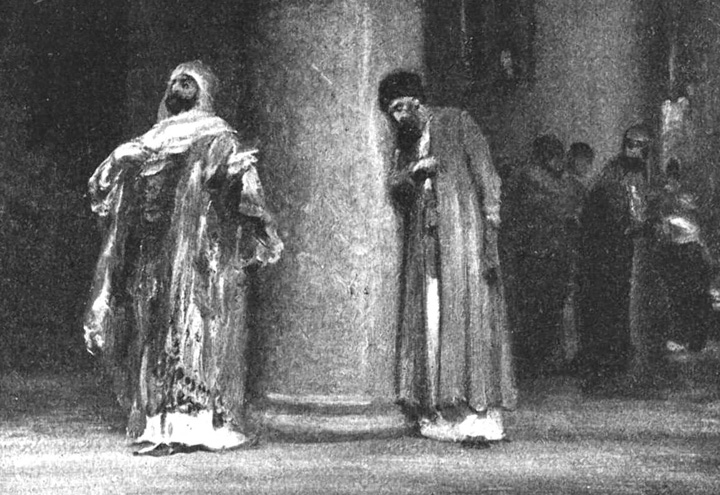 Second, this sinner has come to a terrible realization. This sinner realizes that his sin puts him in a very frightening place with almighty God. He cries out, “be merciful to me.” Cries of mercy recognize their guilt. Mercy begs that the offended one would withhold the righteous judgment and wrath they so richly deserve.
Third, the changed attitude and this terrible realization affect his worship before God. This is why the tax collector will not look up. He is guilty before God and he is ashamed. He beats his chest in shame and disgust at his own sins. This man has nothing to offer God. No excuses. No self-righteousness. No good works. No spiritual bargaining chips. HE IS POOR IN SPIRIT.
Fourthly, his brokenness before God; his spiritual poverty, is found acceptable in God’s eyes. In Matt 4:3, Jesus said that the poor in spirit are blessed, for theirs is the kingdom of heaven. Heaven belongs to, is enjoyed by, and is inhabited by those who are poor in spirit.
Jesus said of the tax collector in Luke 18, that he went home justified—right with God—not the other.
Rich Dad, Poor Dad. Which are you?
No need? No desire for God or what you call religion? Feeling good about yourself? You’re the rich dad who is spiritually bankrupt. You are not right with God, and you will never be right with God with that attitude.
The last sentence in Luke 18:14 said, “For everyone who exalts himself will be humbled, but the one who humbles himself will be exalted.” Humble yourself. See yourself as you really are before God. Beg his mercy, and he will hear your pleas and will forgive you your sins. You can be justified by God today.
 Do you see yourself as a sinner? Do you see yourself with God’s eyes? Are you broken and remorseful over your sins? Ask God for mercy. His mercy is abundant and will forgive any and every sin. First John 1:9 says, “If we confess our sins, he is faithful and just to forgive us our sins and to cleanse us from all unrighteousness.”
When you humble bow before God and ask his mercy and forgiveness, Matt 5:3 says, yours shall be the kingdom of heaven.
Did you resolve to share Christ this year?
 I love fishing. I remember a time when a friend and I climbed a fence and hiked into an abandoned gravel pit to fish a pond we found inside of it. The pond wasn’t very large, (we were able to cast to the other side) but we figured that since it was inaccessible, it might have good fishing. We didn’t catch anything. There weren’t any fish in the little pond. No life at all. It was just a big whole where rainwater had collected.
Sometimes Christians are like that. They don’t venture out where the fish are, and they never catch fish. They reluctantly throw their hooks into a bucket. “Oh well,” they reason, “I guess I’m not an evangelist.” Or, we can be guilty of thinking that since we no longer have any unbelieving friends, we don’t need to share Christ.
Churches as a whole can be guilty of this as well. Instead of being about the business of saving souls, they focus on making everyone in the church comfortable, or inviting Christian friends from other churches to their church. Friends, that isn’t evangelism, that is, to change the analogy, sheep stealing. Moving sheep from one pen to another doesn’t increase the size of the flock.
Pastor E.V. Hill said that the church throughout the ages has struggled in this area, becoming “keepers of the aquarium instead of fishers of men.”
We are not to be keepers of our little (or big) aquarium. We are called by Jesus to be fishers of men.
In this blog post, I would like to call your attention to four facts about the call of every Christian to be fishers of men, or evangelists.
1. Jesus Uses Every Type of Person to Preach the Gospel.
“While walking by the Sea of Galilee, he saw two brothers, Simon (who is called Peter) and Andrew his brother, casting a net into the sea, for they were fishermen.” (Matt 4:18)
Jesus chose rough, unpromising men to be his Apostles. None of the original twelve disciples were formally trained, that we know of. The only exception was the Apostle Paul, who was a special exception all around. None of those Jesus chose were religious leaders. Many were fishermen. Matthew was a tax collector.
Many of them were so obscure in their background that we know very little about them. The other followers of Jesus included women, former prostitutes, slaves and slave-owners, businessmen and women, soldiers, and even politicians.
Although Jesus could have done the work of evangelism alone, his plan was to use his disciples to win other disciples for the kingdom. God uses means (us) to preach the gospel to the world (the end of which is to bring glory to God).
Have you ever considered how God has placed you where you are to effect change in your sphere of influence? We are called to take the gospel to our corner of the world, wherever that may be right not.
As a pastor, I have limited access to many different types of people in their “natural environment” even though I regularly evangelize and share Christ. As a matter of fact, whether at the barbershop or a party, nothing seems to kill a conversation quicker than the question, “So what do you do for a living?” I know that when I say, “I’m a pastor,” immediately most people tense up. I’ve seen beer cans disappear and language instantly cleaned up, followed by a change of subject or location!
 I have limited success and less opportunity to share the gospel with unsaved teachers as a Christian teacher can. I cannot reach out to unsaved businessmen in the same way that a Christian businessman can. I cannot gain the same access to unsaved students as a Christian student can. I can’t speak to your neighbors about Christ as well as you can. I don’t mean that you can explain the gospel in a different way, because the gospel message is the same to all of humanity. But we all have different relationships and are different people—and that gives us different opportunities and different personalities and different styles that God uses as his means for preaching the same gospel to different audiences. Everybody has access to a whole range of unbelievers that many others do not.
2. Jesus Calls Us to Evangelism as Part of Following Him.
And he said to them, “Follow me, and I will make you fishers of men.” (Matt 4:19)
Peter, Andrew, James and John had had other encounters with Jesus before this incident in Matthew 4. This was not the first time they had followed Jesus. But now Jesus was calling them to make a bigger commitment. Included in this command to follow Jesus was the need to evangelize. Why?
- It is the way of the wise (Prov 11:30)
- It results in rewards (Deut. 12:3). This is our capacity to reflect the glory of God.
- It is commanded (Matt 28:19-20). We may not be evangelists, but that does not exempt us from God’s command. As Paul told Timothy in 2 Tim 4:5, “Do the work of an evangelist”
Some excuses you may be using to excuse yourself, along with my response:
- I don’t have any friends. So, make friends.
- I only have Christian friends. So, make non-Christian friends.
- I don’t know how to share my faith. Go to your pastor and tell him you’d like to learn. And then sign up to go out with your church when they do, or call an unsaved friend and make a date to have some coffee together.
- I don’t speak well. Neither did Moses (Ex. 4:10-14)
- I’m too busy.
- Too busy to obey the Lord?
- Too busy to pluck a soul from hell?
- Too busy to throw the life-giving seed of the Word?
- If this is truly the case, you are too busy and your priorities are sinfully warped and out of place.
- I’m shy, I’m scared. This is the fear of man, and it is sinful.
Sometimes we would prefer to die for Jesus than to live for him….We are more concerned about looking stupid (a fear of people) than we are about acting sinfully (fear of the Lord). (Ed Welch, When People are Big and God is Small, pp. 39, 40.)
The reality is that a call to be a disciple of Jesus requires that we die to ourselves and live for Christ. Jesus said it clearly, “Then Jesus told his disciples, “If anyone would come after me, let him deny himself and take up his cross and follow me.” (Matt 16:24). Our comfort and ease matter little in this regard.
3. Jesus is the One who Makes Us Into Fishers of Men.
And he said to them, “Follow me, and I will make you fishers of men.” (Matt 4:19)
“I will make you fishers of men.”
Consider with me for a second the changes to John and James, two of Jesus’ disciples. Mark 3:17 says that Jesus gave these brothers the nickname, Boanerges, or “sons of thunder.” Why? It is quite possible because they were men who were rough around the edges—like bulls in a china shop, as we might say. In Luke 9:51-56, the Sons of Thunder asked Jesus if they could call down fire from heaven to consume an inhospitable Samaritan village. This incident shows us that they did not have tender hearts of mercy for the lost (at least not all the lost). But they would learn, and they would be radically changed by the Lord.
James was the first of the Apostles killed for his faith (Acts 12:1-3). John was later known as the Apostle of Love because of his extensive writing about the love of God (see 1John 4:7-12). Both had learned to be servants and to love others as Christ loved them. They became excellent examples of fishers of men.
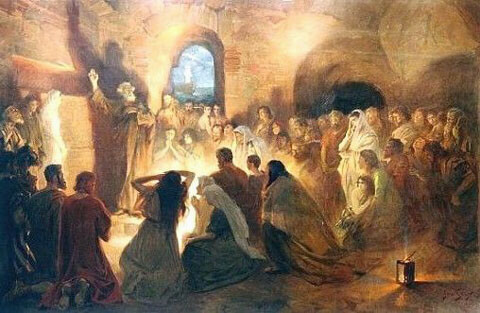 Think about the changes that happened to “first-to-stick-his-foot-in-his-mouth” Peter. Of course, he is most infamously known for being shackled by the fear of man when he had stated publicly that he would be willing to die for Christ before denying him (Matt 26:69-75). But the Peter we see after the resurrection is a completely different man. In Acts 2:14; 3:11-12; 4:7-8, he was set free from his fear of man to be bold for the Lord in his testimony. What was the difference? Acts 4:13 says, “Now when they saw the boldness of Peter and John, and perceived that they were uneducated, common men, they were astonished. And they recognized that they had been with Jesus.” They had been with Jesus and they had received his Spirit. This will be what makes a difference for us as well. As we spend time with the Lord, we will become more like him. We will grow in compassion for the lost and we will preach the gospel to them. When we deny ourselves, as Jesus did, all the excuses begin to melt away. When we remember that we are not alone in our evangelistic efforts, we find comfort and help. Consider Jesus’ words:
Nevertheless, I tell you the truth: it is to your advantage that I go away, for if I do not go away, the Helper will not come to you. But if I go, I will send him to you.
When the Spirit of truth comes, he will guide you into all the truth, for he will not speak on his own authority, but whatever he hears he will speak, and he will declare to you the things that are to come. He will glorify me, for he will take what is mine and declare it to you.” (John 16:7, 13-14)
But you will receive power when the Holy Spirit has come upon you, and you will be my witnesses in Jerusalem and in all Judea and Samaria, and to the end of the earth.” (Acts 1:8)
You cannot evangelize in your own power. God empowers you to do what he commands you to do. He makes you a fisher of men.
4. Jesus Calls Some to Dedicate Their Lives in Full Time Gospel Ministry.
“Immediately they left their nets and followed him” (Matt 4:20). “Immediately they left the boat and their father and followed him” (Matt 4:22).
The disciples left everything (Matt 9:27). Worldly security. Family. Home. They did this to follow Jesus in full time ministry. But being dedicated to the ministry of the gospel is also a high honor (1Tim 3:1). Never again would Peter, Andrew, James and John be known as fishermen. These four and the rest would forever be known as Jesus’ Apostles.
God has not called everyone to be an evangelist or a full time minister of the gospel, but God has called every Christian to share his or her faith. This is not an option, nor is it a suggestion. It is a command. As we have seen, there is no excuse that we can come up with that is acceptable to the Lord. When we don’t share Christ with others, we are disobedient. There may be some who have felt that God might be calling them to give up their job for full time service in the gospel. Maybe it is to be a missionary or maybe to be a pastor one day. If that is the case, how are you preparing to obey the Lord’s calling on your life? Do something! If you don’t plan to do something, you are planning to do nothing.
 Always Reforming