The Sanctity of Marriage, part 2

pexels-photo.jpg

For part 1 of this post, see here.

The first two attributes of God-ordained and blessed marriage are related and are best understood together. Marriage marked by a relationship that is both heterosexual and monogamous demonstrates the glorious design of God in creation. In Genesis 2:18, when the Lord saw that it was not good for man to be alone, he created for Adam from his side a solitary woman (Gen 1:22). At this point of creation, God potentially could have made another male, several males, several females, or an animal that would have been an alternative to this single woman that He chose to create as the perfect mate for Adam. But in the Lord’s infinite wisdom He made a woman from the side of the first man. By defining this attribute of marriage for humanity the Lord ruled out the possibilities of adultery, homosexuality, polygamy, polyamory and bestiality. One man and one woman were all that God made in the Garden when he declared that it was “very good” at the close of the seventh day of creation (Gen. 1:31).

The boundaries of marriage restricted to a couple that are both heterosexual and monogamous are not simply one option among many. Neither is this simply a construct agreed upon by society in the past that has become outdated and impractical in our modern era. Because God established these parameters in the beginning with the first man and woman, they are binding upon all humanity for all time. John MacArthur writes, “From the very first marriage, that of Adam and Eve, God has joined together every husband and wife. Marriage is first of all God’s institution and God’s doing, regardless of how men may corrupt it or deny or disregard His part in it. Whether it is between Christians or between atheists or idolaters, whether it is arranged by parents or by the mutual desire and consent of the bride and bridegroom, marriage is above all the handiwork of God…”[1]The pattern for marriage was established in the first marriage. Thus it excludes all illicit relationships outside of this pattern, including adultery, homosexuality, polygamy and polyamory. Every corruption of the divine order for marriage is willful and open rebellion against the Creator. As Paul address the church in Rome, a church that undoubtedly saw similar desecration of marriage, he wrote: “Therefore God gave them up in the lusts of their hearts to impurity, to the dishonoring of their bodies among themselves, because they exchanged the truth about God for a lie and worshiped and served the creature rather than the Creator, who is blessed forever! Amen”[2](Rom 1:24-25, ESV).

The third attribute of God-glorifying marriage is implied in what has been said above regarding Eve being made for Adam. Marriage was designed by God for the lifetime of each of the marriage partners. The Bible is explicit regarding God’s desire for the commitment of marriage and speaks against such sins as polygamy, polyamory, adultery, divorce and fornication. Each of these sins strikes at the heart of God’s intention for marriage between one man and one woman for life. Although the practices of polygamy, concubinage and divorce were tolerated to a certain extent because of the hardness of man’s heart, the Lord Jesus stressed that “from the beginning it was not so” (Matt 19:8). Such sins as sexual immorality, including prostitution, fornication and adultery have always been an abomination to the Lord (Ex 20:14; Lev 20:10, 14; Matt 15:19; 1Cor 6:18; 1Thes 4:3).

The subject of divorce is a particularly difficult issue that needs to be understood in light of God’s intentions for marriage. Whereas there is no debate among fundamental Bible churches regarding the sinfulness and reprehensible nature of sexual immorality, polygamy, adultery, or homosexuality, there are different views regarding divorce and what is allowable. These differences exist among Bible believing brethren not in spite of, but becauseof our commitment to the authority of the Word. Simplistic answers do not help as we seek to minister and guide hurting families that have struggled in any of these areas of sin, including divorce.

Two biblical facts regarding divorce are agreed upon by all—God hates divorce (Mal 2:16) and divorce was never His intention for marriage (Mk 10:11-12) because it is the destruction of the one flesh union that was created in the marriage covenant (Gen 2:24). Where disagreement occurs among well-intentioned brethren is regarding the question of whether there is anyallowance for divorce. But even among those who believe that divorce is sometimesallowable, such divorces are restricted to two possible reasons: sexual immorality and abandonment by an unbelieving spouse (Matt 5:32; 1Cor 7:15) and is not allowable for just any cause (Matt 19:3).

An additional issue regarding divorce must also reconcile the biblical texts regarding remarriage and whether it is allowable or not (cp. Matt 5:32; Mk 10:11-12; 2Cor 6:14). These matters regarding divorce are not simple because individual situations vary and wisdom in the application of Scripture is necessary. Whatever a person or church concludes about divorce and remarriage, it must be done with a thorough commitment to scriptural truth along with grace in understanding that there are other views that must be recognized with respect and charity.

Seeking to Remain Biblical in Our Changing World

All Christians committed to the inerrant infallible Word understand that these matters are of immense importance to our world as we seek to minister to those who repent and turn to Christ as their only hope. Christ calls His Church to faithfulness to His Word while navigating the new challenges to marriage that we are encountering in our ever changing world. Our commitment to the Scripture’s standard must always remain as unchanging as the Word itself, and we must resist every effort to capitulate to the culture for the sake of expediency or to gain the esteem of the world. This will take wisdom, added care, grace and patience, but it is our responsibility if we intend on ministering to those in our hurting world without compromise.

With Christians not only teaching what the Bible says about marriage, but also living it out before a watching world, Christ will be glorified as we paint a picture of His love for the Church and our submission to Him (Eph 5:22-33). This will be a powerful testimony added to our loving care for those that are in need of the message of gospel.

[1]John MacArthur. The Divorce Dilemma, Day One Publications, Leominster, England, (2009), p. 39.

[2]The Holy Bible: English Standard Version (Wheaton: Standard Bible Society, 2016), Ro 1:24–25.

The Sanctity of Marriage, part 1

pexels-photo-256737.jpeg

Hebrews 13:4 tells us that marriage is to be held in honor among all. Marriage should hold a high place in the minds of the people of God. Where the sanctity of marriage was widely held in our society, that is no longer the case. Wherever one turns, the institution of marriage is being attacked and disparaged. Our IFCA fellowship of churches has sought to be a light for Christ in a dark world while at the same time seeking to reach those that are lost with the truth of the gospel of Christ. We have always been committed to standing firm and reaching out. To do this faithfully in the area of marriage, we need to be committed to what the Scriptures teach so that we can proclaim that truth in a spirit of faithfulness to the Lord with a love for the unregenerate.

The Challenges to Marriage Today

The attacks on the sanctity of marriage are so numerous that this short article can do little more than acknowledge that these issues are a growing concern not only in the culture around us, but many of those the Lord brings our way will be coming from this background. We must be prepared to minister to those who are devastated by these sins.

Cohabitation has become so prevalent that recent statistics show that living together before marriage has risen from 40% in 1980-1984 to 70% in 2010-2014.[1]The National Center for Family & Marriage Research unsurprisingly also found that births to single and cohabiting mothers steadily grew from 21% in 1980-1984 to 41% in 2010-2014.[2]

Divorce has recently been touted as being at a 35 year low. But we can’t be too quick to celebrate because the marriage rate since 2010 has also experienced a forty-five year  low.[3]Obviously, fewer marriages lead to fewer divorces. Instead of being encouraging news, we need to realize that this statistic is an illustration of the demise of traditional marriage. With the advent of homosexual civil unions and same-sex marriage, divorce of both heterosexual and homosexual couples each average about 2% per year.[4]

Adultery is an unfortunate universal reality and can be found in every civilization and culture all the way back to the fall of man. With the advent of modern technology the threat has become epidemic. In July 2015, Ashley Madison, a website designed as a “dating site” targeting married people interested in an adulterous relationship, was hacked and exposed the information of millions of its customers.[5]Now adultery is as close as our cell phones and computers.

Homosexuality and same-sex marriage are the most troublesome attacks upon the sanctity of marriage because their proponents have been organized and aggressive in their campaigns to promote and normalize homosexual activity. No longer restricted to gay and lesbian relationships, the LGBTQ[6]movement continues to spread its tentacles around the world into every place of prominence and power, including the Church.

Polyamory and polygamy has grown in popularity in recent years through the promotion of television programs such as HBO’s Big Loveand TLC’s Sister Wiveswith both programs seeking to gain sympathy for the polygamist lifestyles of fundamentalist Mormons as well as influencing the legality of polygamy[7]. Polyamory, which does not require marriage, refers to the similar philosophy that multiple simultaneous relationships of an intimate nature as normal and natural, so long as all parties agree.

Each of these challenges to the sanctity of marriage flout the Word of God regarding marriage by perverting God’s intention and purposes for it. So, what does the Word of God teach us regarding the preservation of His institution of holy matrimony?

Biblically Defining Marriage

In his book entitled The Bible in Government and Society, Christopher Cone observes the vast chasm that exists between believers and unbelievers regarding marriage as God designed it and how they choose to live their lives. Dr. Cone writes, “People who reject that Designer cannot be expected to uphold marriage as it is designed—in fact, the Bible never prescribes how unbelievers should conduct their own marriages. For unbelievers, marriage is little more than a civil union whereby society is ordered and promulgated. Herein is the cause of tension within a society where believer and unbeliever coexist under a common governmental structure. Believers ought to base their ethical understandings on the metaphysical understanding that the Bible is authoritative for every aspect of life (2 Tim 3:16–17). Unbelievers, on the other hand, do not operate from the same metaphysical understanding, and consequently, their ethical prescriptions will often conflict with those given to believers.”[8]

This different “metaphysical understanding” exists because unregenerate men and women have suppressed the truth that God has made known to them and by nature cannot truly understand the Spirit-given Word (Rom 1:18-32; 1Cor 2:6-14). This does not mean that we should not hold unbelievers in society to the Lord’s standard, but that we must uphold the truth (1Tim 3:15) and declare it to the world without fear or shame (2Tim 1:8-14). The sanctity of marriage can be simplified if we focus on three attributes that the Scriptures teach us about God’s righteous standard.

[1]Paul Hemez and Wendy D. Manning, “Thirty Years of Change in Women’s Premarital Cohabitation Experience” National Center for Family and Marriage Research, Bowling Green State University, https://magic.piktochart.com/output/19755947-hemez-manning-30-yrs-change-women-premarital-cohab-fp-17-05; Accessed 3/9/2017.

[2]Huijng Wu, “Trends in Births to single and Cohabiting Mothers, 1980-2014.” https://magic.piktochart.com/output/19730931-wu-trends-births-single-cohabiting-mothers-fp-17-04-png; Accessed 3/9/2017.

[3]Ben Steverman. “Divorce in U.S. Plunges to 35-Year Low” Bloomberg; https://www.bloomberg.com/news/articles/2016-11-17/divorce-in-u-s-plunges-to-35-year-low?mkt_tok=eyJpIjoiWlRRNU1UQTNPRFV5WTJNMiIsInQiOiJISTR1Tjl3WmliMzVabFF4bGZiSnBXdUN4T0NrXC8waXh6ZjNpTzNZb29pdzR3UGZmODBLVU5HelJkQWxRMVhJT1h5cjh0RysrYklMN25iNWVyR0JzWUplM0ZRSjdJVzR6RmtRWWJRQ1RiRDg9In0%253D; Accessed 3/9/2017.

[4]Andrew Gelman. “Same-Sex Divorce Rate Not As Low As It Seemed.” The Washington Post, Dec. 15, 2014. https://www.washingtonpost.com/news/monkey-cage/wp/2014/12/15/same-sex-divorce-rate-not-as-low-as-it-seemed/?utm_term=.cec6a8232101; Accessed 3/9/2017.

[5]Charles Riley. “Hackers Threaten to Release Names From Adultery Website.” CNN Tech; http://money.cnn.com/2015/07/20/technology/ashley-madison-hack/; Accessed 3/9/2017.

[6]Lesbian, Gay, Bisexual, Transgender and Queer or Questioning. Some have advocated the addition of the letter “A” for “Affirming,” those who may not themselves be homosexual, but affirm and promote homosexual and transgender sexuality.

[7]The Associated Press. “High Court Won’t Hear ‘Sister Wives’ Appeal Over Bigamy Law.” http://woodtv.com/2017/01/23/high-court-wont-hear-sister-wives-appeal-over-bigamy-law/; Accessed 3/9/2017.

[8]Christopher Cone. The Bible in Government and Society, Tyndale Seminary Press, Hurst, TX (2012), pp. 106-7.

Mighty Men of God

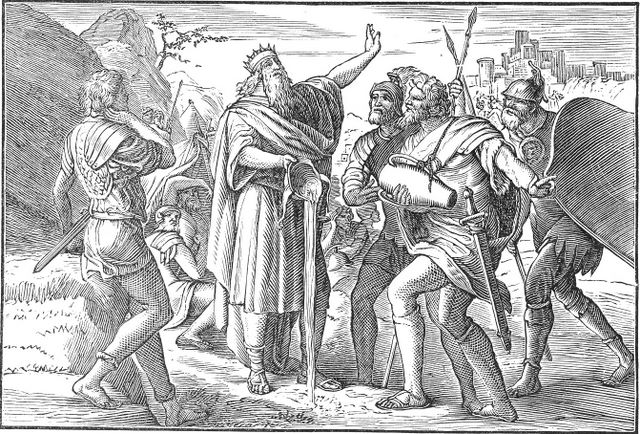
David's three mighty men

David’s Mighty Men

“And David became greater and greater, for the LORD of hosts was with him.” (1 Chronicles 11:9)

The vast majority of the first nine chapters of First Chronicles is a genealogy, and most people simply breeze over the names and relations listed there. And after a description of Saul’s and Jonathan’s deaths and David’s ascension to the throne, another list of names is given. Whereas the first lists were genealogies, this list is very different.

This coming weekend is Memorial Day in the United States, a holiday which is normally celebrated with picnics and barbecues, a long way from the true purpose this holiday. Memorial Day was originally set aside as a day to remember or memorialize the men and women who have fought to defend our country in the armed services. The Vietnam Veterans Memorial Wall in Washington D.C. currently has 58,272 names of those who died or remain missing in the Vietnam War.

So what’s my point? My point is that lists of names mean something. And not only to their family and loved ones. This becomes incredibly clear in 1Chronicles 11:10-12:40 where the names of King David’s mighty men are given along with some of their accomplishments. These were great men of war and courage. Some fought against unthinkable odds and everyone fought with great courage and faithfulness to the king.

Here are a few thoughts I had about these men:

  • Like David, the mighty men were only successful because the Lord had given them success and they knew it. The beginning of a great fall begins with pride!
  • Their faithfulness to King David was a faithfulness to the Lord who had placed David upon the throne. Mighty men recognize God’s leaders and do all they can to support him.
  • The mighty men had different ranks based upon their abilities, performance and successes. There is “the three,” “the thirty” and the those who were very great, but “did not attain to the three” or “the thirty.” Everyone isn’t equal. Performance, skill and effort matter. In a day when everyone gets a participation ribbon, this shows that mighty men strive and push themselves to be their best in the service of the Lord.
  •  The mighty men loved their king and were willing to go above and beyond to serve and please him, even risking their lives to give him water from his hometown well (1Chron 11:15-19). This devotion was matched by David unwillingness to indulge himself with this sort of sacrifice. There was mutual love, respect and loyalty between the king and his mighty men.
  • The mighty men had a great kinship and loving respect for one another built around their devotion to the Lord and his king. They were united in purpose and vision, each doing his own part for the common cause.

The virtues of honor, devotion, courage, selfless service and sacrifice are not exclusive to the military. These are the virtues that members of the Church should uphold as well. Our King is Jesus and our goal is clearly given in the Great Commission. May the Lord be pleased to raise up mighty men (and women!) from within our own churches to his glory and honor!

Lord, Make Us Humble

humble

I’m pretty sure it was innocent, but I still laugh when I think of the sweet gift that a church member gave to me one day, a copy of C.J. Mahaney’s book Humility: True Greatness. How does a person respond to that kind of a gift? I laugh even now thinking about it. I don’t think this person was secretly saying she thought I was proud (at least I didn’t get that idea from her). It was simply a heart-felt gift to me as her pastor, meant to bless me and care for my soul. For that I am thankful because I know from the testimony of Scripture and personal experience that pride is something every Christian struggles with in one form or another.

First Peter 5 gives a much-needed call for every Christian to be humble. The Apostle Peter even begins by placing himself as a fellow elder with those whom he is writing to showing his own need to humble himself under the Lordship of Christ. Peter, a man who throughout the Gospels struggled with pride, understood from years of experience that the church will not function as it needs to if we all hang on to our pride.

Beginning first with the elders, Peter addressed the leaders of Christ’s church with the need to achieve two purposes–shepherd and exercise oversight (v. 2). Interestingly, he does not limit his comments to these activities alone. Like our heavenly Father, Peter is concerned not only with deeds, but also with the attitudes of the heart.

Peter wrote that elders are to lead and oversee but they are to make sure that they are not heavy-handed, or leading out of an attitude that expects the royal treatment from those whom they are leading. He also warned that there is the temptation to lead only to gain money or power. All of these reasons for pastoring are more than sinful, they are shameful.

Sometimes people will ask me the motivation for certain false teachers. How is it that they can callously fleece the most helpless and needy people in the name of God? While I can’t know anyone’s heart motives, I do know that it is a fact of human nature that people change. Perhaps, these false teachers began well, but they took their eyes off of Christ and began to place them on other things-their problems made them bitter and hard, their needs made them seek money, their lust for power made them seek more influence and to make a name for themselves. I simply can’t tell what specifically drives a person to such a wicked state.

What I do know is that your heart as well as mine can also change. We too can slide toward pride. Peter warned that we are to all clothe ourselves with humility (v. 5) because the Lord opposes those who are proud, but gives grace to the humble.

When we fight with one another because of our pride, we open up the church (and our families) to the attacks of the evil one. He is watching, looking for opposition and in-fighting so that he can swoop in and bring his destruction (v. 8). Resist him by humbling yourself. Don’t let pride precede your destruction.


The True Church

/home/wpcom/public_html/wp-content/blogs.dir/ee3/14891026/files/2015/01/img_0563.jpg

On Sunday mornings at our church we have been going through the book of Acts. Right now, we are looking at the characteristics of the Church given at the end of chapter 4. Today I came across this gem by Bishop J.C. Ryle, included in R.A. Torrey’s collection of essays known as The Fundamentals. I have given the full text below (it’s pretty short) for your edification. It is a powerful reminder of the beauty and unity of the True Church of Jesus Christ. Enjoy.

THE TRUE CHURCH
by the Late Bishop Ryle

Do you belong to the one true Church; to the Church outside of which there is no salvation? I do not ask where you go on Sunday; I only ask, “Do you belong to the one true Church?”

Where is this one true Church? What is this one true Church like? What are the marks by which this one true Church may be known? You may well ask such questions. Give me your attention, and I will provide you with some answers.

The one true Church is composed of all believers in the Lord Jesus. It is made up of all God’s elect—of all converted men and women—of all true Christians. In whomsoever we can discern the election of God the Father, the sprinkling of the blood of God the Son, the sanctifying work of God the Spirit, in that person we see a member of Christ’s true Church.

It is a Church of which all the members have the same marks. They are all born of the Spirit; they all possess “repentance towards God, faith towards our Lord Jesus Christ,” and holiness of life and conversation. They all hate sin, and they all love Christ. They worship differently and after various fashions; some worship with a form of prayer, and some with none; some worship kneeling, and some standing; but they all worship with one heart. They are all led by one Spirit; they all build upon one foundation; they all draw their religion from one single Book—that is the Bible. They are all joined to one great center—that is Jesus Christ. They all even now can say with one heart, “Hallelujah”; and they can all respond with one heart and voice, “Amen and Amen.”

It is a Church which is dependent upon no ministers upon earth, however much it values those who preach the Gospel to its members. The life of its members does not hang upon church-membership, and baptism, and the Lord’s Supper—although they highly value these things, when they are to be had. But it has only one great Head—one Shepherd, one chief Bishop—and that is Jesus Christ. He alone, by His Spirit, admits the members of this Church, though ministers may show the door. Till He opens the door no man on earth can open it—neither bishops nor presbyters, nor convocations, nor synods. Once let a man repent and believe the Gospel, and that moment he becomes a member of this Church. Like the penitent thief, he may have no opportunity of being baptized; but he has that which is far better than any water-baptism—the baptism of the Spirit. He may not be able to receive the bread and wine in the Lord’s Supper; but he eats Christ’s body and drinks Christ’s blood by faith every day he lives, and no minister on earth can prevent him. He may be excommunicated by ordained men, and cut off from the outward ordinances of the professing Church; but all the ordained men in the world cannot shut him out of the true Church.

It is a Church whose existence does not depend on forms, ceremonies, cathedrals, churches, chapels, pulpits, fonts, vestments, organs, endowments, money, kings, governments, magistrates, or any act of favor whatsoever from the hand of man. It has often lived on and continued when all these things have been taken from it; it has often been driven into the wilderness or into dens and caves of the earth, by those who ought to have been its friends. Its existence depends on nothing but the presence of Christ and His Spirit; and they being ever with it, the Church cannot die.

This is the Church to which the Scriptural titles of present honor and privilege, and the promises of future glory, especially belong; this is the body of Christ; this is the flock of Christ; this is the household of faith and the family of God; this is God’s building, God’s foundation, and the temple of the Holy Ghost. This is the Church of the first-born, whose names are written in heaven; this is the royal priesthood, the chosen generation, the peculiar people, the purchased possession, the habitation of God, the light of the world; the salt and the wheat of the earth; this is the “Holy Catholic Church” of the Apostle’s Creed; this is the “One Catholic and Apostolic Church” of the Nicene Creed; this is that Church to which the Lord Jesus promises, “the gates of hell shall not prevail against it”, and to which He says, “I am with you always, even unto the end of the world” (Matt. 16:18; 28:20).

This is the only Church which possesses true unity. Its members are entirely agreed on all the weightier matters of religion, for they are all taught by one Spirit. About God, and Christ, and the Spirit, and sin, and their own hearts, and faith, and repentance, and necessity of holiness, and the value of the Bible, and the importance of prayer, and the resurrection, and judgment to come—about all these points they are of one mind. Take three or four of them, strangers to one another, from the remotest corners of the earth; examine them separately on these points; you will find them all of one judgment.

This is the only Church which possesses true sanctity. Its members are all holy. They are not merely holy by profession, holy in name, and holy in the judgment of charity; they are all holy in act, and deed, and reality, and life, and truth. They are all more or less conformed to the image of Jesus Christ. No unholy man belongs to this Church.

This is the only Church which is truly catholic It is not the Church of any one nation or people; its members are to be found in every part of the world where the Gospel is received and believed. It is not confined within the limits of any one country, or pent up within the pale of any particular forms or outward government. In it there is no difference between Jew and Greek, black man and white, Episcopalian and Presbyterian—but faith in Christ is all. Its members will be gathered from north, and south, and east, and west, in the last day, and will be of every name and tongue—but all one in Jesus Christ.

This is the only Church which is truly apostolic. It is built on the foundation laid by the Apostles, and holds the doctrines which they preached. The two grand objects at which its members aim are apostolic faith and apostolic practice; and they consider the man who talks of following the Apostles without possessing these two things to be no better than sounding brass and a tinkling cymbal.

This is the only Church which is certain to endure unto the end. Nothing can altogether overthrow and destroy it. Its members may be persecuted, oppressed, imprisoned, beaten, beheaded, burned; but the true Church is never altogether extinguished; it rises again from its afflictions; it lives on through fire and water. The Pharaohs, the Herods, the Neros, the bloody Marys, have labored in vain to put down this Church; they slay their thousands, and then pass away and go to their own place. The true Church outlives them all and sees them buried each in his turn. It is an anvil that has broken many a hammer in this world, and will break many a hammer still; it is a bush which, often burning, yet is not consumed.

This is the Church which does the work of Christ upon earth. Its members are a little flock, and few in number, compared with the children of the world; one or two here, and two or three there. But these are they who shake the universe; these are they who change the fortunes of kingdoms by their prayers; these are they who are the active workers for spreading the knowledge of pure religion and undefiled; these are the life-blood of a country, the shield, the defense, the stay and the support of any nation to which they belong.

This is the Church which shall be truly glorious at the end. When all earthly glory is passed away then shall this Church be presented without spot before God the Father’s throne. Thrones, principalities, and powers upon earth shall come to nothing; but the Church of the first-born shall shine as the stars at the last, and be presented with joy before the Father’s throne, in the day of Christ’s appearing. When the Lord’s jewels are made up, and the manifestation of the sons of God takes place, one Church only will be named, and that is the Church of the elect.

Reader, this is the true Church to which a man must belong, if he would be saved. Till you belong to this, you are nothing better than a lost soul. You may have countless outward privileges; you may enjoy great light, and knowledge—but if you do not belong to the body of Christ, your light, and knowledge, and privileges, will not save your soul. Men fancy if they join this church or that church, and become communicants, and go through certain forms, that all must be right with their souls. All were not Israel who were called Israel, and all are not members of Christ’s body who profess themselves Christians. Take notice, you may be a staunch Episcopalian, or Presbyterian, or Independent, or Baptist, or Wesleyan, or Plymouth Brother—and yet not belong to the true Church. And if you do not, it will be better at last if you had never been born.