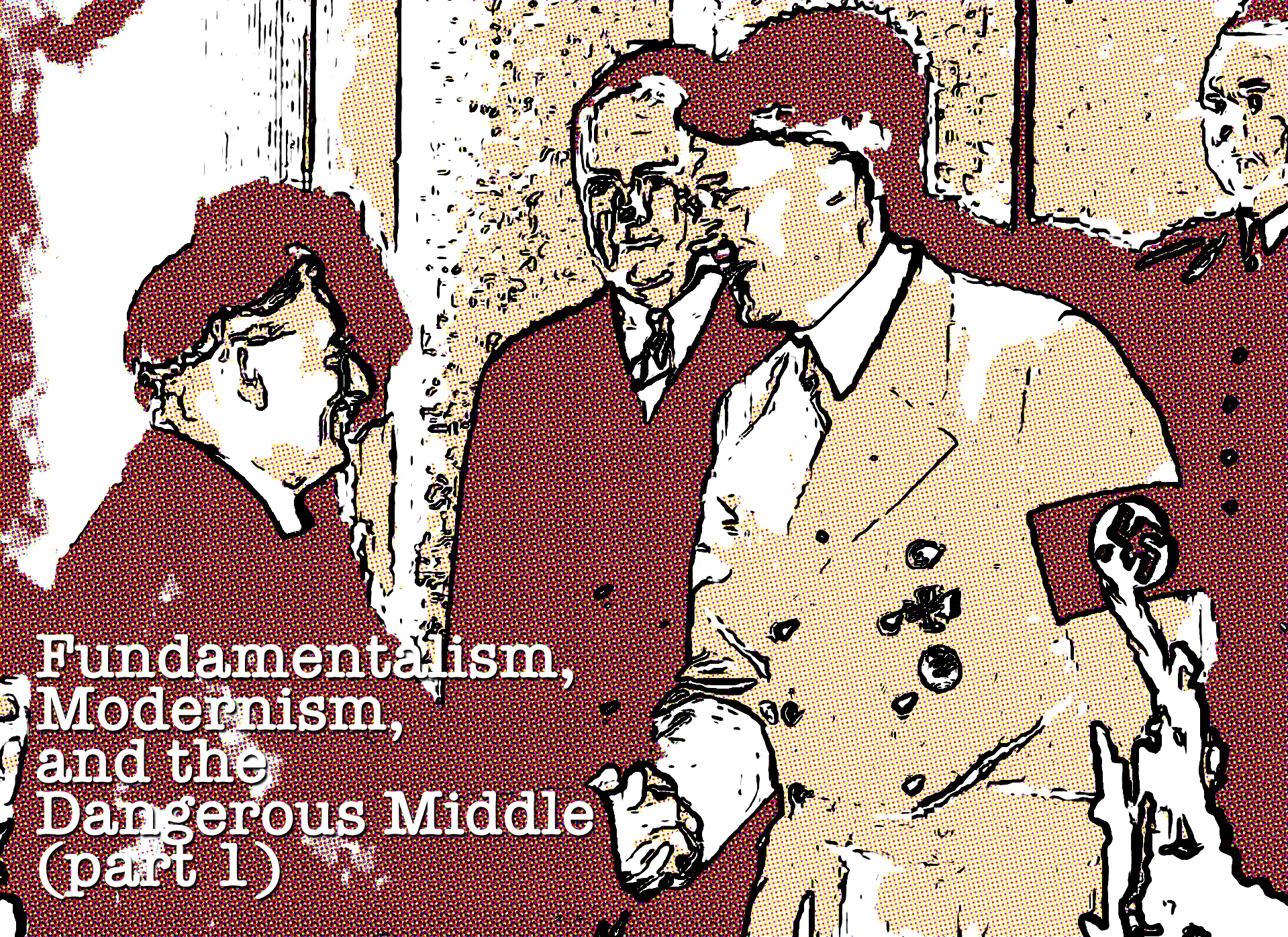
Fundamentalism, Modernism, and the Dangerous Middle (part 1)

In the 2017 World War II movie, The Darkest Hour, Winston Churchill cries out in frustration, “You cannot reason with a tiger when your head is in its mouth!” Although these words are more than likely an artistic embellishment for cinema, they do fairly sum up Churchill’s frustration with the policies of Neville Chamberlain that sought to appease Adolph Hitler by ignoring his aggressions in Europe. Chamberlain truly believed that by signing the Munich Agreement and giving the Sudetenland to Germany along with Hitler’s promise not to continue invading other nations, that Europe would be saved. Chamberlain famously came home and declared that they he had achieved “peace for our time.” Chamberlain thought Hitler was a misunderstood man, when he was in fact the blood-thirsty tiger that would never be satisfied. Churchill understood this and knew that war was the only way to stop him.

The notion of appeasement is not only shared among politicians. Unfortunately, in a world that requires vigilance and sometimes engagement in theological battles, there are those who would seek appeasement and compromise for the sake of “peace in our time.” But as I hope to demonstrate with some examples from recent history, appeasement, and compromise in the face of theological liberalism are always the easier route, but they never achieve the promise they claim.

Setting the Stage: The Fundamentalist and Modernist Controversy

To be clear, we need to understand that prior to the mid-19th century, “evangelical” was synonymous with “fundamentalism.” All Christians who identified with the evangel, the gospel message of Christ, were “evangelicals.” Fundamentalism was a movement that derived its name from those evangelical Christians that sought unity across denominational lines but were committed to certain “fundamental” doctrines that have been accepted by historic Christianity. The number of these fundamentals varied at times, but they almost always included:

  1. The inerrancy of Scripture
  2. The virgin birth of Christ
  3. The substitutionary vicarious atonement of Christ
  4. The bodily resurrection of Christ
  5. The reality of miracles
  6. The imminent and physical return of Christ

Fundamentalists stated that a person had to minimally ascribe to these core doctrines to be within the historic Christian Church because a denial of these doctrines often leads to a wholesale denial of the faith. Modernists (theological liberals), on the other hand, wanted to focus not on the content of belief, but rather the feeling or spirit of Christianity. By denying the need to subscribe to core doctrines of the faith, they could cover the fact that they denied many or all of them, while still insisting they were a part of the Christian church and represented Christianity.

Fundamentalism rejected this minimalistic and emotion drive religion as inadequate at best, and heretical at worst. Several courageous defenders rose up in obedience to Scripture’s call to purify the church:

  • 2 John 9–11 (ESV): “Everyone who goes on ahead and does not abide in the teaching of Christ, does not have God. Whoever abides in the teaching has both the Father and the Son. If anyone comes to you and does not bring this teaching, do not receive him into your house or give him any greeting, for whoever greets him takes part in his wicked works.”
  • Galatians 1:8–9 (ESV): “But even if we or an angel from heaven should preach to you a gospel contrary to the one we preached to you, let him be accursed. As we have said before, so now I say again: If anyone is preaching to you a gospel contrary to the one you received, let him be accursed.”
  • 1 Timothy 6:20–21 (ESV): “O Timothy, guard the deposit entrusted to you. Avoid the irreverent babble and contradictions of what is falsely called “knowledge,” for by professing it some have swerved from the faith. Grace be with you.”

By the middle of the 19th century, theological liberalism has already entered almost all mainline denominations. This was possible because liberal theologians subscribed to the biblical creeds of their denominations and institutions while at the same time teaching non-evangelical theology. Following German liberal Friedrich Schleiermacher (1768-1834), modernists asserted that Christianity was not primarily about doctrine, but rather a “feeling, intuition and experience.”[1] As such, Schleiermacher set the stage for the setting aside of doctrine in favor of a Christianity that affirmed a faith based upon feelings and experiences.

Along with the growth of liberal Christianity came a desire to put aside doctrinal differences among different denominations to bring unity around an ecumenical spirit. This led to the establishment of the World Council of Churches in 1948, made up of “churches which accept our Lord Jesus Christ as God and Savior.”[2] That brief doctrinal statement was all that was required of those joining the WCC, and none were required to expand on what they meant by those words.

Often portrayed as ignorant, uneducated, backwards, anti-science, and anti-progressive by liberals, and “fighting fundamentalists,” uncharitable, ungracious, and divisive, by evangelicals, the fundamentalists stood their ground and called the church to put out of its churches, missions agencies, educational institutions, and para-church organizations all those that were unfaithful to Christ and His Word. But not everyone within evangelicalism agreed with them, thinking there was a better way—a middle way.

My next post will highlight two examples of this attempt to navigate a middle way.


[1] Iain H. Murray, Evangelicalism Divided: A Record of Crucial Change in the Years 1950 to 2000 (Carlisle, PA: Banner of Truth Trust, 2000), 5.

[2] Murray, 3

Placing Our Hope in God Alone (weekend repost)

A few years ago I had the opportunity to walk through the National Museum of the US Air Force in Dayton, OH. Moving from one hangar to the next I saw the evolution of aircraft from the Wright brother’s first plane to the modern surveillance drones of today.

It isn’t hard to be in a place like that and not have an overwhelming sense of patriotism as I see the military defense weapons and aircraft that our nation has used in the defense of our country and many other countries all around the world. Seeing these beautiful machines and their sheer size made me feel a little sorry for anyone that stood against them in a battle.

Read the rest of this post here: Placing our Hope in God Alone

We Will Not Be Silent and We Will Not Back Down (weekend repost)

“In a time of universal deception, telling the truth is a revolutionary act. Let us determine that we will not be shamed into silence or inaction. We will speak, and like Shadrach, Meshach, and Abednego in the book of Daniel, let us resolve that we will not bow.”

Erwin Lutzer, We Will Not Be Silenced, 38.

It is interesting to read about the Apostle Paul’s experience in Jerusalem in Acts 21-26. In these chapters, Paul is constantly allowed to share with different audiences his testimony in one way or another. Incredibly, in many instances, he isn’t allowed to finish his explanation of why he believes in Jesus Christ.

Read the rest of the post here: We Will Not Be Silent and We Will Not Bow Down

Placing our Hope in God Alone

“The king is not saved by his great army; a warrior is not delivered by his great strength. The war horse is a false hope for salvation,
and by its great might it cannot rescue.” Ps 33:16-17

A few years ago I had the opportunity to walk through the National Museum of the US Air Force in Dayton, OH. Moving from one hangar to the next I saw the evolution of aircraft from the Wright brother’s first plane to the modern surveillance drones of today.

It isn’t hard to be in a place like that and not have an overwhelming sense of patriotism as I see the military defense weapons and aircraft that our nation has used in the defense of our country and many other countries all around the world. Seeing these beautiful machines and their sheer size made me feel a little sorry for anyone that stood against them in a battle.

It makes me think about how Pharaoh felt about his horses and chariots, and the king of Babylon about his weapons of war. The same can be said about the Medo-Persians, Greeks, and Romans at different parts of world history. Whether the weapons are spears, swords, arrows, or chariots, tanks, and airplanes, our hearts can become fooled into thinking that it is the weapon and strategies that win the war. Sometimes we think we can simply outnumber the enemy with more soldiers, more money, more missiles, and more technologies. This is heady stuff and it can divert the attention of a nation away from their inherent weakness and need for God.

In Psalm 33, the unnamed psalmist recognized this prideful blindspot and seeks to refocus the attention of the worshippers of Yahweh. The king, he writes, is not saved by his army-no matter how great. A read through the Chronicles and any history book will give credence to this reality. Kings are overthrown, betrayed, killed in battle, poisoned, and even killed by their own sons in a grab of power. King David himself survived an attempted coup by his own son. Some rulers are better than others, but no ruler can exist without God’s help. The Lord puts the man on the throne or behind the desk, but it is God alone who keeps him there, and it is God who removes him.

The psalmist also recognized that the same is true about those warriors that seem unbeatable in battle. We laud those warriors that fight valiantly and bring to our nation victory over the enemy. Stories are told of campaigns where all hope was lost and then the hero emerged and snatched victory out of the jaws of defeat. But even the greatest hero among our warriors should not be hoped upon more than our God. Do not forget men like the mighty Goliath who boasted in his mighty size and ability to defeat Israel, even defying the Lord with mockery. That warrior’s great strength could not deliver him when a boy with a sling brought him to his death on the battlefield.

The warhorse was a great advantage to any ancient kingdom that sought to be a military powerhouse. The war horse was large, brave, and strong. He could charge into a mob of warriors with courage and bowl over those in his path, allowing his rider to swing his longsword or thrust his spear into the melee while remaining out of reach by the foot soldier. Any army that had a cavalry was an almost unstoppable force. Almost.

Knowing the confidence that men put in warhorses, he commanded that the kings of Israel were not to amass large numbers of them knowing that it would easily allow the king to seek confidence in his cavalry and not place his trust in the Lord. In modern weaponry, confidence is placed in ships, drones, fighter jets, missiles, and many other weapons that can unleash “shock and awe” in our enemies.

The writer of Psalm 33:16-17 should be heard. Anything we place our confidence in outside of God can and will fail. It is inevitable. As a matter of fact, it is worse than failure. These things that we place above our trust in God are an affront to Him, and they will not only fail but they will also be brought low as they have become a challenge to God for supremacy in our hearts. He will not allow anything else in His place.

We Will Not Be Silent and We Will Not Bow Down

“In a time of universal deception, telling the truth is a revolutionary act. Let us determine that we will not be shamed into silence or inaction. We will speak, and like Shadrach, Meshach, and Abednego in the book of Daniel, let us resolve that we will not bow.”

Erwin Lutzer, We Will Not Be Silenced, 38.

It is interesting to read about the Apostle Paul’s experience in Jerusalem in Acts 21-26. In these chapters, Paul is constantly allowed to share with different audiences his testimony in one way or another. Incredibly, in many instances, he isn’t allowed to finish his explanation of why he believes in Jesus Christ.

At first, Paul is seized while worshipping in the temple and dragged outside of the temple grounds so he can be stoned to death. By the providence of God, he is rescued by Roman soldiers whom he asks for permission to speak to the angry mob because they don’t seem to agree about why they want to kill him. But before Paul finishes his explanation, the crowd erupts in rage and he is once again needing to be rescued by the Roman soldiers and carried away to safety.

Again and again, Paul speaks: to the Sanhedrin, to Felix the Governor, before Felix’s wife Drusilla. Following Felix, Paul was allowed to speak to the incoming Governor Festus, and in frustration and to seek justice, he finally appealed to Caesar himself.

In each of these interactions, Paul spoke the truth—whether about his beliefs, his experiences, the deception of his enemies, or the truth of the gospel message and Jesus Christ. And in each opportunity, he found that most of those that called him to speak the truth were not actually interested in hearing the truth. And he also found that when he spoke the truth, those who claimed to want to hear the truth did not actually want the truth spoken. Many responded with violence and murder.

Dear Christian, do you not see that this attitude is similar to the one we face in our world today, and it is growing stronger? Many people speak about wanting the truth—but they do not want it when we speak it. Some want a version of the truth that suits them and their version of reality. Some truly want to hear it but are seriously disappointed that it is not what they had hoped. Some respond with calls to silence the truth and truth-speakers.

But like Paul, we cannot be silent. And like Jeremiah before him, we must say, “If I say, “I will not mention him, or speak any more in his name,” there is in my heart as it were a burning fire shut up in my bones, and I am weary with holding it in, and I cannot” Jeremiah 20:9.

In today’s world, telling the truth is a revolutionary act. May we speak the truth no matter what. Don’t forget that we are a city on a hill whose light cannot be hidden.