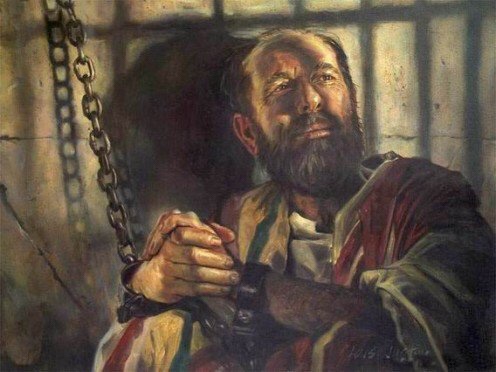
Faith Makes Us Courageous

So he sent horses and chariots and a heavy military force there, and they came by night and surrounded the city. Then the attendant of the man of God arose early and went out, and behold, a military force with horses and chariots was all around the city. And his young man said to him, “Alas, my master! What shall we do?” So he said, “Do not fear, for those who are with us are more than those who are with them.”” (2 Kings 6:14–16, LSB)

Yesterday I wrote that “sin makes us stupid.” You can read that post here. But in the continuing saga of Elisha, we also see that faith makes us courageous.

The King of Aram was determined to get Elisha and silence him. He sent what is described in 2 Kings 6:14 as ancluded not only armed soldiers but also horses and chariots “heavy military force,” which i. Not that any of that scares God, or even Elisha. But it did scare Elisha’s servant.

Can you imagine that poor young man? He got up in the morning and probably went out to the well to make some of that good dark roast Damascus coffee for himself and his master, and what does he see? An enormous army at his front door! Maybe he backed up slowly. Maybe he screamed like a child. Who knows how he reacted initially, but what we read is that he reported to his master his dismay: “What shall we do?”

Elisha’s reaction is calm and cool. He doesn’t rush to look out the window. He doesn’t start pacing or figuring out how he can talk himself out of being killed or arrested. He doesn’t begin counting up all his valuables to see if he has enough to bribe the commander of this grand army. Nope. Elisha, in my imagination, takes a slow sip of his coffee and smiles as he tells the servant to calm down.

“Don’t be afraid,” he says to his attendant. Elisha seems to know something that this young man doesn’t. Don’t panic? Don’t be afraid? Clearly, Elisha didn’t have a full grasp of his faculties. How could they not panic? How could they not be afraid? Today they were most likely going to die. At best, they would be imprisoned and beaten! Don’t be afraid?

The servant saw a great army of the enemy of Israel, but Elisha knew that there is more out there than what our limited human eyes can see. We might be tempted to think that Elisha could see more, but the Bible doesn’t say he saw anything. I think he could only see what his young man could see—an overwhelming situation that would make all of us panic. So what gives? Why was Elisha so calm?

The prophet of God knew what all people of faith know—that this world is made up of material and immaterial realities. We cannot see all that is before us. But with the eyes of faith, we can entrust ourselves to the God who sees it all. Not only could God see the King of Aram, but He can also see our predicaments as well. Elisha knew this, and thus, he was cool and settled even if he didn’t see anything more than his servant.

Hebrews 11:1 says, “Now faith is the assurance of things hoped for, the conviction of things not seen” (LSB). Elisha took the opportunity to show his young servant (as well as Israel, and us too), what only faith understands, that God is greater than any problem we face. He is a Warrior and King, and He is our Defender and Shield. God tells us that in His Word, so we need to believe Him for what He has said. But for our benefit, Elisha prayed that the curtain, just this once, would be pulled back so that our feeble, faithless eyes could see what is ordinarily invisible. And wow!

Elisha wasn’t afraid. Not because he could see the unseen. But because He believed God with the eyes of faith. And that faith makes men and women of God courageous in the face of troubling circumstances. However it might look, we need to remember that God is in control, and there is much more at play behind the scenes than we will ever know.


Finding Hope in Chaos: Isaiah 6:1 Reflection

In the year of King Uzziah’s death I saw the Lord sitting on a throne, high and lifted up, with the train of His robe filling the temple.” (Isaiah 6:1, LSB)

Over the last couple of days, I have watched as the world ponders what could have been, and what might be.

  • A former US President and current candidate for the United States Presidency was almost assassinated.
  • Today, the headlines are swirling around a major tech upheaval as computer systems all over the world are causing problems for airlines, 911 emergency systems, banking, and a host of other issues related to our hyper-networked world.
  • And if that wasn’t enough, the calls for the current President of the United States to step out of the race due to growing concerns within the Democratic party over his ability to win his race against Donald Trump.

If I may, I want to jump back to the days that the words of Isaiah were written to connect some dots for my Christian readers. King Uzziah’s fall is described in 2 Chronicles 26:16-23. Although this king of Judah had started off well, his latter days were lived in the hous of a leper because he forgot who he was before God. This is a point we all need to watch for in our own lives. Our success is a matter of God’s grace upon us, and we need to watch our own hearts lest we well up with pride, the downfall of so many.

However, a more significant point touched my heart this morning as I meditated on the current events in our world, particularly in the US. The downfall and death of Uzziah must have been a shocking blow to the kingdom. This king, who was undoubtedly loved because of his faithfulness and care for his people, reigned over his kingdom for 52 years, taking the throne at the tender age of 16 (2Chron 26:3). America has never had a president reign in office for anywhere close to that time. The news of how he was stricken by God with leprosy in judgment must have been a severe blow to the nation, and then his eventual death must have brought the whole kingdom into a deep sense of mourning.

But Isaiah 6:1 is a passage that we need to ponder for our days. We could insert our own national calamities…

  • “In the year that Donald Trump was almost assassinated…”
  • “In the year that computer systems crashed and left our nation paralyzed…”
  • “In the year that two planes were flown into the twin towers in New York city…”
  • “In the year that…”

Who knows what will come tomorrow or next week? It seems like so much is coming quickly that we hardly have any time to breathe. How does the Christian faith deal with such chaotic times? Let’s read the rest of Isaiah 6:1: “I saw the Lord sitting on a throne, high and lifted up, with the train of His robe filling the temple.

While the kingdom of Judah was reeling in national grief and possibly confusion and fear for what would happen next, we read that the Lord God was sitting upon His throne, exalted. How does the Christian faith deal with an assassination attempt, a tech meltdown, a coup, war, a terrorist attack, or any other tragedy and upheaval that might come? We look to the heavens and recognize that our God is still in control and that He never lost it.

I am praying for America–for our current President, Vice President, and every other elected official. I am also praying for the many candidates who are running for office, including former President Donald Trump. I’m not simply praying for healing and protection for Donald Trump, but I recognize that all men will die one day in some manner. I am praying that America will look beyond the red, white, and blue into the heavens above and see that there is a Throne and He who is sitting on it is still in control. No matter what happens here in America or elsewhere on this planet–He knows, and He rules over it all. I pray that our president–whoever he is, bows his head in humble submission, recognizing that his every breath is given to him as a gift from God, and He alone sustains and removes it.

So, dear Christian friend, don’t fret. God is firmly seated upon His throne. No matter what comes, place your trust–not in men, nations, money, political parties, or any other idol–no, put your trust in Jesus Christ because He alone holds all power and authority.

Facing the Future With Hope

It is a bright and relatively warm day today here in West Michigan, where often this time of year is cold and dreary. The sun shining brightly will soon enough give way to dark skies, bitter cold, ice, and shorter daylight hours. For a person who has lived his whole life in sunny Southern California, the darkness can feel oppressive at times.

The winters in Michigan can sometimes echo the spiritual and cultural climate we are feeling right now. The darkness and gloom seem to grow, and we are only at the beginning of winter. Certainly, there will be bright days, when the clouds will part and the sun will peek through. But soon enough, the clouds will return and the bleakness will return. Winter must run its course, and so must human history.

Hebrews 6 gives some excellent counsel as Christians think about how to face the future–with realism, and hope. Today I’d like to point out three truths that I found to be particularly comforting:

  1. When Facing An Unknown Future, We Must Rely on God’s Certain Promises.

For when God made the promise to Abraham, since He could swear by no one greater, He swore by Himself, saying, “I WILL GREATLY BLESS YOU AND I WILL GREATLY MULTIPLY YOU.” (Hebrews 6:13–14, LSB)

When the Lord spoke to Abram and told him to take his family out of Ur of the Chaldeans, we need to remember that He didn’t tell Abram where he was going. And after the Lord told Abraham that He would make him the father of many nations, He didn’t explain in detail how this would happen. In each step of God’s plan, Abraham was in the dark and was only able to walk by faith and not by sight. God doesn’t owe us a full explanation of His plan and how it will all work out. He often doesn’t give us His plan to review and approve. Most of the time, we just need to step out in faith and go where He sends us trusting that He will work it all out in the end.

In the above verses (Heb 6:12-14), the writer of Hebrews reminds the Christians that he is writing to that all the promises of God are based upon the bedrock of God Himself. Governments, banks, and people make promises every day, but the promises they make are only as good as their reliability and stability. Some government promises are better than others. Some people can be believed more than others. But God’s promises are built upon His perfect, unfailing character and can be completely trusted in every aspect.

2. For Those Who Trust God, We Must Wait Patiently and Avoid the Temptation to Force Our Own Way

And so, having patiently waited, he obtained the promise.” (Hebrews 6:15, LSB)

Interestingly the writer to the Hebrews states that Abraham waited patiently because Genesis seems to show us his impatience at times as well. Abraham tried to “help God” by lying twice about who Sarah was when he feared he would be murdered so the men could take her as their own. So Abraham lied in order to “help” God keep him alive. When he worried about his age becoming an issue for having children (he had none at this point), he gave in to Sarah’s suggestion that he take her maiden Hagar to be their “surrogate” mother to bear a son. Even after the Lord gave the promise and several reassurances, Abraham and Sarah doubted–could a couple that were both nearing a century of age each become first-time parents? Abraham would see with his own eyes that God’s promises–no matter how outlandish they might seem–are never failing.

Many Christians doubt the promises of God toward His Church, and the nation of Israel. How could God possibly save all of Israel (Rom 11:1, 26), and that Christ will usher in His Kingdom in His time? He has given us plenty to do while we await His return, but we cannot force our own way to compel God as if we could do so. The Lord will return, and not a second later or earlier than He has ordained. We must not sit twiddling our thumbs, nor working to do what only He can do.

3. Even in Times of Greatest Despair and Uncertainty, We Must Not Rely on Feelings, or What Our Eyes Can See, But on the Irrevocable Promises of God

For men swear by one greater than themselves, and with them an oath given as confirmation is an end of every dispute. In the same way God, desiring even more to show to the heirs of the promise the unchangeableness of His purpose, guaranteed it with an oath, so that by two unchangeable things in which it is impossible for God to lie, we who have taken refuge would have strong encouragement to take hold of the hope set before us.” (Hebrews 6:16–18, LSB)

In this world, we see only dimly, and even what we see is partial. Our feelings as well can be very unreliable and can sometimes betray us or even lead us into sinful responses. The writer to the Hebrews speaks in the above verses of men making oaths in order to support their words. We expect that those who make an oath should keep their promises, but we also know that even the most honest person sometimes has to break his or her word because circumstances beyond our control can force us to do so.

But God, who is not limited in power, and will never lie, has made promises to us that give us “strong encouragement to take hold of the hope set before us.” Yes, difficult and dark times are on the horizon and even among us in the times we are living in. But what we see, and what we feel are not the sole reality. Even more real, and more dependable are the promises of God to us.

These three truths act like an anchor for our souls in our stormy world. Jesus, our Great Captain, has gone before us, and our duty as His children, is to simply follow Him. “This hope we have as an anchor of the soul, a hope both sure and confirmed and one which enters within the veil, where a forerunner has entered for us—Jesus, having become a high priest forever according to the order of Melchizedek.” (Hebrews 6:19–20, LSB)

Preaching to Be Forgotten and For God to Be Glorified

“And I was with you in weakness and in fear and much trembling, and my speech and my message were not in plausible words of wisdom, but in demonstration of the Spirit and of power, so that your faith might not rest in the wisdom of men but in the power of God.” 1 Corinthians 2:3–5 (ESV)

What did Paul mean when he wrote of his “weakness…in fear and much trembling?” Clearly, Paul was connecting his preaching to these things (“…my speech and my message…”). I think that Paul’s words here are a much-needed correction to the celebrity culture within the Western church today.

The Apostle to the Gentiles stood before this church in Corinth as a weak man. He did not have the polish and trappings that the false teachers of Corinth had, and to many, this was a severe disadvantage. Although they might not say it this way, there are many who would imply strongly that the message is secondary to the method. If you don’t have a media empire pushing your message, then the world won’t listen and you’ll be ineffective. I wonder how Paul would have responded to that sort of thinking. Well, we don’t have to wonder because his Spirit-inspired words are given to us.

In his commentary on these verses, Alan Johnson clarifies what Paul is saying: “…[Paul’s] proclamation (wider than only preaching) of the “mystery” of God, namely, Jesus Christ as the crucified One, was in keeping with the sole focus on the cross because Paul consistently, deliberately presented himself not self-confidently but in self-effacement, not in strength as a “successful” person but in weakness and fear, with much trembling (v. 3).”  (Alan F. Johnson, 1 Corinthians, vol. 7, The IVP New Testament Commentary Series (Westmont, IL: IVP Academic, 2004), 62.)

Paul isn’t working to build his brand. He isn’t seeking to launch a well-strategized media plan that incorporates all the latest channels for all the up-and-coming evangelical elites. He isn’t buddying up to those more popular false teachers in order to share the limelight while justifying this as focusing on the majors and overlooking areas of disagreement in the name of “grace.” Nope. Paul is not about Paul. He unashamedly points to himself as a weak and fearful man. His words were perceived by the Corinthians as implausible and foolish–because that was what the unvarnished gospel sounds like to unregenerate ears. Paul didn’t seek to “fix” it.

And since Paul wasn’t trying to boost his own brand, he didn’t care what others thought about him so long as they saw Jesus. Paul was weak–he didn’t feign weakness to seem more spiritual. He was scared–but God was his strength. He wasn’t practiced and polished in his delivery, intentionally–so that people wouldn’t walk away impressed with this servant’s speech, but so they would walk away worshipping his God.

Paul focused on the cross in his life, message, and methods. In our glitzy evangelical world of super conferences, social media blitzes, and multi-books deals, we are all too often a faint shadow of this servant of God. May we join with George Whitefield in saying, “Let my name die everywhere, let even my friends forget me, if by that means the cause of the blessed Jesus may be promoted.”

Placing Our Hope in God Alone (weekend repost)

A few years ago I had the opportunity to walk through the National Museum of the US Air Force in Dayton, OH. Moving from one hangar to the next I saw the evolution of aircraft from the Wright brother’s first plane to the modern surveillance drones of today.

It isn’t hard to be in a place like that and not have an overwhelming sense of patriotism as I see the military defense weapons and aircraft that our nation has used in the defense of our country and many other countries all around the world. Seeing these beautiful machines and their sheer size made me feel a little sorry for anyone that stood against them in a battle.

Read the rest of this post here: Placing our Hope in God Alone