Although we Protestants say that we don’t venerate the saints, you wouldn’t know it the way some pastors fawn over Luther, Calvin, Knox, Spurgeon, and other reformers. Don’t get me wrong, I think those men were used mightily of God, in spite of their flaws and personal sin.
But what I wonder about is how it is that so many pastors who would look up to these men and admire them for their courage and boldness are so cowardly in their own churches when they are called upon by the testimony of the Word of God to stand firm against a potential revolt by those who do not want biblical change.
“The problem with preachers today is that nobody wants to kill them anymore!”
Steven J. Lawson
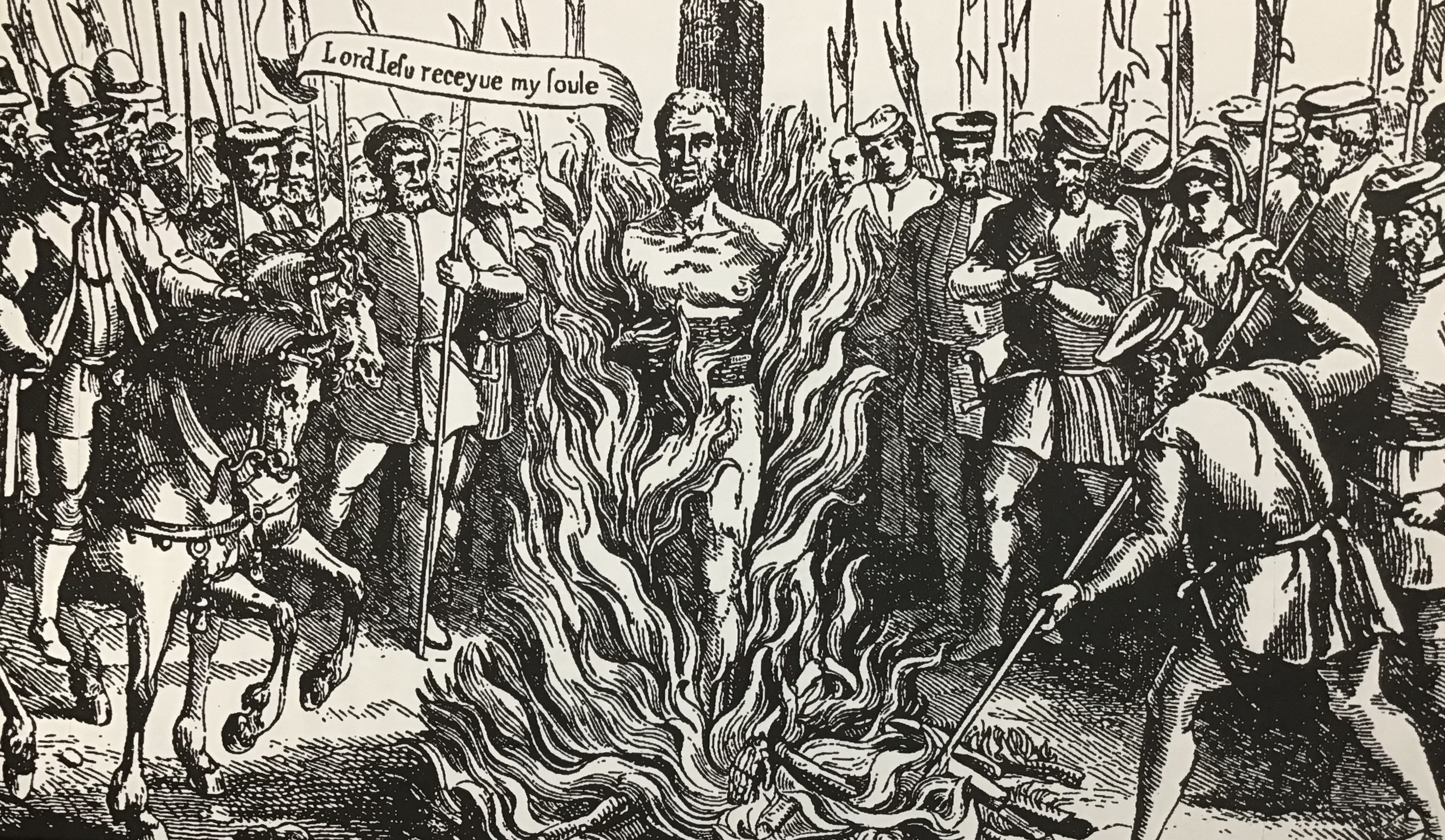
Bishop Hooper burned at the stake for the gospel.
Although we Protestants say that we don’t venerate the saints, you wouldn’t know it the way some pastors fawn over Luther, Calvin, Knox, Spurgeon, and other reformers. Don’t get me wrong, I think those men were used mightily of God, in spite of their flaws and personal sin.
But what I wonder about is how it is that so many pastors who would look up to these men and admire them for their courage and boldness are so cowardly in their own churches when they are called upon by the testimony of the Word of God to stand firm against a potential revolt by those who do not want biblical change.
When Gideon was called to pull down the idols in his town, he may have been overcome by the fear of man, but at least he did it, even if under the cover of night. And when they found out what he did, they wanted to kill him.
When Josiah came to understand how far Judah had fallen away from obedience to the Law, he immediately began to purge Judah and Jerusalem of its idolatrous high places and reinstated the reform that was necessary to please the Lord. This led to a need to rebuild and reorder the temple so that proper worship could be restored.
And the church today is in need of men who are ready and willing to make the changes that are needed in their local churches where unbiblical practices have found a nesting place for ages. For fear of confrontation, loss of income, or prominent families, or a simple fear of losing your job, pastors remain silent in the face of unrepentant sin and all manner of false practices. Unregenerate men are allowed to remain on elder and deacon boards, unhealthy and unbiblical curriculum and programs continue to function so as to avoid a conflict with a women’s ministry head or the parents of the youth. The call for entertainment in church continues to ring louder as the Word of God is given less time to work in the hearts that need it.
Yes, we admire Luther’s stand at the Diet of Worms where he refused to recant. We applaud Spurgeon for being unwilling to give in to the New Measures that sought to entertain the goats. We are in awe of Whitefield who preached the gospel wherever he could garner an audience. We rejoice at the courage of John Rogers and the other Marian martyrs who refused to stop preaching under Bloody Mary of Tudor, and were burned at the stake for it. But will we stand today? Where is our courage? Where is our godly resolve to trust God in the face of angry adversity within and outside of the church? Brothers! Be strong and very courageous!
In the events of Passion week, today is a silent day of mourning. The disciples went home with the horrible reality that Jesus was dead and his body was in a tomb. Now what? But the resurrection gives us hope! In Part 1, we learned that Christ’s Resurrection Guarantees the Christian’s Resurrection, and in Part 2, we saw that Christ’s Resurrection Reverses the Curse of Humanity. But the Apostle Paul gives at least two more reasons for us to draw hope, even on this day of grief as we await Resurrection morning. The third reason is…
Christ’s Resurrection Gives Hope for the Future (v. 23)
“But each in his own order: Christ the firstfruits, then at his coming those who belong to Christ.” (1 Corinthians 15:23, ESV)
Right now, we all see the effects of sin all around us. We feel it in our bodies. Sickness, disease and death are constant reminders of our fallenness.
Sin has a corrosive effect in society that has plunged us into spiritual darkness that it seems we will never recover from. Crime, war, famine, hatred, and all sorts of human suffering is never far away. We see it in our news feeds every day. We can’t ever seem to get a day of relief from the bad news.
We are desperate for some good news. The resurrection of Christ is the best news. It tells us not only that Jesus is alive, but that he is coming back to judge the world and he will raise us up from the dead and glorify our bodies to never die again.
Verses 50-57 describe this even in the future that we as Christians look forward to when we will be made imperishable and immortal. These verses say:
“I tell you this, brothers: flesh and blood cannot inherit the kingdom of God, nor does the perishable inherit the imperishable. Behold! I tell you a mystery. We shall not all sleep, but we shall all be changed, in a moment, in the twinkling of an eye, at the last trumpet. For the trumpet will sound, and the dead will be raised imperishable, and we shall be changed. For this perishable body must put on the imperishable, and this mortal body must put on immortality. When the perishable puts on the imperishable, and the mortal puts on immortality, then shall come to pass the saying that is written: “Death is swallowed up in victory.” “O death, where is your victory? O death, where is your sting?” The sting of death is sin, and the power of sin is the law. But thanks be to God, who gives us the victory through our Lord Jesus Christ.”
(1 Corinthians 15:50–57, ESV)
In 2015 the UC Berkeley Alumni magazine California ran an article about cryonics. Not sure what that is? Let me quote a small portion and you’ll understand,
“Before launching the first cryonaut, they had sandwiches and coffee. It was a Thursday afternoon in January 1967, in the Los Angeles suburb of Glendale. The ad hoc medical team—a physician, a chemist, and Bob Nelson, a voluble TV repairman and president of the newly minted Cryonics Society of California—huddled around the dead man’s bedside. In front of them lay the body of James Bedford, who earned his master’s degree from UC Berkeley in 1928. A retired psychology professor and vocational guidance expert, the 73-year-old had died of liver cancer an hour earlier. All of them, living and dead, were about to make history.
The team went to work. Adapting techniques from the field of cryogenics, which studies materials at low temperatures, they injected medical-grade antifreeze into his neck, diluting his blood. To minimize damage to his brain, they kept oxygen pumping through his system with a machine called an iron heart. Then they slipped the professor into a coffin-shaped capsule filled with dry ice. (Later, the capsule would be placed in a cylinder cooled by liquid nitrogen for permanent storage at -196°C.)
Four hours later the task was completed: They had frozen the first man.
At a triumphal news conference a few days later, Nelson, the TV repairman, explained the purpose of the professor’s “cryopreservation.” Bedford, he told the assembled reporters, “will be kept frozen indefinitely until such time as medical science may be able to cure cancer, any freezing damage that may have occurred, and perhaps old age as well.”[1]
Here we are, over 50 years later, and that Berkeley professor’s body still awaits the cure for cancer, and the science to be able to bring him back to life and heal him of his cancer. If it had been done before, then maybe there would be more hope in cryonics. But this has never been done before. Not even once. Not even close. We don’t have that sort of hope as Christians.
The hope we have is assured. It isn’t a shot in the dark. It’s not a gamble or a pipe-dream. Church, Jesus Christ is alive today! Jesus Christ went through death for us, and he rose again before us. He will come again and we shall be raised from the dead just as he was!
Christ’s Resurrection Gives Hope for the Future to those who follow Jesus Christ as Lord. But what about those who do not believe in Christ and do not follow him? What about death itself?
Ministry can be a lonely place. Sometimes there are very few people that could understand what you re going through, and there aren’t many that you can share your thoughts and struggles with. Ministry partnerships and fellowship can definitely help alleviate this, but there is still the reality that the road of ministry leadership is sometimes still fraught with times of isolation and discouragement.
Finally, The Lord Provides for ministry when he gives us encouragement.
He Gives Us Encouragement
“And the Lord said to Paul in the night by a vision, “Do not be afraid any longer, but go on speaking and do not be silent; for I am with you, and no man will attack you in order to harm you, for I have many people in this city.” (Acts 18:9-10, NASB95)
Think about the English word, “encouragement.” It has the word “courage” right in the middle of it. This English word originally was, in-courage, and it meant “to give courage.” And that is what the Lord is doing in verses 9-10. In a vision one night, the Lord reminded Paul what he often told his prophets in the Old Testament, “do not be afraid!”
In Exodus 3:2, as God called Moses to redeem his people from Egypt, He told him that He would be with him. In Deuteronomy 31:6, Moses told Israel to trust the Lord as they entered the promised land. In Joshua 1:5, 9, the Lord encouraged Joshua that he would be with him as he was with Moses and that he needed to be strong and courageous. In Isaiah 41:10, the Lord told the prophet Isaiah that he is not to fear or be dismayed, because the Lord God will strengthen him, help him, and uphold him. And in Jeremiah 1:8, when Jeremiah was called to go out as the prophet of the Lord, God told him that he was not to be afraid of them because the Lord was with him to deliver him from all dangers.
Paul needed that kind of supernatural encouragement as he faced the daunting task of the ministry the Lord had given to him. And so he gave Paul these instructions:
“Don’t be afraid any longer”…When we react in fear we are lacking faith in the Lord our God who is our strong tower. In our fear we must trust the Lord and turn to him by faith to accomplish his will.
“Go on speaking and do not be silent”…Fear of persecution often silences the faithful witness. Paul needed to be courageous and keep on speaking the truth, in spite of the high probability that he would continue to suffer greatly for the gospel.
And then he gave him three encouragements:
“For I am with you”…Paul was never alone. God was always with him. Just as he was with Moses, Joshua, Israel, David, Isaiah, Jeremiah, Daniel, Habakkuk, and so many others.
“No man will attack you in order to harm you”…No one can touch us if God’s protective hand is upon us. This would be limited to the time that Paul was evangelizing in Corinth until those God would save had been saved. It wasn’t a promise that Paul would never be attacked again. But it was an assurance that for a while, Paul would be able to do the work of the ministry without violence breaking out in Corinth for a while.
“I have many people in this city”…The Lord was saying to Paul, “there were many people left who would be saved. Go find them!” When the time to move on had come, the Lord would let Paul know. He was to be encouraged with the fact that there was a good harvest of souls right there in that city.
We know how the Great Story ends, don’t we? No matter how dark things get, no matter what twists and unforeseen trials we encounter, in the end, Jesus has already won! Therefore, we need to be encouraged and see with the eyes of the Ascended Christ. He is not dead and in the tomb. He is seated at the right hand on high. He is coming again. And he has given us work to do.
Let your hands be strengthened with this truth and carry on with the Lord’s work. Look at our last verse, verse 11: “And he settled there a year and six months, teaching the word of God among them.” (Acts 18:11, NASB95). Do you see the result of these provisions? God had provided co-workers, finances, focus, boldness, souls saved, and words of encouragement. And Paul continued on and so we must carry on as well.
Maybe it’s an American thing, but it seems that there is too much entrepreneurialism in the church today. Every up and coming church is looking to be innovative and cutting-edge. Along with this entrepreneurial spirit comes an equally troubling reality–that man-centered ministry is produced by a man-centered power. It makes sense: if you throw out the book on how to pursue ministry, why would you seek to be empowered in a biblical manner? For the man of God who wants to do things according to God’s Word, we need to remember that God provides in every way for every need.
We began to look at six ways which the Lord provides for His servants.The first way he provides is: He Gives Us Ministry Co-workers. You can read part one here: The Lord’s Provision for Ministry (part 1). Then we saw that he provides financially and by giving us focus in our ministry. You can read this in part 2: The Lord’s Provision for Ministry (part 2). Fourthly…
He Gives Us Gospel Boldness
“But when they resisted and blasphemed, he shook out his garments and said to them, “Your blood be on your own heads! I am clean. From now on I will go to the Gentiles.” (Acts 18:6, NASB95)
Hard hearts are a result of the sinfulness of mankind. It goes all the way back to the Garden of Eden. We shouldn’t be surprised that Paul faced the rejection and mockery of the crowds in Corinth as he had in many cities he preached in. And it shouldn’t surprise us when we see that happen to us as well. It’s nothing new and we should expect it. But we should also expect that the Lord will provide us with gospel boldness as well, so that we can respond as we should in the face of opposition.
In verse 6, Paul can no longer stand the resistance of the Jewish people’s hardened hearts. Their objections degenerated into blasphemies against Christ himself. Paul shook out his garment, a sign of disgust and complete rejection, and rebuked them for their hardness. Paul had done what the Lord said was required in Ezekiel 3:18-19, “When I say to the wicked, ‘You will surely die,’ and you do not warn him or speak out to warn the wicked from his wicked way that he may live, that wicked man shall die in his iniquity, but his blood I will require at your hand. “Yet if you have warned the wicked and he does not turn from his wickedness or from his wicked way, he shall die in his iniquity; but you have delivered yourself.” (Ezekiel 3:18-19, NASB95)
Paul wasn’t fooling around. He had come to complete the King’s business and he didn’t want to waste his time on foolish scoffers.
Some people call alcohol “liquid courage” because it lowers the inhibitions and allows people to say and do things they would never do or say when sober. However, Ephesians 5:18 says, “And do not get drunk with wine, for that is dissipation, but be filled with the Spirit,” (Ephesians 5:18, NASB95). Here, the influence of drunkenness is compared to the influence of being filled with the Holy Spirit. Paul was a Spirit-filled man and this is demonstrated in the fact that with great courage and boldness he spoke out against the rejection and mockery of the gospel of Jesus Christ.
John Calvin once said to the Queen of France, “A dog barks when his master is attacked. I would be a coward if I saw that God’s truth is attacked and yet would remain silent.” God offers this same gospel boldness as well. I think that too many Christians are okay with being quiet wallflowers, even when their Lord is blasphemed in their presence. We must pray for the Lord to fill our mouths with a courageous testimony, even in the face of opposition.


 Always Reforming