Why You Should Boldly Preach Christ Crucified

For the word of the cross is foolishness to those who are perishing, but to us who are being saved it is the power of God.

(1 Corinthians 1:18, NASB95)
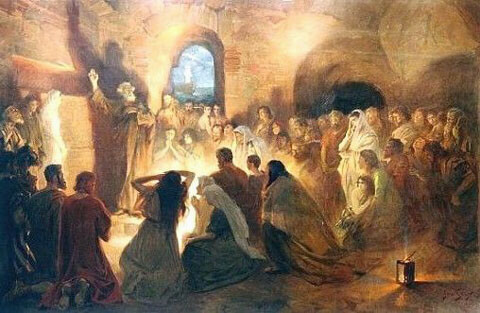
Peter preaching
  1. Because It is Not Popular (v. 18)
    Not only is it not popular, it is moronic (moria in Gk.). Consider the fact that the gospel of Jesus Christ demands that we say to sinners that a poor and humble Jewish man was God, and that he was nailed to a cross to die a criminals death despite his perfect innocence. We proclaim that this man is not only a man, but that he is God in the flesh. That he is perfect and sinless and that he was born of a virgin.

Furthermore, we proclaim that all of humanity is lost and that each individual man, woman, and child is a wretched sinner.
We proclaim that Christ is the only hope for humanity and that all other claims are lies from the pit of hell and all who seek salvation in any other name are doomed to eternal damnation.


We proclaim that Jesus Christ has done all that is necessary for our salvation, and that he rejects all attempts to earn salvation on our own. He, being the King, demands our allegiance and one day every knee shall bow and every tongue shall confess that He is Lord.

Brothers, when we proclaim this the world will overwhelmingly reject us as fools of the worst kind. We will be called bigots, intolerant, and uneducated religious zealots. And that is why so many bow to the pressures and soften their message. Paul was keenly aware of the propensity of men to soften the blow of the gospel by using soothing words that made the hearer feel at ease.
He said in 1Corinthians 2:1-5 that he purposely made it his aim to proclaim the unvarnished gospel of Jesus Christ crucified. Today, preachers everywhere are trying to make Jesus look cool. They are trying to make Christianity attractive. They are doing just what Paul avoided.

Brothers, the cross was not cool. It was brutal and bloody.

The call of Christ is not popular. True Christianity will never court the world. But pastors will continue to attempt to make our precious faith more palatable in order to gain the popularity of the world. This is nothing but pride. Nobody should enter the ministry or the pulpit in order to make his own name great.

Isaac Watts wrote, “When I survey the wondrous cross on which the Prince of glory died; My riches gain I count but loss, and pour contempt on all my pride.”
PREACH CHRIST BECAUSE IT IS NOT POPULAR!

2. Because They Are Perishing (v. 18)
When we preach the message of the cross, the world sees it as folly because they do not see the danger to their souls. Sometimes they fail to see the danger because they do not see it in our eyes and do not hear it in our voices as we proclaim cold truth from our pulpits.
Brothers, do you feel the truth of Hell?
Do you remember the days when you were among the brood of vipers?
Do you recall that you were once a vessel prepared for destruction?
Have you forgotten that you were on the precipice of the bottomless pit and you were ready in due time to slip into eternal fire separate from God to be tormented for all eternity?
HAVE YOU FORGOTTEN?

When we remember our former state we will be quick to point people to the only remedy for their souls—the cross of Christ. When we remember that they are perishing, we will not care about their mocking and their cries for ear-tickling sermons—we will give them what we know they need.

Wrote Thomas Brooks, “The damned shall live as long in hell as God himself shall live in heaven.” That fact alone should drive us to preach Christ crucified. Check your hearts brothers. Do you feel the terror of hell and do you cry out with Paul on Sunday mornings: “For we (!) are the aroma of Christ to God among those who are being saved and among those who are perishing, to one a fragrance from death to death, to the other a fragrance from life to life. Who is sufficient for these things?”(2Cor. 2:15-16)

PREACH CHRIST BECAUSE THEY ARE PERISHING!

3. Because It is the Power of God (v. 18)
Power in the pulpit. Power evangelism. Power encounters. Pastors want power.
But the power of God is not found in the usual places.
It is not found in business models or worldly philosophy (1Cor 1:22).
It is not found in dramatic, emotionalism (1Cor 1:22).
It isn’t found in phony encounters and confrontations with demons and the occult.

The power of God was displayed on the cross, where God sent His Son to be crushed for our iniquities. Jesus became sin on our behalf, so that we might become the righteousness of God! That is power!

Concerning the justification of God, John Calvin said, “Wherever the knowledge of it is taken away, the glory of Christ is extinguished, religion abolished, the Church destroyed, and the hope of salvation utterly overthrown.” This is the power of the cross.

Why is the Church so weak and utterly incapable of making an impact in our nation? Because many so-called Christian churches have left this message behind and taken up the banners of politics, pop psychology, health and wealth, and so many other empty promises.

The Roman Catholic system, the Emerging movement, the Seeker Sensitive movement and the Liberal mainline denominations have all shown us what becomes of those who lay aside the cross of Christ. But it hasn’t stopped many men from flirting with those compromising philosophies.


Puritan pastor Richard Baxter has written, “If a hardened heart is to be broken, it is not stroking but striking that must do it.” The only thing that can cut another stone is a diamond, the hardest gem on earth. In order to cut the hardest heart, we must use the sharpest tool.

In Hebrews 4:12 we are reminded, “For the word of God is living and active, sharper than any two-edged sword, piercing to the division of soul and of spirit, of joints and of marrow, and discerning the thoughts and intentions of the heart.”

Brothers, even in our fundamental Bible churches the temptation can be overwhelming to give up expository preaching in favor of sugar coated sermons that aim to please the itching ears of people. We reason in our hearts that once we have them in our churches we can preach the gospel to them, we just need to ease them into it. Don’t fall for this pragmatic lie!

You are merely a tool in God’s hand. He uses you as His minister to wield His weapon of choice. You cannot change the soul of a man in any way without the intervention of the Word, the Spirit and Christ. It is the Word of God preached—the Gospel alone that brings a sinner to his knees.

PREACH CHRIST BECAUSE THE MESSAGE OF THE CROSS IS YOUR ONLY POWER!

Rejoicing in Trials? Yes!

Circumstances do not bring joy, only Christ does. The Apostle Paul’s outlook on his own life was that it was not his own, that he was a servant of Jesus Christ first and foremost. He said that in his opening words to the Philippian church. Paul derives his joy from his identity as a servant, so that he does not look primarily to his circumstance, but to his fulfillment of his Master’s will. Endurance through trials is not a work of the flesh, but a work of the Spirit.

This is something that the world cannot understand at all. For a world without God, when suffering comes, they often seek the quickest route out. The world does not see any benefit for suffering and pain. As a matter of fact, when they see a Christian suffer, they can sometimes mock us, and ask where our God is. Why doesn’t he relieve our suffering when we have been so faithful to serve him?

Paul is helping the Philippian church to see that his imprisonment is not the worst thing that could happen to him. Discontentment is worse. Joylessness is worse.

In Philippians 1:15-18, Paul sat in a prison cell, yet was filled with joy in the continued preaching of the gospel. He was not bitter about the fact that he wanted to be out doing the work of the ministry. And he wasn’t bitter about those who were free, and used their freedom to preach the gospel, not to serve Christ, but to jab at Paul! Paul ended his thought in verse 18 with “in that I will rejoice.” Christ was being glorified. How could anything be better?

But as Paul thought for a second, he realized that there were reasons for continued rejoicing beyond just the present preaching of the Word. Let’s look at a few of these reasons that he laid out for rejoicing:

Rejoice in the Prayers of the Saints (v.19)

Paul writes how he can rejoice because he knows that the brothers and sisters in Philippi are praying for him. In Philippians 4:1 Paul has mentioned that he constantly kept the church in his prayers, and he is aware that they have done the same for him. This is a greater challenge in the church today because our society tends toward more and more isolation. We might see what you eat on Facebook or Instagram, and hear about how great your vacation was, but the real issues in our lives are kept hidden.

In general, we shouldn’t overshare. We need to be wise about what we say and to whom we say it. But in matters of praying for one another, we need to grow deeper without going into gossip or unnecessary details. The example we see from Paul was that he shared himself with the church. He shared his thoughts, his fears, his needs, and his weaknesses. This type of transparency allowed the church to better pray for him. And in this prayerfulness for one another, Paul could rejoice. He knew that the church was praying for him in his struggles and trials. And he prayed for their welfare as their spiritual father. But prayer is not all that was needed. He adds, “and…”

Rejoice in the Help of the Spirit (v. 19)

Paul’s joy was based upon much more than the faithful prayers of the saints in Philippi. Prayer is only as good as the God to whom we pray. The intercession of the saints must be accompanied by a movement of God. Our prayers shouldn’t stop until God answers one way or another. Paul knows that something will happen when the saints pray and the Spirit “helps.” This is really where Paul finds his assurance. His confidence comes with the working of the Lord.

The word “help” (ESV) is an unfortunate rendering because it seems such a weak word. The KJV’s “supply” is a little better, but still doesn’t give the best picture of the critical nature here. The Greek word epichoragia is a word that is used in Ephesians 4:16 to speak about a ligament that serves to support the body: “from whom the whole body, joined and held together by every joint with which it is equipped, when each part is working properly, makes the body grow so that it builds itself up in love.” (Ephesians 4:16, ESV)

That is the kind of “help” the Spirit is. Without him, we are crippled spiritually. We cannot go on. He is that critical. The Spirit’s help is not like an assistant, whom we can do without. He is like a knee joint for a sprinter—invaluable. The reference to “the Spirit of Jesus Christ” means the Holy Spirit. He is the One who will bring about Paul’s “deliverance.”

But what sort of deliverance was Paul expecting? Some have thought that maybe this salvation is from his situation—temporal salvation; others have thought that it was spiritual. Perhaps Paul was thinking about the fact that whether he lived on and was freed or whether he died a martyr’s death, he would be saved. The Spirit of Jesus would deliver him from death, or deliver him from this life through death. Either way, Paul would be set free in some form or another.

Where we set our eyes changes what we see. If we set our eyes on Christ, we see hope. Christ delivers from the challenges we face today, and he has conquered our sin, winning for us salvation and eternal life. But when we put our eyes on our problems, on the circumstances that we are in the middle of, our vision is clouded. We can be given over to despair and hopelessness. Paul could have easily gone there as he sat in prison. But he knew he had good friends praying for him, and that the Spirit of Jesus was working it all out. He would get out of that prison, and either he would be reunited with his friends, or he would be safe in the arms of Jesus.

What about you? Are you trusting in the Lord to deliver you in your times of need? Have you forgotten the power of God? Stop trusting in your own strength. Stop seeking to be the answer to your own prayers. Depend upon the Lord’s strength. Why are you downcast? It is because you have placed your hopes in something other than the Lord. Hope in God. Finally, we need to…

Rejoice in Expected Courage (v. 20)

Paul is eager to see where the Lord is directing him. He knows the prayers are for his release, and he knows that the Spirit is at work, but the future is still unclear. When Paul says he has “eager expectation,” this idea pictures a person straining his neck to see what is ahead just around the bend. It is a great word. Paul isn’t dreading the future, he is embracing it. He is hopeful!

    So, what are the possibilities? He expects that whatever happens, he will not be ashamed. Why would he be? He is not a criminal. He is on trial for the gospel. He has no remorse in prison. He would do it all over again. He has glorified his Lord in his ministry.

Let me ask you, are you ready to meet the Lord today? Would you be ashamed of what you have accomplished in your short life on this planet? Are you banking on the next 10-20 years to make something of your life for Christ? That is borrowed time, my friends. It may never come. You need to put your life in order today. You don’t want to be lying in a hospital bed thinking about how ashamed you will be to face the Lord because your life was only a pursuit of personal desires.

Instead, Paul was anticipating having a lion’s heart to face whatever would happen. He expected to have “full courage” for whatever he faced. You see, if he was released from prison, his message of the risen Christ would be vindicated in many people’s eyes. And if he received the death penalty, then he expected to be filled with courage just as much. How? It had to do with how he had been as a servant. You see, Paul wasn’t only speaking about the courageous death he would face—courage as he faced the executioner.

Whether he lived or died was inconsequential. Eager expectation, hope, and courage marked Paul’s outlook. Paul’s lion-like boldness was based upon the salvation won for him at the cross and how he had remained faithful to his Master. Paul was ready to die well.

With heaven before us, what do we really need to fear? Jesus has conquered sin and death. Our best days are ahead of us. Christ is King! Let us have courage to face the uncertain future knowing that the face of Christ and eternal life is a certainty!

Three Ways to Minister as a Married Couple (Weekend repost)

Since today is the Lord’s day and many of you were worshipping together as a family, I thought I’d repost this article in case you missed it.

Read the post here.

Make sure you subscribe to get alerts for new posts. Fresh content will be posted tomorrow!

Three Lessons From One Whose Sin Was Found Out (Weekend repost)

Since I’m not planning on writing blogposts for weekends, I thought that I’d repost the most popular blogposts from this past week in case you missed it.

Three Lessons from One Whose Sin was Found Out. Read it here.

The easiest way to get notifications of a new post is to make sure you subscribe. It’s free and easy. Just click the subscribe button to the right and fill in the info.

What Happened to Evangelistic Visitation?

If we are honest, we would have to admit that many churches in the U.S. are not growing from conversions but from transfers from other churches. I’ll admit that there are some valid reasons for a Christian to leave one church to attend another, but the Great Commission isn’t about shuffling believers from one church to another. There are many things a church can do to bolster its outreach, but one that is consistently missed in the vast majority of churches today is evangelistic visitation. What is that you ask? Keep reading and I’ll explain.

Every Saturday for many years there were at least two people from Grace Baptist Church that would go out to share the gospel with our community—myself and one of our deacons named Everett. Some Saturdays there were others that would join us, but many times it was just the two of us. Everett and I shared Christ with gang members, homeless people in the park, people in half-way houses, and everyday people that look like you and me.

We had dogs chase us, people scream at us, a couple of doors slammed in our faces, and even a few people that I am convinced were demon possessed. Although we visited door to door in order to hopefully share Christ with our neighbors, we found that this method wasn’t too successful. Instead we found that evangelistic visitation was far more productive.

Whenever a person visited our church, they would receive a bulletin and a small visitor’s card that we asked them to fill out as a record of their visit. These cards were placed in the offering plate when the offering was received. When the deacons counted the offering, they would take out these cards and give them to me for follow up.

In my discussions with many pastors and church leaders, many churches don’t do anything to record visitors anymore. I’m not sure why, but they don’t seem to even collect a card to record visitors. In my many visits to different churches, most didn’t request a card to be filled out, and of those that I have filled out, only one has ever done something with it.

On Tuesday when I came into the office, I would send out a welcome letter thanking the visitor for coming. If they wrote the name of who invited them on their visitor card, I would include that as well. Sometimes I would call the friend of our visitor and ask them some questions to find out more about what brought them to our church.

But my follow up didn’t stop there. On the following Saturday, Everett and I would take that card and drive over to the visitor’s house to pay them a visit. Yes, you read that right! We actually showed up at their front door! When we did this, we followed a few rules that worked for us:

1. We only visited on Saturdays from 10am-12pm. This is because before 10 some people were sleeping in and after noon they would be leaving for the day. Three day holidays were almost worthless as far as visiting goes.

2. We took a church flyer or business card with us to leave if they didn’t answer the door. We wanted our visitor to know we came by and missed them. A quick note on a church invite flyer or the back of my business card was slipped in the door jamb for the visitor to find when they returned home.

3. We didn’t call to make an appointment. We found that when we made arrangements we would often find nobody home. It was better to surprise our visitors. Even so, the vast majority were happy to see us.

4. We thanked them for their visit and asked if they had any questions about what they heard. Their visit showed us that they had some interest in church and the Bible. Our conversation helped us determine if the visitors were Christians or needed to hear the gospel.

5. We made sure to express that we were there because we had an important message that we wanted them to hear. We assumed God had sent us as His messengers and we were not ashamed, but bold ambassadors for Christ.

6. We invited them to come back Sunday (the next day). Many people were shocked that the man that preached the sermon had taken the time to personally visit them. This impression made them more open to come back, and it showed them in a tangible way that we truly cared for them.

Having successfully visited our visitor, we usually asked them if we could pray for them and if they had any special prayer needs. The visit often ended with smiles, laughs, and a new relationship begun. Of all the people that returned a second time, many were those that had been visited by someone in our church.

When you think about what connected you to your church, what sticks out the most? What were the things that turned you off about visiting a new church?