
There is a bestselling financial book by Robert Kyosaki entitled Rich Dad, Poor Dad. Its purpose, like most books of this type, is to share with the reader financial secrets in order to make you financially wealthy.
In these ever-tightening financial times, people are more concerned than ever that they get their financial house in order, fearing an economic recession is just around the corner, if not at our doorstep.
I think that taking care of your family financially is not only wise, but also biblical. Paul told Timothy, “But if anyone does not provide for his relatives, and especially for members of his household, he has denied the faith and is worse than an unbeliever.” (1Tim 5:8).
Yes, financial responsibility is definitely an important part of a stable life, even for a Christian. But, there is an even more crucial issue that we must prepare for, we must seek after—it is spiritual poverty.
Seeing the crowds, he went up on the mountain, and when he sat down, his disciples came to him. And he opened his mouth and taught them, saying: “Blessed are the poor in spirit, for theirs is the kingdom of heaven. Matthew 5:1-3
“Blessed,” in simplest terms means “happy.” But it is so much more than a “dopey smile on your face giddiness.” It is a deep-seated, satisfying contentedness. Dr. Lloyd-Jones made an insightful comment about happiness. He said,
Happiness is the great question confronting mankind. The whole world is longing for happiness and it is tragic to observe the ways in which people are seeking it. The vast majority, alas, are doing so in a way that is bound to produce misery. Anything which, by evading the difficulties, merely makes people happy for the time being, is ultimately going to add to their misery and problems. That is where the utter deceitfulness of sin comes in; it is always offering happiness and it always leads to unhappiness and to final misery and wretchedness. The Sermon on the Mount says, however, that if you really want to be happy, here is the way.” (Studies in the Sermon on the Mount, p. 24).
So, whom did Jesus say would be blessed? Notice that I did not say, what would make us blessed—as if an object could make us happy—I asked, who is the happy man or woman? Who is the one who is blessed? It is the one who is poor in spirit.
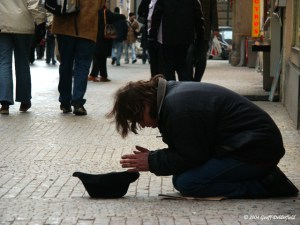 “Poor in spirit” is not about money. “Poor in spirit” does not refer to your bank account, or it would be a virtue to be penniless. There are many among the poor who are just as spiritually starved as those that are rich in this world. While some wealthy folks may trust in their riches, it is equally true that some who are poor are repeatedly telling themselves and others, “If only I had a little more money, things would be different…”
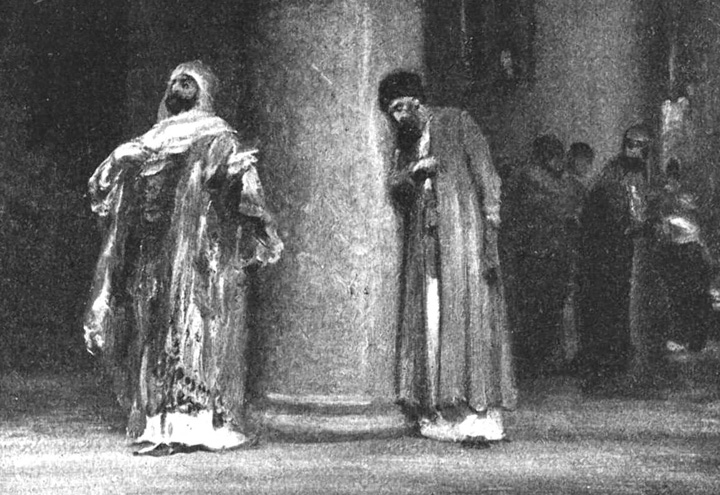
But money doesn’t buy happiness or heaven. Luke 18:9-14 contains probably the best snapshot of the rich dad and poor dad, spiritually speaking. In this story, Jesus is speaking to men who were not spiritually poor, but thought of themselves as spiritual millionaires. They were religious and quite satisfied with themselves. Verse 9 tells us that because of this smug attitude, they looked down their nose at others who were not their spiritual equals.
Let’s look at a few features of the spiritually self-sufficient man, the rich man, and then we will look at the other guy.
First, notice that he had no need. The spiritually “rich” do not see their need for God. They may not be particularly religious. They may be downright wicked. Or, they may be especially skilled in the art of religiosity and morality. Yet, this is the point, they think to themselves, “I am not like these others who need God. I am fine as I am. I don’t need all of this religion and such. It’s not for me.”
Second, they are spiritually blind. The spiritually rich are blind to their own faults. They soothe themselves with thoughts of their own goodness, in comparison to others. But they will not compare themselves to God, because if they did, they would not see themselves as rich, but wretched and poor. Consider what the Bible says about all people:
“The heart is deceitful above all things, and desperately sick; who can understand it? “I the Lord search the heart and test the mind, to give every man according to his ways, according to the fruit of his deeds.” Jeremiah 17:9-10
“As it is written: “None is righteous, no, not one; no one understands; no one seeks for God. All have turned aside; together they have become worthless; no one does good, not even one.” Rom 3:10-12
“We have all become like one who is unclean, and all our righteous deeds are like a polluted garment. We all fade like a leaf, and our iniquities, like the wind, take us away.” Isa 64:6
Third, these spiritually “rich” are really spiritually bankrupt. Yes, those who would consider themselves in the best spiritual state, so good in fact that they have no need for God, are in fact bankrupt. They are spiritually rich only in their imagination. They just don’t want to face the truth. Like people today who live off of credit until it catches up to them, the spiritually rich live like they are close to God until one day God says to them, “Depart from me, I never knew you…” (Matt 7:23).
Let’s go back to Jesus’ story in Luke 18:13. Here we have a man that is spiritually poor, or as Matthew 5:3 says, “poor in spirit.” Let’s look at his character:
First, his actions come from an inner attitude. The thumping of the chest, the averted eyes, the crying out to God with a passionate heart, these originate in a heart that is changed. These come from how he views himself—he calls himself, “a sinner.” He is not merely saying a spiritual platitude-“I am a sinner, but who isn’t?” No, this man feels in every fiber of his being that he is a sinner.
 Second, this sinner has come to a terrible realization. This sinner realizes that his sin puts him in a very frightening place with almighty God. He cries out, “be merciful to me.” Cries of mercy recognize their guilt. Mercy begs that the offended one would withhold the righteous judgment and wrath they so richly deserve.
Third, the changed attitude and this terrible realization affect his worship before God. This is why the tax collector will not look up. He is guilty before God and he is ashamed. He beats his chest in shame and disgust at his own sins. This man has nothing to offer God. No excuses. No self-righteousness. No good works. No spiritual bargaining chips. HE IS POOR IN SPIRIT.
Fourthly, his brokenness before God; his spiritual poverty, is found acceptable in God’s eyes. In Matt 4:3, Jesus said that the poor in spirit are blessed, for theirs is the kingdom of heaven. Heaven belongs to, is enjoyed by, and is inhabited by those who are poor in spirit.
Jesus said of the tax collector in Luke 18, that he went home justified—right with God—not the other.
Rich Dad, Poor Dad. Which are you?
No need? No desire for God or what you call religion? Feeling good about yourself? You’re the rich dad who is spiritually bankrupt. You are not right with God, and you will never be right with God with that attitude.
The last sentence in Luke 18:14 said, “For everyone who exalts himself will be humbled, but the one who humbles himself will be exalted.” Humble yourself. See yourself as you really are before God. Beg his mercy, and he will hear your pleas and will forgive you your sins. You can be justified by God today.
 Do you see yourself as a sinner? Do you see yourself with God’s eyes? Are you broken and remorseful over your sins? Ask God for mercy. His mercy is abundant and will forgive any and every sin. First John 1:9 says, “If we confess our sins, he is faithful and just to forgive us our sins and to cleanse us from all unrighteousness.”
When you humble bow before God and ask his mercy and forgiveness, Matt 5:3 says, yours shall be the kingdom of heaven.


 Always Reforming