A Tool To Sharpen Your Preaching

If we want to improve in any skill, we must practice. This axiom is also true for preaching. If you don’t get many opportunities to preach, them you won’t be able to grow as an expositor. But there is an additional tool beyond practice that is also needed. As a matter of fact, it goes hand in hand with practice. It’s feedback. We need help with seeing our blindspots and our weaknesses in our sermons and delivery. One good place to get helpful feedback is from our church–those people that love us and want us to grow in our skills.

Now I understand that going to someone in your church and asking them to critique your preaching is a scary prospect because we are opening ourselves up to someone when we are very vulnerable. But we need the feedback if we are to get better and improve our preaching skills. So here is how you can being:

  1. Find two or three people you trust will be both kind and honest with you as they critique your preaching.
  2. If you have an idea of where you might need to improve, try working on this skill set for a month. Don;t try to change too much too fact or you will freeze up with the “paralysis of analysis” syndrome. Once you get a skill under your belt, you can move on.
  3. Explain to those people who are giving you feedback what they should be looking for. They need to know how to identify weakness in you beyond what they like and don’t like. It needs to be defined and measurable.
  4. After they give you feedback, thank them and assure them that you will take their comments into consideration and work on these things. Then do it!

I have created a simple form to give to those in a church with helpful areas for them to take notes. I would suggest that you not only explain what they are looking for, understand that they are helping you out, so don’t demand that they spend too much time distracted with the critique so that they get nothing from the message. In fact, you might want to rotate those that help you with feedback so it isn’t the same people week after week. Here are the questions I include on my form:

Sermon Evaluation

  • Preacher’s name: _____________________ 
  • Sermon title: _________________________
  • Sermon main text: ____________________
  • Date preached: _______________________

Introduction:

  • Did the introduction lead to the main idea of the text?
  • Was it interesting?
  • Did it include enough background info to give context without bogging down the sermon?

Sermon Body:

  • Was there a clear outline?
  • Was the outlining of the sermon choppy?
  • Did the preacher point us back to the text to prove his point?
  • Did he stray from the text or explain it?
  • Were there sufficient illustrations to make the abstract ideas concrete? 
  • Was there appropriate application given?
  • Was the main point of the text the main point of the sermon?
  • Was there doctrinal error?
  • Was the explanation of the main doctrines clear?

Sermon Conclusion:

  • Was the gospel somehow included in the sermon or conclusion?
  • Was this message God-centered?
  • Was this message overall clear, somewhat clear, muddy, or confusing?
  • Was the hearer given something to do or believe?

Outline:

(The one giving feedback should be instructed to write out your outline as they heard it. This should help you evaluate how successfully you gave out the outline in regard to repetition, and clarity.)

Why We Must Preach the Bible, part 1 (weekend repost)

The Church of Jesus Christ exist to preach Christ crucified (1 Cor. 1:23), a prospect that has never been acceptable to the world and is rejected by the apostate church. Like the Apostle Paul, we do not shrink from declaring the whole counsel of God (Acts 20:27). We believe that God has spoken without error and that His Word has never failed. We believe that the Word of God rules over the Church and God’s people, and that this authority extends to all humanity whether it accepts it or not. We believe the Bible, and this should have a direct impact upon how we minister in the preaching of the Word. 

“Why We Must Preach the Bible”

With the attack upon truth growing every day, it is a necessary reminder for every Christian to understand why we must preach the Bible. Read it here: Why We Must Preach the Bible (part 1). The next post in this series will be tomorrow. Make sure you subscribe so you can receive email alerts when I post.

Why You Should Boldly Preach Christ Crucified

For the word of the cross is foolishness to those who are perishing, but to us who are being saved it is the power of God.

(1 Corinthians 1:18, NASB95)
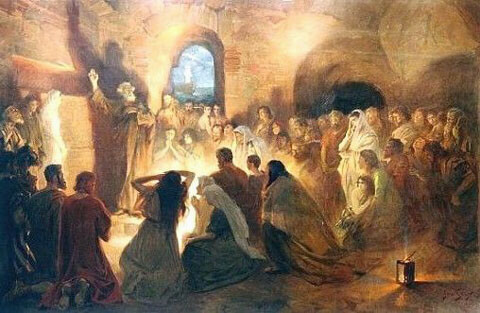
Peter preaching
  1. Because It is Not Popular (v. 18)
    Not only is it not popular, it is moronic (moria in Gk.). Consider the fact that the gospel of Jesus Christ demands that we say to sinners that a poor and humble Jewish man was God, and that he was nailed to a cross to die a criminals death despite his perfect innocence. We proclaim that this man is not only a man, but that he is God in the flesh. That he is perfect and sinless and that he was born of a virgin.

Furthermore, we proclaim that all of humanity is lost and that each individual man, woman, and child is a wretched sinner.
We proclaim that Christ is the only hope for humanity and that all other claims are lies from the pit of hell and all who seek salvation in any other name are doomed to eternal damnation.


We proclaim that Jesus Christ has done all that is necessary for our salvation, and that he rejects all attempts to earn salvation on our own. He, being the King, demands our allegiance and one day every knee shall bow and every tongue shall confess that He is Lord.

Brothers, when we proclaim this the world will overwhelmingly reject us as fools of the worst kind. We will be called bigots, intolerant, and uneducated religious zealots. And that is why so many bow to the pressures and soften their message. Paul was keenly aware of the propensity of men to soften the blow of the gospel by using soothing words that made the hearer feel at ease.
He said in 1Corinthians 2:1-5 that he purposely made it his aim to proclaim the unvarnished gospel of Jesus Christ crucified. Today, preachers everywhere are trying to make Jesus look cool. They are trying to make Christianity attractive. They are doing just what Paul avoided.

Brothers, the cross was not cool. It was brutal and bloody.

The call of Christ is not popular. True Christianity will never court the world. But pastors will continue to attempt to make our precious faith more palatable in order to gain the popularity of the world. This is nothing but pride. Nobody should enter the ministry or the pulpit in order to make his own name great.

Isaac Watts wrote, “When I survey the wondrous cross on which the Prince of glory died; My riches gain I count but loss, and pour contempt on all my pride.”
PREACH CHRIST BECAUSE IT IS NOT POPULAR!

2. Because They Are Perishing (v. 18)
When we preach the message of the cross, the world sees it as folly because they do not see the danger to their souls. Sometimes they fail to see the danger because they do not see it in our eyes and do not hear it in our voices as we proclaim cold truth from our pulpits.
Brothers, do you feel the truth of Hell?
Do you remember the days when you were among the brood of vipers?
Do you recall that you were once a vessel prepared for destruction?
Have you forgotten that you were on the precipice of the bottomless pit and you were ready in due time to slip into eternal fire separate from God to be tormented for all eternity?
HAVE YOU FORGOTTEN?

When we remember our former state we will be quick to point people to the only remedy for their souls—the cross of Christ. When we remember that they are perishing, we will not care about their mocking and their cries for ear-tickling sermons—we will give them what we know they need.

Wrote Thomas Brooks, “The damned shall live as long in hell as God himself shall live in heaven.” That fact alone should drive us to preach Christ crucified. Check your hearts brothers. Do you feel the terror of hell and do you cry out with Paul on Sunday mornings: “For we (!) are the aroma of Christ to God among those who are being saved and among those who are perishing, to one a fragrance from death to death, to the other a fragrance from life to life. Who is sufficient for these things?”(2Cor. 2:15-16)

PREACH CHRIST BECAUSE THEY ARE PERISHING!

3. Because It is the Power of God (v. 18)
Power in the pulpit. Power evangelism. Power encounters. Pastors want power.
But the power of God is not found in the usual places.
It is not found in business models or worldly philosophy (1Cor 1:22).
It is not found in dramatic, emotionalism (1Cor 1:22).
It isn’t found in phony encounters and confrontations with demons and the occult.

The power of God was displayed on the cross, where God sent His Son to be crushed for our iniquities. Jesus became sin on our behalf, so that we might become the righteousness of God! That is power!

Concerning the justification of God, John Calvin said, “Wherever the knowledge of it is taken away, the glory of Christ is extinguished, religion abolished, the Church destroyed, and the hope of salvation utterly overthrown.” This is the power of the cross.

Why is the Church so weak and utterly incapable of making an impact in our nation? Because many so-called Christian churches have left this message behind and taken up the banners of politics, pop psychology, health and wealth, and so many other empty promises.

The Roman Catholic system, the Emerging movement, the Seeker Sensitive movement and the Liberal mainline denominations have all shown us what becomes of those who lay aside the cross of Christ. But it hasn’t stopped many men from flirting with those compromising philosophies.


Puritan pastor Richard Baxter has written, “If a hardened heart is to be broken, it is not stroking but striking that must do it.” The only thing that can cut another stone is a diamond, the hardest gem on earth. In order to cut the hardest heart, we must use the sharpest tool.

In Hebrews 4:12 we are reminded, “For the word of God is living and active, sharper than any two-edged sword, piercing to the division of soul and of spirit, of joints and of marrow, and discerning the thoughts and intentions of the heart.”

Brothers, even in our fundamental Bible churches the temptation can be overwhelming to give up expository preaching in favor of sugar coated sermons that aim to please the itching ears of people. We reason in our hearts that once we have them in our churches we can preach the gospel to them, we just need to ease them into it. Don’t fall for this pragmatic lie!

You are merely a tool in God’s hand. He uses you as His minister to wield His weapon of choice. You cannot change the soul of a man in any way without the intervention of the Word, the Spirit and Christ. It is the Word of God preached—the Gospel alone that brings a sinner to his knees.

PREACH CHRIST BECAUSE THE MESSAGE OF THE CROSS IS YOUR ONLY POWER!

Preaching for a Verdict

An important concept that cannot be ignored in sermon preparation is the fact that the sermon needs to have a purpose–a reason for existing. A meandering monologue that seems to wander to and fro can be muddy, disorganized, frustrating, and unprofitable to the listener.

Each of the biblical writers had a reason for why they wrote their biblical texts, so too the biblical expositor needs to have a purpose as well. He must enter into his sermon preparation with a clear understanding of what he is expecting his hearer to do when he has finished explaining, illustrating, and applying the biblical text.

Whether it is to glorify God, come to repentance, understand a theological concept more clearly, obey a command, or some other purpose, the sermon needs to have a clear purpose.

Can you imagine what it was like for the Israelites to wander in the wilderness for forty years? If you’ve ever sat in a sermon with no point, then you may have felt like an Israelite for 45 minutes, and it probably felt like you were suffering for over an hour!

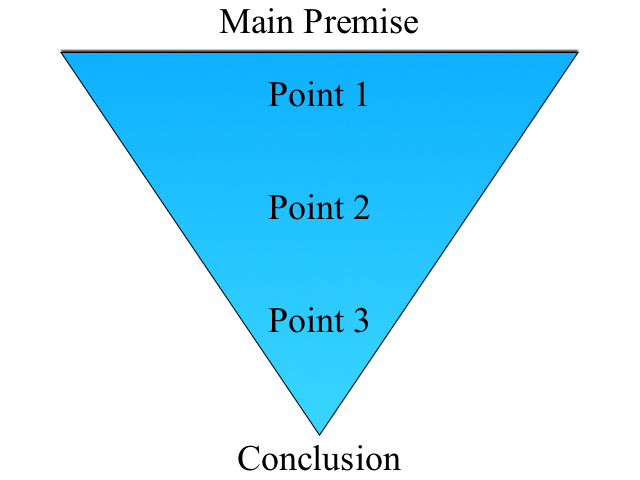
One way to help yourself not be “that guy” is to think about your sermon as an apologetic argument. You are seeking to prove to your listener your main premise. Not every sermon will benefit from this idea, but there are some sermon texts that will be particularly suited for this concept. I have made a graphic to help explain the idea:

If you think about your sermon like an inverted funnel, with the premise to be proven in your introduction, each successive point will develop and build up to the conclusion. The conclusion should leave your hearer with the strong evidence that your premise is true. You want them to understand that they should either accept your biblical premise or they must deny the clear teaching of Scripture.

A simple example of this type of sermon outline is:

  • Premise: Jesus Christ is the Son of God
  • Point/Proof 1: His virgin birth prophesied
  • Point/Proof 2: His sinless life practiced
  • Point/Proof 3: His resurrection proven
  • Conclusion: Therefore, you must believe on the Lord Jesus Christ

In this form of sermon organization, the conclusion is what you are seeking as your verdict. You state it, prove it, and then call your hearer to act. And this action may be simply a change of thinking as much as it could be a change of behavior.

This does not mean that your hearer will necessarily respond as you expect–heart change is the work of the Holy Spirit. But by organizing your message in this way you will make your expectations clear and prove your premise. Hopefully your making it irrefutable from Scripture.

The sinful heart may still reject the truth, but you will have accomplished your goal as an expositor to deliver the message faithfully and compellingly.

The Use and Abuse of Quotes in Your Sermon

Illustrations have been described as windows that add light into the sermon in order to illuminate abstract truths. If that is true, and I believe it is, then quotes are a good tool to have in your sermon arsenal. Except when they aren’t. Quotes can be used effectively, and they can be abused in the worst way. I want to point out the proper and improper uses of quotes in a sermon.

Good Uses of Quotes

Here are 6 reasons to use a good quote would be appropriate:

  1. Artistry: The writer says something more beautifully than you can say it yourself.
  2. Clarity: The writer makes the point clearer than you can.
  3. Impact: The writer says something in a powerful way to make your point.
  4. Pithiness: The writer says something in a memorable and “catchy” way.
  5. Depth: The writer says something with a profundity that you can’t seem to say yourself.
  6. Interesting: The writer says something that draws interest or excites the imagination.

Poor Uses of Quotes

Here are 8 reason you ought to think twice before using that quote in your next sermon:

  1. Quotes that are too good not to share, even though they have nothing to do with the main idea of your sermon. Just because you like it, don’t squeeze it in.
  2. Quotes that are not short and to the point. Two page quotes from a Puritan in old English aren’t helpful unless you are trying to help someone fall asleep.
  3. Quotes that are only an interest to a very specific audience. Just because you love reading Wallace’s Greek Grammar doesn’t mean you should quote from it.
  4. Quotes that you have to explain after you read it. It’s like a joke–if you have to explain it, it’s not funny.
  5. Quotes that can be stated in your own words easily.
  6. Quotes that are meant to carry a sense of authority, i.e., “The great theologian so-and-so says…” The Scripture should be our authority. Quotes of men may bring clarity, but they should not bear the weight of authority to prove our point.
  7. Quotes that you cannot verify or find the source. If we proclaim the truth, we shouldn’t be using quotes that may be false.
  8. Quotes that are shocking and controversial. This isn’t because they don’t work, but because they do. This type of quote might just derail your sermon if your audience does not recover from the shocking quote bomb you let loose.