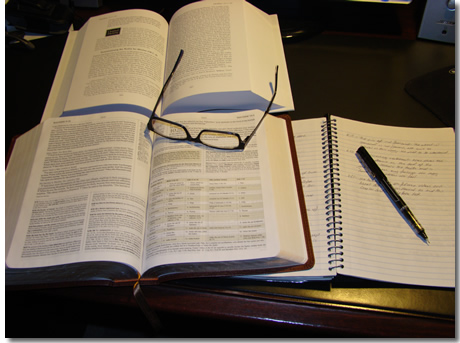
 Expository preaching is both an art and a science. But we must beware of the danger of making our sermons either too light or too dense in regards to our content. Those expositors that are more cerebral can easily slide into a lecture mentality that sees the pulpit as a lecture and each Sunday as an opportunity to dump all of their exegetical research upon their unwary members. Those who have been given the “gift of gab” can think that simply because they can fill the allotted teaching time with witty speech, good stories and lots of application are being faithful to preach when they are most often simply pandering to the baser desires of their listeners.
A helpful way to know how to organize a well-balanced sermon is to follow the rule of the Four P’s–Point, Proof, Picture and Practice. Every sermon point should include all of the “P’s” as a general rule. There are some exceptions, but as a general rule, these should be followed for most sermons.
- Point-Whether you have 2, 3, 4, or more, you need to have main points which point to your thesis statement (sometimes called a propositional statement). If you just read a passage, talk about it a little bit, throw in some illustrations and application randomly as they come to mind, this is not biblical exposition. The mind of the listener needs clarity to aid its understanding and organization helps with this. Stay your point, and then…
- Proof-Prove your point. If you state that your sermon thesis is “Three Unimpeachable Evidences that Jesus is the Son of God,” then one of your points may be–“Jesus forgave sins.” Your proof will be the exegetical proof taken from the given text for this sermon. This might include cross-references to strengthen the doctrinal truth or it might include word studies or contextual information to make clear the meaning of the passage. Whatever you include, this part of the sermon should only include information that adds clarity and argues the idea of the main point. In other words, your long study of the Greek post-positive de should be left in your study, unless it is necessary to understand this main point.
- Picture-Simply put, this is an illustration. Your illustration should direct your hearers to think about the main idea of your point in a concrete way. It might continue an example from Scripture or history, or it might be a more contemporary picture of what this main idea looks like today.
- Practice-This is application. Application follows illustration logically because we cannot apply what we do not fully understand, and illustrations help with clarifying the ideas we have presented. The application seeks to help the hearer put into practice what the biblical text says they should feel, believe or do.
Every one of these P’s should be present for each main point of a sermon to continue to help the sermon move along with clarity, timelines and purpose. All put together, they explain the text, illustrate the main concepts and show the hearer how they should be applied.


 There have been times in my ministry when an icy chill has come over my heart, when my soul no longer weeps, when my sermons no longer connect, and when the act of preaching becomes a drudgery. I know that I have then lost compassion for people. That is when I retreat to a small taco stand in the barrio of East Los Angeles, to a place where real people live. I order a cup of coffee and sit with my back against the wall. Then I watch, I observe, I read, and I listen intently for the heart cry.
 Always Reforming