Why You Should Boldly Preach Christ Crucified

For the word of the cross is foolishness to those who are perishing, but to us who are being saved it is the power of God.

(1 Corinthians 1:18, NASB95)
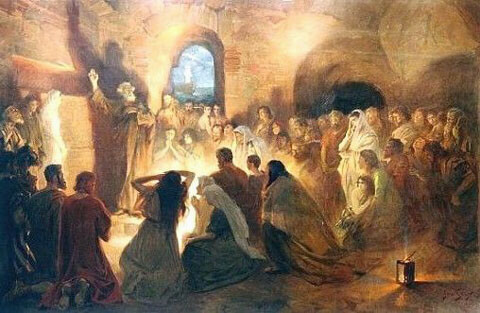
Peter preaching
  1. Because It is Not Popular (v. 18)
    Not only is it not popular, it is moronic (moria in Gk.). Consider the fact that the gospel of Jesus Christ demands that we say to sinners that a poor and humble Jewish man was God, and that he was nailed to a cross to die a criminals death despite his perfect innocence. We proclaim that this man is not only a man, but that he is God in the flesh. That he is perfect and sinless and that he was born of a virgin.

Furthermore, we proclaim that all of humanity is lost and that each individual man, woman, and child is a wretched sinner.
We proclaim that Christ is the only hope for humanity and that all other claims are lies from the pit of hell and all who seek salvation in any other name are doomed to eternal damnation.


We proclaim that Jesus Christ has done all that is necessary for our salvation, and that he rejects all attempts to earn salvation on our own. He, being the King, demands our allegiance and one day every knee shall bow and every tongue shall confess that He is Lord.

Brothers, when we proclaim this the world will overwhelmingly reject us as fools of the worst kind. We will be called bigots, intolerant, and uneducated religious zealots. And that is why so many bow to the pressures and soften their message. Paul was keenly aware of the propensity of men to soften the blow of the gospel by using soothing words that made the hearer feel at ease.
He said in 1Corinthians 2:1-5 that he purposely made it his aim to proclaim the unvarnished gospel of Jesus Christ crucified. Today, preachers everywhere are trying to make Jesus look cool. They are trying to make Christianity attractive. They are doing just what Paul avoided.

Brothers, the cross was not cool. It was brutal and bloody.

The call of Christ is not popular. True Christianity will never court the world. But pastors will continue to attempt to make our precious faith more palatable in order to gain the popularity of the world. This is nothing but pride. Nobody should enter the ministry or the pulpit in order to make his own name great.

Isaac Watts wrote, “When I survey the wondrous cross on which the Prince of glory died; My riches gain I count but loss, and pour contempt on all my pride.”
PREACH CHRIST BECAUSE IT IS NOT POPULAR!

2. Because They Are Perishing (v. 18)
When we preach the message of the cross, the world sees it as folly because they do not see the danger to their souls. Sometimes they fail to see the danger because they do not see it in our eyes and do not hear it in our voices as we proclaim cold truth from our pulpits.
Brothers, do you feel the truth of Hell?
Do you remember the days when you were among the brood of vipers?
Do you recall that you were once a vessel prepared for destruction?
Have you forgotten that you were on the precipice of the bottomless pit and you were ready in due time to slip into eternal fire separate from God to be tormented for all eternity?
HAVE YOU FORGOTTEN?

When we remember our former state we will be quick to point people to the only remedy for their souls—the cross of Christ. When we remember that they are perishing, we will not care about their mocking and their cries for ear-tickling sermons—we will give them what we know they need.

Wrote Thomas Brooks, “The damned shall live as long in hell as God himself shall live in heaven.” That fact alone should drive us to preach Christ crucified. Check your hearts brothers. Do you feel the terror of hell and do you cry out with Paul on Sunday mornings: “For we (!) are the aroma of Christ to God among those who are being saved and among those who are perishing, to one a fragrance from death to death, to the other a fragrance from life to life. Who is sufficient for these things?”(2Cor. 2:15-16)

PREACH CHRIST BECAUSE THEY ARE PERISHING!

3. Because It is the Power of God (v. 18)
Power in the pulpit. Power evangelism. Power encounters. Pastors want power.
But the power of God is not found in the usual places.
It is not found in business models or worldly philosophy (1Cor 1:22).
It is not found in dramatic, emotionalism (1Cor 1:22).
It isn’t found in phony encounters and confrontations with demons and the occult.

The power of God was displayed on the cross, where God sent His Son to be crushed for our iniquities. Jesus became sin on our behalf, so that we might become the righteousness of God! That is power!

Concerning the justification of God, John Calvin said, “Wherever the knowledge of it is taken away, the glory of Christ is extinguished, religion abolished, the Church destroyed, and the hope of salvation utterly overthrown.” This is the power of the cross.

Why is the Church so weak and utterly incapable of making an impact in our nation? Because many so-called Christian churches have left this message behind and taken up the banners of politics, pop psychology, health and wealth, and so many other empty promises.

The Roman Catholic system, the Emerging movement, the Seeker Sensitive movement and the Liberal mainline denominations have all shown us what becomes of those who lay aside the cross of Christ. But it hasn’t stopped many men from flirting with those compromising philosophies.


Puritan pastor Richard Baxter has written, “If a hardened heart is to be broken, it is not stroking but striking that must do it.” The only thing that can cut another stone is a diamond, the hardest gem on earth. In order to cut the hardest heart, we must use the sharpest tool.

In Hebrews 4:12 we are reminded, “For the word of God is living and active, sharper than any two-edged sword, piercing to the division of soul and of spirit, of joints and of marrow, and discerning the thoughts and intentions of the heart.”

Brothers, even in our fundamental Bible churches the temptation can be overwhelming to give up expository preaching in favor of sugar coated sermons that aim to please the itching ears of people. We reason in our hearts that once we have them in our churches we can preach the gospel to them, we just need to ease them into it. Don’t fall for this pragmatic lie!

You are merely a tool in God’s hand. He uses you as His minister to wield His weapon of choice. You cannot change the soul of a man in any way without the intervention of the Word, the Spirit and Christ. It is the Word of God preached—the Gospel alone that brings a sinner to his knees.

PREACH CHRIST BECAUSE THE MESSAGE OF THE CROSS IS YOUR ONLY POWER!

Three Lessons From One Whose Sin Was Found Out (Weekend repost)

Since I’m not planning on writing blogposts for weekends, I thought that I’d repost the most popular blogposts from this past week in case you missed it.

Three Lessons from One Whose Sin was Found Out. Read it here.

The easiest way to get notifications of a new post is to make sure you subscribe. It’s free and easy. Just click the subscribe button to the right and fill in the info.

Pastor-Brothers, Be Strong and Very Courageous

“Moses My servant is dead; now therefore arise, cross this Jordan, you and all this people, to the land which I am giving to them, to the sons of Israel.

(Joshua 1:2, NASB95)

Along with the headlines of a fallen Evangelical leader, Christian social media has also been alerted to the situation in Alberta, Canada, where Pastor James Coates has been arrested for refusing to submit to the unjust laws of the land. These laws require him to limit his church services to 15% capacity and stop serving our God with his responsibility to lead Christ’s Church. Currently Pastor Coates is in custody and will not be given bail unless he agrees not to hold services. The church was ordered to close in January and Pastor Coates was arrested and charged in early February. You can read the story from a Canadian news source here: (Global News), and see the official statement of Pastor Coates’ church here: (GraceLife Church). The aim of this post is not so much about Pastor Coates, but about the growing need for pastors to take up the courageous charge to lead in the face of growing adversity.

The times are changing. For Joshua, a new era began the moment Moses took his last breath (Joshua 1). To Joshua and the Israelites, the days must have looked very dark. But the Lord gave him and Israel courage as they looked to the future. What can we learn from God’s words to Joshua?

  1. Although we may lose key people and leaders, we will never lose God’s presence. Therefore, we take courage because God is always with us.
  2. We cling to the promise of our inheritance of a heavenly city, believing that God does not lie. Should we die in service to our God, we will be in the presence of the Lord.
  3. Just as no enemy could stand before Joshua and Israel, so too Jesus has told us that the gates of hell shall not prevail against his church.
  4. We are commanded to be strong and courageous, trusting in our God. The child of God seeks to obey even in the face of fear of the enemy and the unknown.
  5. As we follow Christ and move forward in faith and courage, the same message of walking by faith is communicated to our people and they too, gain courage in seeing our faithful obedience.

Whether it is governmental restrictions, personal attacks from the enemy, disgruntled members, destructive wolves or some other form of attack, be strong and courageous. Our God is with us.

One day, all of these challenges and threats will be a distant memory as we are gathered together worshipping the Lord God in his presence. Remember this future as you face these light, momentary afflictions. Jesus is coming soon!

Three Ways to Minister as A Married Couple

Luther was a confirmed bachelor until he was 41. He resisted marriage, and only chose to marry after he had preached on the need for the young ministers of the reformation to get married, against the unbiblical practices of Romanism (how romantic!).

On June 13, 1525 Luther married Katharina Von Bora, a former nun who had fled the convent with a group of nuns who had been convinced of the truth of the reformation. Katie was 26.

Luther was already very famous and a wanted man outside of Saxony. It was an overwhelming thing for Katie to be instantly known as Luther’s wife, but she took up the task with vigor.

A biography of Luther describes the woman behind the great Dr. Luther: “Katharina immediately took on the task of administering and managing the vast holdings of the monastery, breeding and selling cattle, and running a brewery in order to provide for their family and the steady stream of students who boarded with them and visitors seeking audiences with her husband. In times of widespread illness, Katharina operated a hospital on site, ministering to the sick alongside other nurses. Luther called her the “boss of Zulsdorf,” after the name of the farm they owned, and the “morning star of Wittenberg” for her habit of rising at 4 a.m. to take care of her various responsibilities….In addition to her busy life tending to the lands and grounds of the monastery, Katharina bore six children: Hans, Elizabeth, Magdalena, Martin, Paul, and Margarete. The Luthers also raised four orphan children, including Katharina’s nephew, Fabian.”

What is the saying? Behind every great man… It is also true of Martin Luther. Martin and Katie were so close, their hearts so knit together that Luther called Katie “my rib.”

In the New Testament we also find a couple who serve alongside one another. They pop up in six places in the New Testament, and always together. Their names were Aquila and Priscilla.

Acts 18:2 tells us that Aquila was a Jewish native of Pontus, which is in Asia Minor. They lived and worked in Rome until 49 AD when Claudius expelled the Jews from Rome, which sent them to the city of Corinth. It was in Corinth that they met the Apostle Paul on his second missionary journey. We don’t know for sure, but it might be that Paul led this couple to salvation.

From this amazing couple, I’ve chosen Three Lessons We Can Learn Regarding Ministry Together in Christ.

1. Ministry Together Means Ministering Where You Are (Acts 18:1-3)

Here is the first occasion that the New Testament gives of this ministry couple, and we find out a little about them—they shared the same trade as the Apostle Paul, they were tentmakers or leather workers.

Acts 18:3 says that the Apostle stayed with this couple and he worked with them. Paul worked by day in the trade of tanning hides and sewing together awnings and tents, possibly in the shop that Aquila and Priscilla owned.

At the end of a long work day they would retire to their home, which Paul shared with them while he was in Corinth. On the Sabbath, verse 4 tells us that Paul would move into the synagogue and would reason (lit. dialogue) with those gathered there, mainly Jews and some Gentile God-fearers who had converted to Judaism. Paul also ministered in the agora, the marketplace where all the merchants gathered.

What I want you to see is the way that Aquila and Priscilla were so key to this situation, right where they were. Their whole life, both work and home-life was sanctified for the sake of the gospel. Not only did their business help support Paul and his ministry, it must have been a place of wonderful theological training and edification!

Can you imagine the conversations around the dinner table? Aquila and Priscilla took advantage of the circumstance they were in and used it for the glory of God; using their lives together as a place of ministry help and fellowship for Paul as well as edification and spiritual growth for themselves.

Luther used his dinner table as a mighty tool in the church. It rivaled his pulpit in influence as he gathered theological students around his table to hash out the implications of the gospel. He called them “table talks.” A table and a meal became a place for the mighty Spirit to move.

What could your home and workplace become for Christ? You don’t need to change jobs, or go into full time ministry to be used mightily for God. You and your spouse can look at where you are right now and ask God to take your circumstance and use it mightily for him.

2. Ministry Together Means You Need to Be Both a Student and a Teacher (Acts 18:4, 24-26)

Because we are told that Aquila was a Jew, it is highly possible that so was his wife. They would have gone with Paul to the synagogue every Sabbath and listened to the debates that Paul brought to the people.

Over time, this couple became very well equipped in the gospel and doctrine. They knew their stuff! Their time with Paul was not spent in chit-chat and trivialities. They were focused on learning as much as they could about the Christ.

Acts 18:18-21 teaches us that Paul and Aquila and Priscilla went on to Ephesus together where they had to part ways.

Then in verses 24-26 Aquila and Priscilla met up with a man named Apollos who was a powerful preacher, but his theology was lacking in some areas that are pretty important. Verse 26 says that when this couple heard him, they took him aside and taught him “more accurately.”

If you think about it, every teacher was at one time a student. And that is where everyone needs to begin—sitting under the authority of the Word of God and walking in obedience to what it says. Priscilla and Aquila sat patiently under Paul, soaking up what he offered to them. They saw the need to be students first.

I once had someone in our church who said that they didn’t feel like they were being spiritually fed at our church. But here was the problem—our church has three preaching services a week (Sunday morning and evening, and Wednesday night) along with Sunday school classes, Bible studies, discipleship groups, and other ministries, all of which were available to this person. But he didn’t take advantage of any of them except for Sunday mornings, and at this service his attendance was sporadic. I told him, “We’re serving up the Word, you’re just not coming to supper.”

What about you? Are you a student of the Word? Husband, are you stopping your wife from getting fed under the guise of wanting “family time?” You’ll regret it. And wife, are you dragging your feet about your husband being at church so much? You’ll regret it.

And beyond your own spiritual benefit, the church will be poorer for it. Because you cannot give what you do not have. You can’t teach what you don’t know. You can’t lead where you have not first gone yourself.

Sometimes church members complain about the ministries of the church, but they don’t see their own part in it all. How can the Lord use you in your immaturity?

And those who are laboring need you! The church needs godly couples who love Christ and His Word. We need more people like Aquila and Priscilla who can come alongside the Apollos’ of the church and teach them more accurately.

Are you a student of the Word? Could the leaders of our church ask you to come alongside them to help teach and lead this church?

3. Ministry Together Means Working with a Kingdom Focus (Rom 16:3-4)

At some point Priscilla and Aquila moved back to Rome and became an active part of the church there. According to Romans 16:5, they used their home as a meeting place for the church.

Paul called them sunergos, fellow-workers. These two were more than a couple, they were team workers. They didn’t see their part in the church as building up their own little kingdom. They were part of something much bigger.

That meant that their view of this life was much more than living to make a buck. Even though we were told that they were tentmakers back in Acts 18, it is never mentioned again. I’m sure they kept practicing their trade, but they weren’t defined by that fact. Their life wasn’t about being the pre-eminent tent-makers of Rome. They were part of the mission of the Church, and that was where they focused their love and energy.

This is shown in what Paul says about them in verse 4. He tells that whole church something that we wonder how many knew before he wrote it—that Aquila and Priscilla risked their necks in order to save Paul’s life. We don’t know how they did this or any of the circumstances, but it is there, locked into Scripture for all eternity. Priscilla and Aquila were bold enough to be willing to die for the sake of the gospel, and they knew that Paul was a key player in God’s plan. They were so sold out that they would rather have died than to see Paul die. It didn’t happen, but they were ready to take a bullet, so to speak. That’s how focused they were.

They didn’t let pettiness, selfishness, career, ambition, or anything else derail them from the mission. They didn’t care who got the credit, they were working for the same goal—to see Christ magnified through the proclamation of the gospel to the whole world.

In her book, One with a Shepherd, Mary Somerville describes the attitude that God calls us to. Writing from the perspective of ministry together, she writes: “My marriage is unique in that I am one with God through Jesus Christ and that makes me uniquely one with Bob [her husband]. We have a complete oneness that those outside of Christ cannot experience. We have one Savior and Lord, one name, one new family, one goal, one Word to guide us, and one focus of our lives—to glorify God. We have the Holy Spirit living within both of us to empower us to love each other sacrificially and to help us work through all hinderances to our oneness. With Christ in our lives there is hope for any difficulty we face. By his grace we can forgive as we have been forgiven. The Spirit knits us together and gives us a new heart that desires to serve Christ and give sacrificially to one another in love.”

And even though Mary Somerville is writing as a pastor’s wife, there is nothing that she wrote that isn’t true of all Christian couples serving God in all capacities from the perspective of either husband or wife.

If God calls you to any ministry, he calls you together. You may not serve together (i.e., elder, teacher, nursery, etc.) but you’re marriage brings you together to mutually support and care for one another in every ministry.

Ministry together means:

1. Ministering Where You Are

2. You Need to Be Both a Student and a Teacher

3. Working with a Kingdom Focus

What are some steps you can take to make these things happen?

1. Begin developing a family culture around the Word of God. Not just reading but discussing the Word. Husbands with wives. Moms with children. Dads do this with the family. Grandparents with children and grandchildren. Use that dinner table for the glory of God. Discuss the sermon on Sunday. Make your meal a theological feast, even if its around peanut butter and jelly sandwiches!

2. Tolle lege! Take up and read! We all need to be better students of the Word. That is primary. But after you have feasted on the Word, you cannot stop. Pick up good theological books. I know that many people think that they don’t have the time, but I will let John Piper convince you that you really do:

Now, I know what you are thinking: I don’t have the time or the ability to get anywhere in books like that. So I want to show you something really encouraging. When this was shown to me about four years ago by my pastor, it changed my life. Most of us don’t aspire very high in our reading because we don’t feel like there is any hope.

But listen to this: Suppose you read about 250 words a minute and that you resolve to devote just 15 minutes a day to serious theological reading to deepen your grasp of biblical truth. In one year (365 days) you would read for 5,475 minutes. Multiply that times 250 words per minute and you get 1,368,750 words per year. Now most books have between 300 and 400 words per page. So if we take 350 words per page and divide that into 1,368,750 words per year, we get 3,910 pages per year. This means that at 250 words a minute, 15 minutes a day, you could read about 20 average sized books a year!

3. Come alongside those already serving, including your spouse. Support them in regular prayer. Provide them resources that will help them and give them plenty of encouragement. In this way, you will have a part of their ministry.

May the Lord take all of us and make us into more Aquila’s and Priscilla’s. O how the church could use more like them. Focused not on our own agenda, but on the greatest mission this world has ever known, making our great God known to every corner of the earth!

The Growing Need for Bible Institutes

Back at the beginning of the 20th century, a massive change was taking place in the evangelical church in America. Denominations had become overrun by the ideas of Higher Criticism which was nothing short of an attack on the authority and inerrancy of the Bible. But the changes in the churches and denominations were only the symptoms of something much worse. The average person in the pew heard sermons from these compromised churches that denied the fundamentals of the Christian faith—so much so that J. Gresham Machen called Liberalism “another religion.”

These sermons were coming from the men that were trained at denominational seminaries where the professors had embraced the lies of liberal theology in many forms. Although begun as biblical schools, liberalism had kept in and taken over. From Europe to America, the eventual result was that the unwary Christian found himself shocked to hear the assault on the Bible coming from their pastors. But many Christians were ill-equipped to respond.

The historic Christian church did respond though. New churches were planted. Fellowships were formed to work together. Missions agencies were begun. And seminaries were started to train men for the ministry, and Bible institutes were raised up to equip the layman. The Moody Bible Institute, Philadelphia School of the Bible, Bible Institute of Los Angeles, and others sprang up to meet the needs of the church.

With our nation currently undergoing a dramatic change, the church has not been untouched. For decades many discerning believers have been sounding the alarm that what was once “evangelical” has changed. Although it is still known by that name, it no longer teaches the same things. The church in America as a whole has slid far from its foundations, and with it so have the churches, missions agencies, seminaries and Bible institutes. The reality is that liberalism never builds anything because it is parasitic. It only takes over its healthy host and then devours it from the inside.

The time has come for rebuilding once again. We must continue planting churches, form fellowships and partnerships, rebuild or replace missions agencies, and begin training our pastors and laymen in Bible colleges and seminaries that are faithful to the truth.

Not all is lost. There are still many who have not bent the knee to Baal. But with the way things appear to be headed, larger Bible colleges, Christian universities, and seminaries will have a hard time staying open with greater pressure put upon them from our government. We need to remember the power of the Bible institute.

Bible institutes are a powerful blessing to the local church. They can train local church leaders to better serve the church. They can be a source of training an army of Sunday school teachers, Bible study leaders, missionaries, evangelists, counselors, and more. They have low overhead and don’t often offer degrees, so tuition is affordable enough for almost everyone.

I’d encourage you to look up your local Bible institute and support it through sending students, praying for them, teaching if you are trained, and supporting them with your gifts.

If you attended a Bible Institute, what was your experience? Would you recommend them and how did it bless you and the Church?