Fundamentalism, Modernism, and the Dangerous Middle (part 1)

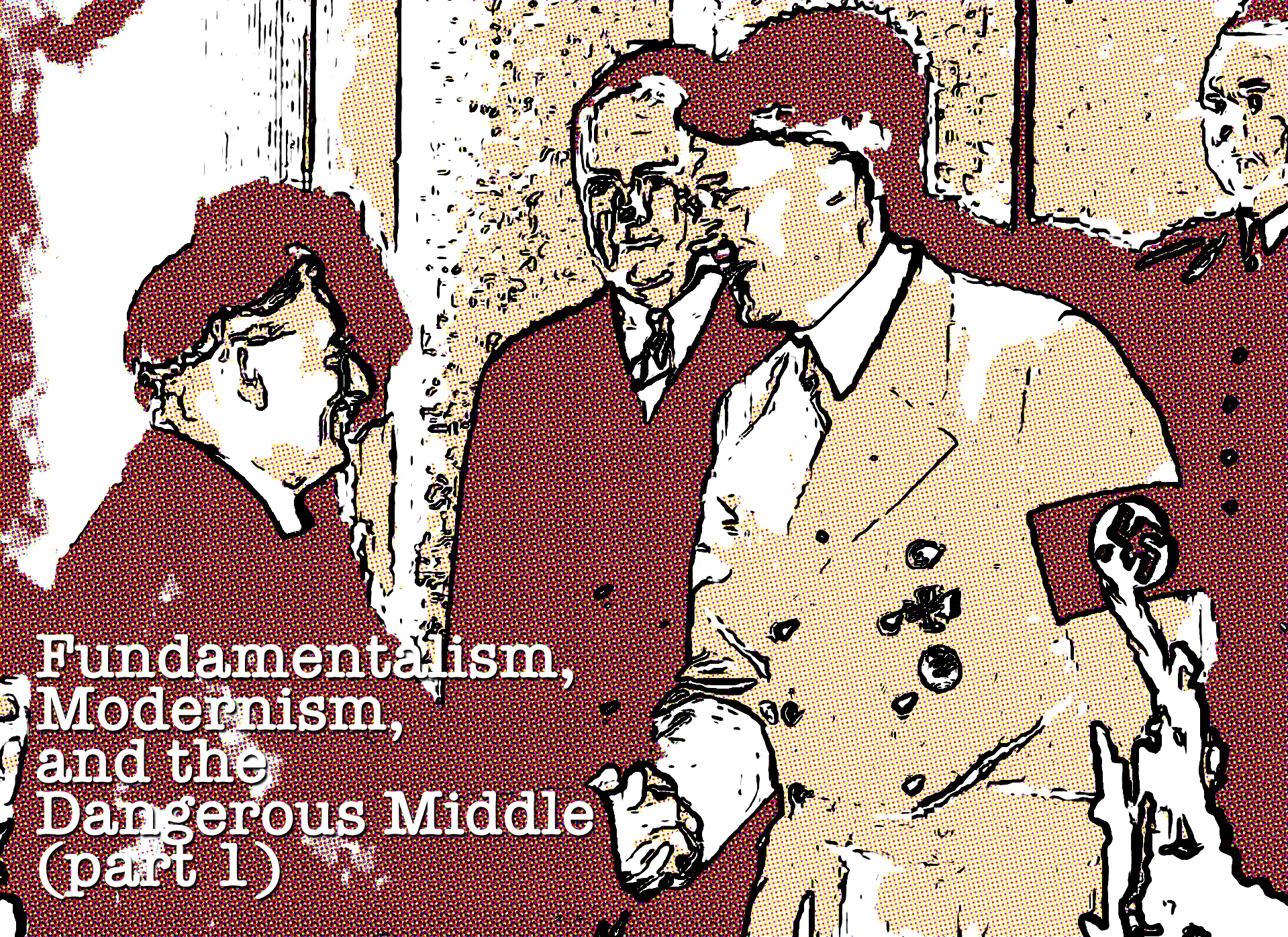
In the 2017 World War II movie, The Darkest Hour, Winston Churchill cries out in frustration, “You cannot reason with a tiger when your head is in its mouth!” Although these words are more than likely an artistic embellishment for cinema, they do fairly sum up Churchill’s frustration with the policies of Neville Chamberlain that sought to appease Adolph Hitler by ignoring his aggressions in Europe. Chamberlain truly believed that by signing the Munich Agreement and giving the Sudetenland to Germany along with Hitler’s promise not to continue invading other nations, that Europe would be saved. Chamberlain famously came home and declared that they he had achieved “peace for our time.” Chamberlain thought Hitler was a misunderstood man, when he was in fact the blood-thirsty tiger that would never be satisfied. Churchill understood this and knew that war was the only way to stop him.

The notion of appeasement is not only shared among politicians. Unfortunately, in a world that requires vigilance and sometimes engagement in theological battles, there are those who would seek appeasement and compromise for the sake of “peace in our time.” But as I hope to demonstrate with some examples from recent history, appeasement, and compromise in the face of theological liberalism are always the easier route, but they never achieve the promise they claim.

Setting the Stage: The Fundamentalist and Modernist Controversy

To be clear, we need to understand that prior to the mid-19th century, “evangelical” was synonymous with “fundamentalism.” All Christians who identified with the evangel, the gospel message of Christ, were “evangelicals.” Fundamentalism was a movement that derived its name from those evangelical Christians that sought unity across denominational lines but were committed to certain “fundamental” doctrines that have been accepted by historic Christianity. The number of these fundamentals varied at times, but they almost always included:

  1. The inerrancy of Scripture
  2. The virgin birth of Christ
  3. The substitutionary vicarious atonement of Christ
  4. The bodily resurrection of Christ
  5. The reality of miracles
  6. The imminent and physical return of Christ

Fundamentalists stated that a person had to minimally ascribe to these core doctrines to be within the historic Christian Church because a denial of these doctrines often leads to a wholesale denial of the faith. Modernists (theological liberals), on the other hand, wanted to focus not on the content of belief, but rather the feeling or spirit of Christianity. By denying the need to subscribe to core doctrines of the faith, they could cover the fact that they denied many or all of them, while still insisting they were a part of the Christian church and represented Christianity.

Fundamentalism rejected this minimalistic and emotion drive religion as inadequate at best, and heretical at worst. Several courageous defenders rose up in obedience to Scripture’s call to purify the church:

  • 2 John 9–11 (ESV): “Everyone who goes on ahead and does not abide in the teaching of Christ, does not have God. Whoever abides in the teaching has both the Father and the Son. If anyone comes to you and does not bring this teaching, do not receive him into your house or give him any greeting, for whoever greets him takes part in his wicked works.”
  • Galatians 1:8–9 (ESV): “But even if we or an angel from heaven should preach to you a gospel contrary to the one we preached to you, let him be accursed. As we have said before, so now I say again: If anyone is preaching to you a gospel contrary to the one you received, let him be accursed.”
  • 1 Timothy 6:20–21 (ESV): “O Timothy, guard the deposit entrusted to you. Avoid the irreverent babble and contradictions of what is falsely called “knowledge,” for by professing it some have swerved from the faith. Grace be with you.”

By the middle of the 19th century, theological liberalism has already entered almost all mainline denominations. This was possible because liberal theologians subscribed to the biblical creeds of their denominations and institutions while at the same time teaching non-evangelical theology. Following German liberal Friedrich Schleiermacher (1768-1834), modernists asserted that Christianity was not primarily about doctrine, but rather a “feeling, intuition and experience.”[1] As such, Schleiermacher set the stage for the setting aside of doctrine in favor of a Christianity that affirmed a faith based upon feelings and experiences.

Along with the growth of liberal Christianity came a desire to put aside doctrinal differences among different denominations to bring unity around an ecumenical spirit. This led to the establishment of the World Council of Churches in 1948, made up of “churches which accept our Lord Jesus Christ as God and Savior.”[2] That brief doctrinal statement was all that was required of those joining the WCC, and none were required to expand on what they meant by those words.

Often portrayed as ignorant, uneducated, backwards, anti-science, and anti-progressive by liberals, and “fighting fundamentalists,” uncharitable, ungracious, and divisive, by evangelicals, the fundamentalists stood their ground and called the church to put out of its churches, missions agencies, educational institutions, and para-church organizations all those that were unfaithful to Christ and His Word. But not everyone within evangelicalism agreed with them, thinking there was a better way—a middle way.

My next post will highlight two examples of this attempt to navigate a middle way.


[1] Iain H. Murray, Evangelicalism Divided: A Record of Crucial Change in the Years 1950 to 2000 (Carlisle, PA: Banner of Truth Trust, 2000), 5.

[2] Murray, 3

The Long Term Benefits of Planting Acorns Today

As I talk to pastors and missionaries in many contexts, there is a topic that seems to be a repeated refrain that I hear often. It has to do with the shortage of men to take the place of retiring pastors, teachers, missionaries, and ministry leadership roles. It has been clear for many years that there is a growing need for Christian leaders serving in ministry. Today, the swelling need for leaders has grown into a tsunami of massive proportions.

So, whose responsibility is to to provide these new leaders? Does the responsibility lay upon the denominational leaders, seminaries, Bible colleges, and missions agencies? Although there are many who believe this, the biblical answer is a resounding “No.” Leaders for the church may be trained and equipped for the church and mission field within these parachurch organizations, but the duty of identification, discipleship, mentoring, and at least initial training is the responsibility of the local church itself.

The fact that the local church is supposed to be identifying, discipline, mentoring, and training up the next generations of leaders and in many places have failed to do so is the reason that we are in a leadership crisis in the church today. My purpose isn’t to pass the buck, but to put the responsibility firmly where it belongs.

In Acts 13:2-3, Luke records, “While they were worshiping the Lord and fasting, the Holy Spirit said, “Set apart for me Barnabas and Saul for the work to which I have called them.” Then after fasting and praying they laid their hands on them and sent them off.” The sending of these first two missionaries was done through the local church in Antioch and not through a missions agency. Agencies have their place in aiding the church, but it is the Spirit that calls apart missionaries, and it is the church that sends them.

In Ephesians 4:11-12, we see that the Spirit has given pastors and teachers, among others, to the church for the edification and training of the church. “And he gave the apostles, the prophets, the evangelists, the shepherds and teachers, to equip the saints for the work of ministry, for building up the body of Christ…”

This work of preparation by these gifted leaders was done in house, and would have led to the identification of young leaders that would be mentored within the church. An important example of this would be Paul’s identification of Timothy and the church’s agreement in Timothy’s calling: “Do not neglect the gift you have, which was given you by prophecy when the council of elders laid their hands on you” (1 Timothy 4:14).

And when Timothy is instructed about his own duties as a pastor in the church, he was strongly reminded by Paul, “and what you have heard from me in the presence of many witnesses entrust to faithful men, who will be able to teach others also” (2 Timothy 2:2).

There can be no denying that the New Testament clearly teaches that leaders within the church are to be produced by the local church. So, why isn’t this happening? There are probably many reasons that would be given by some pastors who fail to do this—no time, feeling of inadequacy, fear of being replaced by their disciples, fear of discouraging disciples from ministry, and not knowing where to start. But none of these are valid in disobeying the clear admonition of Scripture.

Where do we go from here? That brings me to the title of this post, “The Long Term Benefit of Planting Acorns Today.” The mighty oak tree is moderate in the speed at which it grows, growing about 12-18 inches per year (30-46 cm) to a height of about 60 feet tall (18.28 meters). Compare this to pine, which can grow to 2 feet (61 cm) in a year.

Sometimes we fail to plan for the distant future, only looking up from our labors as our time of departure draws near. And what happens when we have not discipled men whom we can entrust the gospel, who will be able to teach others also? We will find that we have endangered our local church because the resource it so desperately needs in a leader cannot be easily found. Focused labor is admirable, but discipline leaders for the future is to be a part of our labors.

Growing accords into mighty oaks takes time. The future of many local churches has been jeopardized by short-sited pastors who figured they would simply call the local seminary and order a shiny new pastor to take their place when they retire. But many of these pipelines are empty or the hands-off approach of local churches have produced a generation of young pastors who have little or no loyalty to the local church. What do we do?

The answer from Scripture is the same. We plant the acorns. We may not live to see them fully develop, but we must plant the seeds from which the future church will benefit. If we do not, we will not only be unfaithful to the Scriptures in fulfilling our duty, but we will leave the church poorer than when it was handed to us.

The Pastor and His Schedule

No matter where you serve the Lord, whether in a city or rural setting, it is easy to become overwhelmed with the many responsibilities that are required of a minister. For 12 of my 17 years as the pastor of a small church in an urban inner-city area of Los Angeles, I juggled two sets of responsibilites—leading our church in many of the main teaching responsibilities, which consisted of preaching for about 45 minutes three times a week from three different books of the Bible, along with men’s discipleship, and counseling. There were, of course, many other responsibilities which we could sprinkle in along with those, but those took up major chunks of my time.

Additionally, I taught pastoral ministry courses at a nearby seminary twice a week during the regular semesters. Because of Los Angeles traffic and the distance to the seminary, I would spend about 4 hours each day on congested freeways as I travelled to and from the school. That meant that on the days that I taught, I would spend most of my days either commuting to and from the seminary as well as teaching. When I returned I would most often drive straight to my office at church and pick up my duties there.

These two worlds, church pastor and seminary professor, required that I have a very good grasp of time management and discipline or else I knew that all those involved—my wife and children, my church, and my students—would suffer and I would not be able to faithfully discharge my duties.

Because of this, I understand the time constraints that are placed upon any servant of God as they seek to make the best use of their time to bring glory to God. To help those that might be working at doing this very thing, I’d like to share with you how I did this, even thought it was imperfect, in hopes that you might benefit from the lessons I learned.

I remember reading several years ago in a book by the famous productiviy guru Stephen Covey, the illustration of the big rocks and little rocks. It helped me to see the importance of prioritizing the big responsibilities in my life and ministries, and was a help in looking at the big picture.

In this illustration, Covey says he invited a seminar attendee to the front of the room to a table with a glass jar and several bowls with rocks, pea gravel, sand, and a glass of water. He asked the woman if she thought she could fit everything on the table into the jar. She said she’d try and made a few attempts, trying to put the sand and gravel in first. By doing this she found that the larger rocks wouldn’t fit. After a few more attempts she said that she didn’t think it was possible. Covey thanked her and then proceeded to take an empty jar and added in each element one at a time. He started with the larger rocks, then added the pea gravel, shaking the jar to settle in the gravel as much as possible. Then he added the sand. At each step he asked the women who had failed if she thought the jar was full. At first she said it was, then as she caught on, she answered that somehow she knew more would fit in. After the gravel and the sand, Covey once again shook the jar so the sand filled in all the spaces between the large rocks and the gravel. Finally, Covey added the water, which filled the microscopic spaces between the grains of sand, assuring his audience that the jar was now truly full.

Covey used this illustration to show that unless the large rocks, which represent the important things in our lives, are put into place first, we will never accomplish what matters most. And when what matters most is our families and our ministry to the Lord, we want to make sure that these things are placed in the most important place of priority in our life and limited time. The other stuff, the small stuff, can be added afterwards if we so desire.

So, for me, I set up a general day by day schedule that looked like this:

Mondays—Family Day. This was time that unless absolutely necessary due to a real emergency, I did not work or neglect the family. These focused days were filled with great joy and helped me to relax and spend time with my wife and children. I understood that if I lost my family, I lost my ministry.

Tuesdays—Seminary teaching in the day, church administration and counseling appointments in afternoons and the evenings.

Wednesday-Study and sermon preparation for Wednesday night, and teaching in the evenings.

Thursday– Seminary teaching in the day, study and sermon preparation for Sunday mornings.

Friday-Continue study and sermon prep for Sunday morning if not finished, study and sermon prep for Sunday evenings.

Saturday-Men’s Bible study and/or evangelism; finish sermon prep for Sunday nights if not done.

Sunday-Worship in the morning and evening, monthly leadership training and board meetings in between services.

This was my regular “big picture” schedule for most of my 17 years as pastor of my church. When the seminary had a break, then usually my involvement at church increased and I was able to divert my attention to other necessary needs at church.

And although I can’t say that I never struggled with being exhausted at times, or having too much on my plate, my schedule helped me to fit the big things into my days, and then the smaller “pebbles, and sand,” like phone calls, visitation to homes and hospitals, and pop-in-visits, fit in without losing sight of the important responsibilities that needed to happen.

Most people within your church will never have any idea how many hours and how much time you put into serving them—and that’s as it should be. We are servants after all. But the Lord knows, and we will all have to give an account for how we spent our time as ministers of the gospel. So, if you are a pastor of a church, take that seriously. The pastorate is no place for lazy men.

Preaching to Be Forgotten and For God to Be Glorified (weekend repost)

What did Paul mean when he wrote of his “weakness…in fear and much trembling?” Clearly, Paul was connecting his preaching to these things (“…my speech and my message…”). I think that Paul’s words here are a much-needed correction to the celebrity culture within the Western church today.

The Apostle to the Gentiles stood before this church in Corinth as a weak man. He did not have the polish and trappings that the false teachers of Corinth had, and to many, this was a severe disadvantage. Although they might not say it this way, there are many who would imply strongly that the message is secondary to the method. If you don’t have a media empire pushing your message, then the world won’t listen and you’ll be ineffective. I wonder how Paul would have responded to that sort of thinking. Well, we don’t have to wonder because his Spirit-inspired words are given to us.

Read the full post here: Preaching to Be Forgotten and For God to Be Glorified

Preaching to Be Forgotten and For God to Be Glorified

“And I was with you in weakness and in fear and much trembling, and my speech and my message were not in plausible words of wisdom, but in demonstration of the Spirit and of power, so that your faith might not rest in the wisdom of men but in the power of God.” 1 Corinthians 2:3–5 (ESV)

What did Paul mean when he wrote of his “weakness…in fear and much trembling?” Clearly, Paul was connecting his preaching to these things (“…my speech and my message…”). I think that Paul’s words here are a much-needed correction to the celebrity culture within the Western church today.

The Apostle to the Gentiles stood before this church in Corinth as a weak man. He did not have the polish and trappings that the false teachers of Corinth had, and to many, this was a severe disadvantage. Although they might not say it this way, there are many who would imply strongly that the message is secondary to the method. If you don’t have a media empire pushing your message, then the world won’t listen and you’ll be ineffective. I wonder how Paul would have responded to that sort of thinking. Well, we don’t have to wonder because his Spirit-inspired words are given to us.

In his commentary on these verses, Alan Johnson clarifies what Paul is saying: “…[Paul’s] proclamation (wider than only preaching) of the “mystery” of God, namely, Jesus Christ as the crucified One, was in keeping with the sole focus on the cross because Paul consistently, deliberately presented himself not self-confidently but in self-effacement, not in strength as a “successful” person but in weakness and fear, with much trembling (v. 3).”  (Alan F. Johnson, 1 Corinthians, vol. 7, The IVP New Testament Commentary Series (Westmont, IL: IVP Academic, 2004), 62.)

Paul isn’t working to build his brand. He isn’t seeking to launch a well-strategized media plan that incorporates all the latest channels for all the up-and-coming evangelical elites. He isn’t buddying up to those more popular false teachers in order to share the limelight while justifying this as focusing on the majors and overlooking areas of disagreement in the name of “grace.” Nope. Paul is not about Paul. He unashamedly points to himself as a weak and fearful man. His words were perceived by the Corinthians as implausible and foolish–because that was what the unvarnished gospel sounds like to unregenerate ears. Paul didn’t seek to “fix” it.

And since Paul wasn’t trying to boost his own brand, he didn’t care what others thought about him so long as they saw Jesus. Paul was weak–he didn’t feign weakness to seem more spiritual. He was scared–but God was his strength. He wasn’t practiced and polished in his delivery, intentionally–so that people wouldn’t walk away impressed with this servant’s speech, but so they would walk away worshipping his God.

Paul focused on the cross in his life, message, and methods. In our glitzy evangelical world of super conferences, social media blitzes, and multi-books deals, we are all too often a faint shadow of this servant of God. May we join with George Whitefield in saying, “Let my name die everywhere, let even my friends forget me, if by that means the cause of the blessed Jesus may be promoted.”