Although we Protestants say that we don’t venerate the saints, you wouldn’t know it the way some pastors fawn over Luther, Calvin, Knox, Spurgeon, and other reformers. Don’t get me wrong, I think those men were used mightily of God, in spite of their flaws and personal sin.
But what I wonder about is how it is that so many pastors who would look up to these men and admire them for their courage and boldness are so cowardly in their own churches when they are called upon by the testimony of the Word of God to stand firm against a potential revolt by those who do not want biblical change.
“The problem with preachers today is that nobody wants to kill them anymore!”
Steven J. Lawson
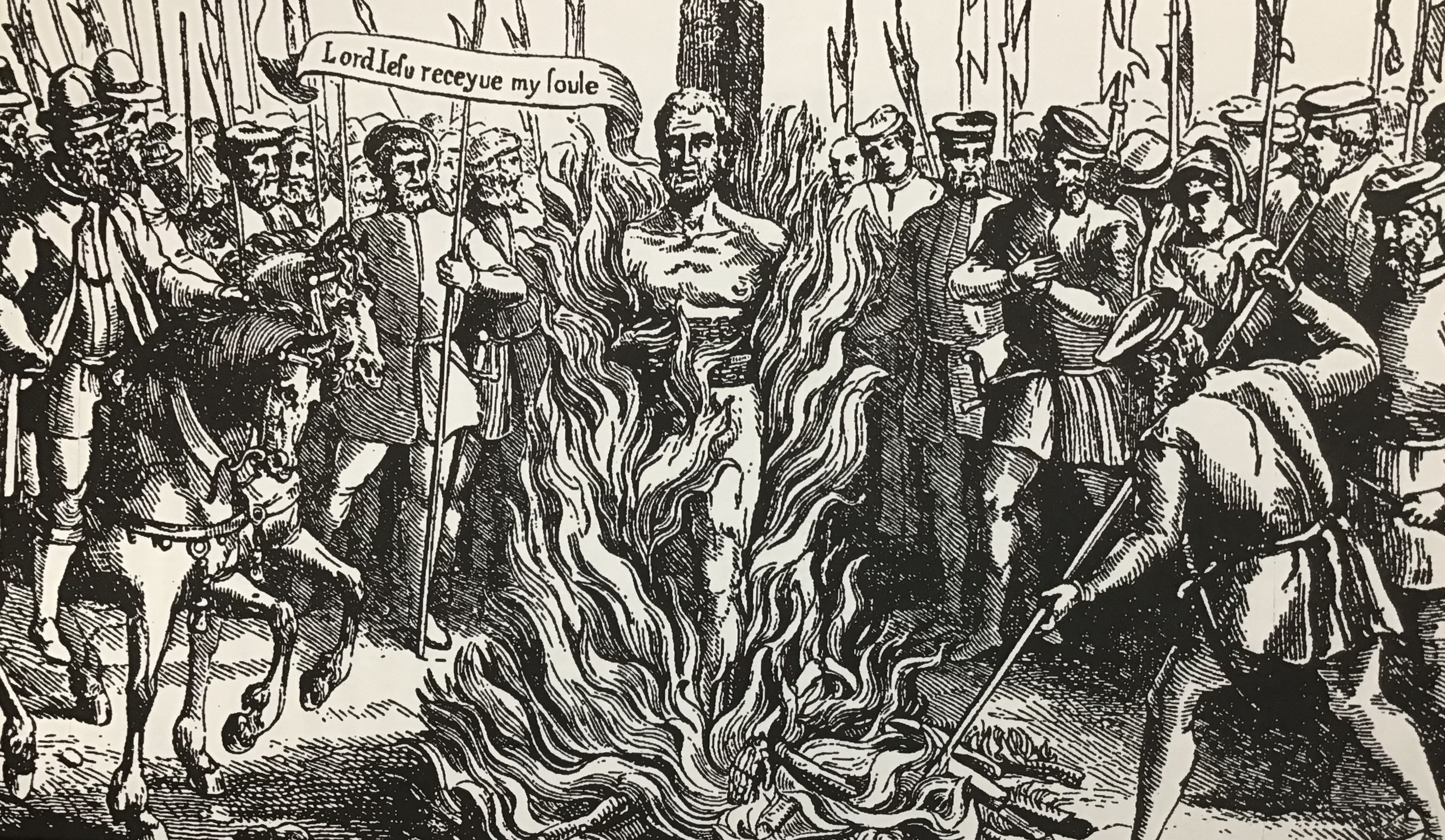
Bishop Hooper burned at the stake for the gospel.
Although we Protestants say that we don’t venerate the saints, you wouldn’t know it the way some pastors fawn over Luther, Calvin, Knox, Spurgeon, and other reformers. Don’t get me wrong, I think those men were used mightily of God, in spite of their flaws and personal sin.
But what I wonder about is how it is that so many pastors who would look up to these men and admire them for their courage and boldness are so cowardly in their own churches when they are called upon by the testimony of the Word of God to stand firm against a potential revolt by those who do not want biblical change.
When Gideon was called to pull down the idols in his town, he may have been overcome by the fear of man, but at least he did it, even if under the cover of night. And when they found out what he did, they wanted to kill him.
When Josiah came to understand how far Judah had fallen away from obedience to the Law, he immediately began to purge Judah and Jerusalem of its idolatrous high places and reinstated the reform that was necessary to please the Lord. This led to a need to rebuild and reorder the temple so that proper worship could be restored.
And the church today is in need of men who are ready and willing to make the changes that are needed in their local churches where unbiblical practices have found a nesting place for ages. For fear of confrontation, loss of income, or prominent families, or a simple fear of losing your job, pastors remain silent in the face of unrepentant sin and all manner of false practices. Unregenerate men are allowed to remain on elder and deacon boards, unhealthy and unbiblical curriculum and programs continue to function so as to avoid a conflict with a women’s ministry head or the parents of the youth. The call for entertainment in church continues to ring louder as the Word of God is given less time to work in the hearts that need it.
Yes, we admire Luther’s stand at the Diet of Worms where he refused to recant. We applaud Spurgeon for being unwilling to give in to the New Measures that sought to entertain the goats. We are in awe of Whitefield who preached the gospel wherever he could garner an audience. We rejoice at the courage of John Rogers and the other Marian martyrs who refused to stop preaching under Bloody Mary of Tudor, and were burned at the stake for it. But will we stand today? Where is our courage? Where is our godly resolve to trust God in the face of angry adversity within and outside of the church? Brothers! Be strong and very courageous!
Although there isn’t a substitute for actually conducting a funeral yourself, it is possible to be better prepared to have those conversations that will make for a better memorial and graveside service. Like many things in pastoral ministry, after struggling to figure out how to do something as a new pastor, I figured out a way that worked for me and then standardized a format that made my “system” repeatable.
After being contacted by a church member or someone who has lost a loved one, it is best to set a day and time as soon as possible to meet together to talk about planning their service(s). Because most people have been to a funeral, we can assume that they might have some idea about how they would want the service of their loved one to be ordered. That assumption is almost 99% incorrect. Most people have no idea how a service should be ordered, what elements they might want to include, who they want to speak, or even how long they want the service to be.
We obviously think about the need for comfort as a part of ministering to those who are mourning, but part of bringing comfort is helping the loved ones walk through a very confusing and difficult time by leading and guiding them through a very scary and unfamiliar process.
I developed my Funeral Service Planner as a way of walking through the typical services that people desire for a funeral, including a viewing/wake, memorial service, and graveside service. I not only ask about the particular elements that the family might want, but I also mark the order of each element in the service as well as which family members will be involved. The lines to the right are for names of those involved, including the pastor, if desired. The short lines to the left of service elements are to place a number for the order of the element when it will occur in the service.
Viewings or wakes are normally connected to Roman Catholicism, but sometimes they are conducted by a family of different faiths. If no priest will be present, then a Protestant pastor might be looked at as one who should do something. If this is the case, you might want to choose some passages of Scripture to read and pray. The rest of the time can be left for family to mourn together and if the casket is open, for them to say their goodbyes.
The last element, “full burial” follows the graveside service. Some families opt to wait until the casket is lowered and the vault (a concrete protective box) is placed over the casket, and then the whole thing is covered by dirt. In many funeral services, this is done for an extra fee and must be pre-arranged. If this occurs, it extends the time at the cemetery, and can be somewhat traumatic for the family to watch because it involves heavy machinery pounding down the ground to compact the soil. It would be best to know this so the family will be aware of the extra cost and what happens.
My form looks like this:
Funeral Service Planner
Decedent’s Full Name:__________________________________ Age:______ Saved? ____
Viewing/ Wake? Date, Time and Location: ______________________________________
___Family and Friends Memories (Prepared or open? _________ How many?____ )
___Prayer ___Gospel Message
Closing Prayer
Other elements?
Special music? _________________________
Other minister co-officiating? __________________________
Graveside Service? Date, Time and Location: ____________________________________
Scripture Reading (Jn 11:25; Ps 103)
Words of Interment Prayer
Other elements? ____________________________________
Full burial?
Contact info: Pastor Richard Bargas Office: (XXX) XXX-XXXX Email: XXXXXX@gmail.com
When I fill out the above form, I make sure to include as many details as possible. Some things, like particular family involvement, will sometimes be confirmed at a later date. After I have sat and walked through this process with the family, I will usually either photocopy or email a copy of the completed form to the family so they can know the order of the services and who is doing what. This is especially helpful the next day when they have a hard time remembering the meeting details because of their grief.
Normally, people are so overwhelmed with stress and the emotion of the day that they will need to be guided through each service element during the funeral, but it is good and comforting for them to know that you are in charge and know what is happening. I have included at the bottom of my form my church office number and my email in case they needed to get ahold of me, since I sometimes conducted funerals for friends of friends.
One last thing. There is a place in my form for a gospel message in the service. For me, this is a non-negotiable element. I won’t do a funeral if I’m not allowed to freely share the gospel, and I normally only take about 15 minutes to do so. I once had a person say they didn’t want me preaching at their guests. I replied that as a minister of the gospel I don’t know of any other hope to give to people than the hope of salvation in Christ. If they didn’t want this hope presented, then they didn’t want me to conduct the service. I spoke with a gentle but firm resolve. The widow took a second to think about what I said and then agreed that she did want this and asked me to do the service. She even thanked me after the service for the great comfort the Word of God brought. Fellow pastors, don’t fail to point the grieving to Christ, our only hope!
Below you can download a PDF copy of my form. Be aware that the contact info at the bottom of the form is no longer valid for me, so please don’t try to contact me at the phone number or email address.
It’s not hard for me to think about multiple examples of personal failure over my 51 years of life. I can recall so many bad decisions–dumb ones, sinful ones, immature ones, naive ones, rash ones, prideful ones. Like I said, I remember too many. The problem is, leaders have to make multiple decisions all day, every day. The more decisions we need to make, the greater potential there is to make another bonehead decision. So what do we do? Well, you could:
Give up being a leader. And if you really are poor at decision making because you constantly make the kinds of bad choices I named before, that might not be a bad decision. But don’t rush into it! Keep reading.
Give up making decisions, but remain a leader. This type of leader is known as a “lame duck.” You have actually done #1 above, but continue to call yourself a leader. This never works for long, and is frustrating for the people you are supposed to lead. It’s better for you to step down than to play this game.
Start making better decisions.Duh. But before you stop reading, consider this: All leaders make bad decisions. All of them. The best leaders make fewer poor decisions and there are reasons for that, which are beyond the scope of this article. But the fact is, by growing and improving on your decision making, you will become a better leader.
In Joshua 7, Joshua made some poor decisions as he took Israel from a victory over Jericho, to an embarrassing defeat when his army was defeated by a tiny army. His failure not only cost the lives of thirty-six of his men (Josh 7:5), but it put courage into the heart of his enemies while simultaneously putting fear into the heart of Israel.
Several years ago my wife and I got food poisoning from eating at a fast-food place. It was pretty traumatic for us, and we were sick for days. I knew it was the food–I could taste it and smell it. It was so engrained into my memory that now, over 20 years later I can still go back to that moment when we started to become violently ill. I had no desire to eat at that restaurant again for many, many years. Bad decisions are like that–they leave a really bad taste in your mouth that makes it hard to overcome.
After the Lord directed Joshua on how to make everything right, it was time for Joshua to face his fear. Joshua 8:1 helps us so much here for learning how to overcome the fear of a poor decision so that we can make better decisions. It says,
“And the Lord said to Joshua, “Do not fear and do not be dismayed. Take all the fighting men with you, and arise, go up to Ai. See, I have given into your hand the king of Ai, and his people, his city, and his land.”
(Joshua 8:1, ESV)
Fear of the future and the unknown as well as discouragement from past failings can be the biggest hurdle to clear after a major failure. But notice here that the Lord commanded Joshua not to fear or be dismayed. Yes, poor decisions were made. But the mission has not changed. Joshua was to lead the people into the Promised Land, and Ai needed to be conquered. The problem was that Joshua had rushed in, he didn’t consult the Lord and made the decisions to go to war and send in a smaller army without seeing if this was the Lord’s will. The Bible doesn’t tell us, but maybe Joshua was beating himself up over the bad decisions made. Any leader knows that’s not a stretch to imagine. It happens all the time.
But the Lord says to Joshua, Do not fear and do not be dismayed. Once we are assured that we are being guided by the Word and Spirit, we must move forward without fear of the future or discouragement from the past. Joshua wasn’t running ahead of God anymore. Now he was going to decide that he needed to obey, and this was the first command. Warren Wiersbe has wisely written, “The promises of God make the difference between faith and presumption” ( Warren W. Wiersbe, Be Strong, “Be” Commentary Series (Wheaton, IL: Victor Books, 1996), 97.)
Notice also, that the Lord gave Joshua direction: “Take all the fighting men with you, and arise, go up to Ai.” So often, poor decisions are made because we make the decision. Spiritual leadership is not the same as corporate leadership because the spiritual leader directs God’s people from God’s Word to do God’s business. When we forget this, we become spiritual entrepreneurs, not spiritual leaders. They may look the same, but they aren’t. Spiritual entrepreneurs work for themselves, to achieve their own goals, and often receive the glory for it from men who do not recognize the difference. Joshua had taken the reigns and failed, now he was going to learn to take his lead from the Lord.
Finally, the Lord gave Joshua his strength: “See, I have given into your hand the king of Ai, and his people, his city, and his land.” After the amazing victory over Jericho, you would think that it was obvious that God was going to give Israel the strength to fight. But the loss at Ai shows how quickly a victory can blind us to our dependence. All too quickly we can begin to strut like roosters, full of pride as if we did anything to achieve the victory. In order for Joshua to grow as a leader, he needed to remember that every victory was given by the Lord–big or small.
Joshua obeyed the Lord, carrying out the directives he was given with precision, and the Lord gave him the victory as he promised. Remember that. The answer isn’t give up when you fail, but learn from your failures and grow as a leader. Psalm 37:23-24 is a great encouragement in this way: “The steps of a man are established by the Lord, when he delights in his way; though he fall, he shall not be cast headlong, for the Lord upholds his hand.” (Psalm 37:23–24, ESV)
A few nights ago I awoke with the aches and pains of a sickness I have been fighting for a few days. Unable to sleep, I started to reflect upon all the friends and loved ones that are struggling with pain and suffering to a much greater degree. I thought about those who are facing a crumbling marriage, the loss of a spouse, the onset of a disease that will take their life. I lay in the dark and considered the deep comfort that we have in Christ.
The Christian life is not an easy one, and may even be fraught with greater struggles because of our commitment to follow Christ whatever the cost. But there is no accounting for the presence of Christ in the midst of these struggles.
Dear brothers and sisters in Christ, the world is watching. Please do not show them a perfect, polished life free of any pain or sorrow. Such a life does not exist in this broken world. Show them that you too are cracked and flawed, just as they are. Show them that you too struggle with weaknesses and doubts. And then show them that our God sent his Son for us, to bring us safely to his promised land. He gives his Spirit so that as we sit in pain and doubt we will know his supernatural presence and find comfort.
As you listen to the song below, remember that we must sometimes fight for faith to know the joy of the Lord—and in the end, Jesus will be victorious. Like Job, we may not always understand, but we trust.



 Always Reforming