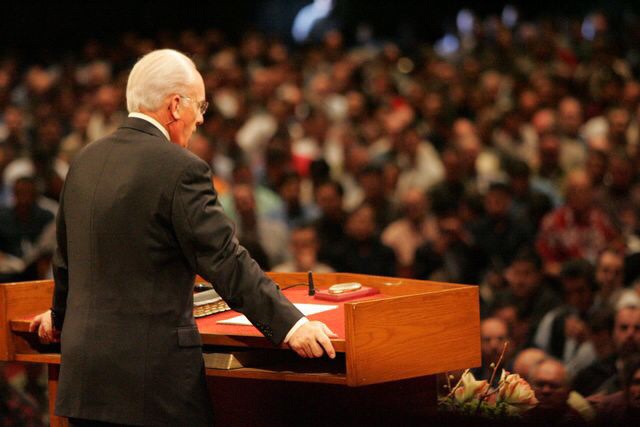
Preach for the Common Man!

20140804-112114-40874973.jpg

There are times when I encounter a young expositor (or wannabe) who feels that his knowledge (or at least his ability to parrot someone else’s knowledge) must be on display in his sermons; so he speaks in such a way that the man in the pew cannot understand him, and he feels all the more spiritually superior than most for his erudition.

I am a simple preacher. I can wax eloquent too. But why? To prove that I have degrees hanging on my walls? As I think of all the godly men that I respect, both currently and in history, those men used simple language, but spent time in deep study and deeper prayer. They sought to preach for the benefit and edification of the people, not to lift themselves up.

Apparently, Richard Baxter, a most eminent Puritan, would agree with me. More importantly, I think I am in the company of my Savior, who taught with clarity and power to the common man.

“All our teaching must be as plain and simple as possible. This doth best suit a teacher’s ends. He that would be understood must speak to the capacity of his hearers. Truth loves the light, and is most beautiful when most naked. It is the sign of an envious enemy to hide the truth; and it is the work of a hypocrite to do this under pretense of revealing it; and therefore painted obscure sermons (like painted glass in windows which keeps out the light) are too oft the marks of painted hypocrites. If you would not teach men, what do you in the pulpit? If you would, why do you not speak so as to be understood? I know the height of the matter may make a man not understood, when he hath studied to make it as plain as he can; but that a man should purposely cloud the matter in strange words, and hide his mind from the people, whom he pretendeth to instruct, is the way to make fools admire his profound learning, and wise men his folly, pride, and hypocrisy. Some men conceal their sentiments, under the pretense of necessity, because of men’s prejudices, and the unpreparedness of common understandings to receive the truth. But truth overcomes prejudice by the mere light of evidence, and there is no better way to make a good cause prevail, than to make it as plain, and as generally and thoroughly known as we can; it is this light that will dispose an unprepared mind. It is, at best, a sign that a man hath not well digested the matter himself, if he is not able to deliver it plainly to others.”

—Richard Baxter, The Reformed Pastor

The Ministry Is No Place for Lazy Men


“The ministerial work must be carried on diligently and laboriously, as being of such unspeakable consequence to ourselves and others. We are seeking to uphold the world, to save it from the curse of God, to perfect the creation, to attain the ends of Christ’s death, to save ourselves and others from damnation, to overcome the devil, and demolish his kingdom, to set up the kingdom of Christ, and to attain and help others to the kingdom of glory. And are these works to be done with a careless mind, or a lazy hand? O see, then, that this work be done with all your might! Study hard, for the well is deep, and our brains are shallow; and, as Cassiodorus says: ‘Here the common level of knowledge is not to be the limit; here a true ambition is demonstrated; the more a deep knowledge is sought after, the greater the honor in attaining it.’ But especially be laborious in the practice and exercise of your knowledge. Let Paul’s words ring continually in your ears, ‘Necessity is laid upon me; yea, woe is unto me, if I preach not the gospel! ”

—Richard Baxter, The Reformed Pastor


What Are a Your Motives For Studying Theology?

20140731-104342-38622684.jpg

“Some desire to know merely for the sake of knowing, and that is shameful curiosity. Some desire to know that they may sell their knowledge, and that too is shameful. Some desire to know for reputation’s sake, and that is shameful vanity. But there are some who desire to know that they may edify others, and that is praiseworthy; and there are some who desire to know that they themselves may be edified, and that is wise.”

—Richard Baxter, The Reformed Pastor

Salvation By Works Gives No Hope

20140730-070159-25319356.jpg

“And next I think it will be admitted by all, that the way of salvation by good works would be self-evidently unsuitable to a considerable number. I will take a case. I am sent for in an emergency, and it is the dead of night. A man is dying, smitten suddenly by the death-blast. I go to his bedside, as requested. Consciousness remains, but he is evidently in mortal agony. He has lived an ungodly life—and he is about to die. I am asked by his wife and friends to speak to him a word that may bless him. Shall I tell him that he can only be saved by good works? Where is the time for works? Where is the possibility of them? While I am speaking, his life is struggling to escape him! He looks at me in the agony of his soul, and he stammers out, ‘What must I do to be saved?’ Shall I read to him the Moral Law? Shall I expound to him the Ten Commandments and tell him that he must keep all these? He would shake his head and say, ‘I have broken them all; I am condemned by them all!’ If salvation is of works, what more have I to say? I am of no use here. What can I say? The man is utterly lost! There is no remedy for him. How can I tell him the cruel dogma of ‘modern thought’ that his own personal character is everything? How can I tell him that there is no value in belief, no help for the soul in looking to Another—even to Jesus, the Substitute? There is no whisper of hope for a dying man in the hard and stony doctrine of salvation by works!”

—CH Spurgeon

Help For New Expositors: Applying the Bible to Your Hearers

Preaching

In some circles, there is a question whether the preacher needs to apply the Word of God or whether that is strictly the domain of the Holy Spirit. I don’t think there needs to be an either/or question about application. When John the Baptist preached about repentance, those who heard him asked what exactly they were to do to prove they had truly repented (Lk 3:10-14). John gladly gave specifics for each  group of people present. The fact remains that you are to bring the Word of God to bear upon the hearts and lives of your hearers. This is assumed in the preaching act.

  1. Find the universal principle(s) given in the biblical text. Some passages have clear applications while others you will need to find the timeless, universal principle that can be applied to your hearers.
  2. Meditate on how you will respond to the text.
    • Does this text impact your life?
    • What will you now do, believe, be thankful for or repent of?
    • If you can’t answer, neither will your listener know what to do, either.
  3. Think about your listeners.
    • Who are they? (What are their careers, education, marital status, children, etc.?)
    • What are they going through right now? (joys, trials, spiritual life)
    • How will this text impact them when they hear it?
    • Will it help them? How?
  4. Be pointed and specific.
    • Don’t fall into the trap of just telling people to “pray more” or “read your Bible more” or “have more faith.” Tell them how.
    • Be specific enough that they have a few ideas about how they can apply the text—this is helpful for the newer believer.
    • Be generic enough that the more mature believers can see other application in their own life outside of your suggestions.
    • Use “You” in your application. Don’t shy away from being the messenger of God. He is speaking to them through his Word.
  5. Point people to the Cross and the Holy Spirit
    • You don’t want to err into moralism, where your sermon application simply tells the listener to “be better” or “do more.” Unbelievers and believers alike need to know that the imperatives can only be accomplished because of Christ’s atoning work on the cross through the power of the Holy Spirit.
    • Preach the need for Christ to unbelievers who are unable to obey without salvation. If you do not, at best you will frustrate your hearers; at worst you will lull them into a self-righteousness that only condemns.
    • Preach the necessary power of the Holy Spirit for the believer to change.
    • Preach the Gospel! As Spurgeon said, “Make a bee-line to the cross.”


Find help for other sermon preparation skills here:

Sermon Preparation Checklist

Help With Introductions

Help With Illustrations