
This is My Father’s World

20140805-101221-36741684.jpg

This is my Father’s world, and to my listening ears
All nature sings, and round me rings the music of the spheres.
This is my Father’s world: I rest me in the thought
Of rocks and trees, of skies and seas;
His hand the wonders wrought.

This is my Father’s world, the birds their carols raise,
The morning light, the lily white, declare their Maker’s praise.
This is my Father’s world: He shines in all that’s fair;
In the rustling grass I hear Him pass;
He speaks to me everywhere.

This is my Father’s world. O let me ne’er forget
That though the wrong seems oft so strong, God is the ruler yet.
This is my Father’s world: the battle is not done:
Jesus Who died shall be satisfied,
And earth and Heav’n be one.

This is my Father’s world, dreaming, I see His face.
I ope my eyes, and in glad surprise cry, “The Lord is in this place.”
This is my Father’s world, from the shining courts above,
The Beloved One, His Only Son,
Came—a pledge of deathless love.

This is my Father’s world, should my heart be ever sad?
The lord is King—let the heavens ring. God reigns—let the earth be glad.
This is my Father’s world. Now closer to Heaven bound,
For dear to God is the earth Christ trod.
No place but is holy ground.

This is my Father’s world. I walk a desert lone.
In a bush ablaze to my wondering gaze God makes His glory known.
This is my Father’s world, a wanderer I may roam
Whate’er my lot, it matters not,
My heart is still at home.

—Maltbie Babcock, 1901
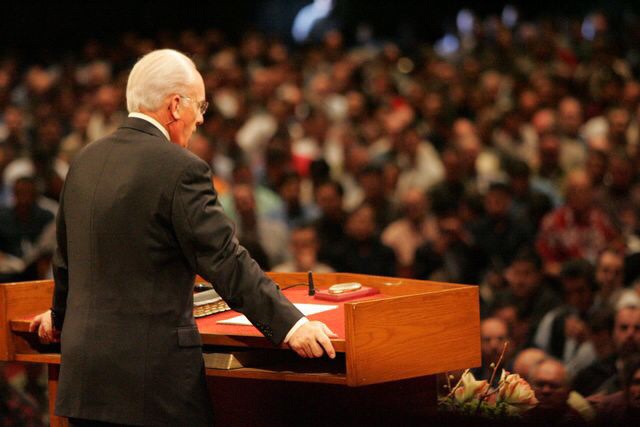
Preach for the Common Man!

20140804-112114-40874973.jpg

There are times when I encounter a young expositor (or wannabe) who feels that his knowledge (or at least his ability to parrot someone else’s knowledge) must be on display in his sermons; so he speaks in such a way that the man in the pew cannot understand him, and he feels all the more spiritually superior than most for his erudition.

I am a simple preacher. I can wax eloquent too. But why? To prove that I have degrees hanging on my walls? As I think of all the godly men that I respect, both currently and in history, those men used simple language, but spent time in deep study and deeper prayer. They sought to preach for the benefit and edification of the people, not to lift themselves up.

Apparently, Richard Baxter, a most eminent Puritan, would agree with me. More importantly, I think I am in the company of my Savior, who taught with clarity and power to the common man.

“All our teaching must be as plain and simple as possible. This doth best suit a teacher’s ends. He that would be understood must speak to the capacity of his hearers. Truth loves the light, and is most beautiful when most naked. It is the sign of an envious enemy to hide the truth; and it is the work of a hypocrite to do this under pretense of revealing it; and therefore painted obscure sermons (like painted glass in windows which keeps out the light) are too oft the marks of painted hypocrites. If you would not teach men, what do you in the pulpit? If you would, why do you not speak so as to be understood? I know the height of the matter may make a man not understood, when he hath studied to make it as plain as he can; but that a man should purposely cloud the matter in strange words, and hide his mind from the people, whom he pretendeth to instruct, is the way to make fools admire his profound learning, and wise men his folly, pride, and hypocrisy. Some men conceal their sentiments, under the pretense of necessity, because of men’s prejudices, and the unpreparedness of common understandings to receive the truth. But truth overcomes prejudice by the mere light of evidence, and there is no better way to make a good cause prevail, than to make it as plain, and as generally and thoroughly known as we can; it is this light that will dispose an unprepared mind. It is, at best, a sign that a man hath not well digested the matter himself, if he is not able to deliver it plainly to others.”

—Richard Baxter, The Reformed Pastor

Muddy Sermon? Sharpen The Big Idea!

20140801-224704-82024554.jpg

I have the conviction that no sermon is ready for preaching, not ready for writing out, until we can express its theme in a short,
pregnant sentence as clear as crystal. I find the getting of that
sentence is the hardest, the most exacting, and the most fruitful
labor in my study.… I do not think any sermon ought to be
preached, or even written, until that sentence has emerged,
clear and lucid as a cloudless moon!

—J. H. Jowett

The Ministry Is No Place for Lazy Men


“The ministerial work must be carried on diligently and laboriously, as being of such unspeakable consequence to ourselves and others. We are seeking to uphold the world, to save it from the curse of God, to perfect the creation, to attain the ends of Christ’s death, to save ourselves and others from damnation, to overcome the devil, and demolish his kingdom, to set up the kingdom of Christ, and to attain and help others to the kingdom of glory. And are these works to be done with a careless mind, or a lazy hand? O see, then, that this work be done with all your might! Study hard, for the well is deep, and our brains are shallow; and, as Cassiodorus says: ‘Here the common level of knowledge is not to be the limit; here a true ambition is demonstrated; the more a deep knowledge is sought after, the greater the honor in attaining it.’ But especially be laborious in the practice and exercise of your knowledge. Let Paul’s words ring continually in your ears, ‘Necessity is laid upon me; yea, woe is unto me, if I preach not the gospel! ”

—Richard Baxter, The Reformed Pastor


What Are a Your Motives For Studying Theology?

20140731-104342-38622684.jpg

“Some desire to know merely for the sake of knowing, and that is shameful curiosity. Some desire to know that they may sell their knowledge, and that too is shameful. Some desire to know for reputation’s sake, and that is shameful vanity. But there are some who desire to know that they may edify others, and that is praiseworthy; and there are some who desire to know that they themselves may be edified, and that is wise.”

—Richard Baxter, The Reformed Pastor