How Spirit-dependent is your preaching?

“How utterly dependent we are on the Holy Spirit in the work of preaching! All genuine preaching is rooted in a feeling of desperation. You wake up on Sunday morning and you can smell the smoke of hell on one side and feel the crisp breezes of heaven on the other. You go to your study and look down at your pitiful manuscript, and you kneel down and cry, “O God, this is so weak! Who do I think I am? What audacity to think that in three hours my words will be the odor of death to death and the fragrance of life to life (2 Cor. 2:16). My God, who is sufficient for these things?”—John Piper, The Supremacy of God in Preaching, Kindle loc. 400.

Help for New Expositors: 8 Reasons You Need to Introduce Your Sermon Well

pulpit 1

Although it is not the most important part of a sermon, the introduction is still important.   The introduction moves your hearer from a cold start to the body of the message and the exposition of the text. If your introduction is not done well, it can produce all sorts of problems that will hinder your hearers from getting the most from all the hard work you have done in studying the Scriptures.

Why does every sermon or address need an introduction?

  1. The congregation needs to be prepared to hear the message profitably.
    • Coming off of a hard week, dropping a crying baby at the nursery, having an argument on the way to church, distractions from the woes of this world, and many more things are hindrances to hearing the Word preached. The introduction helps get everyone ready.
  2. People have an aversion to abruptness. An introduction provides the gradual approach to the message.
    • People need a gradual change in subject matter that allows their minds to follow along. Moving from the introduction to the text allows the hearer to prepare for a change from a subject they know to one which they are less familiar with.
  3. The needs of the hearers must be addressed during the introduction.
    • Developing need is critical for a good introduction. Why should your hearers continue listening to you? What is it about the main theme that is important for their life and faith that they need to continue on the “Bible bus” with you? Think about the practicalities of the sermon and how it impacts the different people you will be addressing.
  4. Gets attention and secures interest. 
    • Sometimes we think about the interest of the most mature Christians when we prepare our sermons. But in any healthy church, there will be both immature and mature Christians along with visitors and unbelievers. These immature Christians, unbelievers and visitors will need more help than the mature when it comes to getting into the sermon. A good attention grabber helps gain their interest.
  5. Dismisses prejudice, creates favorable regard for the preacher.
    • If you are a guest preacher, then the introduction helps to allow the congregation to get to know you a little better and to see that you are trustworthy and someone they want to listen to for the next 45 minutes. Greek oration valued ethos and pathos along with logos. The introduction helps to establish your ethos and pathos before you can get very far into the Word.
  6. Indicates the purpose of the sermon.
    • What is this sermon about? Similar to developing need, the purpose of the sermon is classically attached to the proposition statement as a “so that” clause. The purpose answers the question “So what?” to your sermon idea. What do you want your hearer to do, feel, believe or change?
  7. Connects the sermon to the last.
    • In lectio continua or preaching through a book, there is a need to explain the flow of the argument of the text and weave that into the current preaching portion. This allows the argument of the biblical author and book to be made clear while also connecting what has come before. All sermons should stand alone, but should be connected at the same time.
  8. Introduces the subject/text of the sermon.
    • This often comes in the form of biblical background and context. This is an area where too much information can easily be given. The purpose of this in the introduction is to give enough information to place the text and the subject in its setting for the listener to understand the main idea of the sermon. Too much background information can muddy the introduction and weigh it down as well as taking away time from the exposition of the text.


Every sermon needs a good introduction, and these eight reasons show why one is not only necessary, but also why it is helpful. In an upcoming post I will share with you some sources where you can find good material for using in your introductions. What are some other good ideas you have for sermon introductions? Share your ideas in the comments.

Preaching Christ from All of Scripture? TMS Lecture Series #1- Richard Mayhue

Mayhue.png

One of the more difficult issues that often comes up in preaching is how to properly preach the gospel in any given sermon. Obviously, there are texts which easily lend themselves to preaching the gospel, but how can we be faithful to stress the authorial intent of the Bible and still be faithful to preach Christ?

Thankfully, back in 2016 The Master’s Seminary held its annual Faculty Lecture Series on Christ-Centered Preaching. I would commend the whole series to you if you struggle with this issue, which many men do, but I want to take some time here to highlight each message and then when I have finished the sermon series I’d like to make some practical applicational comments for how we can preach Christ in our sermons in a way that is biblically faithful to the text.

The first message is from Dr. Richard L. Mayhue, the former dean of The Master’s Seminary from 1990 to 2014.

His message can be be heard here as audio or video.

In this message, Dr. Mayhue covers:

  • An Overview of the Christ-Centered Preaching Movement
  • An Overview of the Improper Practices of the Movement
  • And Overview of Legitimate Christ-Centered Preaching

“It is exegetically fraudulent to try to extract from every biblical text some truth about Christ.”–Daniel Block

Dr. Mayhue briefly addresses the argument used to defend this preaching from texts such which seem at first glance to say that Christ can be found in the totality of the Old Testament, such as Luke 24:44; John 5:39; 1Cor 1:22-23; 1Cor 2:2; 2Cor 4:5. He also deals with the issue of hermeneutics and how coming to the text with a theological bias may allow for preaching Christ in every text, but it also abuses the authorial intent of the text. Likewise, Mayhue argues that a Christo-centric hermeneutic falls short of a full theocentric emphasis in Scripture and points to John Calvin himself as a good model of faithful, biblical exposition which does not fall into the same pitfalls as modern Christo-centric preachers.

Although this message clocks in at 52:31, it only begins to scratch the surface of the issues at hand and does not deal with a lot of the issues, nor does it help much in showing a young expositor how Christ can be preached in many texts other than those which are explicitly Messianic. That task is left for those that will follow.

 

Fuzzy Thinking Produces Confusing Sermons

Wutt?

“The great failure of much preaching is fuzzy thinking. The preacher is not quite clear about his subject and the ideas that express it. His language is imprecise. The progression of his thought meanders in search of a line of direction. The basis for this vague and uncertain communication in an expository sermon is a failure to identify the text writer’s central idea and how he expresses it. If the preacher is unsure of his thoughts, the audience will be even more unsure of what he is saying. The key to clear thinking is the careful use of precise language…

Becoming a skilled word crafter calls for the capacity for critical thinking. By critical thinking we mean analyzing thoughts, sorting out ideas, distinguishing one concept from another, evaluating arguments, and making judgments about the best way to express ideas. It requires levels of precision and craftsmanship not necessary to casual thinking. You want to find the words that exactly express the idea. You want to distinguish it from ideas that are similar but not quite the same, such as various words for preaching: proclaim, declare, exhort, bear witness. It is this kind of thinking that is so needed among preachers today.” – Wayne McDill, 12 Essential Skills for Great Preaching, 75.

Preaching with a Tender, Compassionate Heart

There have been times in my ministry when an icy chill has come over my heart, when my soul no longer weeps, when my sermons no longer connect, and when the act of preaching becomes a drudgery. I know that I have then lost compassion for people. That is when I retreat to a small taco stand in the barrio of East Los Angeles, to a place where real people live. I order a cup of coffee and sit with my back against the wall. Then I watch, I observe, I read, and I listen intently for the heart cry.

A group of gang-bangers come in for a snack-one in four will die before the age of eighteen; two of the others will end up in prison. All are doomed to a hard life. A young mother comes in with her brood of youngsters. It is obvious that they are poor. They share drinks. They live in poverty; some will never see a forest or snow. An old drunk staggers in, begging for a meal. He is quickly thrown out. That was somebody’s baby boy. A mother at one time cradled that man and nursed him. The poor specimen of humanity has children. His wife is somewhere out there. They have long since disowned him, but they have not forgotten him. He is still somebody’s daddy. For all I know, he could have been my own.

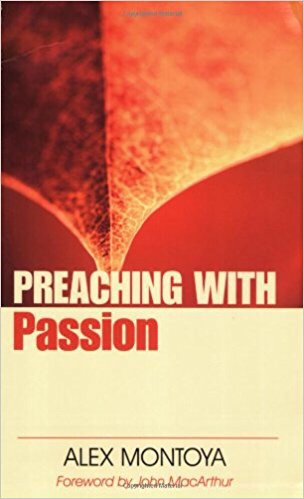
I look, I listen until I hear their cries, until their souls cry out to me, “Please help, I’m perishing!” until the tears pour forth from my melted heart! I am in love with humanity once again. Now I am fit to ascend the pulpit, to weep with those who weep, to laugh with those who laugh, and to bring a living Word-Christ-to a needy people. Now I can preach with passion, for now I have compassion.— Dr. Alex Montoya, Preaching with Passion