Although we Protestants say that we don’t venerate the saints, you wouldn’t know it the way some pastors fawn over Luther, Calvin, Knox, Spurgeon, and other reformers. Don’t get me wrong, I think those men were used mightily of God, in spite of their flaws and personal sin.
But what I wonder about is how it is that so many pastors who would look up to these men and admire them for their courage and boldness are so cowardly in their own churches when they are called upon by the testimony of the Word of God to stand firm against a potential revolt by those who do not want biblical change.
Although there isn’t a substitute for actually conducting a funeral yourself, it is possible to be better prepared to have those conversations that will make for a better memorial and graveside service. Like many things in pastoral ministry, after struggling to figure out how to do something as a new pastor, I figured out a way that worked for me and then standardized a format that made my “system” repeatable.
“The problem with preachers today is that nobody wants to kill them anymore!”
Steven J. Lawson
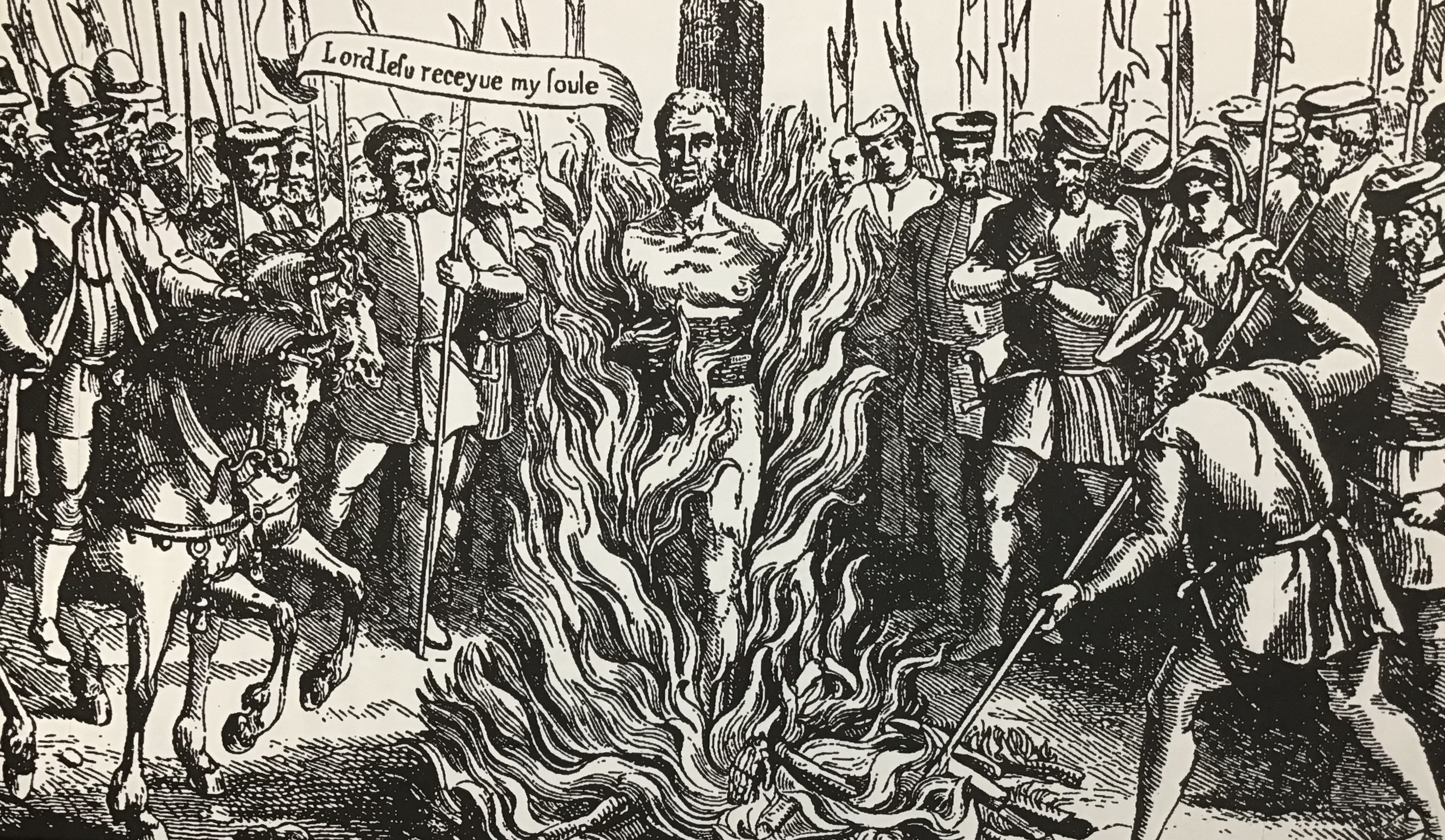
Bishop Hooper burned at the stake for the gospel.
Although we Protestants say that we don’t venerate the saints, you wouldn’t know it the way some pastors fawn over Luther, Calvin, Knox, Spurgeon, and other reformers. Don’t get me wrong, I think those men were used mightily of God, in spite of their flaws and personal sin.
But what I wonder about is how it is that so many pastors who would look up to these men and admire them for their courage and boldness are so cowardly in their own churches when they are called upon by the testimony of the Word of God to stand firm against a potential revolt by those who do not want biblical change.
When Gideon was called to pull down the idols in his town, he may have been overcome by the fear of man, but at least he did it, even if under the cover of night. And when they found out what he did, they wanted to kill him.
When Josiah came to understand how far Judah had fallen away from obedience to the Law, he immediately began to purge Judah and Jerusalem of its idolatrous high places and reinstated the reform that was necessary to please the Lord. This led to a need to rebuild and reorder the temple so that proper worship could be restored.
And the church today is in need of men who are ready and willing to make the changes that are needed in their local churches where unbiblical practices have found a nesting place for ages. For fear of confrontation, loss of income, or prominent families, or a simple fear of losing your job, pastors remain silent in the face of unrepentant sin and all manner of false practices. Unregenerate men are allowed to remain on elder and deacon boards, unhealthy and unbiblical curriculum and programs continue to function so as to avoid a conflict with a women’s ministry head or the parents of the youth. The call for entertainment in church continues to ring louder as the Word of God is given less time to work in the hearts that need it.
Yes, we admire Luther’s stand at the Diet of Worms where he refused to recant. We applaud Spurgeon for being unwilling to give in to the New Measures that sought to entertain the goats. We are in awe of Whitefield who preached the gospel wherever he could garner an audience. We rejoice at the courage of John Rogers and the other Marian martyrs who refused to stop preaching under Bloody Mary of Tudor, and were burned at the stake for it. But will we stand today? Where is our courage? Where is our godly resolve to trust God in the face of angry adversity within and outside of the church? Brothers! Be strong and very courageous!
Although there isn’t a substitute for actually conducting a funeral yourself, it is possible to be better prepared to have those conversations that will make for a better memorial and graveside service. Like many things in pastoral ministry, after struggling to figure out how to do something as a new pastor, I figured out a way that worked for me and then standardized a format that made my “system” repeatable.
After being contacted by a church member or someone who has lost a loved one, it is best to set a day and time as soon as possible to meet together to talk about planning their service(s). Because most people have been to a funeral, we can assume that they might have some idea about how they would want the service of their loved one to be ordered. That assumption is almost 99% incorrect. Most people have no idea how a service should be ordered, what elements they might want to include, who they want to speak, or even how long they want the service to be.
We obviously think about the need for comfort as a part of ministering to those who are mourning, but part of bringing comfort is helping the loved ones walk through a very confusing and difficult time by leading and guiding them through a very scary and unfamiliar process.
I developed my Funeral Service Planner as a way of walking through the typical services that people desire for a funeral, including a viewing/wake, memorial service, and graveside service. I not only ask about the particular elements that the family might want, but I also mark the order of each element in the service as well as which family members will be involved. The lines to the right are for names of those involved, including the pastor, if desired. The short lines to the left of service elements are to place a number for the order of the element when it will occur in the service.
Viewings or wakes are normally connected to Roman Catholicism, but sometimes they are conducted by a family of different faiths. If no priest will be present, then a Protestant pastor might be looked at as one who should do something. If this is the case, you might want to choose some passages of Scripture to read and pray. The rest of the time can be left for family to mourn together and if the casket is open, for them to say their goodbyes.
The last element, “full burial” follows the graveside service. Some families opt to wait until the casket is lowered and the vault (a concrete protective box) is placed over the casket, and then the whole thing is covered by dirt. In many funeral services, this is done for an extra fee and must be pre-arranged. If this occurs, it extends the time at the cemetery, and can be somewhat traumatic for the family to watch because it involves heavy machinery pounding down the ground to compact the soil. It would be best to know this so the family will be aware of the extra cost and what happens.
My form looks like this:
Funeral Service Planner
Decedent’s Full Name:__________________________________ Age:______ Saved? ____
Viewing/ Wake? Date, Time and Location: ______________________________________
___Family and Friends Memories (Prepared or open? _________ How many?____ )
___Prayer ___Gospel Message
Closing Prayer
Other elements?
Special music? _________________________
Other minister co-officiating? __________________________
Graveside Service? Date, Time and Location: ____________________________________
Scripture Reading (Jn 11:25; Ps 103)
Words of Interment Prayer
Other elements? ____________________________________
Full burial?
Contact info: Pastor Richard Bargas Office: (XXX) XXX-XXXX Email: XXXXXX@gmail.com
When I fill out the above form, I make sure to include as many details as possible. Some things, like particular family involvement, will sometimes be confirmed at a later date. After I have sat and walked through this process with the family, I will usually either photocopy or email a copy of the completed form to the family so they can know the order of the services and who is doing what. This is especially helpful the next day when they have a hard time remembering the meeting details because of their grief.
Normally, people are so overwhelmed with stress and the emotion of the day that they will need to be guided through each service element during the funeral, but it is good and comforting for them to know that you are in charge and know what is happening. I have included at the bottom of my form my church office number and my email in case they needed to get ahold of me, since I sometimes conducted funerals for friends of friends.
One last thing. There is a place in my form for a gospel message in the service. For me, this is a non-negotiable element. I won’t do a funeral if I’m not allowed to freely share the gospel, and I normally only take about 15 minutes to do so. I once had a person say they didn’t want me preaching at their guests. I replied that as a minister of the gospel I don’t know of any other hope to give to people than the hope of salvation in Christ. If they didn’t want this hope presented, then they didn’t want me to conduct the service. I spoke with a gentle but firm resolve. The widow took a second to think about what I said and then agreed that she did want this and asked me to do the service. She even thanked me after the service for the great comfort the Word of God brought. Fellow pastors, don’t fail to point the grieving to Christ, our only hope!
Below you can download a PDF copy of my form. Be aware that the contact info at the bottom of the form is no longer valid for me, so please don’t try to contact me at the phone number or email address.
Ministry can be a lonely place. Sometimes there are very few people that could understand what you re going through, and there aren’t many that you can share your thoughts and struggles with. Ministry partnerships and fellowship can definitely help alleviate this, but there is still the reality that the road of ministry leadership is sometimes still fraught with times of isolation and discouragement.
Finally, The Lord Provides for ministry when he gives us encouragement.
He Gives Us Encouragement
“And the Lord said to Paul in the night by a vision, “Do not be afraid any longer, but go on speaking and do not be silent; for I am with you, and no man will attack you in order to harm you, for I have many people in this city.” (Acts 18:9-10, NASB95)
Think about the English word, “encouragement.” It has the word “courage” right in the middle of it. This English word originally was, in-courage, and it meant “to give courage.” And that is what the Lord is doing in verses 9-10. In a vision one night, the Lord reminded Paul what he often told his prophets in the Old Testament, “do not be afraid!”
In Exodus 3:2, as God called Moses to redeem his people from Egypt, He told him that He would be with him. In Deuteronomy 31:6, Moses told Israel to trust the Lord as they entered the promised land. In Joshua 1:5, 9, the Lord encouraged Joshua that he would be with him as he was with Moses and that he needed to be strong and courageous. In Isaiah 41:10, the Lord told the prophet Isaiah that he is not to fear or be dismayed, because the Lord God will strengthen him, help him, and uphold him. And in Jeremiah 1:8, when Jeremiah was called to go out as the prophet of the Lord, God told him that he was not to be afraid of them because the Lord was with him to deliver him from all dangers.
Paul needed that kind of supernatural encouragement as he faced the daunting task of the ministry the Lord had given to him. And so he gave Paul these instructions:
“Don’t be afraid any longer”…When we react in fear we are lacking faith in the Lord our God who is our strong tower. In our fear we must trust the Lord and turn to him by faith to accomplish his will.
“Go on speaking and do not be silent”…Fear of persecution often silences the faithful witness. Paul needed to be courageous and keep on speaking the truth, in spite of the high probability that he would continue to suffer greatly for the gospel.
And then he gave him three encouragements:
“For I am with you”…Paul was never alone. God was always with him. Just as he was with Moses, Joshua, Israel, David, Isaiah, Jeremiah, Daniel, Habakkuk, and so many others.
“No man will attack you in order to harm you”…No one can touch us if God’s protective hand is upon us. This would be limited to the time that Paul was evangelizing in Corinth until those God would save had been saved. It wasn’t a promise that Paul would never be attacked again. But it was an assurance that for a while, Paul would be able to do the work of the ministry without violence breaking out in Corinth for a while.
“I have many people in this city”…The Lord was saying to Paul, “there were many people left who would be saved. Go find them!” When the time to move on had come, the Lord would let Paul know. He was to be encouraged with the fact that there was a good harvest of souls right there in that city.
We know how the Great Story ends, don’t we? No matter how dark things get, no matter what twists and unforeseen trials we encounter, in the end, Jesus has already won! Therefore, we need to be encouraged and see with the eyes of the Ascended Christ. He is not dead and in the tomb. He is seated at the right hand on high. He is coming again. And he has given us work to do.
Let your hands be strengthened with this truth and carry on with the Lord’s work. Look at our last verse, verse 11: “And he settled there a year and six months, teaching the word of God among them.” (Acts 18:11, NASB95). Do you see the result of these provisions? God had provided co-workers, finances, focus, boldness, souls saved, and words of encouragement. And Paul continued on and so we must carry on as well.


 Always Reforming