Placing our Hope in God Alone

“The king is not saved by his great army; a warrior is not delivered by his great strength. The war horse is a false hope for salvation,
and by its great might it cannot rescue.” Ps 33:16-17

A few years ago I had the opportunity to walk through the National Museum of the US Air Force in Dayton, OH. Moving from one hangar to the next I saw the evolution of aircraft from the Wright brother’s first plane to the modern surveillance drones of today.

It isn’t hard to be in a place like that and not have an overwhelming sense of patriotism as I see the military defense weapons and aircraft that our nation has used in the defense of our country and many other countries all around the world. Seeing these beautiful machines and their sheer size made me feel a little sorry for anyone that stood against them in a battle.

It makes me think about how Pharaoh felt about his horses and chariots, and the king of Babylon about his weapons of war. The same can be said about the Medo-Persians, Greeks, and Romans at different parts of world history. Whether the weapons are spears, swords, arrows, or chariots, tanks, and airplanes, our hearts can become fooled into thinking that it is the weapon and strategies that win the war. Sometimes we think we can simply outnumber the enemy with more soldiers, more money, more missiles, and more technologies. This is heady stuff and it can divert the attention of a nation away from their inherent weakness and need for God.

In Psalm 33, the unnamed psalmist recognized this prideful blindspot and seeks to refocus the attention of the worshippers of Yahweh. The king, he writes, is not saved by his army-no matter how great. A read through the Chronicles and any history book will give credence to this reality. Kings are overthrown, betrayed, killed in battle, poisoned, and even killed by their own sons in a grab of power. King David himself survived an attempted coup by his own son. Some rulers are better than others, but no ruler can exist without God’s help. The Lord puts the man on the throne or behind the desk, but it is God alone who keeps him there, and it is God who removes him.

The psalmist also recognized that the same is true about those warriors that seem unbeatable in battle. We laud those warriors that fight valiantly and bring to our nation victory over the enemy. Stories are told of campaigns where all hope was lost and then the hero emerged and snatched victory out of the jaws of defeat. But even the greatest hero among our warriors should not be hoped upon more than our God. Do not forget men like the mighty Goliath who boasted in his mighty size and ability to defeat Israel, even defying the Lord with mockery. That warrior’s great strength could not deliver him when a boy with a sling brought him to his death on the battlefield.

The warhorse was a great advantage to any ancient kingdom that sought to be a military powerhouse. The war horse was large, brave, and strong. He could charge into a mob of warriors with courage and bowl over those in his path, allowing his rider to swing his longsword or thrust his spear into the melee while remaining out of reach by the foot soldier. Any army that had a cavalry was an almost unstoppable force. Almost.

Knowing the confidence that men put in warhorses, he commanded that the kings of Israel were not to amass large numbers of them knowing that it would easily allow the king to seek confidence in his cavalry and not place his trust in the Lord. In modern weaponry, confidence is placed in ships, drones, fighter jets, missiles, and many other weapons that can unleash “shock and awe” in our enemies.

The writer of Psalm 33:16-17 should be heard. Anything we place our confidence in outside of God can and will fail. It is inevitable. As a matter of fact, it is worse than failure. These things that we place above our trust in God are an affront to Him, and they will not only fail but they will also be brought low as they have become a challenge to God for supremacy in our hearts. He will not allow anything else in His place.
Taking a Break for Convention Time

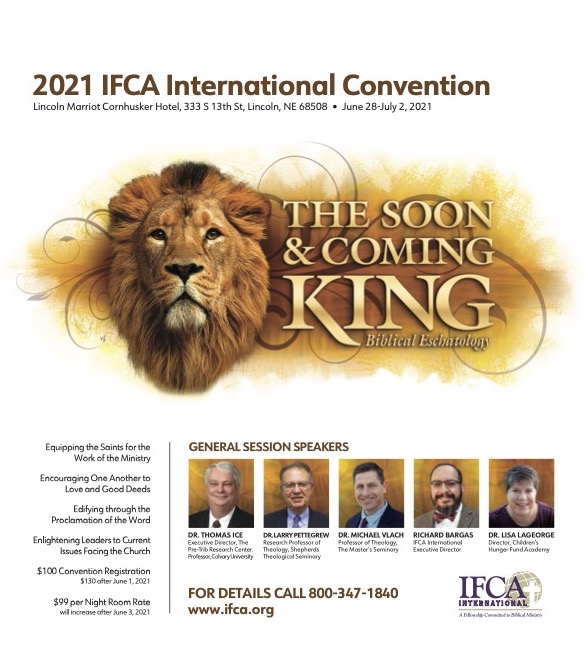
I need to take a break from writing here to focus on our IFCA Annual Convention and Board meetings for the next couple of weeks and to take some time off with my family. I will return to writing on July 12, Lord willing.

If you’d be interested in viewing the Convention General Session speakers via Livestream, you can find out more information and register for the convention at the link below. Your prayers are appreciated!

Virtual Convention Registration: https://www.ifca.org/page/2021-annual-convention-virtual-version

Spirit Empowered Church Planting

“For I am not ashamed of the gospel, for it is the power of God for salvation to everyone who believes, to the Jew first and also to the Greek.” Rom 1:16 ESV

It would seem that some people who are all for church planting are unaware of Romans 1:16, so I have reproduced it here for the benefit of those who think that a church is best planted by human invention.

What do I mean by ‘human invention?’ How about slick marketing programs that blanket the city? Or freebies, raffles, and give-aways that are meant to be a spiritual bait-and-switch? There are surveys meant to find out what unbelieving pagans want in a church so that a church can be tailored for them, and there are those ‘church planters’ who blanket Christian radio, Christian bookstores and encourage their core team to invite their friends over to their cool, new church that is so much better than the one they’re in now. There are other so-called church planting and church growth gimmicks I could mention, but I think that you probably know of one or two places like this.

Then there is Holy Spirit power that converts a soul from being a prisoner of darkness into a light-reflecting child of the Kingdom. Those churches that seek to grow from preaching a gospel that leads to Spirit-regeneration of the souls of men are true church plants. And those who plant churches by the power of the gospel do so in the methodology that gives all glory to God and cannot be conjured up by Madison Avenue methods.

To all my brothers out there who are holding forth the truth in faithfulness, keep it up. For those growing weary of doing good, email me and I’ll join you in prayer so that you won’t be tempted to give in to powerless quick fixes that yield a crowd, but not gospel growth.

Is Your Sunday Worship Driven by the Holy Spirit or an Entrepreneurial Spirit? (weekend repost)

“The light of nature showeth that there is a God, who hath lordship and sovereignty over all; is good, and doeth good unto all; and is therefore to be feared, loved, praised, called upon, trusted in, and served, with all the heart, and with all the soul, and with all the might. But the acceptable way of worshipping the true God is instituted by himself, and so limited by his own revealed will, that he may not be worshipped according to the imaginations and devices of men, or the suggestions of Satan, under any visible representation, or any other way not prescribed in the holy Scripture.”

Read the rest of the post here: Is Your Sunday Worship Driven by the Holy Spirit or an Entrepreneurial Spirit?

The Glory of God in a Season of Pain

“So when Martha heard that Jesus was coming, she went and met him, but Mary remained seated in the house. Martha said to Jesus, “Lord, if you had been here, my brother would not have died. But even now I know that whatever you ask from God, God will give you.” Jesus said to her, “Your brother will rise again.” Martha said to him, “I know that he will rise again in the resurrection on the last day.” Jesus said to her, “I am the resurrection and the life. Whoever believes in me, though he die, yet shall he live, and everyone who lives and believes in me shall never die. Do you believe this?” She said to him, “Yes, Lord; I believe that you are the Christ, the Son of God, who is coming into the world.” John 11:20–27

The glory of God and the love of God are not in conflict with one another. Some theologians try to pit one against the other saying that the sovereignty of God (intimately tied to His glory) cannot override His love for humanity., and therefore the love of God willingly overrides His sovereignty so that God actually submits to the will of His creatures.

John 11 is an interesting test of this idea. In verses 4-6 it says, “But when Jesus heard it he said, “This illness does not lead to death. It is for the glory of God, so that the Son of God may be glorified through it.” Now Jesus loved Martha and her sister and Lazarus. So, when he heard that Lazarus was ill, he stayed two days longer in the place where he was.”]

In these verses we have the glory of God shown in His sovereign decision to allow the life of Lazarus to be overcome by death, with the divine purpose of God being glorified through His resurrection of Lazarus. To some Christians and many unbelievers, this is unthinkable—even monstrous. But this is because the unregenerate mind and the immature Christian mind attribute all discomfort, pain, trial, and even death, as only evil and that the only good that comes is from the avoidance of these things.

But the pain and suffering that occurs in this world is only a small part of the much bigger picture. And not only this, but the pain and suffering as well as the joy unspeakable that are available to humanity either through grace or denial of the offer of salvation are infinite. The present world and its pains and joys are only a small sampling of a greater reality that all of humanity shall experience personally one day.

Jesus, looking beyond the suffering and eventual death of His friend Lazarus knows that a greater lesson needs to be grasped and through the truth He will bring glory to His Father.

So, instead of rushing to the scene to be at His friend’s side, Jesus stayed two days longer to assure His disciples that Lazarus was dead and buried by the time they reached Bethany.

This means that when we are tempted to cry out “Why?” In our trials, we must not push aside the glory of God and begin to question the love of God. The Lord’s mind is vast and His plans are more infinitely complex that we can know or imagine; therefore we must never doubt His love.

Mary and Martha were correct in placing all of their hope in Jesus’ power to heal their brother. The issue was simply timing. Jesus could have healed Lazarus while he was sick (Jn 11:21-27, 32); or immediately after he had died; or long after he died in the future Day of resurrection (v. 24).

The sisters had hoped that the healing would be before his death, but after he had died, they found some comfort in the future resurrection when he would be raised from the dead.

But Jesus gave them immediate resurrection while also pointing them to the reality of the greater day of resurrection that they would still need to look forward to and hope in. We too must cling to this very same hope even without our own personal experience with an immediate healing or resurrection. Jesus proved to Mary and Martha, and by extension to us as well, that He is able to raise the dead—because He raised Lazarus from the dead, and He rose from the grave by His own power.

So the next time you find yourself doubting God’s love or not understanding how such pain could bring God glory, remember Lazarus. You might never understand God’s reasoning, but you must know this—God desires to be glorified and His love for us is infinite. Both are true and both are never super versed by His perfect plans.