With the proliferation of media sources it is possible to take in news and media non-stop from all over the world instantaneously at any hour of the day. Because of this mass flow of information, it is easy for Christians to become swept up in the downpour of news and information. And although it is good that we become aware of what is going on in our world so that we can be informed, like any good thing, there’s also a need to guard our hearts against the negative effects on our souls.
A few nights ago I awoke with the aches and pains of a sickness I have been fighting for a few days. Unable to sleep, I started to reflect upon all the friends and loved ones that are struggling with pain and suffering to a much greater degree. I thought about those who are facing a crumbling marriage, the loss of a spouse, the onset of a disease that will take their life. I lay in the dark and considered the deep comfort that we have in Christ.
The Christian life is not an easy one, and may even be fraught with greater struggles because of our commitment to follow Christ whatever the cost. But there is no accounting for the presence of Christ in the midst of these struggles.
Dear brothers and sisters in Christ, the world is watching. Please do not show them a perfect, polished life free of any pain or sorrow. Such a life does not exist in this broken world. Show them that you too are cracked and flawed, just as they are. Show them that you too struggle with weaknesses and doubts. And then show them that our God sent his Son for us, to bring us safely to his promised land. He gives his Spirit so that as we sit in pain and doubt we will know his supernatural presence and find comfort.
As you listen to the song below, remember that we must sometimes fight for faith to know the joy of the Lord—and in the end, Jesus will be victorious. Like Job, we may not always understand, but we trust.
Biblical Christian leadership has always been in short supply. For some prominent leaders, sometimes the cracks in the facade begin to show that below the surface, there exists a double standard for life–“What is good for thee is not for me.” For Christians, our final authority is Scripture, but it seems that for some, biblical authority is placed below popularity, past success, and unquestioned loyalty. Every person will answer to the Lord and no one is above biblical scrutiny. “But he gives more grace. Therefore it says, “God opposes the proud but gives grace to the humble.”” (James 4:6, ESV). How can we be assured that we don’t fall or become dis-integrated? King David’s Psalm 101:1-4 gives us great encouragement and direction for becoming leaders with integrity.
“I will sing of steadfast love and justice; to you, O Lord, I will make music. I will ponder the way that is blameless. Oh when will you come to me? I will walk with integrity of heart within my house; I will not set before my eyes anything that is worthless. I hate the work of those who fall away; it shall not cling to me. A perverse heart shall be far from me; I will know nothing of evil.” (Psalm 101:1–4, ESV)
Leading with Integrity:
1. Requires a Resolute Determination (vv. 1-3). David sings over and over again, “I will…” with a resolute determination that he will worship with song and life. He will live in such a way that he pleased the Lord and not the flesh. There are basically three things we commonly call “resolutions.” The first is what some people do each New Year–promises they don’t intend to keep. Then there are official statements made by governments and groups which really have little to no power to change anything. It is simply a public declaration. The third type of resolution happens deep in the heart and soul. It is the opposite of the other two. It is a strong and determined statement of the will that says that you will do everything in your power to fulfill this promise. The leader of integrity determines that with God’s help he will accomplish the will of God.
2. Requires a Balance of Love and Justice (v. 1). David is wise, declaring his love and desire for both loving mercy and justice. James Montgomery Boice wrote, “Mercy and justice operate as checks on one another. Justice checks love that might otherwise be wrongly indulgent and therefore harmful. Love checks judgment that might otherwise be unduly harsh and therefore also harmful. David wanted his rule to be marked by both of these.”(James Montgomery Boice, Psalms 42–106: An Expositional Commentary (Grand Rapids, MI: Baker Books, 2005), 819). We should strive to be leaders who are both merciful and just. Whether in our home, work, church, or other group, we should strive to be balanced in love and justice. That can be hard, but that is what we see in our Lord Jesus, don’t we?
3. Requires a Biblically Thoughtful Direction (v. 2a). Pondering is not a glance at something, a simple passing over or a peek at it. Pondering means to look long and hard at something while meditating on it. What is the object of David’s pondering? It is the “way that is blameless” or “the perfect way,” which for the Christian is the Word of God. And the child of God who desires to lead with integrity needs to take this Book and use it to gain biblically thought ful direction and guidance. Your Bible should be like an old path–familiar and worn out. David said he would “ponder” the way that is blameless. Do you meditate on the Word. I know we ponder on our failures, our struggles, our temptations, our hurts, our needs, and our disappointments. But do you ponder God’s answers? Do you sit and think? Do you take God’s Word into your thoughts like a hard candy in your mouth. Rolling it over and over, savoring it?
4. Requires Beginning in the Heart and Extending to Every Realm of Our Lives (v. 2b). To walk with integrity of heart is a way of speaking of growing in holiness, what we call the process of sanctification. In his book, Living for God’s Glory, Joel Beeke writes, “Holi- ness that resembles God and is patterned after Christ saves us from hypocrisy and resorting to a “Sunday only” Christianity. It gives vitality, purpose, meaning, direction, and contentment to daily living” ( ) The word “integrity” is a math term, from the word “integer.” And integer is a whole number, it is not a fraction. Put theologically, it means a whole person, not a partially committed person, a half believer or an “almost Christian.” Leading with integrity requires that we must begin in our heart first. Before you look to your spouse for change, or your children or other family members, or your boss or friends or so- ciety or the church, where do you need to begin? With yourself.
5. Requires an Awareness of the Company that We Keep (v. 3). This word “worthless” in v. 3 is the Hebrew word belial, and it means “worthless,” but not in the way we think of trash or junk. The KJV uses the word “wicked” and the HCSB uses “vile.” These two translations show us that “worthless” is a ref- erence to its deep moral depravity. David says that he will not place before his eyes anything that is wicked or worthless. To see the proper understanding of this for ourselves, it is helpful to see this in a spectrum:
Absolutely abstain from the outright wicked–Gal 5:19-21
Situationally discern the marginally wicked–Prov 25:16, 17
Strategically refrain from useless pursuits–2Tim 2:1-6
In Psalm 101:3, David makes a commitment that he won’t look at wicked things, and that he won’t allow wicked people into his life. As the King, this would have meant in his realm. Do you al- low wicked things into your life? What about into your home? If you’re walking in the counsel of the wicked you might not even recognize them. You might even tell someone who points it out that they are being too legalistic. Imagine that, a Christian brother or sister counsels you to move toward holiness, but you would rather walk with the wicked! May this never be said of any of us. May we be men and women of integrity who lead our homes and work place with a heart moved to holiness.
6. Requires Removing Wicked Influences from Our Lives (v. 4). The “perverse heart” is not the danger from within, but the dan- ger from without. Remember, we are talking about leading with integrity here. We must guard our own hearts from wickedness lest we become a wicked leader. But we just as much guard ourselves from wicked counselors who would lead us away from godly leadership as well. Brothers and sisters, we must have discretion in our choices of those who are influential in our lives. You see, the danger is not merely in making poor choices in leadership. The danger is far greater than that. The greater threat is that we shall become like the wicked. We shall join their ranks.
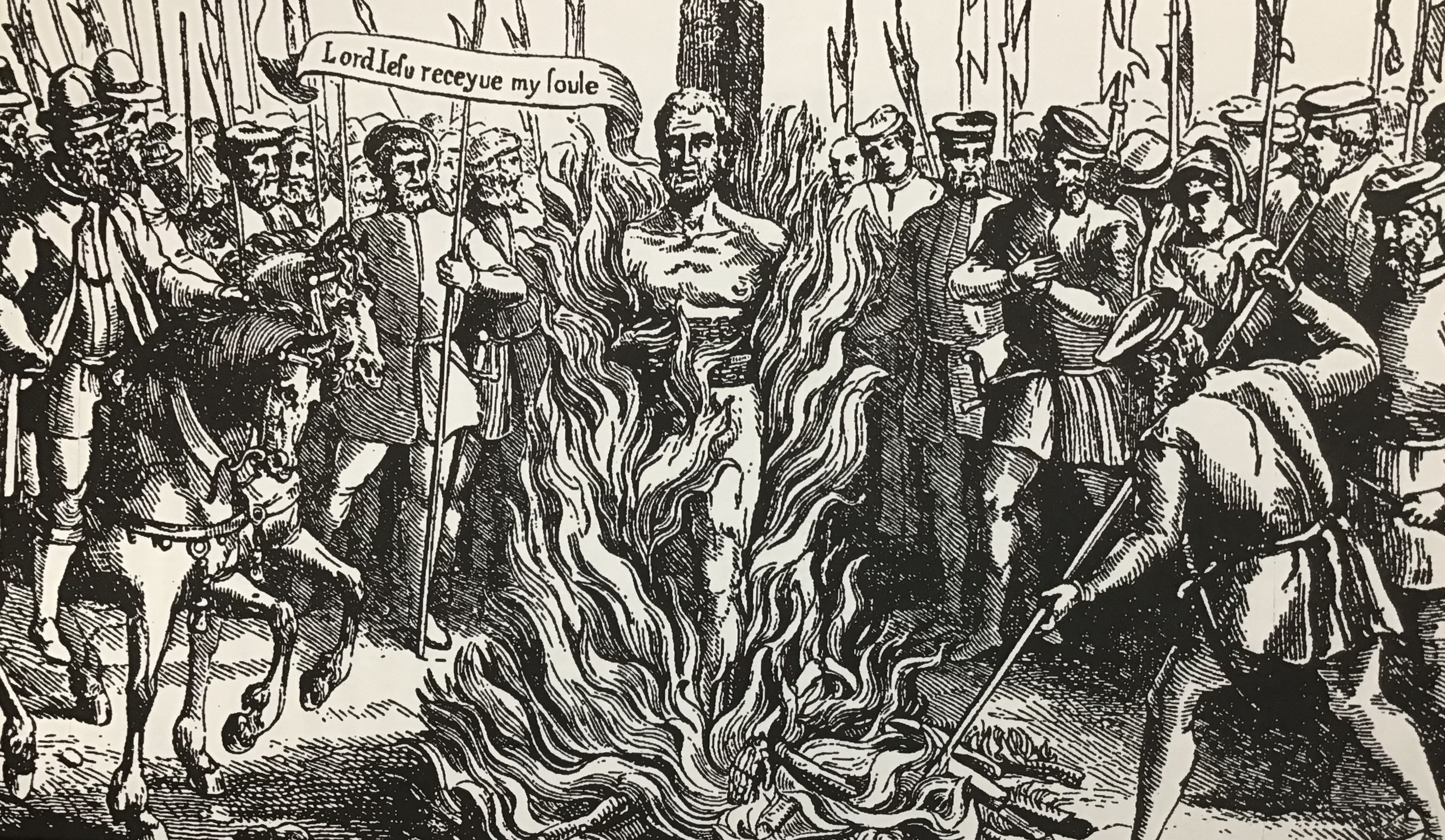
Bishop John Hooper burned at the stake by the order of Queen Mary Tudor
Some claim that since whether one is Amil, Premil, Postmil, is not an issue of salvation, and therefore should be left out of a church doctrinal statement. I think I addressed this in the last post, but I will say this: If we are only going to include universal truths that all Christians agree upon from every communion and tradition, we will indeed have a very small statement.
With the most recent discovery of the moral failure of Ravi Zacharias, many have wondered how it is that such a thing could happen again. But there is a common denominator among many of these men that we must address because although our own fall may not be publicized to the same extent, there is no doubt that it will have similar destructive results.
Whether it was Zacharias, James McDonald, Mark Driscoll, Jack Schapp, Jim and Tammy Faye Bakker, Jimmy Swaggart, or any of the seemingly endless list of failures, there is a commonness to their ability to go so far in their sin before they crashed and burned. You don’t need to look far and you will see that each of these people were able to get so far in their sin because they built a structure around them of yes-men that they knew would not stand up to them and hold them accountable to biblical standards of holiness.
Whether it is gold, girls, glory, or a combination of these, each failure achieved such great heights because they had constructed a system that assured them that their lusts could grow unchecked. In essence they set a trap for themselves, as the Proverbs say:
“For in vain is a net spread in the sight of any bird, but these men lie in wait for their own blood; they set an ambush for their own lives. Such are the ways of everyone who is greedy for unjust gain; it takes away the life of its possessors.” (Proverbs 1:17–19, ESV)
The threat is not only for the A-list celebrity Christian though. We may not be able to attain to the great heights from which they fall, but we shall fall nonetheless. The Apostle Paul warned Timothy of words that must be ever-present in our lives: “Keep a close watch on yourself and on the teaching. Persist in this, for by so doing you will save both yourself and your hearers.” (1 Timothy 4:16, ESV)
How can we avoid the same end?
Make sure you are in the Word and in prayer daily. This doesn’t point to a legalistic requirement, but a need for the Spirit to continuously work in our hearts through the Sword of the Spirit.
Make sure you have submitted yourself to a pastor or elder(s) to hold you accountable. This means that if you are a pastor, you are allowing another godly elder or elders to confront you and ask you the hard questions when necessary.
Be aware of your own propensities and weaknesses, but do not put too much trust in your own judgment. Allow those closest to you to point out your blind spots and then you must listen to their wise counsel and correction.
Allow trusted men of God access to you. Don’t cut yourself off from those who will be most honest with you because they love you.
Be careful not to shut out those who disagree with you. “Yes men” might make your plans go smoother, but you need those who will look at things differently from you and might point out those things you (and your yes-men) might fail to see.
When you are wrong, confess it, repent, and ask forgiveness. Don’t cover your sin or make excuses for it. We all mess up, but there is no excuse for prideful avoidance of guilt.
Be willing to listen to criticism with a humble heart. Try to find truth and helpful counsel, even in those complaints that might be unfair and even mean-spirited.
Be an open book to several trusted people in your life. You should be unafraid to open up any area of your life to a trusted friend who asks, especially in the areas where there may be a potential risk of failure.
Don’t develop a form of church government that cordons you off from any form of biblical scrutiny. Special committees that don’t answer to or communicate with anyone but the pastor have great potential to be a hiding place for sin.
Satan loves to work in shadows and whispers. The more light that we allow to shine on our ministry, the less there is a possibility that sin can grow or remain hidden for long.




 Always Reforming