Why You Should Boldly Preach Christ Crucified

For the word of the cross is foolishness to those who are perishing, but to us who are being saved it is the power of God.

(1 Corinthians 1:18, NASB95)
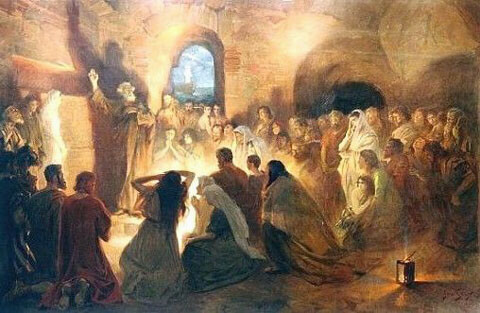
Peter preaching
  1. Because It is Not Popular (v. 18)
    Not only is it not popular, it is moronic (moria in Gk.). Consider the fact that the gospel of Jesus Christ demands that we say to sinners that a poor and humble Jewish man was God, and that he was nailed to a cross to die a criminals death despite his perfect innocence. We proclaim that this man is not only a man, but that he is God in the flesh. That he is perfect and sinless and that he was born of a virgin.

Furthermore, we proclaim that all of humanity is lost and that each individual man, woman, and child is a wretched sinner.
We proclaim that Christ is the only hope for humanity and that all other claims are lies from the pit of hell and all who seek salvation in any other name are doomed to eternal damnation.


We proclaim that Jesus Christ has done all that is necessary for our salvation, and that he rejects all attempts to earn salvation on our own. He, being the King, demands our allegiance and one day every knee shall bow and every tongue shall confess that He is Lord.

Brothers, when we proclaim this the world will overwhelmingly reject us as fools of the worst kind. We will be called bigots, intolerant, and uneducated religious zealots. And that is why so many bow to the pressures and soften their message. Paul was keenly aware of the propensity of men to soften the blow of the gospel by using soothing words that made the hearer feel at ease.
He said in 1Corinthians 2:1-5 that he purposely made it his aim to proclaim the unvarnished gospel of Jesus Christ crucified. Today, preachers everywhere are trying to make Jesus look cool. They are trying to make Christianity attractive. They are doing just what Paul avoided.

Brothers, the cross was not cool. It was brutal and bloody.

The call of Christ is not popular. True Christianity will never court the world. But pastors will continue to attempt to make our precious faith more palatable in order to gain the popularity of the world. This is nothing but pride. Nobody should enter the ministry or the pulpit in order to make his own name great.

Isaac Watts wrote, “When I survey the wondrous cross on which the Prince of glory died; My riches gain I count but loss, and pour contempt on all my pride.”
PREACH CHRIST BECAUSE IT IS NOT POPULAR!

2. Because They Are Perishing (v. 18)
When we preach the message of the cross, the world sees it as folly because they do not see the danger to their souls. Sometimes they fail to see the danger because they do not see it in our eyes and do not hear it in our voices as we proclaim cold truth from our pulpits.
Brothers, do you feel the truth of Hell?
Do you remember the days when you were among the brood of vipers?
Do you recall that you were once a vessel prepared for destruction?
Have you forgotten that you were on the precipice of the bottomless pit and you were ready in due time to slip into eternal fire separate from God to be tormented for all eternity?
HAVE YOU FORGOTTEN?

When we remember our former state we will be quick to point people to the only remedy for their souls—the cross of Christ. When we remember that they are perishing, we will not care about their mocking and their cries for ear-tickling sermons—we will give them what we know they need.

Wrote Thomas Brooks, “The damned shall live as long in hell as God himself shall live in heaven.” That fact alone should drive us to preach Christ crucified. Check your hearts brothers. Do you feel the terror of hell and do you cry out with Paul on Sunday mornings: “For we (!) are the aroma of Christ to God among those who are being saved and among those who are perishing, to one a fragrance from death to death, to the other a fragrance from life to life. Who is sufficient for these things?”(2Cor. 2:15-16)

PREACH CHRIST BECAUSE THEY ARE PERISHING!

3. Because It is the Power of God (v. 18)
Power in the pulpit. Power evangelism. Power encounters. Pastors want power.
But the power of God is not found in the usual places.
It is not found in business models or worldly philosophy (1Cor 1:22).
It is not found in dramatic, emotionalism (1Cor 1:22).
It isn’t found in phony encounters and confrontations with demons and the occult.

The power of God was displayed on the cross, where God sent His Son to be crushed for our iniquities. Jesus became sin on our behalf, so that we might become the righteousness of God! That is power!

Concerning the justification of God, John Calvin said, “Wherever the knowledge of it is taken away, the glory of Christ is extinguished, religion abolished, the Church destroyed, and the hope of salvation utterly overthrown.” This is the power of the cross.

Why is the Church so weak and utterly incapable of making an impact in our nation? Because many so-called Christian churches have left this message behind and taken up the banners of politics, pop psychology, health and wealth, and so many other empty promises.

The Roman Catholic system, the Emerging movement, the Seeker Sensitive movement and the Liberal mainline denominations have all shown us what becomes of those who lay aside the cross of Christ. But it hasn’t stopped many men from flirting with those compromising philosophies.


Puritan pastor Richard Baxter has written, “If a hardened heart is to be broken, it is not stroking but striking that must do it.” The only thing that can cut another stone is a diamond, the hardest gem on earth. In order to cut the hardest heart, we must use the sharpest tool.

In Hebrews 4:12 we are reminded, “For the word of God is living and active, sharper than any two-edged sword, piercing to the division of soul and of spirit, of joints and of marrow, and discerning the thoughts and intentions of the heart.”

Brothers, even in our fundamental Bible churches the temptation can be overwhelming to give up expository preaching in favor of sugar coated sermons that aim to please the itching ears of people. We reason in our hearts that once we have them in our churches we can preach the gospel to them, we just need to ease them into it. Don’t fall for this pragmatic lie!

You are merely a tool in God’s hand. He uses you as His minister to wield His weapon of choice. You cannot change the soul of a man in any way without the intervention of the Word, the Spirit and Christ. It is the Word of God preached—the Gospel alone that brings a sinner to his knees.

PREACH CHRIST BECAUSE THE MESSAGE OF THE CROSS IS YOUR ONLY POWER!

Three Lessons From One Whose Sin Was Found Out (Weekend repost)

Since I’m not planning on writing blogposts for weekends, I thought that I’d repost the most popular blogposts from this past week in case you missed it.

Three Lessons from One Whose Sin was Found Out. Read it here.

The easiest way to get notifications of a new post is to make sure you subscribe. It’s free and easy. Just click the subscribe button to the right and fill in the info.

Three Lessons From One Whose Sin Was Found Out

Right now the Christian community is responding with grief, anger, and shock about the unveiling of another Christian leader whose sin has found him out. My interest is not in adding to the finger pointing, but rather to step back and gain wisdom–or as the Bible says, take heed lest you fall. My mind goes back to Genesis and another great moral failure.

The biblical account of the first recorded murder is one that demonstrates the fact that the descendants of Adam and Eve inherited the sin nature of their parents. Some people get hung up on the type of sacrifice that Cain offered when in reality the issue had largely to do with Cain’s heart. But there are more lessons to learn from this account. I’d like to highlight three lessons we learn about sin from the short account of Cain in Genesis 4.

  1. We are both responsible for our sins as well as eventual victims of it (Genesis 4:7-8)

“If you do well, will not your countenance be lifted up? And if you do not do well, sin is crouching at the door; and its desire is for you, but you must master it.”Cain told Abel his brother. And it came about when they were in the field, that Cain rose up against Abel his brother and killed him.

(Genesis 4:7–8, NASB95)

Everyone generally agrees about Cain’s need to be held responsible for his sin. It is clear-cut: Cain killed Abel (v. 8). There were only two people there in the field, and only one walked out. No passing the buck here like Cain’s parents did when they were asked about eating the forbidden fruit.

But something more is revealed in this account about the nature of temptation. Sin is depicted as a stalker. In verse 7, like a tiger waiting to pounce upon its prey, sin is crouching—hunting for Cain. This is the way sin is in some ways. It is personified as a hunter looking for our weakest and most vulnerable moments-those unguarded times-and then pouncing to take advantage of them.

Prov. 1:10-19 speaks about the lying promise of sin—like a parasite, it kills its host. It says:

My son, if sinners entice you, Do not consent. If they say, “Come with us, Let us lie in wait for blood, Let us ambush the innocent without cause; Let us swallow them alive like Sheol, Even whole, as those who go down to the pit; We will find all kinds of precious wealth, We will fill our houses with spoil; Throw in your lot with us, We shall all have one purse,”

My son, do not walk in the way with them. Keep your feet from their path, For their feet run to evil And they hasten to shed blood. Indeed, it is useless to spread the baited net In the sight of any bird; But they lie in wait for their own blood; They ambush their own lives. So are the ways of everyone who gains by violence; It takes away the life of its possessors.” (Proverbs 1:10–19, NASB95)

Hear the Lord’s words to Cain-sin wants to rule over you, it wants to enslave you. You must rule over it, but you cannot master it in your own strength, without Jesus. But with Christ, you can have victory over sin through the power of the Spirit.

2. Sin not only seeks to destroy you, it seeks to destroy the very things that you love most (Vv. 12-14)

“When you cultivate the ground, it will no longer yield its strength to you; you will be a vagrant and a wanderer on the earth.” Cain said to the Lord, “My punishment is too great to bear! Behold, You have driven me this day from the face of the ground; and from Your face I will be hidden, and I will be a vagrant and a wanderer on the earth, and whoever finds me will kill me.”

(Genesis 4:12–14, NASB95)

Obviously Cain didn’t love his brother or his family all that much, so we aren’t talking about that loss here, although we wonder if Cain ever missed his brother. But we do see that Cain did love two things, and they were interrelated:

First, He loved himself. Listen to his wining about the punishment he received for killing his brother (vv. 12-14). No remorse or repentance is in his complaint, only that the punishment is “too great to bear.”

Second, He loved his job as a farmer. God cursed the land for Cain. The land he farmed would no longer produce for Cain the way it had before. Others could till the soil and it would yield a harvest, but it would no longer produce a yield for Cain. At one time he loved gardening and the harvest so much that he only gave his second best to the Lord in worship. His job had become an idol for him. Now God forcibly removed it from his hands.

So, the sin that Cain did not want to flee from destroyed him and his selfish loves. Although he didn’t receive the death penalty for his sin immediately, if he was unrepentant to the end of his life, he would extend his penalty into eternity.

The same can be said about others and their chasing after an idol that would eventually destroy them:

  • Samson lusted after Delilah.
  • David lusted after Bathsheba.
  • Amnon lusted after Tamar.
  • Solomon lusted after many women.
  • Ahab lusted after a vineyard.
  • Gehazi lusted after riches.
  • Israel lusted after other gods.
  • Judas lusted after money.

And in every instance, the thing lusted after was the very thing that destroyed the lover. You and I are not better.

3. Our sinful attitudes and habits are not kept to ourselves, but are shared with our children and their children (Genesis 4:17-24).

After his banishment, Cain went on to have a family of his own, and that family grew until only five short generations later the sinfulness of Cain had grown by leaps and bounds (vv. 17-18)

By the time of Lamech, we see in this ancestor of Cain:

  • Polygamy (v. 19)
  • Pride (vv. 23-24) (he actually wrote a poem about his sin!)
  • Violence and murder (vv. 23-24)

Cain’s ancestors (and the testimony of human history) are a visible record of how sin affects a family–sometimes for generations. This isn’t an excuse for sin, but it demonstrates for us the power of influence and example.

We have heard about genetic diseases that are passed on to family members. That’s why they ask questions about our parents and family on medical questionnaires. One form I once filled out asked if I had any family members who had mental instability. I was tempted to answer, “Who doesn’t?”

We need to remember that in our example, we will pass on our lifestyle, our fear and reverence for God and whatever attitudes we have about sin. These attitudes and examples will have an influence, and in some ways, you will be held responsible. Cain’s name even comes up in his great-great-great grandson’s poem about his own wickedness. Isn’t that interesting? 

The flipside of this negative influence was Seth (Gen. 4:25-26). Seth was the son that replaced Abel. In a very real way, Adam and Eve had lost both sons on that fateful day in the field. Abel was murdered and Cain was banished.

Now Seth would replace Abel. Seth means “appointed.” God had appointed Seth to replace Abel as the godly son. Seth would have an influence too—on his son Enosh. It was after Enosh, perhaps because of his influence, that people began to call upon and worship the Lord.

The headlines of a fallen leader should be a sobering thing to us. They should cause us to examine our own lives. And they should serve as a warning that we must heed. Sin is crouching at the door. Will we seek the Lord’s help in mastering it, or will we allow this beast to take control and bring us to ruin as well?

The Lying Allure of Desire

My son, be attentive to my wisdom;
incline your ear to my understanding,
that you may keep discretion,
and your lips may guard knowledge.
For the lips of a forbidden woman drip honey,
and her speech is smoother than oil,
but in the end she is bitter as wormwood,
sharp as a two-edged sword.
Her feet go down to death;
her steps follow the path to Sheol;
she does not ponder the path of life;
her ways wander, and she does not know it.
” (Proverbs 5:1-6)

Although the context of Proverbs 5 clearly is a father’s warning to his son about the dangers of adultery, there is something more basic here that I think we all need to pay attention to if we are to continue walking in holiness.

This “forbidden woman” aligns not only with the tempter/temptress in the area of sex, but there is also a warning against chasing after anything forbidden. Eve desired the forbidden fruit in the Garden of Eden, and before her, Lucifer sought to take the place of God by seeking to take the glory that belongs to God alone. Man also seeks to steal God’s glory through pride, and we seek to idolize our own desires, placing them above the will and commands of God.

And what should catch our eye in this section of Proverbs 5 is the desirability of the forbidden object that blinds us to the tragic end that comes when we seek after it. The forbidden woman’s lips drip honey—not only desirable, but speaking with sweet words that are entice us to overlook the wickedness in her words. Her speech is described as being smooth like oil, words which rationalize and clear the way for our sin, without which we might be stopped by a sensitive conscience. These “smooth words” give answers to objections, and resistance is overcome with cool reasoning. Like the neurotoxin of a spider’s sting, the desire numbs the conscience, drawing in its victim slowly and carefully so as not to awaken a sense of guilt.

The fruit looks desirable, and it only makes sense to take it, after all, it offers so many advantages—what fool would pass up the delights that are promised? The fruit may take on many forms and flavors, but the fruit and its poison always fools and the same pathway of promises are never kept.

Hidden under the tongue of honey and smooth oil is a dagger. And the fool who follows this path will find they will awaken from their poison-induced stupor when it is too late. The desire has conceived her deadly spawn within the soul of the fool and has birthed sin. And like tiny parasitoid wasp eggs that have hatched, and the larvae awaken to feast on their host, leading to its tortuous death.

Why would we ever chase the forbidden fruit of sin and its desires? Because we are children of Adam and follow in Adam’s footsteps. And the only hope we have of breaking free from this body of sin and death is to place our hope in the One who resisted every temptation to sin and paid for the penalties of our sins committed upon the cross Romans 7:24-25).

The good news is that Christ, the serpent crusher, has won the victory. And as God’s children, we have been set free to walk in holiness and righteousness. One day, the victory will be complete, the serpent will be cast away into eternal fire, and the temptations will all end. Until then, I pray that we would all take the warnings of Scripture seriously and not allow for sin—even baby sin—to find a hiding place in our hearts, any more than we would allow a poisonous spider to nest in our pillow.

When the Struggles Run Deep

But sexual immorality and all impurity or covetousness must not even be named among you, as is proper among saints. Let there be no filthiness nor foolish talk nor crude joking, which are out of place, but instead let there be thanksgiving. For you may be sure of this, that everyone who is sexually immoral or impure, or who is covetous (that is, an idolater), has no inheritance in the kingdom of Christ and God. Let no one deceive you with empty words, for because of these things the wrath of God comes upon the sons of disobedience. Therefore do not become partners with them; for at one time you were darkness, but now you are light in the Lord. Walk as children of light

(Ephesians 5:3–8, ESV)

What happens when a sinner is redeemed? Do all of their sinful habits and lifestyles instantly disappear, with no trace or spot left? Yes and no. Before the holy eyes of God, our sins, every one of them, vanish beneath the blood of Christ. But for now, there remains in us an ongoing struggle that is a battle between the desires of the flesh and the desires of the Holy Spirit who now resides in us. At times, the battle cools and the temptation will lay dormant. At other times it will be sparked and set ablaze like a fire in a powder keg.

As Paul has laid out in Epehsians 4, we need to live or “walk” in a manner worthy of our calling, and this new lifestyle must be empowered by the Holy Spirit filled life (Eph 5:18). The new life in Christ is too often described as something it is not. The miraculous redemption we receive is described in terms that are over-realized; making young Christians think that their new life in Christ has given them complete mastery over their sin. But that sort of idea is dangerous for two reasons: It does not warn of the power of the flesh and the strength of temptation, especially in those areas of past habitual sin. The second reason this idea is dangerous is the fact that most new Christians are told very little about the need for dependence upon the supernatural power of the Holy Spirit to defend against the overwhelming urges to give in to sin. The result is that they try to overcome their temptation with will power and fleshly means and end up failing.

In Ephesians 5, Paul deals with some pretty strong sins that were affecting some of the Christians at Ephesus: sexual immorality, impurity, covetousness (v. 3), filthiness, foolish talk, and crude joking (v. 4). These sins, like all sin, have been conquered by the cross of Christ. Those who place their trust in Jesus Christ alone for salvation have been cleansed and set free from the filthiest of sins. We need to say that more. We need to let the man or woman who is mired in shame and guilt know that Christ can set them free and cleanse them from all unrighteousness. They don’t need to clean up themselves in order to come to Christ. As a matter of fact, they can’t. As the song says, “What can wash away my sin, nothing but the blood of Jesus!”

But we must also acknowledge that once a person has come to Christ and been washed clean, and they are justified with Christ, they are not incapable of the temptation to sin. If this were the case, then Paul’s words of warning would make no sense. Neither would all of the exhortations in the New Testament about fleeing from sin and temptation. And since we are to grow in holiness, and to learn to grow in dependence upon the power of the Spirit, and to wield the Sword of the Spirit, we need to also acknowledge that the young Christian is in need of discipleship, patience, and brotherly oversight. And this is especially true when the struggles run deep.

In our society today we have been hearing more and more about the “gay Christian.” In this passage, Paul is pretty clear–there is no such thing. But that doesn’t mean that we will not have new believers who will need us to walk with them as they battle sin and temptation. They will need much prayer, Bible instruction, love, friendships, and hospitality. So will the Christian struggling with other forms of sexual immorality, and adultery. So will those struggling with anger, gossip, ingratitude, coveting, bitterness, and shame. The list is never ending. We need one another. None of us has arrived, but we are all making our way.

We cannot accept that Christ saved us so we can remain in our sin, therefore we can continue to wallow in it. But neither can we say that Christ saves us and therefore, temptation is stricken from our hearts so that we no longer struggle with it anymore. If that were true, we wouldn’t need the Church, we wouldn’t need each other. And we wouldn’t need Christ or the Spirit of God. May the Lord help us to reach out to those who are struggling. And may we be prepared to go with them for the long haul, knowing that this is how Christ uses the Church, the Spirit and the Word to bring about our sanctification.