Human Heart and Unbelief: A Biblical Perspective

Therefore many of the Jews who came to Mary, and saw what He had done, believed in Him. But some of them went to the Pharisees and told them the things which Jesus had done. Therefore the chief priests and the Pharisees gathered the Sanhedrin together, and were saying, ‘What are we doing? For this man is doing many signs. If we let Him go on like this, all will believe in Him, and the Romans will come and take away both our place and our nation.’”  (John 11:45–48, LSB)

It is amazing how deep the human capacity is for unbelief and skepticism. In Luke 16:19-31, Jesus tells the parable of the rich man who is cast into hell. The man begs for permission to allow Lazarus to rise from the dead to go and warn his brothers that hell is not only real but that they are heading toward joining him. The rich man believes that if only a dead man will warn them, then their hard hearts will melt and they will believe. In Jesus’ parable, Abraham tells the rich man that these five brothers have the Scriptures and that this testimony from God should be enough. The rich man disagrees. After all, he too had the Scriptures, and he ended up in hell! No, a man raised from the dead was needed. Something so miraculous, so irrefutable that they had to believe and repent. He had one shot at getting through to his brothers, and he knew he needed a BIG sign to get their attention.

After Jesus raised his friend Lazarus from the dead (not the fictional man by the same name), we read in John 11:45-48 the response of those that were eyewitnesses. Many believed in Him, Jesus (v. 45). But notice where the emphasis moves after the mention of those who believed; some went to the unbelieving religious leaders and told them what Jesus had done. Since this group is set apart from those who believed, we shouldn’t be confused about what they were doing. They weren’t reporting the miracle as a good thing, but as a concern.

And the Pharisees, how did they take it? They didn’t deny that Jesus was doing sings that pointed people to God, and that they were irrefutable. They were past the phase where they considered Jesus a huckster and fraud. No, Jesus was demonstrating unmistakable power, most likely from God Himself. His power not only confirmed that He had been sent by God, but it further undergirded His own claim to be God.

This led them to a greater fear than the fear of God. They feared losing their positions of power and prominence. They feared that if word spread, the believers would grow to the point that everyone would believe that Jesus was the promised Messiah. But their fears were unfounded. Everyone wouldn’t believe, and their own resistance in the face of proof was evidence of the stubborn hearts of men. A man had been raised from the dead and it was very clear that Jesus did this by His own power. Yet, those who reported didn’t believe in Him, and neither did the majority of the religious leaders.

There are some people who say they are agnostic in their beliefs, denying God because they think evidence is lacking. But will there ever be enough evidence for these doubters? The proof of God is all around them and even beats within their chests. God sent His Son, and His Son died on the cross as the Savior of the world. “But…I need more proof.” The problem isn’t that proof doesn’t exist. The problem is the human heart, laden with sin, doesn’t want to believe. There is no neutral ground. God has shown Himself in so many ways, but still the human heart wants to suppress that knowledge:

“For the wrath of God is revealed from heaven against all ungodliness and unrighteousness of men who suppress the truth in unrighteousness, because that which is known about God is evident within them; for God made it evident to them. For since the creation of the world His invisible attributes, both His eternal power and divine nature, have been clearly seen, being understood through what has been made, so that they are without excuse. For even though they knew God, they did not glorify Him as God or give thanks, but they became futile in their thoughts, and their foolish heart was darkened.  (Romans 1:18–21, LSB)

The people that watched Lazarus come out of that tomb believed in God, but they couldn’t believe in Jesus. The Pharisees believed in God, but they rejected Jesus. The agnostic doesn’t deny God exists, he just doesn’t have enough proof to believe. But that’s not an honest assessment, as much as the agnostic wants it to sound humble and honest. The evidence is “clearly seen” and so all people, are without excuse.

What’s the solution? Seek God. Go to Him in humble prayer and ask Him to reveal Himself to you. Pick up a Bible and read it. It is God’s Word to you. Begin in the New Testament, maybe in John, the Gospel I am writing from this morning. Then as you read, let the God who came to save the world speak to you through His Word.  

Justified by Faith in Jesus Christ Alone

But God, being rich in mercy because of His great love with which He loved us, even when we were dead in our transgressions, made us alive together with Christ—by grace you have been saved—and raised us up with Him, and seated us with Him in the heavenly places in Christ Jesus, so that in the ages to come He might show the surpassing riches of His grace in kindness toward us in Christ Jesus. For by grace you have been saved through faith, and this not of yourselves, it is the gift of God; not of works, so that no one may boast. For we are His workmanship, created in Christ Jesus for good works, which God prepared beforehand so that we would walk in them.” (Ephesians 2:4–10, LSB)

In yesterday’s post, I contrasted the works-based religions of the world with the biblical gospel that says that Jesus Christ paid the full payment for sins on the cross and that this salvation is offered to sinful mankind by grace alone (sola gratia), and not based upon our merits. And since even our good works are tainted by our sin, we cannot hope to somehow earn salvation through our own righteousness. Paul called this whole predicament “dead in our trespasses and sins.”

Since we are dead in our sins and incapable of doing the good that God demands, God must act. In verses 4-7, Paul wrote that our salvation is given by the grace of God from beginning to end:

1. God is rich in mercy toward us. This is grace because we are sinners who don’t deserve God’s forgiveness!

2. God shows his great love to us by sending Christ to take our punishment for us. This too is grace since we are rebels against God, and we don’t want his love at first.

3. God shows us his great power by making us alive–first spiritually, and then one day he will resurrect us from the dead.

4. Finally, God demonstrates his massive generosity by seating us with Jesus Christ as royal children of the King. What grace! Remember that only a few short verses ago we were described as sons of disobedience, and then in verses 6-7 we are described as being seated with our King.

Verses 8-9 further drive this truth home. They say, “For by grace you have been saved through faith, and this not of yourselves, it is the gift of God; not of works, so that no one may boast.” (Ephesians 2:8–9, LSB). Faith in Jesus Christ alone is how we are saved. That message and the fact that it is offered to us is all of grace. Humanity did not deserve for God to send his son to earth to save us. We did not deserve Christ as our substitute on the bloody cross. We were not worthy, nor were we lovely and deserving. It was while we were yet sinners that Christ died for us. Salvation is God’s gracious gift. It is unearned and undeserved.

It is only after the Apostle Paul has laid out the gracious offer of the gospel that he introduces good works. Grace leads us to respond: “For we are His workmanship, created in Christ Jesus for good works, which God prepared beforehand so that we would walk in them” (Ephesians 2:10, LSB).

In this verse, even good works are attributed to the Lord. He created them for us that we should walk in them. Even our good works are not truly our own. We must live in gratitude, but never with an attitude that we are gaining the favor of God by our works. We must be sure that our good works are meant to bring glory to our great God and Savior

What are the practical implications for the doctrine of Grace Alone?

  1. We must ensure that our gospel witness does not downplay the reality of sin in a person’s life.
  2. We must make sure that our gospel witness highlights the finished work of Jesus Christ on the cross.
  3. We must make sure that our gospel witness clarifies that good works are the fruit of salvation and not the root of salvation.
  4. We must ensure that our own experience of the gospel leads us to worship and praise. 

Soli Gratia in a Pluralistic World

And you were dead in your transgressions and sins, in which you formerly walked according to the course of this world, according to the ruler of the power of the air, the spirit that is now working in the sons of disobedience, among whom we all also formerly conducted ourselves in the lusts of our flesh, doing the desires of the flesh and of the mind, and were by nature children of wrath, even as the rest.” Ephesians 2:1–3 (LSB)

The Reformers did not set out to cause a split in the church. They wanted to bring the church back into a proper understanding of many of the doctrines that had been distorted and changed. The chief doctrine that they saw as the hinge of all their discussions was the doctrine of justification. How is a person made right with God? The doctrine of Soli Gratia (Grace Alone), and its connected doctrine of faith alone brought the true gospel to the forefront of the Reformers’ differences with the Roman Church.

This battle is not new. Jesus opposed the Pharisees, Paul fought the Judaizers, John fought the Gnostics, Athanasius fought against Arius, Augustine fought Pelagius, and Luther fought Erasmus, and the battles against false gospels continue to this day. All of them wanted to add the necessity of good works to their gospel message. Today, there is still a need for reformation because the gospel is still under attack, by cults, false religions, and even some within the church itself.

Soli Gratia, simply put, teaches us that salvation is not by works, but by the grace of God alone. Religious pluralism (above and beyond simple religious freedom) is the idea that there are many gods, many religions, and many roads that lead to heaven, and nobody is wrong as long as you are sincere. The opposite of pluralism is exclusivism. An example of exclusivism can be seen in Jesus’ words, “…I am the way, and the truth, and the life. No one comes to the Father but through Me” (John 14:6, LSB).

But there are at least three major problems in what religious pluralism teaches that need to be addressed:

Religious Pluralism says:

  1. Man may be morally sick, but he has the strength to help himself. This is contrary to Ephesians 2:1: “And you were dead in your transgressions and sins,” (Ephesians 2:1, LSB)

This is the heresy called semi-Pelagianism and it is still inherent in the doctrine of salvation in the Roman Catholic Church as well as any church that teaches that man must exercise his free will to come to salvation.

The semi-Pelagian slogan said this: “God will not deny his grace to those who do that which lies within their power.” This means that you do all that you can, and God will make up the difference where you fall short. The Roman Catholic Church called for people to draw close to God through the sacraments, and do their very best. When they fell short, they could add to their good works through the good works of others, such as purchasing indulgences, viewing relics, going on religious pilgrimages, and praying the rosary.

But this idea isn’t limited to the Roman Catholic system. It is part of every man-made system of religion, and unfortunately, we can find it in some Christian churches. If you think that praying, church attendance, ministry involvement, tithing, Bible reading, and other activities are things that earn God’s favor and help make you right in God’s eyes, then you are adding to the gospel. 

Look at what the Bible says in Ephesians 2:1. It describes us before salvation in Christ as spiritually dead. Dead means incapable. We are not simply spiritually sick or weak. We are dead! We cannot do anything to please God in ourselves. We have no strength in ourselves to do anything that might earn us favor with God.

Religious Pluralism says:

2. Man has many paths by which he can achieve peace within and with God. This is contrary to Ephesians 2:2: “in which you formerly walked according to the course of this world, according to the ruler of the power of the air, the spirit that is now working in the sons of disobedience,” (Ephesians 2:2, LSB)

If we accept that we can reach God on our own, assisted by our good works, then the next step would naturally be to discover the path that we must now take to achieve personal peace in ourselves and peace with God. 

I mentioned the Catholic path of the sacraments, but the RCC isn’t the only religious group to make a pathway to gain peace with our good deeds. Jehovah’s Witnesses fulfill their duties as well by door-to-door witnessing and regular attendance at meetings. Mormons go on their mission and meet the standard of tithing and right living, as well as regular attendance at meetings. Muslims, Buddhists, Taoists, Hindus, animists, and every other religion on the planet all have various paths on which they seek to find inner peace and peace with their gods.

But look at what the Bible says in Ephesians 2:2: there is one course or path that all of humanity naturally takes. There are not many roads in this life although they may slightly vary. Just like it was said that “all roads lead to Rome,” in the seeking after inner peace, all roads lead to hell. The Bible calls it “the course of this world.” It is the path that follows Satan himself, called “the ruler of the power of the air.”

The relativist might think that he has chosen his own path, but his spiritual deadness makes him unaware that he is on the same road as everyone else—and the road that all unsaved men are on leads to destruction.

Religious Pluralism says:

3. Man has the power to change himself and society if he simply changes his behavior. This is Contrary to Ephesians 2:3: “among whom we all also formerly conducted ourselves in the lusts of our flesh, doing the desires of the flesh and of the mind, and were by nature children of wrath, even as the rest.” (Ephesians 2:3, LSB)

Another tenant of the pluralistic worldview says that we can all make a change in ourselves and our world if we simply try hard enough. Maybe you have seen the bumper stickers that say “Visualize World Peace.” This was a wacky campaign by a New Age group that taught that if enough people in the world stopped on a certain day and pictured in their minds a world without war and hostility, then it would come to be a reality. Guess what? It didn’t work! But that doesn’t stop people from trying!

Our society also thinks that things like education, economic equality, human rights, and environmental awareness will change society. However good these things might be, they are impotent to make lasting change. Why not? Because these things all require that we work on ourselves to be better persons. But this goes against what God says in Ephesians 2:3.

Simplified, this passage says that we are all selfish. We do what we want and only what we want. This makes us “children of wrath” because we oppose any sort of rule over us, and that includes God. We are children of God’s wrath. As the last phrase says, this isn’t just the worst criminals. This is all of us without Jesus Christ. This is our nature. That means it is who we are at our core. When we think about our ability to “just be good,” the prophet Jeremiah said, “Can the Ethiopian change his skin or the leopard his spots?  Then also you can do good who are accustomed to do evil” (Jer 13:23). You and I can’t just choose to be good because it is not in our nature. We are not sinners because we have sinned. In reality, we sin, because we are sinners by nature.

The baby tiger may drink milk when it is a toothless cub. But in that little tiger cub is the nature of a meat-eating man-killer. Time and opportunity will show that to be true. The same is true for all of mankind. We might be able to be good and religious for a time, but we will not be able to stay that way for long. Our true nature will eventually kick in and we will soon enough show who we truly are, sinners under the wrath of God.

These three reasons are why all man-made religions fall short of bringing salvation. We need to know this so we have a good grasp when we share with our unbelieving family and friends the difference between their understanding of salvation and the biblical gospel.

But we also need to make sure that our understanding is biblical and not a warped version of a do-it-yourself salvation.

So How Can a person be right with God? By Grace Alone!

The most incredible part is still ahead in the following verses!

Legalism is as Deadly as Liberalism

“And he said to them, “Well did Isaiah prophesy of you hypocrites, as it is written, ‘This people honors me with their lips, but their heart is far from me; in vain do they worship me, teaching as doctrines the commandments of men.’ You leave the commandment of God and hold to the tradition of men.” (Mark 7:6–8)

After chastening Christ for his disciples’ failure to observe all of the ritual washings of their tradition, the Pharisees received the above response from Jesus which should stand as an open rebuke to many within the “fundamentalist” camp.

I define a “fundamentalist” in its most basic, historic, and orthodox sense—those that hold to the biblical fundamentals of the Christian faith. I would also add that a fundamentalist is willing to contend for that faith that was once for all delivered to the saints. This stand of willingness to content would differentiate me from some of my evangelical brothers. I believe that all fundamentalists are evangelical (as historically defined), while not all evangelicals are fundamentalists.

But there are some that have added there own “fundamentals” to the historic beliefs of fundamentalism, and because of this, they have been more than willing to separate from others over these issues. I think there is much room for discussion on several of these things, because many of them are important and their inclusion or exclusion will have a great impact upon the local church context.

However, there are some issues that, although important, have been elevated to a place that they should not be elevated. Additionally, there are some who have added to the “fundamentals” those things which are not biblically required, but are issues of personal conscience. My thoughts from Mark 7:6-8 and Jesus’ rebuke bring me to reflect upon those elevated issues that are not sin, but can be treated as sin in the judgment of some—including those issues of personal conscience which become sin for all believers in the minds of the weak.

Whether it is the teaching that those that don’t use the King James Bible are damned and their churches are apostate, or that women with short hair who wear pants are dressing like men or of objectionable moral character, or that worship for the church must be on Saturday, or that Jesus turned the water into grape juice at the wedding in Cana because all consumption of alcohol is sin—these and several others are the traditions of men parading themselves as the commands of God.

I don’t think God cares if you use the KJV or whether the women in church wear pants or not, or whether your communion service uses wine, as the Jews used in their Passover feasts. The problem is when those that care do so to the degree that they push their conviction upon all Christians in a way that Scripture does not, and in doing so elevate their word above God’s Word.

Satan is just as pleased when we add to God’s Word as he is when we take away from it. Both are wrong and both are damning. The lips might be saying all the right things, but as Jesus says, the heart can be completely wrong, and not pleasing to the Lord.

What good does it do to obey every jot and tittle of the cultural fundamentalist’s “gospel” if in the end you are adding to God’s Word, perverting His gospel, and not truly worshipping Him? Instead, may we all be committed to recovering true fundamentalism in our commitment to every Word of God bringing joyful worship that is the overflow of the heart.

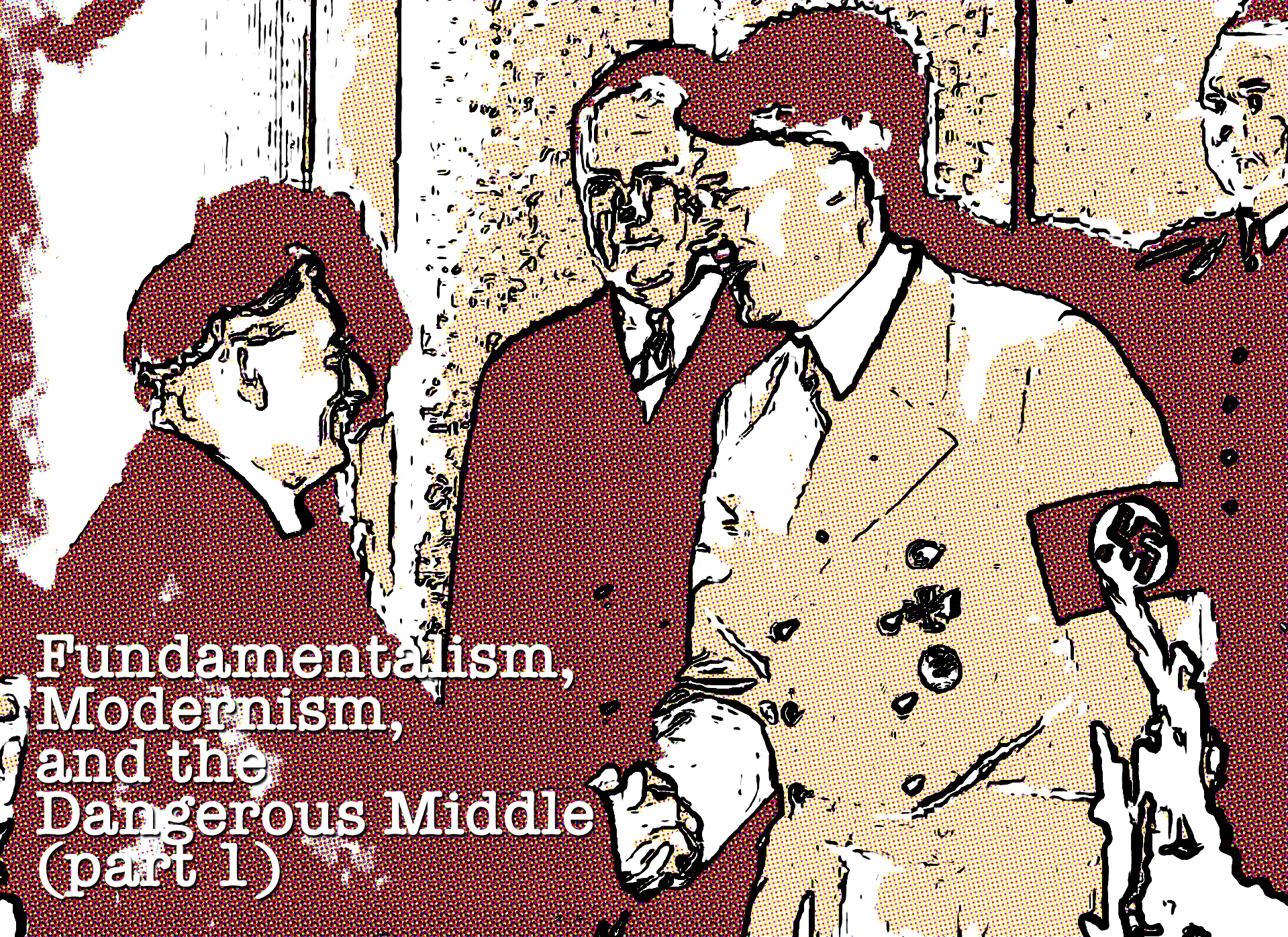
Fundamentalism, Modernism, and the Dangerous Middle (part 1)

In the 2017 World War II movie, The Darkest Hour, Winston Churchill cries out in frustration, “You cannot reason with a tiger when your head is in its mouth!” Although these words are more than likely an artistic embellishment for cinema, they do fairly sum up Churchill’s frustration with the policies of Neville Chamberlain that sought to appease Adolph Hitler by ignoring his aggressions in Europe. Chamberlain truly believed that by signing the Munich Agreement and giving the Sudetenland to Germany along with Hitler’s promise not to continue invading other nations, that Europe would be saved. Chamberlain famously came home and declared that they he had achieved “peace for our time.” Chamberlain thought Hitler was a misunderstood man, when he was in fact the blood-thirsty tiger that would never be satisfied. Churchill understood this and knew that war was the only way to stop him.

The notion of appeasement is not only shared among politicians. Unfortunately, in a world that requires vigilance and sometimes engagement in theological battles, there are those who would seek appeasement and compromise for the sake of “peace in our time.” But as I hope to demonstrate with some examples from recent history, appeasement, and compromise in the face of theological liberalism are always the easier route, but they never achieve the promise they claim.

Setting the Stage: The Fundamentalist and Modernist Controversy

To be clear, we need to understand that prior to the mid-19th century, “evangelical” was synonymous with “fundamentalism.” All Christians who identified with the evangel, the gospel message of Christ, were “evangelicals.” Fundamentalism was a movement that derived its name from those evangelical Christians that sought unity across denominational lines but were committed to certain “fundamental” doctrines that have been accepted by historic Christianity. The number of these fundamentals varied at times, but they almost always included:

  1. The inerrancy of Scripture
  2. The virgin birth of Christ
  3. The substitutionary vicarious atonement of Christ
  4. The bodily resurrection of Christ
  5. The reality of miracles
  6. The imminent and physical return of Christ

Fundamentalists stated that a person had to minimally ascribe to these core doctrines to be within the historic Christian Church because a denial of these doctrines often leads to a wholesale denial of the faith. Modernists (theological liberals), on the other hand, wanted to focus not on the content of belief, but rather the feeling or spirit of Christianity. By denying the need to subscribe to core doctrines of the faith, they could cover the fact that they denied many or all of them, while still insisting they were a part of the Christian church and represented Christianity.

Fundamentalism rejected this minimalistic and emotion drive religion as inadequate at best, and heretical at worst. Several courageous defenders rose up in obedience to Scripture’s call to purify the church:

  • 2 John 9–11 (ESV): “Everyone who goes on ahead and does not abide in the teaching of Christ, does not have God. Whoever abides in the teaching has both the Father and the Son. If anyone comes to you and does not bring this teaching, do not receive him into your house or give him any greeting, for whoever greets him takes part in his wicked works.”
  • Galatians 1:8–9 (ESV): “But even if we or an angel from heaven should preach to you a gospel contrary to the one we preached to you, let him be accursed. As we have said before, so now I say again: If anyone is preaching to you a gospel contrary to the one you received, let him be accursed.”
  • 1 Timothy 6:20–21 (ESV): “O Timothy, guard the deposit entrusted to you. Avoid the irreverent babble and contradictions of what is falsely called “knowledge,” for by professing it some have swerved from the faith. Grace be with you.”

By the middle of the 19th century, theological liberalism has already entered almost all mainline denominations. This was possible because liberal theologians subscribed to the biblical creeds of their denominations and institutions while at the same time teaching non-evangelical theology. Following German liberal Friedrich Schleiermacher (1768-1834), modernists asserted that Christianity was not primarily about doctrine, but rather a “feeling, intuition and experience.”[1] As such, Schleiermacher set the stage for the setting aside of doctrine in favor of a Christianity that affirmed a faith based upon feelings and experiences.

Along with the growth of liberal Christianity came a desire to put aside doctrinal differences among different denominations to bring unity around an ecumenical spirit. This led to the establishment of the World Council of Churches in 1948, made up of “churches which accept our Lord Jesus Christ as God and Savior.”[2] That brief doctrinal statement was all that was required of those joining the WCC, and none were required to expand on what they meant by those words.

Often portrayed as ignorant, uneducated, backwards, anti-science, and anti-progressive by liberals, and “fighting fundamentalists,” uncharitable, ungracious, and divisive, by evangelicals, the fundamentalists stood their ground and called the church to put out of its churches, missions agencies, educational institutions, and para-church organizations all those that were unfaithful to Christ and His Word. But not everyone within evangelicalism agreed with them, thinking there was a better way—a middle way.

My next post will highlight two examples of this attempt to navigate a middle way.


[1] Iain H. Murray, Evangelicalism Divided: A Record of Crucial Change in the Years 1950 to 2000 (Carlisle, PA: Banner of Truth Trust, 2000), 5.

[2] Murray, 3