Is salvation merely a message of “do better?” Is Christianity simply a moralistic religion that teaches that all we need to do is obey God? That is what the self-righteous Pharisees thought, and it is what many people in churches think. To them, Christianity is a list of rules that can be kept–albeit with a lot of sacrifice. Don’t think so? How many times have you heard someone say their wayward son or daughter “just needs to get back to church?” Is that all they need? Is that what Jesus taught?
“On the way to Jerusalem he was passing along between Samaria and Galilee. And as he entered a village, he was met by ten lepers, who stood at a distance and lifted up their voices, saying, “Jesus, Master, have mercy on us.” When he saw them he said to them, “Go and show yourselves to the priests.” And as they went they were cleansed. Then one of them, when he saw that he was healed, turned back, praising God with a loud voice; and he fell on his face at Jesus’ feet, giving him thanks. Now he was a Samaritan. Then Jesus answered, “Were not ten cleansed? Where are the nine? Was no one found to return and give praise to God except this foreigner?” And he said to him, “Rise and go your way; your faith has made you well.””
(Luke 17:11–19, ESV)
It was a disturbing disease, to say the least. The classic case, caused by mycobacterium leprae, might also include related maladies like subcutaneous erysipelas which resulted in a red swelling of the extremities and face, boils, ringworm and sycosis of the scalp and beard which would result in inflammation of the hair follicles. Any form of dermatitis would be terrible enough, but leprosy was worse. Beyond all of the pain, there was the isolation demanded by the Levitical law of the Old Testament.
The passage of Scripture must have haunted each leper’s mind like a bad dream: “As for the leper who has the infection, his clothes shall be torn, and the hair of his head shall be uncovered, and he shall cover his mustache and cry, ‘Unclean! Unclean!’ 46 “He shall remain unclean all the days during which he has the infection; he is unclean. He shall live alone; his dwelling shall be outside the camp” (Lev. 13:45-46).
What a helpless and devastating situation. There was nothing else that could be done. There was no clinic with a newly discovered serum, and no witch doctor with a secret potion. The leper was left with no medicine and very little sympathy. Of course there were other lepers with which one could commiserate, but every glance at a fellow leper only served to remind him that he was grotesque, helpless, and isolated.
Think for a moment about such a man, and about the day this leper heard that Jesus was in town—the rumored Messiah. This was the one everybody had been talking about. They said he could heal. They said he could work miracles. These lepers knew they needed the healing that only God could provide.
The Bible says that one day as Jesus approached a town and ten lepers stood at a distance and began yelling, “Hey! Over here! Jesus! Have mercy on us!” Incredibly, the famous Rabbi actually walked over to them and said simply and calmly, “Go and show yourself to the priest.”
This must have been a shock. “Showing yourself to the priest” was reserved for those whose skin disorder was not permanent. It was for those whose skin had cleared up and showed no sign of the disease. The clean bill of health from the priest was only a nebulous dream for those in the leper colony. But, “who knows?” they may have thought, “maybe the Messiah will empower the priest to heal us?” So off they went, all ten (running I would imagine). Before they arrived, on the way, it happened! All ten social outcasts were instantaneously healed of their leprosy. Think of it! No more leper colony! No more disease! No more discomfort! No more agony!
It surely dawned on them all; it wasn’t the priest, it was the Rabbi. It was Jesus who healed them. Jesus had shown compassion. Jesus had stooped to help their helpless situation. There had to have been a million reasons why the Messiah could have walked right past them. But He didn’t. He noticed. He cared. He healed them.
They were finally clean, and now there was so much to do. There were so many family members to inform, so many friends to tell, so many things to catch up on! Jesus had given them an incredible gift and it seemed only right to begin to celebrate.
Unfortunately, their celebration was incomplete. The Bible says that when those ten leper were faced with the profound choice between enjoying the gift and thanking the giver, nine were so enamored with the benefits of their new life that they gave no attention to the source of their joy. The gift had completely overshadowed the giver. All ten knew who had given them a new life, but only one grateful former leper took the time to fall at the Giver’s feet to say thanks. Just one.
You might expect that the “understanding Messiah” might have been satisfied with 10%, but the chilling response of Jesus must have made the thankful man cringe. “Where are the other nine?” Christ asked. “Weren’t all ten cleansed? Are you the only one who returned to give thanks to God?” With an air of inflexibility Jesus revealed that he expected gratitude be expressed by all to whom his gifts are granted.
What could this man say? “They’re on their way.” “They should be here any second.” Or “They had more important things to do.” “I think they must have forgotten.” There was no way to cover for them. They were simply too busy enjoying the gift to expend any effort in thanking the Giver. Could it be that in reality they selfishly loved the gift more than the Giver?
It’s not right, but it happens. It happens every day. All year long, every month, every week and every day, God is giving good gifts. In our lives he has given and continues to give even more. When it comes to responding with our heartfelt thanks you should know that Jesus is inflexible in his expectation of worship! He expects full and regular participation. Let’s not allow Thanksgiving to just be a date on our calendars. For spiritual lepers made clean, let’s make it a sincere and joyful way of life. Make it a daily practice, not an annual ritual. Make it a discipline and not just a holiday.
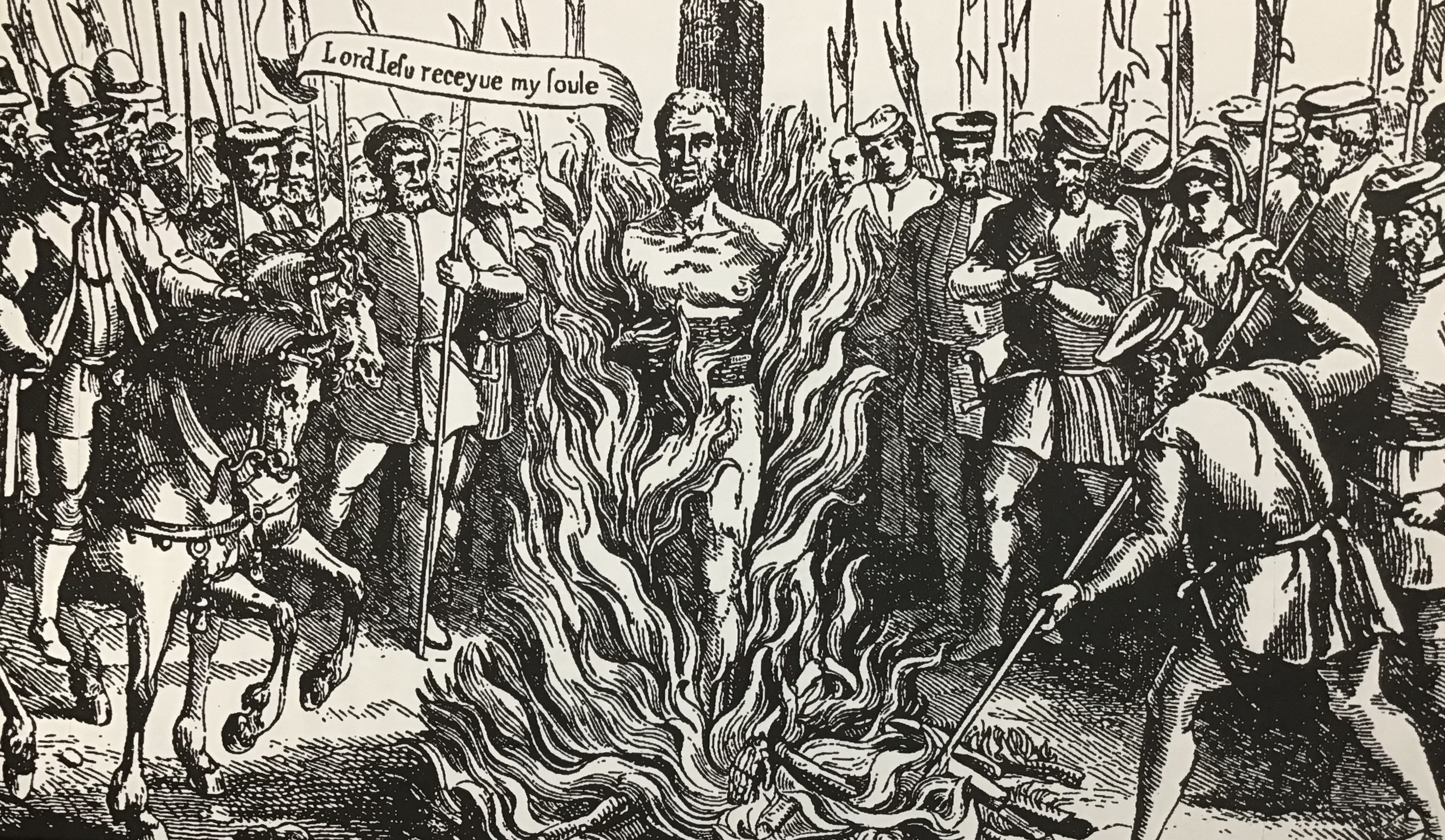
Bishop John Hooper burned at the stake by the order of Queen Mary Tudor
Some claim that since whether one is Amil, Premil, Postmil, is not an issue of salvation, and therefore should be left out of a church doctrinal statement. I think I addressed this in the last post, but I will say this: If we are only going to include universal truths that all Christians agree upon from every communion and tradition, we will indeed have a very small statement.
We have been considering the need for the Church of Jesus Christ to preach the Bible faithfully, in full dependence upon God and the power vested in His Word. In the first article, I wrote that we must preach the Bible because it is our only authority. Without that divine Book, no man standing up on a Sunday morning has any authority. Secondly, we must preach the Bible because the Bible alone demonstrates divine power. Manipulation, oratorical skill, and emotionalism will only get you so far. Today I want to look at one last reason why we must preach the Bible.
3. It Demands Divine Duty
The hard soil of men’s hearts is not something unique to the 21st century. It is as old as humanity itself. This fact needs to sink into the heart of the pastor who is looking for low-hanging fruit when he seeks a ministry. God has not called most of us to a large pulpit ministry, nor world-wide fame. But He has called every one of His ministers to faithfully proclaim the Word wherever we are sent. Hard hearts, gang violence, poor attendance, meager offerings, inadequate facilities, nonexistent leadership, are all realities that can make ministry challenging, but none are reasons to walk away from a church or a community. As a matter of fact, all of these are reasons that a faithful Bible preaching, gospel-saturated church is needed in that place. The marks of this divine duty require us to preach faithfully, preach plainly, and preach patiently.
Preach Faithfully (Ezek. 2-3; 2 Tim. 4:1-5)
Facing the rebellious nation of Israel, the Lord clearly told Ezekiel what he must do, “And you shall speak my words to them, whether they hear or refuse to hear, for they are a rebellious house.” (Ezek. 2:7, ESV). Over and over again, Ezekiel was told that Israel was a rebellious house, impudent, stubborn, and hard-headed. And yet, his instructions were clear, speak God’s words to them. Though they would not listen, and though they were so hard in heart, it did not change the directive—be a watchman (3:17) and speak the words of impending judgment (v. 19) no matter what. Faithfulness is what God requires (3:19, 21).
As the Apostle Paul faced his own death, he exhorted Timothy to continue to persevere in the ministry of the Word in season and out of season. For Timothy, Paul’s imprisonment and coming death was a very real illustration of the threat to the gospel ministry. Paul didn’t instruct Timothy to move to a safer territory nor did he instruct him to avoid suffering, but instead encouraged him to keep preaching even when people will no longer endure it and that this might include the need to endure suffering for the sake of Christ. Paul was faithful to preach the whole counsel of God and he would receive his reward in due time (2 Tim. 4:7-8).
Preach Plainly (1Cor. 2:1-5)
Plain preaching is not the same as bland preaching, nor does it mean to preach simplistically. Paul’s desire to give Jesus Christ all the glory required him to make sure that his own preaching did not put the spotlight on his considerable education, gifts, and talents. Although the so-called super-apostles had a low view of Paul’s presence and preaching ability (2 Cor. 10:10), he placed his full dependence upon the power of God’s Spirit working through the Word of God. In doing this, Paul put the cross of Christ on full display. Plain preaching is not flashy, gimmicky, or self-seeking. Simply put, plain preaching is Spirit-empowered, not man-centered. The Puritan Richard Baxter wrote, “It is no easy matter to speak so plain that the ignorant may understand us, so seriously that the deadest heart may feel us, and so convincingly that contradictory cavaliers may be silenced.” (Joel R. Beeke and Mark Jones, A Puritan Theology: Doctrine for Life, (Reformation Heritage Books, Grand Rapids, 2012), 695).
Preach Patiently (2 Tim. 4:2)
Our duty to preach the Word must be done with the reminder that we do not preach ourselves nor do we preach our words. Pastors are under-shepherds that are to lead without being domineering. We are to be loving examples to the flock that has been placed in our charge (1 Pet. 5:2-4). This means that we must teach the Word of God with the patience of our Master (2 Tim. 4:2), and that is easier said than done, particularly when we are facing the growing challenges of ministry today. Nevertheless, we must teach and preach with great patience, waiting upon the Word and Spirit to do their mighty work.
Although the reasons that we preach the Word could be multiplied, these three should stand out for us—it is our authority, our power and our duty. And as we faithfully proclaim the Word, we can expect that it will do its mighty work of reviving the soul and enlightening the eyes (Ps. 19:7, 8). The benefits of doing so will manifest themselves in due time, showing us that as we sow the seeds of the Word into the hearts of our congregations that all our efforts are profitable (2 Tim. 3:16-17), and will accomplish the will of God in the end (Isa. 55:11).
As William Gurnall wrote a long time ago, “The Word of God is too sacred a thing and preaching to solemn a work, to be toyed and played with” (Ibid., 685). May we pick up our Swords and faithfully execute the ministry that the Lord has called each of us to do, for His greater glory and for the good of the Church.
It was June 18, 1815, the Battle of Waterloo. The French under the command of Napoleon were fighting the allied forces of the British, Dutch, and Germans under the command of the Duke of Wellington. The people of England depended on a system of signals to find out how the battle was going. One of these signals was on the tower of Winchester Cathedral.
Late in the day it flashed the signal: “W – E – L – L – I – N – G – T – O – N – – – D – E – F – E – A – T – E – D – – -.” Just at that moment a fog cloud made it impossible to read the message. The news of defeat quickly spread throughout the city. The whole countryside was sad and gloomy when they heard the news that their country had lost the war. Suddenly, the fog lifted, and the remainder of the message could be read. The message had four words, not two. The complete message was: “W – E – L – L – I – N – G – T – O – N – – – D – E – F – E – A – T – E – D – – – T – H – E – – – E – N – E – M – Y!” It took only a few minutes for the good news to spread. Sorrow was turned into joy, defeat was turned into victory!
So it was when Jesus was laid in the tomb. Hope had died in the hearts of Jesus’ most loyal friends. After the frightful crucifixion, the fog of disappointment and misunderstanding had crept in on the friends of Jesus. They had read only part of the message. “Christ defeated” was all they knew. But then on the third day the fog of disappointment and misunderstanding lifted, and the world received the complete message: “Christ defeated sin and death!” Defeat was turned into victory; death was turned into life!
“Now if Christ is preached, that He has been raised from the dead, how do some among you say that there is no resurrection of the dead?But if there is no resurrection of the dead, not even Christ has been raised;and if Christ has not been raised, then our preaching is vain, your faith also is vain.Moreover we are even found to be false witnesses of God, because we testified against God that He raised Christ, whom He did not raise, if in fact the dead are not raised.For if the dead are not raised, not even Christ has been raised;and if Christ has not been raised, your faith is worthless; you are still in your sins.Then those also who have fallen asleep in Christ have perished.If we have hoped in Christ in this life only, we are of all men most to be pitied.”
(1 Corinthians 15:12–19, NASB95)
I want us to consider one question today: what if Christ didn’t rise again?
Jesus would be a liar.
Christ predicted His resurrection on several occasions. At first He used only vague terms, such as “Destroy this temple, and in three days I will raise it up (John 2:19). But later on in His ministry He spoke quite plainly. Matthew writes, “From that time Jesus began to show his disciples that he must go to Jerusalem and suffer many things from the elders and chief priests and scribes, and be killed, and on the third day be raised.” (Matt. 16:21).
Jesus says in Matthew 12:40, “For just as Jonah was three days and three nights in the belly of the great fish, so will the Son of Man be three days and three nights in the heart of the earth.” And later in 20:18-19 He predicts, “See, we are going up to Jerusalem. And the Son of Man will be delivered over to the chief priests and scribes, and they will condemn him to death and deliver him over to the Gentiles to be mocked and flogged and crucified, and he will be raised on the third day.” Mark records Jesus saying, “But after I am raised up, I will go before you to Galilee.” (Mark 14:28).
In John 10:17-18 we find Jesus saying these words: “For this reason the Father loves me, because I lay down my life that I may take it up again. No one takes it from me, but I lay it down of my own accord. I have authority to lay it down, and I have authority to take it up again. This charge I have received from my Father.” To the women who came to Christ’s tomb on Easter morning and wondered where His body was, the angel said, “He is not here, for he has risen, as he said. Come, see the place where he lay.” (Matt. 28:6).
If the resurrection did not happen, we would have to say the Jesus was a liar. And if He lied about the resurrection, could we trust His other sayings?
If Christ Didn’t Rise Again, Then There is No Good News. (1Cor. 15:14)
Paul tells us what the gospel is in 1Corinthians 15:3, 4: “For I delivered unto you first of all that which I also received, how that Christ died for our sins according to the scriptures; and that he was buried, and that he rose again the third day according to the scriptures.”
The word “gospel” means “good news.” But if the resurrection is taken from the gospel, we are left with sad news, not good news. We are left with Jesus’ death and burial. That is not “Good News.”
We’d have a Savior who died for our sins on the cross, and was buried, but he is still in the grave. That is only half of the Gospel, and half a gospel is no gospel at all.
If Jesus Didn’t Rise Again, Then Our Faith is Groundless (1Cor. 15:14b, 17)
Faith in a dead Savior is both preposterous and pathetic. If you were being chased by a madman, and you had the choice of running either to a house full of people or a cemetery for help, where would you run? I think we would all run to the house full of people. Why? Because the house if filled with living people who could help, while the cemetery is filled with dead bodies which can do nothing.
If Jesus Christ did not rise and is still dead then He has no power to save us. He had no power to save himself! Our faith would be in vain, and worse, we would still be in our sins and still on our way to hell.
We are spreading a lie (1Cor 15:15)
While claiming to do God’s work, we would actually be spreading a lie!
If Jesus is still dead and was buried in a tomb never to be raised alive, then we are the worst charlatans because we are giving hope to the hopeless, but it is all a sham. This would be like the old snake-oil salesmen of the west who would sell a cheap elixer that would give a sick man hope that he would be cured, all the while he is dying.
Could this please God if it is not true? We would be, as Paul says, “misrepresenting God.” We would be guilty of spiritual malpractice of the worst kind.
We have no hope for the future (1Cor. 15:18).
Christ’s resurrection is a guarantee of the future resurrection of His people; so if Christ is not risen then this guarantee is worthless. Paul wrote to some bereaved Christians at Thessalonica who had lost relatives and friends (1 Thess. 4:13-14). And then at the close of this message of consolation he writes, “Therefore encourage one another with these words.” (v. 18). If Christ is not risen, there is no comfort.
We suffer for nothing (1Cor 15:19).
Here is how Alan Redpath paraphrases this passage: “If Christ is not risen, then our faith is empty, our preaching useless, and he has failed to deal with sin at all. If he has not been raised from the tomb, we are still in our sins and all his promises are absolutely untrue. He is a fraud, an imposter, and his ashes are buried somewhere in Palestine today. There is no hope beyond the grave for anybody, and those who have died professing faith in him are just left there forever.”
When Paul says if Christ is not risen then we are “of all people most to be pitied,” he means that of all the people in the world, Christians are the ones who deserve the most pity.
If Christ is not risen, why bother to go to church? You would be better off somewhere else.
If Christ is not risen, why bother to put money in the offering plate? You’re only giving to a lost cause.
If Christ is not risen, why bother to serve Him? You’re only wasting your time.
If Christ is not risen, why tell others about Him? You might as well save your breath.
Thomas Jefferson, a great man, nevertheless could not accept the miraculous elements in Scripture. He edited his own special version of the Bible in which all references to the supernatural were deleted. Jefferson, in editing the Gospels, confined himself solely to the moral teachings of Jesus. The closing words of Jefferson’s Bible are these: “There laid they Jesus and rolled a great stone at the mouth of the sepulchre and departed.” Thank God that is not the way the story really ends!
Christ was telling the truth when He predicted He would rise from the dead. He is the Son of God. The gospel really is good news. It really is “the power of God to salvation to every one that believes.” Our faith is grounded in a living Savior who can save every person from sin, death, and hell. When we share the good news of Jesus Christ, we are spreading the truth, not a lie. We also have the sure expectation of a bodily resurrection. Our bodies will not stay in the grave; we will rise again as Christ did. And we are not of “of all men most to be pitied.” We have every reason to be the happiest people on earth.
Sigmund Freud, the founder of modern psychiatry, wrote: “And finally there is the painful riddle of death, for which no remedy at all has yet been found, nor probably ever will be!” But Christians have victory in death and over death because of the victory of Jesus Christ in His own resurrection. Jesus said, “Because I live, you shall live also” (John 14:19).
Every year thousands of people climb a mountain in the Italian Alps, passing the “stations of the cross” to stand at an outdoor crucifix. One tourist noticed a little trail that led beyond the cross. He fought through the rough thicket and, to his surprise, came upon another shrine, a shrine that symbolized the empty tomb. It was neglected. The brush had grown up around it. Almost everyone had gone as far as the cross, but there they stopped. Far too many have gotten to the cross and have known the despair and the heartbreak. Far too few have moved beyond the cross to find the real message of the resurrection. That is the message of the empty tomb. You can be saved today because Christ died and rose again. This is not simply the message of Easter, this is the message of Christianity.



 Always Reforming