A few nights ago I awoke with the aches and pains of a sickness I have been fighting for a few days. Unable to sleep, I started to reflect upon all the friends and loved ones that are struggling with pain and suffering to a much greater degree. I thought about those who are facing a crumbling marriage, the loss of a spouse, the onset of a disease that will take their life. I lay in the dark and considered the deep comfort that we have in Christ.
The Christian life is not an easy one, and may even be fraught with greater struggles because of our commitment to follow Christ whatever the cost. But there is no accounting for the presence of Christ in the midst of these struggles.
Dear brothers and sisters in Christ, the world is watching. Please do not show them a perfect, polished life free of any pain or sorrow. Such a life does not exist in this broken world. Show them that you too are cracked and flawed, just as they are. Show them that you too struggle with weaknesses and doubts. And then show them that our God sent his Son for us, to bring us safely to his promised land. He gives his Spirit so that as we sit in pain and doubt we will know his supernatural presence and find comfort.
As you listen to the song below, remember that we must sometimes fight for faith to know the joy of the Lord—and in the end, Jesus will be victorious. Like Job, we may not always understand, but we trust.
Is salvation merely a message of “do better?” Is Christianity simply a moralistic religion that teaches that all we need to do is obey God? That is what the self-righteous Pharisees thought, and it is what many people in churches think. To them, Christianity is a list of rules that can be kept–albeit with a lot of sacrifice. Don’t think so? How many times have you heard someone say their wayward son or daughter “just needs to get back to church?” Is that all they need? Is that what Jesus taught?
“On the way to Jerusalem he was passing along between Samaria and Galilee. And as he entered a village, he was met by ten lepers, who stood at a distance and lifted up their voices, saying, “Jesus, Master, have mercy on us.” When he saw them he said to them, “Go and show yourselves to the priests.” And as they went they were cleansed. Then one of them, when he saw that he was healed, turned back, praising God with a loud voice; and he fell on his face at Jesus’ feet, giving him thanks. Now he was a Samaritan. Then Jesus answered, “Were not ten cleansed? Where are the nine? Was no one found to return and give praise to God except this foreigner?” And he said to him, “Rise and go your way; your faith has made you well.””
(Luke 17:11–19, ESV)
It was a disturbing disease, to say the least. The classic case, caused by mycobacterium leprae, might also include related maladies like subcutaneous erysipelas which resulted in a red swelling of the extremities and face, boils, ringworm and sycosis of the scalp and beard which would result in inflammation of the hair follicles. Any form of dermatitis would be terrible enough, but leprosy was worse. Beyond all of the pain, there was the isolation demanded by the Levitical law of the Old Testament.
The passage of Scripture must have haunted each leper’s mind like a bad dream: “As for the leper who has the infection, his clothes shall be torn, and the hair of his head shall be uncovered, and he shall cover his mustache and cry, ‘Unclean! Unclean!’ 46 “He shall remain unclean all the days during which he has the infection; he is unclean. He shall live alone; his dwelling shall be outside the camp” (Lev. 13:45-46).
What a helpless and devastating situation. There was nothing else that could be done. There was no clinic with a newly discovered serum, and no witch doctor with a secret potion. The leper was left with no medicine and very little sympathy. Of course there were other lepers with which one could commiserate, but every glance at a fellow leper only served to remind him that he was grotesque, helpless, and isolated.
Think for a moment about such a man, and about the day this leper heard that Jesus was in town—the rumored Messiah. This was the one everybody had been talking about. They said he could heal. They said he could work miracles. These lepers knew they needed the healing that only God could provide.
The Bible says that one day as Jesus approached a town and ten lepers stood at a distance and began yelling, “Hey! Over here! Jesus! Have mercy on us!” Incredibly, the famous Rabbi actually walked over to them and said simply and calmly, “Go and show yourself to the priest.”
This must have been a shock. “Showing yourself to the priest” was reserved for those whose skin disorder was not permanent. It was for those whose skin had cleared up and showed no sign of the disease. The clean bill of health from the priest was only a nebulous dream for those in the leper colony. But, “who knows?” they may have thought, “maybe the Messiah will empower the priest to heal us?” So off they went, all ten (running I would imagine). Before they arrived, on the way, it happened! All ten social outcasts were instantaneously healed of their leprosy. Think of it! No more leper colony! No more disease! No more discomfort! No more agony!
It surely dawned on them all; it wasn’t the priest, it was the Rabbi. It was Jesus who healed them. Jesus had shown compassion. Jesus had stooped to help their helpless situation. There had to have been a million reasons why the Messiah could have walked right past them. But He didn’t. He noticed. He cared. He healed them.
They were finally clean, and now there was so much to do. There were so many family members to inform, so many friends to tell, so many things to catch up on! Jesus had given them an incredible gift and it seemed only right to begin to celebrate.
Unfortunately, their celebration was incomplete. The Bible says that when those ten leper were faced with the profound choice between enjoying the gift and thanking the giver, nine were so enamored with the benefits of their new life that they gave no attention to the source of their joy. The gift had completely overshadowed the giver. All ten knew who had given them a new life, but only one grateful former leper took the time to fall at the Giver’s feet to say thanks. Just one.
You might expect that the “understanding Messiah” might have been satisfied with 10%, but the chilling response of Jesus must have made the thankful man cringe. “Where are the other nine?” Christ asked. “Weren’t all ten cleansed? Are you the only one who returned to give thanks to God?” With an air of inflexibility Jesus revealed that he expected gratitude be expressed by all to whom his gifts are granted.
What could this man say? “They’re on their way.” “They should be here any second.” Or “They had more important things to do.” “I think they must have forgotten.” There was no way to cover for them. They were simply too busy enjoying the gift to expend any effort in thanking the Giver. Could it be that in reality they selfishly loved the gift more than the Giver?
It’s not right, but it happens. It happens every day. All year long, every month, every week and every day, God is giving good gifts. In our lives he has given and continues to give even more. When it comes to responding with our heartfelt thanks you should know that Jesus is inflexible in his expectation of worship! He expects full and regular participation. Let’s not allow Thanksgiving to just be a date on our calendars. For spiritual lepers made clean, let’s make it a sincere and joyful way of life. Make it a daily practice, not an annual ritual. Make it a discipline and not just a holiday.
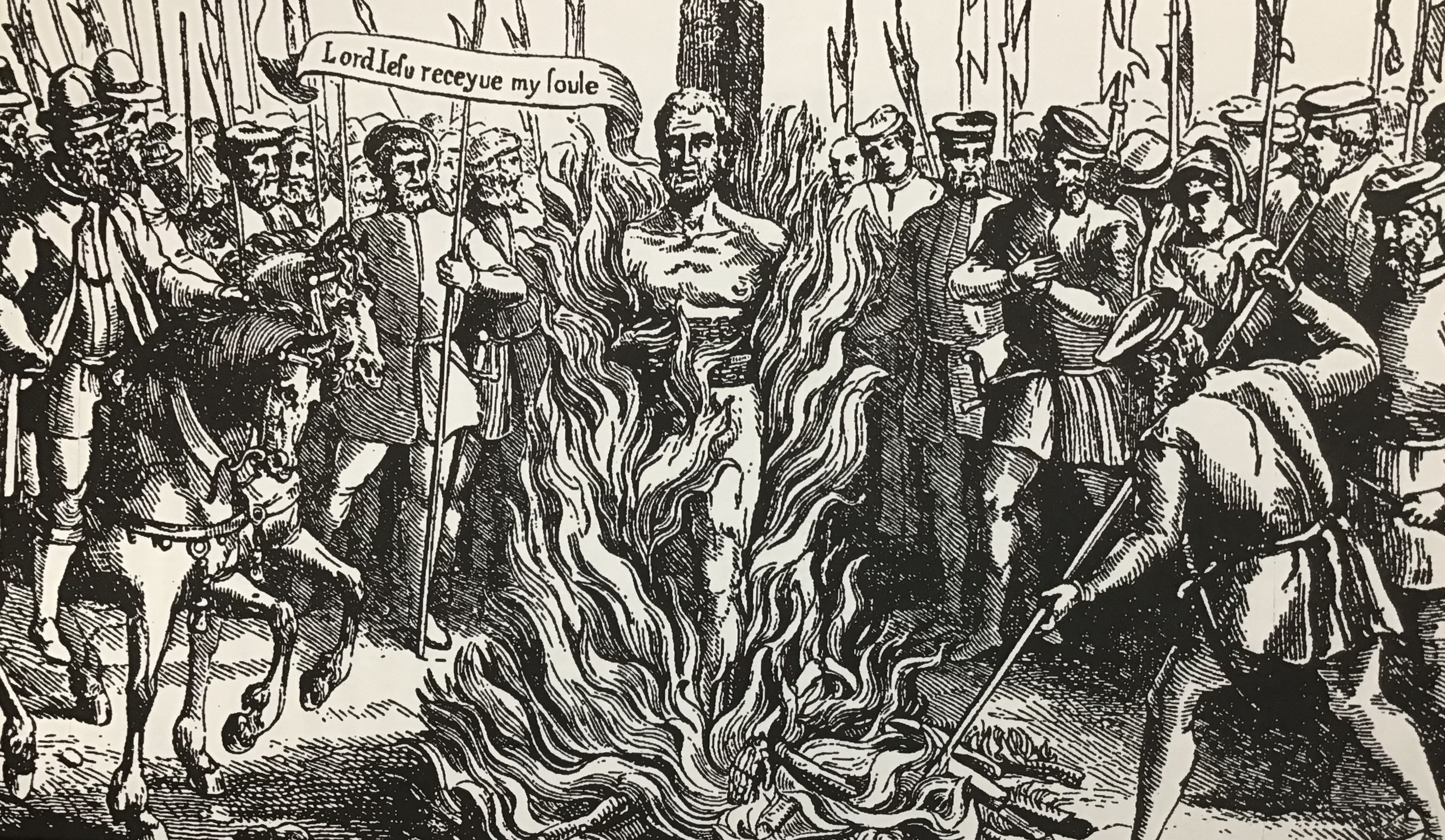
Bishop John Hooper burned at the stake by the order of Queen Mary Tudor
Some claim that since whether one is Amil, Premil, Postmil, is not an issue of salvation, and therefore should be left out of a church doctrinal statement. I think I addressed this in the last post, but I will say this: If we are only going to include universal truths that all Christians agree upon from every communion and tradition, we will indeed have a very small statement.
We have been considering the need for the Church of Jesus Christ to preach the Bible faithfully, in full dependence upon God and the power vested in His Word. In the first article, I wrote that we must preach the Bible because it is our only authority. Without that divine Book, no man standing up on a Sunday morning has any authority. Secondly, we must preach the Bible because the Bible alone demonstrates divine power. Manipulation, oratorical skill, and emotionalism will only get you so far. Today I want to look at one last reason why we must preach the Bible.
3. It Demands Divine Duty
The hard soil of men’s hearts is not something unique to the 21st century. It is as old as humanity itself. This fact needs to sink into the heart of the pastor who is looking for low-hanging fruit when he seeks a ministry. God has not called most of us to a large pulpit ministry, nor world-wide fame. But He has called every one of His ministers to faithfully proclaim the Word wherever we are sent. Hard hearts, gang violence, poor attendance, meager offerings, inadequate facilities, nonexistent leadership, are all realities that can make ministry challenging, but none are reasons to walk away from a church or a community. As a matter of fact, all of these are reasons that a faithful Bible preaching, gospel-saturated church is needed in that place. The marks of this divine duty require us to preach faithfully, preach plainly, and preach patiently.
Preach Faithfully (Ezek. 2-3; 2 Tim. 4:1-5)
Facing the rebellious nation of Israel, the Lord clearly told Ezekiel what he must do, “And you shall speak my words to them, whether they hear or refuse to hear, for they are a rebellious house.” (Ezek. 2:7, ESV). Over and over again, Ezekiel was told that Israel was a rebellious house, impudent, stubborn, and hard-headed. And yet, his instructions were clear, speak God’s words to them. Though they would not listen, and though they were so hard in heart, it did not change the directive—be a watchman (3:17) and speak the words of impending judgment (v. 19) no matter what. Faithfulness is what God requires (3:19, 21).
As the Apostle Paul faced his own death, he exhorted Timothy to continue to persevere in the ministry of the Word in season and out of season. For Timothy, Paul’s imprisonment and coming death was a very real illustration of the threat to the gospel ministry. Paul didn’t instruct Timothy to move to a safer territory nor did he instruct him to avoid suffering, but instead encouraged him to keep preaching even when people will no longer endure it and that this might include the need to endure suffering for the sake of Christ. Paul was faithful to preach the whole counsel of God and he would receive his reward in due time (2 Tim. 4:7-8).
Preach Plainly (1Cor. 2:1-5)
Plain preaching is not the same as bland preaching, nor does it mean to preach simplistically. Paul’s desire to give Jesus Christ all the glory required him to make sure that his own preaching did not put the spotlight on his considerable education, gifts, and talents. Although the so-called super-apostles had a low view of Paul’s presence and preaching ability (2 Cor. 10:10), he placed his full dependence upon the power of God’s Spirit working through the Word of God. In doing this, Paul put the cross of Christ on full display. Plain preaching is not flashy, gimmicky, or self-seeking. Simply put, plain preaching is Spirit-empowered, not man-centered. The Puritan Richard Baxter wrote, “It is no easy matter to speak so plain that the ignorant may understand us, so seriously that the deadest heart may feel us, and so convincingly that contradictory cavaliers may be silenced.” (Joel R. Beeke and Mark Jones, A Puritan Theology: Doctrine for Life, (Reformation Heritage Books, Grand Rapids, 2012), 695).
Preach Patiently (2 Tim. 4:2)
Our duty to preach the Word must be done with the reminder that we do not preach ourselves nor do we preach our words. Pastors are under-shepherds that are to lead without being domineering. We are to be loving examples to the flock that has been placed in our charge (1 Pet. 5:2-4). This means that we must teach the Word of God with the patience of our Master (2 Tim. 4:2), and that is easier said than done, particularly when we are facing the growing challenges of ministry today. Nevertheless, we must teach and preach with great patience, waiting upon the Word and Spirit to do their mighty work.
Although the reasons that we preach the Word could be multiplied, these three should stand out for us—it is our authority, our power and our duty. And as we faithfully proclaim the Word, we can expect that it will do its mighty work of reviving the soul and enlightening the eyes (Ps. 19:7, 8). The benefits of doing so will manifest themselves in due time, showing us that as we sow the seeds of the Word into the hearts of our congregations that all our efforts are profitable (2 Tim. 3:16-17), and will accomplish the will of God in the end (Isa. 55:11).
As William Gurnall wrote a long time ago, “The Word of God is too sacred a thing and preaching to solemn a work, to be toyed and played with” (Ibid., 685). May we pick up our Swords and faithfully execute the ministry that the Lord has called each of us to do, for His greater glory and for the good of the Church.