Make your introduction disproportionate to the sermon. Your intro is like a porch to your sermon (the house). Make the porch fit the house.
Cram details into the sermon that should more properly be placed into the sermon under a main or sub-point.
Avoid eye contact or read your intro. Eye contact is important to engage your listeners. Know your intro so well that you will not need to read it. With that said, lengthy quotes are seldom appropriate in an introduction.
Introduce your first point, or a sub-point or idea in your sermon. This is confusing. Introduce the main point, which should cover your proposition and outline.
Introduce the book, genre, author or audience. This material is background, but not the main idea of the text.
Do:
Be clear, and concise. Make an impact that will leave your listener wanting more.
Be creative. Introducing every sermon in the same manner gets as tedious as a bologna sandwich every day for lunch. Mix it up.
Be careful in your use of sensational or shocking introductions. They may distract from the message proper, and if over-done will desensitize your listeners over time.
Be brief. Don’t repeat yourself or use multiple illustrations. Get to the main idea and transition into your proposition as quickly as possible. Your job is to exposit the text—so move on to it!
Be energetic. Nothing invites a wandering mind and a good nap than a boring preacher.
If we want to improve in any skill, we must practice. This axiom is also true for preaching. If you don’t get many opportunities to preach, them you won’t be able to grow as an expositor. But there is an additional tool beyond practice that is also needed. As a matter of fact, it goes hand in hand with practice. It’s feedback. We need help with seeing our blindspots and our weaknesses in our sermons and delivery. One good place to get helpful feedback is from our church–those people that love us and want us to grow in our skills.
Now I understand that going to someone in your church and asking them to critique your preaching is a scary prospect because we are opening ourselves up to someone when we are very vulnerable. But we need the feedback if we are to get better and improve our preaching skills. So here is how you can being:
Find two or three people you trust will be both kind and honest with you as they critique your preaching.
If you have an idea of where you might need to improve, try working on this skill set for a month. Don;t try to change too much too fact or you will freeze up with the “paralysis of analysis” syndrome. Once you get a skill under your belt, you can move on.
Explain to those people who are giving you feedback what they should be looking for. They need to know how to identify weakness in you beyond what they like and don’t like. It needs to be defined and measurable.
After they give you feedback, thank them and assure them that you will take their comments into consideration and work on these things. Then do it!
I have created a simple form to give to those in a church with helpful areas for them to take notes. I would suggest that you not only explain what they are looking for, understand that they are helping you out, so don’t demand that they spend too much time distracted with the critique so that they get nothing from the message. In fact, you might want to rotate those that help you with feedback so it isn’t the same people week after week. Here are the questions I include on my form:
Sermon Evaluation
Preacher’s name: _____________________
Sermon title: _________________________
Sermon main text: ____________________
Date preached: _______________________
Introduction:
Did the introduction lead to the main idea of the text?
Was it interesting?
Did it include enough background info to give context without bogging down the sermon?
Sermon Body:
Was there a clear outline?
Was the outlining of the sermon choppy?
Did the preacher point us back to the text to prove his point?
Did he stray from the text or explain it?
Were there sufficient illustrations to make the abstract ideas concrete?
Was there appropriate application given?
Was the main point of the text the main point of the sermon?
Was there doctrinal error?
Was the explanation of the main doctrines clear?
Sermon Conclusion:
Was the gospel somehow included in the sermon or conclusion?
Was this message God-centered?
Was this message overall clear, somewhat clear, muddy, or confusing?
Was the hearer given something to do or believe?
Outline:
(The one giving feedback should be instructed to write out your outline as they heard it. This should help you evaluate how successfully you gave out the outline in regard to repetition, and clarity.)
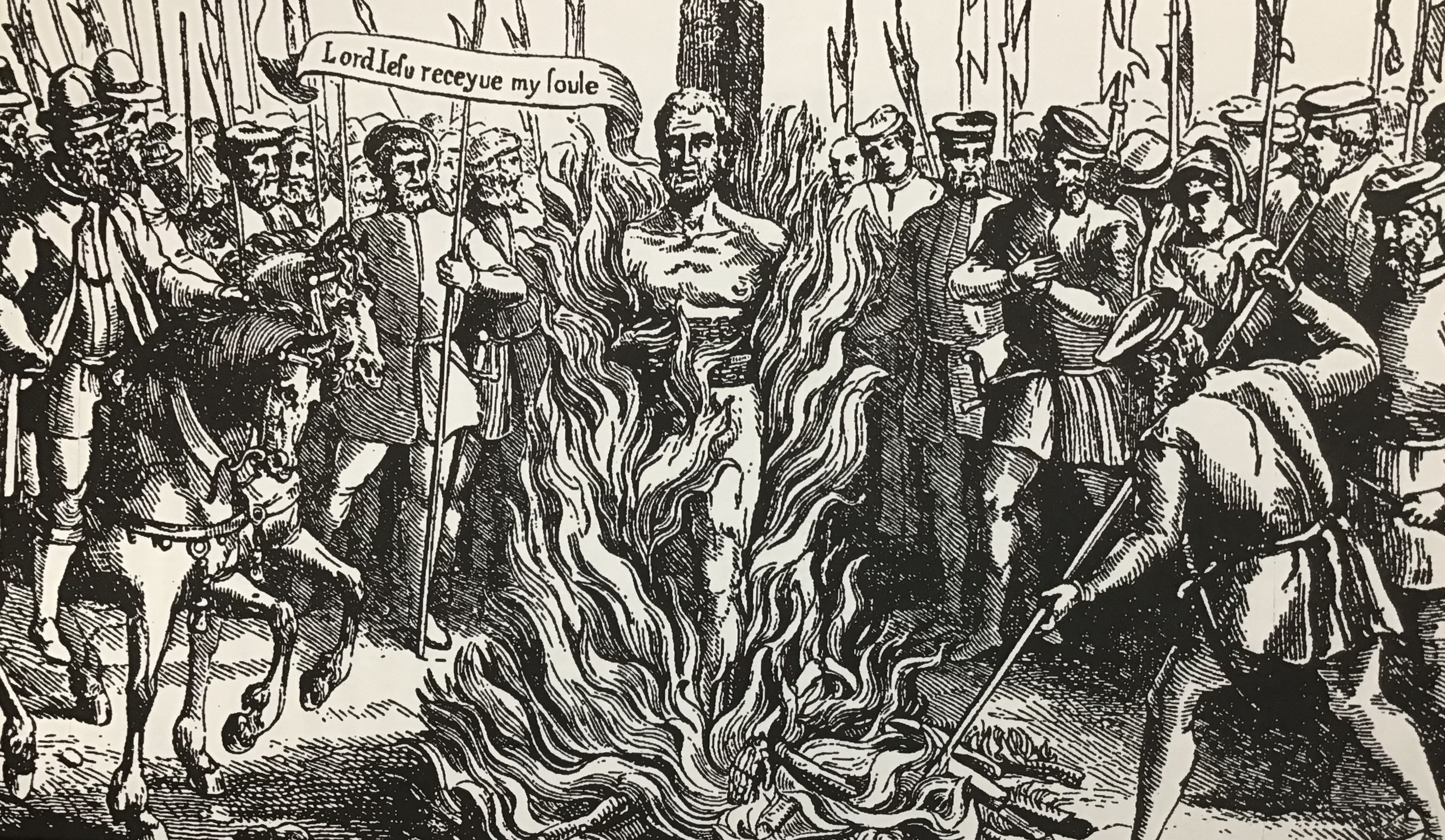
Bishop John Hooper burned at the stake by the order of Queen Mary Tudor
Some claim that since whether one is Amil, Premil, Postmil, is not an issue of salvation, and therefore should be left out of a church doctrinal statement. I think I addressed this in the last post, but I will say this: If we are only going to include universal truths that all Christians agree upon from every communion and tradition, we will indeed have a very small statement.
Why do we bother preaching the Bible as divinely authoritative? If you listen to what came out of many pulpits yesterday, you might think that preaching deep and doctrinal truth from the Bible is optional. In this three part series I want to argue that preaching deep and expositional messages from the Bible isn’t simply a personal preference, but is actually the necessary requirement of any man who is called of God to proclaim the Word of the Lord. In my last blogpost (you can read it here: Why We Must Preach the Bible (part 1), I argued that we must preach the Bible because it declares with divine power. This isn’t whipped up by yelling in the pulpit, lighting packages, emotion-driven love songs to Jesus, or “authentic” talks meant to motivate. We need to preach the Word of God because it is the only thing that can cut into the hardest heart. Secondly…
2. It Demonstrates Divine Power
If we understand that all of unregenerate mankind has been blinded by Satan (2 Cor. 4:4) and are dead in their trespasses and sin without Christ (Eph. 2:1), and that even after we have come to know Jesus as Savior we are still in need of the Spirit’s illuminating power (1 Cor. 1:12-13), then we also will understand the need for the divine power of the Word that can overcome the devastating spiritual effects of the Fall.
The Power to Open Blind Eyes
In the aftermath of the resurrection of Christ, there was a lot of confusion among the disciples of Jesus. They had begun to recall the words of Jesus about His rising from the dead, and they had also heard the seemingly outrageous stories from the women who said they saw angels who told them about the risen Christ (Lk. 24:1-9, 22-24). As two disciples puzzled over the events of that first Easter morning, they moved along the road to Emmaus where they encountered a fellow traveler, the resurrected Christ, who was veiled to their eyes.
As they spoke to Jesus, they explained the confusion and the promises and the grief they shared over having lost their dear Master. Jesus gently rebuked the men (v. 25) as He explained from the Old Testament how the Scriptures needed to be fulfilled concerning the Messiah (v. 27). After Jesus’ sudden self-revelation and departure, these two men discussed what they felt as the Scriptures were opened to them: “They said to each other, “Did not our hearts burn within us while he talked to us on the road, while he opened to us the Scriptures?”” (Lk. 24:32, ESV). Their experience was not simply an emotional response, but the active working of the Spirit in revealing truth to their blind eyes, which now could see.
Another example of such power to open blind eyes can be seen along a riverside just outside of the city of Philippi where the Apostle Paul and his team proclaimed the gospel message to a small group of women who had gathered there to pray on the Sabbath (Acts 16:11-13). As Paul preached, Lydia’s eyes were opened by the Lord, causing her to pay attention to the message that Paul preached. Immediately she was changed as she gave her life to Christ. She was baptized and hosted Paul and his companions in her home (v. 15).
Why do we preach the Bible? Because it is the only means that God has given us to open blind eyes.
The Power to Bring Revival
Our God is not a genie that we can simply schedule when we want Him to show up. Biblical revival cannot be stirred up by man, for “The wind blows where it wishes, and you hear its sound, but you do not know where it comes from or where it goes. So it is with everyone who is born of the Spirit.”” (John 3:8, ESV). But this truth does not mean that there are not elements of true, biblical revival that accompany God’s work in bringing about a genuine work of God. The Old Testament gives a few prominent examples of revival that came to the people of Israel, and each one was accompanied by the proclamation of the Word of God. I want to highlight two of those examples so that the power of the Word might be shown in how God brings about genuine revival.
Josiah (2 Kgs. 22-23)
Having found the Book of the Law while making repairs to the Temple, King Josiah was undone when it was read in his presence. As he listened to the reading of the Book of the Law, the king began to see more clearly how disobedient Judah had been in God’s eyes (vv. 10-13). After seeking the prophetic Word of the Lord, Josiah was humbled, and he actively began seeking to eradicate the wicked idolatry that had been rampant in his kingdom. Along with cleansing the land of false worship, he also sought to restore the approved worship that the Word of God directed to his people. Think about it, the Word wasn’t preached, it was simply read. No fancy outlines, no illustrations or catchy titles or PowerPoint slides. The Word was read, and the Spirit did His convicting work in Josiah, moving him to reform the whole kingdom.
Ezra (Neh. 8-9)
Under the leadership of Ezra, the priestly scribe, and Nehemiah the governor, the returning exiles longed to hear from the God of their Fathers as they had begun to see their need to be a separate people from the pagans all around them. God had begun to restore the nation, but not without challenges from their enemies. And so, as Ezra opened the Law and the elders explained its meaning to the people (8:3), the people began to sense their spiritual thirst and their parched souls began to be refreshed as the Spirit began to move them to understand the great and tender mercy of their God (8:9-12). Following a short time of rejoicing, the people began to reinstate the holy practices that had been long lost and forgotten (vv. 14-18) and began to openly confess their sin with grief and contrition (9:1-4). The brokenness of the people led to worship that was filled with confession, restoration, cleansing and rejoicing. The power of the Word had broken the hardest hearts and restored them like nothing else could.
In the modern church today, there are all sorts of man-made methods and programs that seek these kinds of results but fail to make any lasting change. Pragmatism, that philosophy that seeks to determine value based upon the success or failure of end results, is not a Christian concept. Where was the pragmatism in the prophet Isaiah when God said to Him, ““Go, and say to this people: “‘Keep on hearing, but do not understand; keep on seeing, but do not perceive.’ Make the heart of this people dull, and their ears heavy, and blind their eyes; lest they see with their eyes, and hear with their ears, and understand with their hearts, and turn and be healed.” (Isa. 6:9–10, ESV)? There was no revival in the land, but God still called for faithfulness in the ministry of Isaiah.
And where can we find a pragmatic approach in the ministry of Jeremiah, the weeping prophet who mourned over the sins of God’s people for their sin, but was mistreated and scorned and seemed to have been ignored by nearly everyone (Jer. 38:6)? And what about the testimonies of those spoken of in Hebrews 11:36-38?
“Others suffered mocking and flogging, and even chains and imprisonment. They were stoned, they were sawn in two, they were killed with the sword. They went about in skins of sheep and goats, destitute, afflicted, mistreated— of whom the world was not worthy—wandering about in deserts and mountains, and in dens and caves of the earth.” (Heb. 11:36–38, ESV)
There is still power in the Scripture, and it is to be preached whether revival comes or not, because Scripture carries with it a divine duty for God’s people.
Tomorrow’s post will conclude this series with our final reason we must preach the Bible. Thanks for reading, and don’t forget to subscribe to received reminders when I post new material.
The Church of Jesus Christ exist to preach Christ crucified (1 Cor. 1:23), a prospect that has never been acceptable to the world and is rejected by the apostate church. Like the Apostle Paul, we do not shrink from declaring the whole counsel of God (Acts 20:27). We believe that God has spoken without error and that His Word has never failed. We believe that the Word of God rules over the Church and God’s people, and that this authority extends to all humanity whether it accepts it or not. We believe the Bible, and this should have a direct impact upon how we minister in the preaching of the Word.
Why do we preach the Bible, and even more specifically, why preach expositional sermons? Why take the pains to study deeply and move book-by-book and verse-by-verse through the Bible? Many answers could be given to answer these questions, but I’d like to give three reasons that center around the nature of this divine Book that has been handed down to us from God. I’ll begin with the first reason in this post and follow it up with the next two reasons in the next two posts.
1. It Declares with Divine Authority
When a preacher stands in the pulpit, he has no inherent authority. His authority is derived from God alone. Those who demand respect and unquestioning obedience simply because they are a pastor or preacher have more in common with the Roman Catholic Pope and a cult leader than the Apostles of Christ (Mk. 10:42-45). The faithful preacher of the Word shepherds through the teaching of the Word of God. Our Savior demonstrated this in his ministry with such power and grace that it is worth noting four examples of when Christ used the same biblically derived authority that is available to all Christians.
Authority in Denouncing the Enemy: Challenging the Son of God (Matt. 4:1-10)
The Apostle Paul tells us in Ephesians 6:17 that the Word of God is the Sword of the Spirit. Because of this, we should not be surprised to see our Savior use the Sword not only in His teaching and discipling, but also in His direct confrontations with Satan himself. Although Christ has all authority to command Satan in any way He desires, Jesus ended each targeted attack of the enemy with the words, “It is written…” (vv. 4, 7, 10). Of all the options available to the Son of God, Jesus chose to wield the Sword of the Spirit against the Enemy. We do not have any power in ourselves to fight the enemy. We must follow the example laid down by our Lord and take the Word of God and use it to call out evil in all its forms so that those who have come under its sway might bow the knee to Christ.
Authority in Decrying the Legalists: Challenging the Lord of the Sabbath (Matt. 12:1-5)
When the Pharisees brought charges of unlawful Sabbath breaking against the disciples, Jesus once again turned to the Scripture to silence their accusations. Whereas the legalists were quick to point to the Law regarding the sin of harvesting on the Sabbath, Jesus responded to their legalistic error with the cutting words, “Have you not read…? (vv. 3, 5). In pointing to the Word of God, Jesus demonstrated the authority of the Word of God itself. Then, with Scriptural precision, Jesus referred them to Hosea 6:6 to learn that what God wants is not only obedience, but also mercy. This powerful response could not be overcome because Jesus’ challenge stood firmly upon the Scripture itself.
Authority in Discerning Application: Challenging the Traditions of Men (Matt. 15:1-9)
When the Pharisees and scribes once again attacked Jesus, this time through the actions of his disciples regarding the traditional cleansing ceremonies of the elders, Jesus turned the tables on them and immediately challenged them from the Scriptures. They had quoted the tradition of the elders and demanded to know why Jesus did not respect such traditions. But Jesus stated with great boldness his biblical reasons for not following these traditions, “For God commanded…” (v. 4). By placing this debate on the uneven footing of the traditions of men versus the commandments of God, he declared these men hypocrites—and then used the prophet Isaiah to show that the Word of God condemned them for this sort of vanity and pride. The traditions of men are not equal to Scripture and even useful traditions must submit to the authority of the Bible.
Authority in Declaring Orthodoxy: Challenging the Resurrection (Matt. 22:23-33)
When the Sadducees stepped up to try and overthrow Jesus’ popularity, they brought a theological challenge that was probably successful in silencing other opponents. These men who denied the resurrection brought a question which they couched in pious references to the teaching of Moses (v. 24). These deceivers thought their question would silence Jesus and show Him to be the uneducated man they thought Him to be. Jesus once again directly refuted them with the Bible, saying, “You are wrong, because you know neither the Scriptures nor the power of God” (v. 29). He then referred them to Moses, this time to Exodus 3:6 where He destroyed their argument by pointing to the present tense of the verb in that verse that demonstrates that there is a resurrection of the dead. Jesus proved that although the Sadducees said that they accepted the writings of Moses, they had not read carefully enough what God had said (v. 31)! When we say that we believe in verbal plenary inspiration, we mean that every word in the Bible is inspired by God. That includes the grammatical tenses of the verbs too!
The herald of the gospel must stand upon this same authority. We must declare the truth of the Word of God when we proclaim that Christ has won the victory over sin and death. We must courageously face off with legalists who seek to place a yoke of burden onto people by adding law to the gospel message and some who add the traditions of men on top of the gospel, taking away the freedom we have in Christ. We must declare with the authority of the Word the fundamental truths of Scripture when men want to deny doctrine, thereby silencing the deceptive hiss of the Serpent. In ourselves we have no authority, but wielding the Bible, we have authority that comes from heaven itself!
Many times, the reason that sermons lack power is not because the Word is ineffective. Instead it is because Scripture has been given second place, with primacy given to a heavy dependence upon devices that we think will make our message more effective—quotes from commentaries and so-called authorities, emotional appeals and stories that seek to move the hearer, and exegetical data that would better be called a seminary lecture, delivering dry, passionless facts that don’t seek to affect the heart and the conscience, along with the mind. When the pews begin to empty, we either blame the people, or the Word. But there is power in the Word.




 Always Reforming