If we want to improve in any skill, we must practice. This axiom is also true for preaching. If you don’t get many opportunities to preach, them you won’t be able to grow as an expositor. But there is an additional tool beyond practice that is also needed. As a matter of fact, it goes hand in hand with practice. It’s feedback. We need help with seeing our blindspots and our weaknesses in our sermons and delivery. One good place to get helpful feedback is from our church–those people that love us and want us to grow in our skills.
Now I understand that going to someone in your church and asking them to critique your preaching is a scary prospect because we are opening ourselves up to someone when we are very vulnerable. But we need the feedback if we are to get better and improve our preaching skills. So here is how you can being:
Find two or three people you trust will be both kind and honest with you as they critique your preaching.
If you have an idea of where you might need to improve, try working on this skill set for a month. Don;t try to change too much too fact or you will freeze up with the “paralysis of analysis” syndrome. Once you get a skill under your belt, you can move on.
Explain to those people who are giving you feedback what they should be looking for. They need to know how to identify weakness in you beyond what they like and don’t like. It needs to be defined and measurable.
After they give you feedback, thank them and assure them that you will take their comments into consideration and work on these things. Then do it!
I have created a simple form to give to those in a church with helpful areas for them to take notes. I would suggest that you not only explain what they are looking for, understand that they are helping you out, so don’t demand that they spend too much time distracted with the critique so that they get nothing from the message. In fact, you might want to rotate those that help you with feedback so it isn’t the same people week after week. Here are the questions I include on my form:
Sermon Evaluation
Preacher’s name: _____________________
Sermon title: _________________________
Sermon main text: ____________________
Date preached: _______________________
Introduction:
Did the introduction lead to the main idea of the text?
Was it interesting?
Did it include enough background info to give context without bogging down the sermon?
Sermon Body:
Was there a clear outline?
Was the outlining of the sermon choppy?
Did the preacher point us back to the text to prove his point?
Did he stray from the text or explain it?
Were there sufficient illustrations to make the abstract ideas concrete?
Was there appropriate application given?
Was the main point of the text the main point of the sermon?
Was there doctrinal error?
Was the explanation of the main doctrines clear?
Sermon Conclusion:
Was the gospel somehow included in the sermon or conclusion?
Was this message God-centered?
Was this message overall clear, somewhat clear, muddy, or confusing?
Was the hearer given something to do or believe?
Outline:
(The one giving feedback should be instructed to write out your outline as they heard it. This should help you evaluate how successfully you gave out the outline in regard to repetition, and clarity.)
Biblical Christian leadership has always been in short supply. For some prominent leaders, sometimes the cracks in the facade begin to show that below the surface, there exists a double standard for life–“What is good for thee is not for me.” For Christians, our final authority is Scripture, but it seems that for some, biblical authority is placed below popularity, past success, and unquestioned loyalty. Every person will answer to the Lord and no one is above biblical scrutiny. “But he gives more grace. Therefore it says, “God opposes the proud but gives grace to the humble.”” (James 4:6, ESV). How can we be assured that we don’t fall or become dis-integrated? King David’s Psalm 101:1-4 gives us great encouragement and direction for becoming leaders with integrity.
“I will sing of steadfast love and justice; to you, O Lord, I will make music. I will ponder the way that is blameless. Oh when will you come to me? I will walk with integrity of heart within my house; I will not set before my eyes anything that is worthless. I hate the work of those who fall away; it shall not cling to me. A perverse heart shall be far from me; I will know nothing of evil.” (Psalm 101:1–4, ESV)
Leading with Integrity:
1. Requires a Resolute Determination (vv. 1-3). David sings over and over again, “I will…” with a resolute determination that he will worship with song and life. He will live in such a way that he pleased the Lord and not the flesh. There are basically three things we commonly call “resolutions.” The first is what some people do each New Year–promises they don’t intend to keep. Then there are official statements made by governments and groups which really have little to no power to change anything. It is simply a public declaration. The third type of resolution happens deep in the heart and soul. It is the opposite of the other two. It is a strong and determined statement of the will that says that you will do everything in your power to fulfill this promise. The leader of integrity determines that with God’s help he will accomplish the will of God.
2. Requires a Balance of Love and Justice (v. 1). David is wise, declaring his love and desire for both loving mercy and justice. James Montgomery Boice wrote, “Mercy and justice operate as checks on one another. Justice checks love that might otherwise be wrongly indulgent and therefore harmful. Love checks judgment that might otherwise be unduly harsh and therefore also harmful. David wanted his rule to be marked by both of these.”(James Montgomery Boice, Psalms 42–106: An Expositional Commentary (Grand Rapids, MI: Baker Books, 2005), 819). We should strive to be leaders who are both merciful and just. Whether in our home, work, church, or other group, we should strive to be balanced in love and justice. That can be hard, but that is what we see in our Lord Jesus, don’t we?
3. Requires a Biblically Thoughtful Direction (v. 2a). Pondering is not a glance at something, a simple passing over or a peek at it. Pondering means to look long and hard at something while meditating on it. What is the object of David’s pondering? It is the “way that is blameless” or “the perfect way,” which for the Christian is the Word of God. And the child of God who desires to lead with integrity needs to take this Book and use it to gain biblically thought ful direction and guidance. Your Bible should be like an old path–familiar and worn out. David said he would “ponder” the way that is blameless. Do you meditate on the Word. I know we ponder on our failures, our struggles, our temptations, our hurts, our needs, and our disappointments. But do you ponder God’s answers? Do you sit and think? Do you take God’s Word into your thoughts like a hard candy in your mouth. Rolling it over and over, savoring it?
4. Requires Beginning in the Heart and Extending to Every Realm of Our Lives (v. 2b). To walk with integrity of heart is a way of speaking of growing in holiness, what we call the process of sanctification. In his book, Living for God’s Glory, Joel Beeke writes, “Holi- ness that resembles God and is patterned after Christ saves us from hypocrisy and resorting to a “Sunday only” Christianity. It gives vitality, purpose, meaning, direction, and contentment to daily living” ( ) The word “integrity” is a math term, from the word “integer.” And integer is a whole number, it is not a fraction. Put theologically, it means a whole person, not a partially committed person, a half believer or an “almost Christian.” Leading with integrity requires that we must begin in our heart first. Before you look to your spouse for change, or your children or other family members, or your boss or friends or so- ciety or the church, where do you need to begin? With yourself.
5. Requires an Awareness of the Company that We Keep (v. 3). This word “worthless” in v. 3 is the Hebrew word belial, and it means “worthless,” but not in the way we think of trash or junk. The KJV uses the word “wicked” and the HCSB uses “vile.” These two translations show us that “worthless” is a ref- erence to its deep moral depravity. David says that he will not place before his eyes anything that is wicked or worthless. To see the proper understanding of this for ourselves, it is helpful to see this in a spectrum:
Absolutely abstain from the outright wicked–Gal 5:19-21
Situationally discern the marginally wicked–Prov 25:16, 17
Strategically refrain from useless pursuits–2Tim 2:1-6
In Psalm 101:3, David makes a commitment that he won’t look at wicked things, and that he won’t allow wicked people into his life. As the King, this would have meant in his realm. Do you al- low wicked things into your life? What about into your home? If you’re walking in the counsel of the wicked you might not even recognize them. You might even tell someone who points it out that they are being too legalistic. Imagine that, a Christian brother or sister counsels you to move toward holiness, but you would rather walk with the wicked! May this never be said of any of us. May we be men and women of integrity who lead our homes and work place with a heart moved to holiness.
6. Requires Removing Wicked Influences from Our Lives (v. 4). The “perverse heart” is not the danger from within, but the dan- ger from without. Remember, we are talking about leading with integrity here. We must guard our own hearts from wickedness lest we become a wicked leader. But we just as much guard ourselves from wicked counselors who would lead us away from godly leadership as well. Brothers and sisters, we must have discretion in our choices of those who are influential in our lives. You see, the danger is not merely in making poor choices in leadership. The danger is far greater than that. The greater threat is that we shall become like the wicked. We shall join their ranks.
I want us as Christians to think about how we behave in regard to stepping in and offering help to those who are our brothers and sisters in Christ when there is a chance that we might get berated, burned, verbally beaten, or worse.
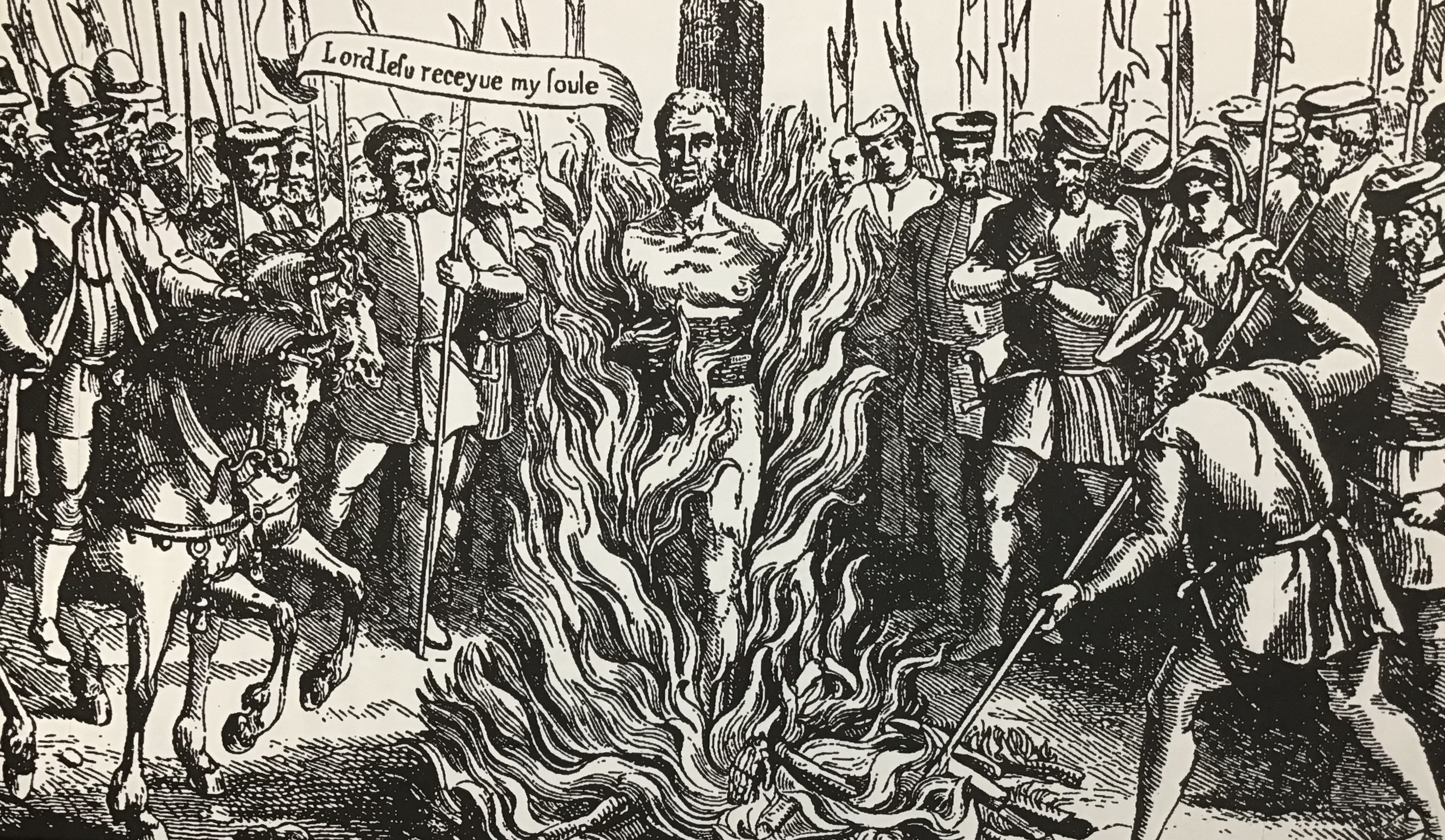
Bishop John Hooper burned at the stake by the order of Queen Mary Tudor
Some claim that since whether one is Amil, Premil, Postmil, is not an issue of salvation, and therefore should be left out of a church doctrinal statement. I think I addressed this in the last post, but I will say this: If we are only going to include universal truths that all Christians agree upon from every communion and tradition, we will indeed have a very small statement.
“Put on the whole armor of God, that you may be able to stand against the schemes of the devil.”
(Ephesians 6:11, ESV)
Be Armored
In preparing for spiritual battle, we need to make sure that we “put on the whole armor,” not just selected pieces. Later in this chapter Paul describes each piece of armor, but for now, we need to know that we cannot pick and choose. To do so would be disastrous because would leave us exposed to attack.
My dad was involved in the LA riots of 1992 as a police officer for Los Angeles. The rioting lasted six days, during which 63 people were killed and and almost 2400 people were injured. It ended only after the California Army National Guard, the United States Army, and the United States Marine Corps provided reinforcements to re-establish control. In preparation for going into a war zone, which is what LA was at the time, which would a policeman choose? A bullet-proof vest or a riot helmet? What will happen if he chooses one over the other? What about if he chose a riot shield and not boots? These are foolish questions because to be prepared to battle, a soldier or a policeman needs to be fully equipped with his whole armor, not simply bits and pieces. As Christians, we too need to be armored, not choosing some, but all of the armor that God provides.
Be Anchored
“Stand against” or “stand firm” is a reference to not being moved in our fundamental doctrinal positions. The opposite of this means to be blown around by every wind of doctrine. Ephesians 4:11-14 says, “And He gave some as apostles, and some as prophets, and some as evangelists, and some as pastors and teachers, for the equipping of the saints for the work of service, to the building up of the body of Christ; until we all attain to the unity of the faith, and of the knowledge of the Son of God, to a mature man, to the measure of the stature which belongs to the fullness of Christ. As a result, we are no longer to be children, tossed here and there by waves and carried about by every wind of doctrine, by the trickery of men, by craftiness in deceitful scheming;” (Ephesians 4:11–14, NASB95)
There’s a lot to grasp in those verses, but the quick truth I want you to see here is that a lack of biblical discipleship leads to many things, including the immaturity of believers who will be like children who are rocked upon the shore by the waves of doubt and deception.
Those who have drifted in their faith have brought disaster to their lives, and to the lives of many others. Paul warned Timothy of this happening in Ephesus: “keeping faith and a good conscience, which some have rejected and suffered shipwreck in regard to their faith. Among these are Hymenaeus and Alexander, whom I have handed over to Satan, so that they will be taught not to blaspheme.” (1 Timothy 1:19–20, NASB95)
Be Alert
First Peter 5:8 says, “Be sober-minded; be watchful. Your adversary the devil prowls around like a roaring lion, seeking someone to devour.” (1 Peter 5:8, ESV). Being “sober-minded” is not something that our age is known for. We are easily distracted, silly, and fascinated with the trivial. Five minutes on Youtube would be enough to confirm this truth to anyone who doubted it.
In 2 Corinthians 2:11 Paul wrote, “…so that no advantage would be taken of us by Satan, for we are not ignorant of his schemes.” (2 Corinthians 2:11, NASB95). Outwitted and ignorant of Satan’s schemes is unfortunately a perfect description of many Christians and churches today. We look to the Bible to see God’s will, and to answer questions for life, and rightly so. We see in it the glory of God in Christ Jesus as we should. But in this Book we also have a manual for warfare. War against our great enemies: the World, the flesh, and the Devil. Know these enemies and their schemes! Study the Word to learn about how these enemies of our soul will try to trip us up and lead us astray. We can’t afford to live like there isn’t a roaring lion out there!
In his excellent books, The Christian in Complete Armour, the Puritan pastor William Gurnall wrote, “One of the dangers of playing the devil’s games is that you come to like them. They are as addictive as wine, and create an insatiable thirst. Practice the devil’s tricks long enough, and your blackened soul will begin to devise mischief of its own, to help satisfy your ravishing appetite for sin…. Set your heart toward wickedness and Satan will lend you his own chariot and drive you himself to perform the deed.”
We need to prepare for battle, but we need to fight with the weapons of our King, not earthly weapons of politics, power plays, or philosophies. We need to proclaim the life-giving gospel message and preach the truth. As we do, we can stand firm and watch the Lord fight for us.




 Always Reforming