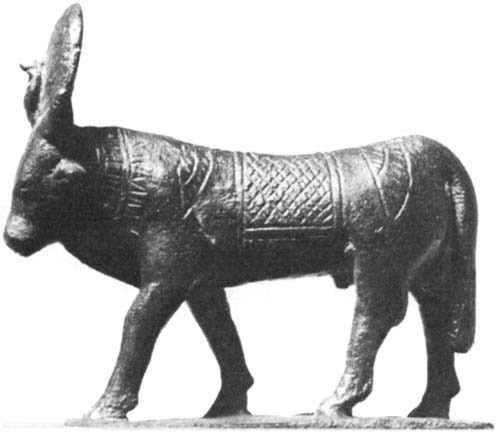
Last night’s Bible study in Psalm 106:19-23 focused upon Israel’s involvement in the worship of the golden calf. This account can be found in Exodus 32, with references in several places throughout the Scripture. It was a low-point in Israel’s history and one which they eventually learned their lesson, at least regarding making idols of metal and wood.
In preparing for the study, I came across Doug Stuart’s excursus in the New American Commentary: Exodus in which Stuart lays out why ancient people would have been attracted to idolatry. His article gives important insight into why God’s people struggled with this sin so often, and additionally helps us to see how idolatry still exists today. I have included the text of the excursus below in full with the hope that many will find this gem a blessing in their understanding of the Bible.
Excursus: The Attractions of Idolatry
1. Guaranteed: Ancients assumed that the presence of a god or goddess was guaranteed by the presence of an idol since the idol “partook” of the very essence of the divinity it was designed to represent. When, for example, a statue of a given god was carved and certain ritual incantations spoken over that statue to cause the essence of the god to enter it, the statue was then understood to become a functioning conduit for anything done in its presence from the worshiper to that god. In the same way that a modern persons might speak to and look into a sound-equipped television camera knowing that their words and actions were being transmitted accurately to other locations, ancient people believed that the offerings they brought before an idol of a god and the prayers they said in the idol’s presence were fully and unfailingly perceived by the god whom that idol represented.
2. Selfish: Idolatry was an entire materialistic system of thinking and behavior, sometimes called the “fertility cult,” built on the idea that the gods could do virtually anything but feed themselves. The one sort of “hold” or advantage humans had over the gods was the ability to feed them. Accordingly, it was felt that if one fed a given god, that god was in turn obligated to use his power on behalf of the feeder-worshiper. Not much else was required; if you fed a god adequately and regularly, that god would, in “quid pro quo” fashion, bless you in return with abundance of crops, fertility of cattle.
3. Easy: Frequency and generosity of worship (offering sacrifices) were the sole significant requirements of faithful idolatrous religion. Idolatry minimized the importance of ethical behavior. Ritual provision of food to the gods was important; keeping a divinely revealed covenant was not. At Sinai the Israelites took upon themselves the obligation to live as a holy people, subjecting themselves to obedience to hundreds of individual commandments so as to conform their lives ethically to Yahweh’s will, including the faithful offering of sacrifices to the true God. By contrast, idolatry was easy, requiring sacrifices but little else.
4. Convenient: Deut 12:2 requires that the Israelites “destroy completely all the places on the high mountains and on the hills and under every spreading tree where the nations you are dispossessing worship their gods.” Comparably, 1 Kgs 14:23 reports of Israelite idolaters that “they also set up for themselves high places, sacred stones and Asherah poles on every high hill and under every spreading tree.” These ubiquitous idol shrines allowed worshipers to take a sacrifice to the god or goddess of their choice virtually any time of day, any day of the week, and at a location nearby any place they happened to be. By contrast, Yahweh’s covenant required all Israelites to report to a single, central location three times a year, necessitating costly and time-consuming travel for many and prohibiting worship anywhere in the land but that single, approved sanctuary.
5. Normal: Idolatry was the common way of religion—without exception outside Israel—in the ancient world. This made it seem entirely normal since no one could find any parallel to the Israelite covenant obligation to worship an invisible God outside of the area of Yahweh’s special revelation to his people. Idolatry was, as well, the settled, experienced Canaanite way. When the Israelites entered Canaan, they could hardly help thinking that the successful farming methods of the Canaanites necessarily involved various idolatrous magical rituals used for generations, from boiling a goat kid in its mother’s milk (see comments on 23:19) to sowing a crop in a special pattern with two different kinds of plant seeds (Lev 19:19; Deut 22:9). If an Israelite asked a Canaanite neighbor, “How do you farm around here?” the Canaanite neighbor probably would start his explanation with a description of how to make proper offerings to Baal and Asherah in advance of preparing the fields and planting (or other farm duties) in order to ensure the fertility of the farm. Moreover, idolatry was the way of the superpowers and the economically successful states, whose riches and prestige seemed to go hand in hand with their idolatrous rites.
6. Logical: Idolatry was polytheistic, syncretistic, and pantheistic. The ancients believed in a multiplicity of gods—every one being a specialist in some aspect of the world or nature; and therefore the ancients found it enormously attractive to think they could gain assured access to those gods through idols. It was unthinkable to most ancients that a single god could be the only God. The idea of a “general practitioner” having to be responsible for all the various divine duties was simply not part of the mind-set of ancient peoples, and it seems to have been, indeed, hard even for most Israelites to imagine as well, judging from the frequency to which they turned to polytheistic idolatry in their history.
Ancient people also believed in three categories of gods, all of which any individual was likely to differentiate by his or her own beliefs and worship: the personal god, the family god, and the national god. For most Israelites at most times, and for all other people who knew anything about Israel’s God, Yahweh was merely a national god. Ancient Israelites might have, say, Dagon (Judg 16:23; 1 Sam 5; 1 Chr 10:10) as their personal god and perhaps Baal (e.g., Judg 2:13; 6:25, 28, 30–32; 1 Kgs 16:31–32) as their family god, but they would always have Yahweh as his national God. No Israelite, no matter how totally immersed in idolatry, would ever answer no to the question, “Do you believe in Yahweh?” But most, at most times in Israel’s history, would, sadly, see him only as a national god (the one who had brought them out of Egypt or the one to whom they would appeal in times of war). Their greater day-by-day loyalty in worship would be directed toward the various idols representing their various categories of gods.
7. Pleasing to the senses: 1 Kgs 19:18 describes the Israelite practice of worshiping the fertility-weather god Baal by, in part, bowing down to his idol and kissing it. Ezekiel 8:9ff. details some of the extensive depictions of various creatures in idolatrous form worshiped in Jerusalem. Idolatry provided worshipers with images of divinity pleasing to the eyes, spawned a whole, entrenched industry of image making (cf. Acts 19:24–27), and appealed to the sensual, even, broadly speaking, to the “artistic” in the people. It was hard to appreciate the beauty or attractiveness of someone who refused to be seen, that is, Yahweh.
8. Indulgent: Although the Israelites were permitted by the covenant to eat meat whenever they chose (Deut 12:15), the usual pagan practice was to eat meat only as part of a worship sacrifice to an idol. That way, a portion of the sacrifice would go to the idol as a burnt offering, a portion to the priest representing the idol (and his family), and the remainder to the worshiper and his family, thus never “wasting” the effect of eating meat but rather getting double value from the meat: nutrition for oneself and favor with the idol god. Accordingly, the more frequently one ate meat (since it was always eaten in connection with worship) and the more meat one ate (since thereby the god’s portion was increased), the more likely one could curry favor with the gods. “Pigging out” thus typified pagan sacrifices, in contrast to the more clearly symbolic value of an orthodox Israelite’s worship. Heavy drinking and drunkenness31 also were considered proper in idol worship feasts because debauching oneself was simply part of being generous to a god.
9. Erotic: Temple prostitution is described at various points in the Old Testament. Behind it lay the notion that all creation was in fact procreation, so everything that would exist had to be born into existence. When this was coupled with the “sympathetic magic” idea that things done symbolically in one location might cause certain behaviors in another, ritual worship sex performed in order to stimulate the gods to produce fertility on earth was the result. Ancient pagan worshipers were taught that if they, taking the symbolic role of, say, Baal, would have sex with a temple prostitute symbolically portraying, say, Asherah, this act would stimulate Baal and Asherah to have sex in heaven, which in turn would stimulate things to be born on earth: the young of flocks and herds, as well as the seedlings of all desired plants. Sex thus became a regular aspect of idol worship and was so widely practiced even at the Jerusalem temple in Israelite times that Josiah’s reform had to pay special attention to its eradication (2 Kgs 23:6–7); similarly, in northern Israel Amos noted the way father and son would visit the same temple prostitute (Amos 2:7–8).
Douglas K. Stuart, Exodus, vol. 2, The New American Commentary (Nashville: Broadman & Holman Publishers, 2006), 450–454.




 Always Reforming