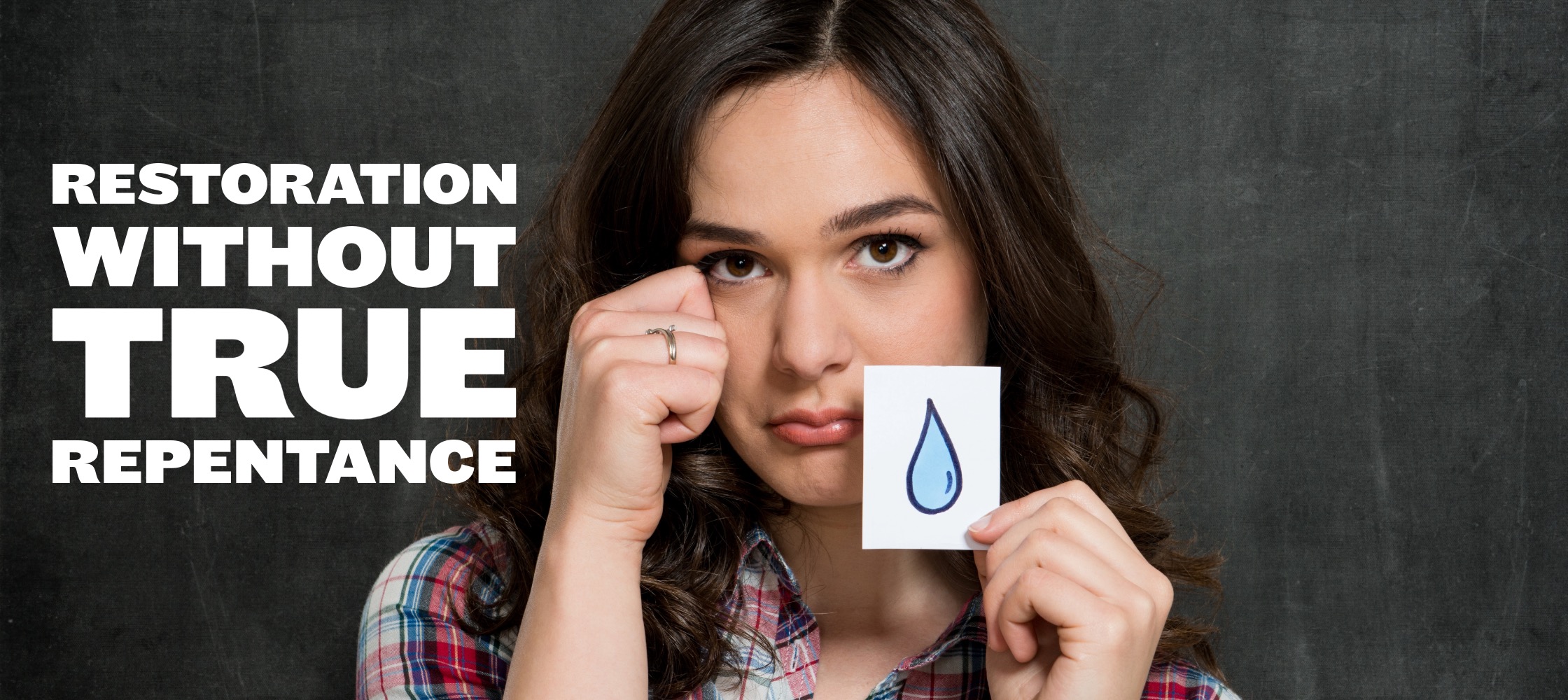
Restoration Without True Repentance

“Come, let us return to Yahweh. For He has torn us, but He will heal us; He has struck us, but He will bandage us.…What shall I do with you, O Ephraim? What shall I do with you, O Judah? For your lovingkindness is like a morning cloud and like the dew which goes away early.” (Hosea 6:1, 4, LSB)

There is a type of emotional response that happens when one is caught in the consequences of one’s sin. The prospect of facing jail time or an imminent divorce will often bring the guilty to their knees. I was surprised to see a young man at the door of my office that I hadn’t seen in many years. His father came to our church, and as a younger teen, he had accompanied him. This man expressed to me that he knew that his life needed to change and that we would begin once again attending church services. His words seemed to be genuine, but I could sense there was more to this sudden devotion that appeared out of thin air.

Following that morning’s service, the young man came with his father to my office gain and once again spoke of the changes he was feeling regarding his desire to “get right with God.” After a few moments of this, the real motivation for his return emerged. He had been caught printing and using counterfeit US bills and was soon going to be facing a judge for his crimes. He and his father wanted to know if I would be willing to write a character letter that stated that this man had frequently attended church (which he had not in many years) and that he had good moral character (which he did not have). After listening to his appeal, I shared with him that if his return to Christ was true and sincere, then he should speak truthfully at this court hearing about his guilt, entrusting himself to the mercy of God. If he was imprisoned, then God would be with him. If God showed mercy and he was given a lesser penalty for his crime, then God’s grace was the source of this reprieve from the consequences he deserved. Whatever the case, if he was sincere, he needed to continue in his profession of faith and walk with the Lord since he claimed his faith was genuine and not simply a ploy to escape the consequences of his sin. I then shared that I would not write the letter he asked for since to do so would be lying. I never saw that man again, and his father soon left our church, angry that I refused to help his son escape prison time for counterfeiting money.

In the above passage from the book of Hosea, God’s people are acting similarly. They are feigning an attitude of repentance from their sin, but there is not much below the surface. Hosea 6:1 says, “Come, let us return to Yahweh. For He has torn us, but He will heal us; He has struck us, but He will bandage us.” Notice that the people never say what they are guilty of doing. They speak about the consequences of God’s hand upon them, but they do not address their own sin. Like Cain’s response to murdering his brother Abel (Gen 4:13-14), nothing is said about guilt, only the desire to remove the burden of the consequences.

Did God see through their plot and refusal to truly deal with the source of God’s displeasure? Absolutely! In Hosea 6:4, God responded with these words: “What shall I do with you, O Ephraim? What shall I do with you, O Judah? For your lovingkindness is like a morning cloud and like the dew which goes away early.” Like dew that vanishes with the rising sun, so too did the love of Judah. Once the consequences were lifted, the Lord knew that the people would return to their sinful ways.

So what is the solution? True repentance and faith. The words that are spoken by Judah are true. God will heal and bandage what he has torn and damaged, but he will not bring about that restoration if we still conceal our deception and sin. We might be able to play games with people, hiding our intentions and true heart attitudes behind emotional appeals, but God knows the heart (2Chron 6:30; Acts 1:24).

Christian Leaders with a Bullseye on Their Back

“Then Satan stood up against Israel and incited David to number Israel.”1 Chronicles 21:1 (LSB)

A few quick thoughts I had as I read the above words:

1. When Satan wanted to attack a group (in this case, Israel) he went t after their leader.

2. Satanic attack often comes in the form of temptations. For David it was pride.

3. Satan didn’t cause David to act. He simply presented an opportunity to trip himself up. David was completely guilty for his actions.

4. Although not stated in the above verse, the consequences of David’s actions don’t only hurt him, but affect a large group of those who depend upon his faithful leadership.

If you’re a Christian leader of any kind, be wary. Our enemy is looking for someone to devour. Don’t let it be you or those entrusted to your care.

Legalism is as Deadly as Liberalism

“And he said to them, “Well did Isaiah prophesy of you hypocrites, as it is written, ‘This people honors me with their lips, but their heart is far from me; in vain do they worship me, teaching as doctrines the commandments of men.’ You leave the commandment of God and hold to the tradition of men.” (Mark 7:6–8)

After chastening Christ for his disciples’ failure to observe all of the ritual washings of their tradition, the Pharisees received the above response from Jesus which should stand as an open rebuke to many within the “fundamentalist” camp.

I define a “fundamentalist” in its most basic, historic, and orthodox sense—those that hold to the biblical fundamentals of the Christian faith. I would also add that a fundamentalist is willing to contend for that faith that was once for all delivered to the saints. This stand of willingness to content would differentiate me from some of my evangelical brothers. I believe that all fundamentalists are evangelical (as historically defined), while not all evangelicals are fundamentalists.

But there are some that have added there own “fundamentals” to the historic beliefs of fundamentalism, and because of this, they have been more than willing to separate from others over these issues. I think there is much room for discussion on several of these things, because many of them are important and their inclusion or exclusion will have a great impact upon the local church context.

However, there are some issues that, although important, have been elevated to a place that they should not be elevated. Additionally, there are some who have added to the “fundamentals” those things which are not biblically required, but are issues of personal conscience. My thoughts from Mark 7:6-8 and Jesus’ rebuke bring me to reflect upon those elevated issues that are not sin, but can be treated as sin in the judgment of some—including those issues of personal conscience which become sin for all believers in the minds of the weak.

Whether it is the teaching that those that don’t use the King James Bible are damned and their churches are apostate, or that women with short hair who wear pants are dressing like men or of objectionable moral character, or that worship for the church must be on Saturday, or that Jesus turned the water into grape juice at the wedding in Cana because all consumption of alcohol is sin—these and several others are the traditions of men parading themselves as the commands of God.

I don’t think God cares if you use the KJV or whether the women in church wear pants or not, or whether your communion service uses wine, as the Jews used in their Passover feasts. The problem is when those that care do so to the degree that they push their conviction upon all Christians in a way that Scripture does not, and in doing so elevate their word above God’s Word.

Satan is just as pleased when we add to God’s Word as he is when we take away from it. Both are wrong and both are damning. The lips might be saying all the right things, but as Jesus says, the heart can be completely wrong, and not pleasing to the Lord.

What good does it do to obey every jot and tittle of the cultural fundamentalist’s “gospel” if in the end you are adding to God’s Word, perverting His gospel, and not truly worshipping Him? Instead, may we all be committed to recovering true fundamentalism in our commitment to every Word of God bringing joyful worship that is the overflow of the heart.

Why Nobody Preaches “Be Like Samson”

For the last few days I have been reading the book of Judges, and I have particularly been thinking about the life of Samson. Although Samson often stirs up images that are more like the cover of a romance novel than a Bible character, it is the tragedy of a life thrown away that draws me in.

Even before his birth, expectations were high for Samson. His mother and father were visited by the angel of the Lord and told that their son would be used by God, but that they needed to raise him as one under the vows of a Nazirite. Normally, a person took on this vow for short while, but Manoah and his wife were told that this would be a lifelong commitment that he would need to make. No eating of any products derived from grapes—wine, juice, raisins, or even the grape itself. Along with this, Samson was not to cut his hair- ever. All of these things, in addition to the normal restrictions placed upon the Jewish people, were meant to demonstrate that Samson was set apart for a special purpose by God. Samson would be a sort of redeemer for his people, helping to free them from the oppression of their enemies the Philistines.

The problem was that Samson himself was not free. He may have had supernatural strength, but he was enslaved to his lusts. He may have been able to overpower a gang of men, but he couldn’t win victory over himself. He was his own worst enemy. Following the short life of this man, it quickly becomes apparent that when Samson sees something he wants, he will do whatever it takes to get it. He repeats a refrain that is seen often throughout the book of Judges, and he personalizes it-every man did that which was right in his own eyes.

It was not simply the cutting of his hair that caused this mighty warrior to fall. It was his lust for women, his raging anger, his disdain for purity-both ritual and spiritual, and his selfish drive to please himself. All of these came crashing down upon him like the building that took his life. Even Samson’s final (and only) prayer to God was laced with astonishing selfishness. This is the tragic result for not only Samson but for any of us that choose the foolish path of “following our heart.” Don’t do it. To follow your own heart is like cutting off the rudder on a ship and allowing the wind to blow the sails in whatever direction it gusts. A sailor that follows that practice will end up shipwrecked or lost at sea.

I’m not writing as one who has never followed his own heart. On the contrary, I have all too much experience in living the same way that Samson lived. I seek my counsel, and I go my own way. But it doesn’t take long before the initial satisfaction of my selfishness wears off and my foolishness reveals painful consequences. The only comfort and solution that I have found for avoiding this is to sail by a north star that is not within my own heart. The Bible gives me the wisdom and counsel that I need, not what I want. It speaks truth to my stubborn and deceptive heart. It points out the painful consequences and it shows me the true joy that can come if I will only trust the One who loves me more than I even love myself.

Samson’s life ended in tragedy, but my life won’t. My compass is set by Jesus Christ, and He will bring me home. I may put aside the compass now and then in my foolishness, but in the end, Christ will bring me into my heavenly port.

If you’d like to read about Samson for yourself, his story can be read in Judges chapters 13-16.

Rejoicing After God’s Discipline

“I will extol you, O Lord, for you have drawn me up and have not let my foes rejoice over me. O Lord my God, I cried to you for help, and you have healed me. O Lord, you have brought up my soul from Sheol; you restored me to life from among those who go down to the pit. Sing praises to the Lord, O you his saints, and give thanks to his holy name. For his anger is but for a moment, and his favor is for a lifetime. Weeping may tarry for the night, but joy comes with the morning.” (Psalm 30:1–5, ESV)

Beautiful sculptures like Michelangelo’s “David” or “Pieta” which look like living marble. When asked how he did it, said that he simply chiseled away everything that didn’t look like David.

Similarly, God is at work in us, chiseling away everything that is not part of his desire for us to look and act like children of God. 

And as living pieces of God’s work, it is painful when the hammer and chisel of God remove the rough edges and carve out of hardened marble a beautiful masterpiece. But it is necessary in order to make us beautiful, so that the Master Artist’s skill and grace can be put on display through us.

The reason for David needing to be rescued from his foes, being the Lord’s “drawing up” in Psalm 30:1 is unclear, but it seems to correspond to a time in David’s life when he was very near to death (see also Pss. 71:20; 130:1), and quite possibly because of some sin in his life since he speaks about the Lord’s anger being only momentary. Like water drawn out of a deep dark well, so the Lord has lifted David out of a deep hole when he faced a severe trial, which was possibly self-inflicted through his own sin.

Because of these problems David faced, he knew that his enemies would gloat over the illness that he faced (see also Ps. 35:19, 24-27). David says that it was the Lord that healed him in response to his cries for help. His sickness was so severe that he feared that he surely would face death (Sheol). In death, the Lord would have been delivering divine justice upon David, but instead he received mercy and grace.

The New Testament reminds us that God is serious about sin in his children. He sometimes acts against those who have been unrepentant and have brought about shame to the name of Christ. It is true that there is no more condemnation for those in Christ Jesus, but that does not mean that the Lord does not bring about temporal consequences for our sin that might be used as a means to our sanctification. In this psalms we can see that very effect whereby David learned in a deeper way of the love and care of the Lord.

Not only did David praise God for saving him, but he used the opportunity to encourage others to praise God also. David learned that with the Lord, forgiveness comes along with the chastening; and with our weeping comes a joy that our Father had never stopped loving us.

The hymn “Amazing Grace” closes with the lines, “When we’ve been there ten thousand years, Bright shining as the sun, We’ve no less days to sing God’s praise Than when we first begun.” Our days in heaven will be filled with praise because our Savior is worthy, and because we will more clearly see how much we do not deserve the “amazing grace” that has been bestowed upon all of God’s children. So remember the next time you face the chastening hand of God and come out of it with a heart filled with praise for the lessons God has taught you about who He is, and who we are.