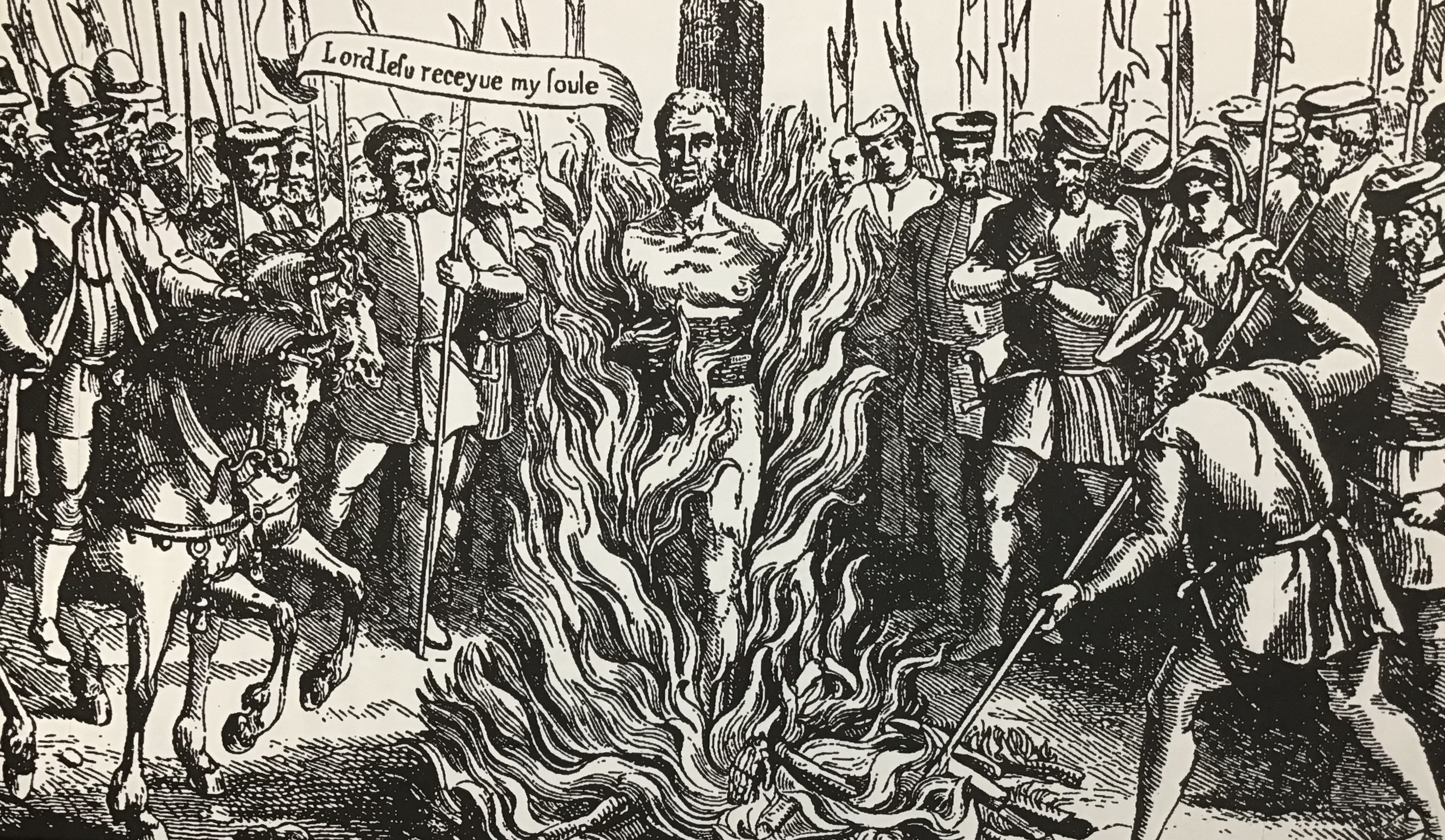
Bishop John Hooper burned at the stake by the order of Queen Mary Tudor
Some claim that since whether one is Amil, Premil, Postmil, is not an issue of salvation, and therefore should be left out of a church doctrinal statement. I think I addressed this in the last post, but I will say this: If we are only going to include universal truths that all Christians agree upon from every communion and tradition, we will indeed have a very small statement.
“Put on the whole armor of God, that you may be able to stand against the schemes of the devil.”
(Ephesians 6:11, ESV)
Be Armored
In preparing for spiritual battle, we need to make sure that we “put on the whole armor,” not just selected pieces. Later in this chapter Paul describes each piece of armor, but for now, we need to know that we cannot pick and choose. To do so would be disastrous because would leave us exposed to attack.
My dad was involved in the LA riots of 1992 as a police officer for Los Angeles. The rioting lasted six days, during which 63 people were killed and and almost 2400 people were injured. It ended only after the California Army National Guard, the United States Army, and the United States Marine Corps provided reinforcements to re-establish control. In preparation for going into a war zone, which is what LA was at the time, which would a policeman choose? A bullet-proof vest or a riot helmet? What will happen if he chooses one over the other? What about if he chose a riot shield and not boots? These are foolish questions because to be prepared to battle, a soldier or a policeman needs to be fully equipped with his whole armor, not simply bits and pieces. As Christians, we too need to be armored, not choosing some, but all of the armor that God provides.
Be Anchored
“Stand against” or “stand firm” is a reference to not being moved in our fundamental doctrinal positions. The opposite of this means to be blown around by every wind of doctrine. Ephesians 4:11-14 says, “And He gave some as apostles, and some as prophets, and some as evangelists, and some as pastors and teachers, for the equipping of the saints for the work of service, to the building up of the body of Christ; until we all attain to the unity of the faith, and of the knowledge of the Son of God, to a mature man, to the measure of the stature which belongs to the fullness of Christ. As a result, we are no longer to be children, tossed here and there by waves and carried about by every wind of doctrine, by the trickery of men, by craftiness in deceitful scheming;” (Ephesians 4:11–14, NASB95)
There’s a lot to grasp in those verses, but the quick truth I want you to see here is that a lack of biblical discipleship leads to many things, including the immaturity of believers who will be like children who are rocked upon the shore by the waves of doubt and deception.
Those who have drifted in their faith have brought disaster to their lives, and to the lives of many others. Paul warned Timothy of this happening in Ephesus: “keeping faith and a good conscience, which some have rejected and suffered shipwreck in regard to their faith. Among these are Hymenaeus and Alexander, whom I have handed over to Satan, so that they will be taught not to blaspheme.” (1 Timothy 1:19–20, NASB95)
Be Alert
First Peter 5:8 says, “Be sober-minded; be watchful. Your adversary the devil prowls around like a roaring lion, seeking someone to devour.” (1 Peter 5:8, ESV). Being “sober-minded” is not something that our age is known for. We are easily distracted, silly, and fascinated with the trivial. Five minutes on Youtube would be enough to confirm this truth to anyone who doubted it.
In 2 Corinthians 2:11 Paul wrote, “…so that no advantage would be taken of us by Satan, for we are not ignorant of his schemes.” (2 Corinthians 2:11, NASB95). Outwitted and ignorant of Satan’s schemes is unfortunately a perfect description of many Christians and churches today. We look to the Bible to see God’s will, and to answer questions for life, and rightly so. We see in it the glory of God in Christ Jesus as we should. But in this Book we also have a manual for warfare. War against our great enemies: the World, the flesh, and the Devil. Know these enemies and their schemes! Study the Word to learn about how these enemies of our soul will try to trip us up and lead us astray. We can’t afford to live like there isn’t a roaring lion out there!
In his excellent books, The Christian in Complete Armour, the Puritan pastor William Gurnall wrote, “One of the dangers of playing the devil’s games is that you come to like them. They are as addictive as wine, and create an insatiable thirst. Practice the devil’s tricks long enough, and your blackened soul will begin to devise mischief of its own, to help satisfy your ravishing appetite for sin…. Set your heart toward wickedness and Satan will lend you his own chariot and drive you himself to perform the deed.”
We need to prepare for battle, but we need to fight with the weapons of our King, not earthly weapons of politics, power plays, or philosophies. We need to proclaim the life-giving gospel message and preach the truth. As we do, we can stand firm and watch the Lord fight for us.
“For to one is given through the Spirit the utterance of wisdom, and to another the utterance of knowledge according to the same Spirit, to another faith by the same Spirit, to another gifts of healing by the one Spirit, to another the working of miracles, to another prophecy, to another the ability to distinguish between spirits, to another various kinds of tongues, to another the interpretation of tongues.”
(1 Corinthians 12:8–10, ESV)
“When the day of Pentecost arrived, they were all together in one place. And suddenly there came from heaven a sound like a mighty rushing wind, and it filled the entire house where they were sitting. And divided tongues as of fire appeared to them and rested on each one of them. And they were all filled with the Holy Spirit and began to speak in other tongues as the Spirit gave them utterance. Now there were dwelling in Jerusalem Jews, devout men from every nation under heaven. And at this sound the multitude came together, and they were bewildered, because each one was hearing them speak in his own language. And they were amazed and astonished, saying, “Are not all these who are speaking Galileans? And how is it that we hear, each of us in his own native language? Parthians and Medes and Elamites and residents of Mesopotamia, Judea and Cappadocia, Pontus and Asia, Phrygia and Pamphylia, Egypt and the parts of Libya belonging to Cyrene, and visitors from Rome, both Jews and proselytes, Cretans and Arabians—we hear them telling in our own tongues the mighty works of God.” And all were amazed and perplexed, saying to one another, “What does this mean?” But others mocking said, “They are filled with new wine.””
(Acts 2:1–13, ESV)
One of the more divisive issues within the evangelical Christian church today is the issue of speaking in tongues. The growth of Pentecostal denominations and charismatic churches over the last 100 years has been phenomenal. For some, this is enough evidence that the modern gift of tongues is biblical. Add to this the experiential element and those who are convinced of the legitimacy of modern charismatic practices would be hard-pressed to deny their existence. Although the continuationist view is the newer position on the use of the miraculous gifts today, it has become the majority view within evangelicalism.
In this post I’d like to look at three characteristics on the Day of Pentecost to consider the question of what is the gift of tongues? After I answer them, I’d like to compare that special day and see if Pentecost is still happening today.
The account in Acts 2 follows Jesus’ ascension after he told the disciples to stay in Jerusalem until the promised Holy Spirit came. This small band of believers gathered together in an upper room and prayed together. The following is an examination of what happened in that room when the Spirit came:
Sound (vv. 2, 6)
This was a sign to both the believers gathered as well as the unbelievers that were drawn to the loud commotion.
This sound is described as being like “a mighty rushing wind.” The Greek word for “wind” is pneuma and it is also the word used for Spirit. The wind was described as sounding like rushing or violent wind. This sound was meant to communicate the power of the Holy Spirit.
This surprising sound was not wind but was “like” wind in its mighty power–reminding the disciples of the promise given by Jesus in Acts 1:8 that he would give them power to accomplish his commission.
Sight (v. 3)
The “tongues of fire” appeared to those in the upper room and thus were a sign to the believers gathered.
The tongues were distributed among them all, and everyone in the room received this sign as it rested upon each of them. This was followed by speaking in tongues. In 1Cor 12:11, Paul tells us that the Holy Spirit gives his spiritual gifts to those whom he wills.
Why a sign of fire? Throughout the Bible fire represents two major ideas-judgment and purity. In this setting and context, it is appropriate to understand the symbol as a reference to the purifying work of the Spirit (Isaiah 6; Rev. 1:14, 15).
Speech (vv. 4-11)
The speech was a sign to the unbelievers (vv. 6-12). Those gathered Jews in the city of Jerusalem did not hear God speaking in Hebrew, as he had done in the Old Testament through his prophets. He spoke to them through the foreign languages of the nations. In 1 Corinthians 14, Paul said, “In the Law it is written, “By people of strange tongues and by the lips of foreigners will I speak to this people, and even then they will not listen to me, says the Lord.” Thus tongues are a sign not for believers but for unbelievers, while prophecy is a sign not for unbelievers but for believers.” (1 Corinthians 14:21–22, ESV)
What did these Christians say when they spoke in tongues? What was the content of their speech? We don’t have to wonder. Verse 11 says they were speaking of the mighty deeds of God. It is important to also note that their words were understandable to the people–not Christians, but unbelieving Jews.
Additionally, it is important to point out that the miracle was in speech, not hearing. Verses 9-11 tells us that the people gathered heard the praise of these Christians in their own tongues. That was because the languages were genuine human languages from the places these Jewish pilgrims had come from.
Conclusion: What happened after this event? What were the conclusions the crowd came to?
Confusion (v. 12). They didn’t have a clue about what was happening.
Contempt (v. 13). They mocked and said the people were drunk.
Conversions (2:41). Three thousand souls were saved.
Some Parallels to Today’s Tongues Movement?
Before I get to my questions, I need to ask, is Acts 2 descriptive or prescriptive? In other words, is Acts supposed to be a handbook for how we should conduct the Church today or is it a history of how the early church functioned at one time and in many ways is unique?
Some within the Pentecostal and Charismatic movement call the church to a new Pentecost. They lament that the church is powerless today because we need that same power, and so we need the same Pentecostal experience. If Acts 2 is prescriptive and gives instructions for the Church to follow today:
Where is the rushing wind sound today?
Where are the fiery tongues today?
Why are tongues not identifiable languages today?
Why are tongues not used to testify to the unbelievers today?
Why are there not mass conversions on the scale of those in Acts 2 today?
Why is it that all those who are believers are not given this gift today? Even the 3,000 that were saved that day are never said to have been given the gift of tongues. Why not if it is supposed to be normal for every Christian?
It is my conviction that the gift of tongues and its accompanying gift of interpretation ceased after the completion of the Bible and is no longer necessary for the church to function. This is not just my opinion, but is in fact the confirmed historical stand of the Church from the end of the Apostolic age all the way up until the early 19th Century.
We do not need to practice tongues to become close to our Savior, God, and King. If you do not read God’s Word, tongues will not help you know Him better. If you do not pray, muttering in a supposed “angelic language” will not edify anyone. If you do not practice love, you can have no part with the Father. Such a large portion of so many churches are taken up with this practice that whole churches are known for their concentration on the Holy Spirit. Let us not forget what Jesus said concerning the Holy Spirit in John 16:13-14, “When the Spirit of truth comes, he will guide you into all the truth, for he will not speak on his own authority, but whatever he hears he will speak, and he will declare to you the things that are to come. He will glorify me, for he will take what is mine and declare it to you.” (John 16:13–14, ESV). The Spirit never points to himself, but to Jesus. May we do the same.
We have been considering the need for the Church of Jesus Christ to preach the Bible faithfully, in full dependence upon God and the power vested in His Word. In the first article, I wrote that we must preach the Bible because it is our only authority. Without that divine Book, no man standing up on a Sunday morning has any authority. Secondly, we must preach the Bible because the Bible alone demonstrates divine power. Manipulation, oratorical skill, and emotionalism will only get you so far. Today I want to look at one last reason why we must preach the Bible.
3. It Demands Divine Duty
The hard soil of men’s hearts is not something unique to the 21st century. It is as old as humanity itself. This fact needs to sink into the heart of the pastor who is looking for low-hanging fruit when he seeks a ministry. God has not called most of us to a large pulpit ministry, nor world-wide fame. But He has called every one of His ministers to faithfully proclaim the Word wherever we are sent. Hard hearts, gang violence, poor attendance, meager offerings, inadequate facilities, nonexistent leadership, are all realities that can make ministry challenging, but none are reasons to walk away from a church or a community. As a matter of fact, all of these are reasons that a faithful Bible preaching, gospel-saturated church is needed in that place. The marks of this divine duty require us to preach faithfully, preach plainly, and preach patiently.
Preach Faithfully (Ezek. 2-3; 2 Tim. 4:1-5)
Facing the rebellious nation of Israel, the Lord clearly told Ezekiel what he must do, “And you shall speak my words to them, whether they hear or refuse to hear, for they are a rebellious house.” (Ezek. 2:7, ESV). Over and over again, Ezekiel was told that Israel was a rebellious house, impudent, stubborn, and hard-headed. And yet, his instructions were clear, speak God’s words to them. Though they would not listen, and though they were so hard in heart, it did not change the directive—be a watchman (3:17) and speak the words of impending judgment (v. 19) no matter what. Faithfulness is what God requires (3:19, 21).
As the Apostle Paul faced his own death, he exhorted Timothy to continue to persevere in the ministry of the Word in season and out of season. For Timothy, Paul’s imprisonment and coming death was a very real illustration of the threat to the gospel ministry. Paul didn’t instruct Timothy to move to a safer territory nor did he instruct him to avoid suffering, but instead encouraged him to keep preaching even when people will no longer endure it and that this might include the need to endure suffering for the sake of Christ. Paul was faithful to preach the whole counsel of God and he would receive his reward in due time (2 Tim. 4:7-8).
Preach Plainly (1Cor. 2:1-5)
Plain preaching is not the same as bland preaching, nor does it mean to preach simplistically. Paul’s desire to give Jesus Christ all the glory required him to make sure that his own preaching did not put the spotlight on his considerable education, gifts, and talents. Although the so-called super-apostles had a low view of Paul’s presence and preaching ability (2 Cor. 10:10), he placed his full dependence upon the power of God’s Spirit working through the Word of God. In doing this, Paul put the cross of Christ on full display. Plain preaching is not flashy, gimmicky, or self-seeking. Simply put, plain preaching is Spirit-empowered, not man-centered. The Puritan Richard Baxter wrote, “It is no easy matter to speak so plain that the ignorant may understand us, so seriously that the deadest heart may feel us, and so convincingly that contradictory cavaliers may be silenced.” (Joel R. Beeke and Mark Jones, A Puritan Theology: Doctrine for Life, (Reformation Heritage Books, Grand Rapids, 2012), 695).
Preach Patiently (2 Tim. 4:2)
Our duty to preach the Word must be done with the reminder that we do not preach ourselves nor do we preach our words. Pastors are under-shepherds that are to lead without being domineering. We are to be loving examples to the flock that has been placed in our charge (1 Pet. 5:2-4). This means that we must teach the Word of God with the patience of our Master (2 Tim. 4:2), and that is easier said than done, particularly when we are facing the growing challenges of ministry today. Nevertheless, we must teach and preach with great patience, waiting upon the Word and Spirit to do their mighty work.
Although the reasons that we preach the Word could be multiplied, these three should stand out for us—it is our authority, our power and our duty. And as we faithfully proclaim the Word, we can expect that it will do its mighty work of reviving the soul and enlightening the eyes (Ps. 19:7, 8). The benefits of doing so will manifest themselves in due time, showing us that as we sow the seeds of the Word into the hearts of our congregations that all our efforts are profitable (2 Tim. 3:16-17), and will accomplish the will of God in the end (Isa. 55:11).
As William Gurnall wrote a long time ago, “The Word of God is too sacred a thing and preaching to solemn a work, to be toyed and played with” (Ibid., 685). May we pick up our Swords and faithfully execute the ministry that the Lord has called each of us to do, for His greater glory and for the good of the Church.
Why do we bother preaching the Bible as divinely authoritative? If you listen to what came out of many pulpits yesterday, you might think that preaching deep and doctrinal truth from the Bible is optional. In this three part series I want to argue that preaching deep and expositional messages from the Bible isn’t simply a personal preference, but is actually the necessary requirement of any man who is called of God to proclaim the Word of the Lord. In my last blogpost (you can read it here: Why We Must Preach the Bible (part 1), I argued that we must preach the Bible because it declares with divine power. This isn’t whipped up by yelling in the pulpit, lighting packages, emotion-driven love songs to Jesus, or “authentic” talks meant to motivate. We need to preach the Word of God because it is the only thing that can cut into the hardest heart. Secondly…
2. It Demonstrates Divine Power
If we understand that all of unregenerate mankind has been blinded by Satan (2 Cor. 4:4) and are dead in their trespasses and sin without Christ (Eph. 2:1), and that even after we have come to know Jesus as Savior we are still in need of the Spirit’s illuminating power (1 Cor. 1:12-13), then we also will understand the need for the divine power of the Word that can overcome the devastating spiritual effects of the Fall.
The Power to Open Blind Eyes
In the aftermath of the resurrection of Christ, there was a lot of confusion among the disciples of Jesus. They had begun to recall the words of Jesus about His rising from the dead, and they had also heard the seemingly outrageous stories from the women who said they saw angels who told them about the risen Christ (Lk. 24:1-9, 22-24). As two disciples puzzled over the events of that first Easter morning, they moved along the road to Emmaus where they encountered a fellow traveler, the resurrected Christ, who was veiled to their eyes.
As they spoke to Jesus, they explained the confusion and the promises and the grief they shared over having lost their dear Master. Jesus gently rebuked the men (v. 25) as He explained from the Old Testament how the Scriptures needed to be fulfilled concerning the Messiah (v. 27). After Jesus’ sudden self-revelation and departure, these two men discussed what they felt as the Scriptures were opened to them: “They said to each other, “Did not our hearts burn within us while he talked to us on the road, while he opened to us the Scriptures?”” (Lk. 24:32, ESV). Their experience was not simply an emotional response, but the active working of the Spirit in revealing truth to their blind eyes, which now could see.
Another example of such power to open blind eyes can be seen along a riverside just outside of the city of Philippi where the Apostle Paul and his team proclaimed the gospel message to a small group of women who had gathered there to pray on the Sabbath (Acts 16:11-13). As Paul preached, Lydia’s eyes were opened by the Lord, causing her to pay attention to the message that Paul preached. Immediately she was changed as she gave her life to Christ. She was baptized and hosted Paul and his companions in her home (v. 15).
Why do we preach the Bible? Because it is the only means that God has given us to open blind eyes.
The Power to Bring Revival
Our God is not a genie that we can simply schedule when we want Him to show up. Biblical revival cannot be stirred up by man, for “The wind blows where it wishes, and you hear its sound, but you do not know where it comes from or where it goes. So it is with everyone who is born of the Spirit.”” (John 3:8, ESV). But this truth does not mean that there are not elements of true, biblical revival that accompany God’s work in bringing about a genuine work of God. The Old Testament gives a few prominent examples of revival that came to the people of Israel, and each one was accompanied by the proclamation of the Word of God. I want to highlight two of those examples so that the power of the Word might be shown in how God brings about genuine revival.
Josiah (2 Kgs. 22-23)
Having found the Book of the Law while making repairs to the Temple, King Josiah was undone when it was read in his presence. As he listened to the reading of the Book of the Law, the king began to see more clearly how disobedient Judah had been in God’s eyes (vv. 10-13). After seeking the prophetic Word of the Lord, Josiah was humbled, and he actively began seeking to eradicate the wicked idolatry that had been rampant in his kingdom. Along with cleansing the land of false worship, he also sought to restore the approved worship that the Word of God directed to his people. Think about it, the Word wasn’t preached, it was simply read. No fancy outlines, no illustrations or catchy titles or PowerPoint slides. The Word was read, and the Spirit did His convicting work in Josiah, moving him to reform the whole kingdom.
Ezra (Neh. 8-9)
Under the leadership of Ezra, the priestly scribe, and Nehemiah the governor, the returning exiles longed to hear from the God of their Fathers as they had begun to see their need to be a separate people from the pagans all around them. God had begun to restore the nation, but not without challenges from their enemies. And so, as Ezra opened the Law and the elders explained its meaning to the people (8:3), the people began to sense their spiritual thirst and their parched souls began to be refreshed as the Spirit began to move them to understand the great and tender mercy of their God (8:9-12). Following a short time of rejoicing, the people began to reinstate the holy practices that had been long lost and forgotten (vv. 14-18) and began to openly confess their sin with grief and contrition (9:1-4). The brokenness of the people led to worship that was filled with confession, restoration, cleansing and rejoicing. The power of the Word had broken the hardest hearts and restored them like nothing else could.
In the modern church today, there are all sorts of man-made methods and programs that seek these kinds of results but fail to make any lasting change. Pragmatism, that philosophy that seeks to determine value based upon the success or failure of end results, is not a Christian concept. Where was the pragmatism in the prophet Isaiah when God said to Him, ““Go, and say to this people: “‘Keep on hearing, but do not understand; keep on seeing, but do not perceive.’ Make the heart of this people dull, and their ears heavy, and blind their eyes; lest they see with their eyes, and hear with their ears, and understand with their hearts, and turn and be healed.” (Isa. 6:9–10, ESV)? There was no revival in the land, but God still called for faithfulness in the ministry of Isaiah.
And where can we find a pragmatic approach in the ministry of Jeremiah, the weeping prophet who mourned over the sins of God’s people for their sin, but was mistreated and scorned and seemed to have been ignored by nearly everyone (Jer. 38:6)? And what about the testimonies of those spoken of in Hebrews 11:36-38?
“Others suffered mocking and flogging, and even chains and imprisonment. They were stoned, they were sawn in two, they were killed with the sword. They went about in skins of sheep and goats, destitute, afflicted, mistreated— of whom the world was not worthy—wandering about in deserts and mountains, and in dens and caves of the earth.” (Heb. 11:36–38, ESV)
There is still power in the Scripture, and it is to be preached whether revival comes or not, because Scripture carries with it a divine duty for God’s people.
Tomorrow’s post will conclude this series with our final reason we must preach the Bible. Thanks for reading, and don’t forget to subscribe to received reminders when I post new material.




 Always Reforming