The Long Term Benefits of Planting Acorns Today

As I talk to pastors and missionaries in many contexts, there is a topic that seems to be a repeated refrain that I hear often. It has to do with the shortage of men to take the place of retiring pastors, teachers, missionaries, and ministry leadership roles. It has been clear for many years that there is a growing need for Christian leaders serving in ministry. Today, the swelling need for leaders has grown into a tsunami of massive proportions.

So, whose responsibility is to to provide these new leaders? Does the responsibility lay upon the denominational leaders, seminaries, Bible colleges, and missions agencies? Although there are many who believe this, the biblical answer is a resounding “No.” Leaders for the church may be trained and equipped for the church and mission field within these parachurch organizations, but the duty of identification, discipleship, mentoring, and at least initial training is the responsibility of the local church itself.

The fact that the local church is supposed to be identifying, discipline, mentoring, and training up the next generations of leaders and in many places have failed to do so is the reason that we are in a leadership crisis in the church today. My purpose isn’t to pass the buck, but to put the responsibility firmly where it belongs.

In Acts 13:2-3, Luke records, “While they were worshiping the Lord and fasting, the Holy Spirit said, “Set apart for me Barnabas and Saul for the work to which I have called them.” Then after fasting and praying they laid their hands on them and sent them off.” The sending of these first two missionaries was done through the local church in Antioch and not through a missions agency. Agencies have their place in aiding the church, but it is the Spirit that calls apart missionaries, and it is the church that sends them.

In Ephesians 4:11-12, we see that the Spirit has given pastors and teachers, among others, to the church for the edification and training of the church. “And he gave the apostles, the prophets, the evangelists, the shepherds and teachers, to equip the saints for the work of ministry, for building up the body of Christ…

This work of preparation by these gifted leaders was done in house, and would have led to the identification of young leaders that would be mentored within the church. An important example of this would be Paul’s identification of Timothy and the church’s agreement in Timothy’s calling: “Do not neglect the gift you have, which was given you by prophecy when the council of elders laid their hands on you” (1 Timothy 4:14).

And when Timothy is instructed about his own duties as a pastor in the church, he was strongly reminded by Paul, “and what you have heard from me in the presence of many witnesses entrust to faithful men, who will be able to teach others also” (2 Timothy 2:2).

There can be no denying that the New Testament clearly teaches that leaders within the church are to be produced by the local church. So, why isn’t this happening? There are probably many reasons that would be given by some pastors who fail to do this—no time, feeling of inadequacy, fear of being replaced by their disciples, fear of discouraging disciples from ministry, and not knowing where to start. But none of these are valid in disobeying the clear admonition of Scripture.

Where do we go from here? That brings me to the title of this post, “The Long Term Benefit of Planting Acorns Today.” The mighty oak tree is moderate in the speed at which it grows, growing about 12-18 inches per year (30-46 cm) to a height of about 60 feet tall (18.28 meters). Compare this to pine, which can grow to 2 feet (61 cm) in a year.

Sometimes we fail to plan for the distant future, only looking up from our labors as our time of departure draws near. And what happens when we have not discipled men whom we can entrust the gospel, who will be able to teach others also? We will find that we have endangered our local church because the resource it so desperately needs in a leader cannot be easily found. Focused labor is admirable, but discipline leaders for the future is to be a part of our labors.

Growing accords into mighty oaks takes time. The future of many local churches has been jeopardized by short-sited pastors who figured they would simply call the local seminary and order a shiny new pastor to take their place when they retire. But many of these pipelines are empty or the hands-off approach of local churches have produced a generation of young pastors who have little or no loyalty to the local church. What do we do?

The answer from Scripture is the same. We plant the acorns. We may not live to see them fully develop, but we must plant the seeds from which the future church will benefit. If we do not, we will not only be unfaithful to the Scriptures in fulfilling our duty, but we will leave the church poorer than when it was handed to us.

The Danger of Cutting Off Our Doctrinal Roots (weekend repost)

And I, when I came to you, brothers, did not come proclaiming to you the testimony of God with lofty speech or wisdom. For I decided to know nothing among you except Jesus Christ and him crucified.” 1 Corinthians 2:1–2 (ESV)

Set in a backdrop where the church in Corinth was filled with many Christians who had a strong taste for ear-pleasing speakers, Paul addresses his intentional plan to not be seeker sensitive in his preaching. The words “lofty speech” and “wisdom” (ESV) both reference the exalted form of rhetoric that the preferred speakers used in their addresses to the church.

Read the full post here: The Danger of Cutting Off Our Doctrinal Roots

Preaching to Be Forgotten and For God to Be Glorified (weekend repost)

What did Paul mean when he wrote of his “weakness…in fear and much trembling?” Clearly, Paul was connecting his preaching to these things (“…my speech and my message…”). I think that Paul’s words here are a much-needed correction to the celebrity culture within the Western church today.

The Apostle to the Gentiles stood before this church in Corinth as a weak man. He did not have the polish and trappings that the false teachers of Corinth had, and to many, this was a severe disadvantage. Although they might not say it this way, there are many who would imply strongly that the message is secondary to the method. If you don’t have a media empire pushing your message, then the world won’t listen and you’ll be ineffective. I wonder how Paul would have responded to that sort of thinking. Well, we don’t have to wonder because his Spirit-inspired words are given to us.

Read the full post here: Preaching to Be Forgotten and For God to Be Glorified

Preaching to Be Forgotten and For God to Be Glorified

“And I was with you in weakness and in fear and much trembling, and my speech and my message were not in plausible words of wisdom, but in demonstration of the Spirit and of power, so that your faith might not rest in the wisdom of men but in the power of God.” 1 Corinthians 2:3–5 (ESV)

What did Paul mean when he wrote of his “weakness…in fear and much trembling?” Clearly, Paul was connecting his preaching to these things (“…my speech and my message…”). I think that Paul’s words here are a much-needed correction to the celebrity culture within the Western church today.

The Apostle to the Gentiles stood before this church in Corinth as a weak man. He did not have the polish and trappings that the false teachers of Corinth had, and to many, this was a severe disadvantage. Although they might not say it this way, there are many who would imply strongly that the message is secondary to the method. If you don’t have a media empire pushing your message, then the world won’t listen and you’ll be ineffective. I wonder how Paul would have responded to that sort of thinking. Well, we don’t have to wonder because his Spirit-inspired words are given to us.

In his commentary on these verses, Alan Johnson clarifies what Paul is saying: “…[Paul’s] proclamation (wider than only preaching) of the “mystery” of God, namely, Jesus Christ as the crucified One, was in keeping with the sole focus on the cross because Paul consistently, deliberately presented himself not self-confidently but in self-effacement, not in strength as a “successful” person but in weakness and fear, with much trembling (v. 3).”  (Alan F. Johnson, 1 Corinthians, vol. 7, The IVP New Testament Commentary Series (Westmont, IL: IVP Academic, 2004), 62.)

Paul isn’t working to build his brand. He isn’t seeking to launch a well-strategized media plan that incorporates all the latest channels for all the up-and-coming evangelical elites. He isn’t buddying up to those more popular false teachers in order to share the limelight while justifying this as focusing on the majors and overlooking areas of disagreement in the name of “grace.” Nope. Paul is not about Paul. He unashamedly points to himself as a weak and fearful man. His words were perceived by the Corinthians as implausible and foolish–because that was what the unvarnished gospel sounds like to unregenerate ears. Paul didn’t seek to “fix” it.

And since Paul wasn’t trying to boost his own brand, he didn’t care what others thought about him so long as they saw Jesus. Paul was weak–he didn’t feign weakness to seem more spiritual. He was scared–but God was his strength. He wasn’t practiced and polished in his delivery, intentionally–so that people wouldn’t walk away impressed with this servant’s speech, but so they would walk away worshipping his God.

Paul focused on the cross in his life, message, and methods. In our glitzy evangelical world of super conferences, social media blitzes, and multi-books deals, we are all too often a faint shadow of this servant of God. May we join with George Whitefield in saying, “Let my name die everywhere, let even my friends forget me, if by that means the cause of the blessed Jesus may be promoted.”

We Will Not Be Silent and We Will Not Back Down (weekend repost)

“In a time of universal deception, telling the truth is a revolutionary act. Let us determine that we will not be shamed into silence or inaction. We will speak, and like Shadrach, Meshach, and Abednego in the book of Daniel, let us resolve that we will not bow.”

Erwin Lutzer, We Will Not Be Silenced, 38.

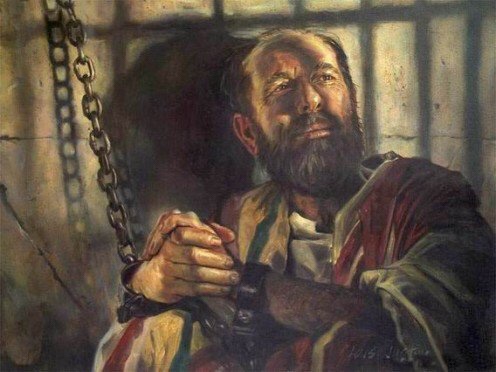
It is interesting to read about the Apostle Paul’s experience in Jerusalem in Acts 21-26. In these chapters, Paul is constantly allowed to share with different audiences his testimony in one way or another. Incredibly, in many instances, he isn’t allowed to finish his explanation of why he believes in Jesus Christ.

Read the rest of the post here: We Will Not Be Silent and We Will Not Bow Down