“The problem with preachers today is that nobody wants to kill them anymore!”
Steven J. Lawson
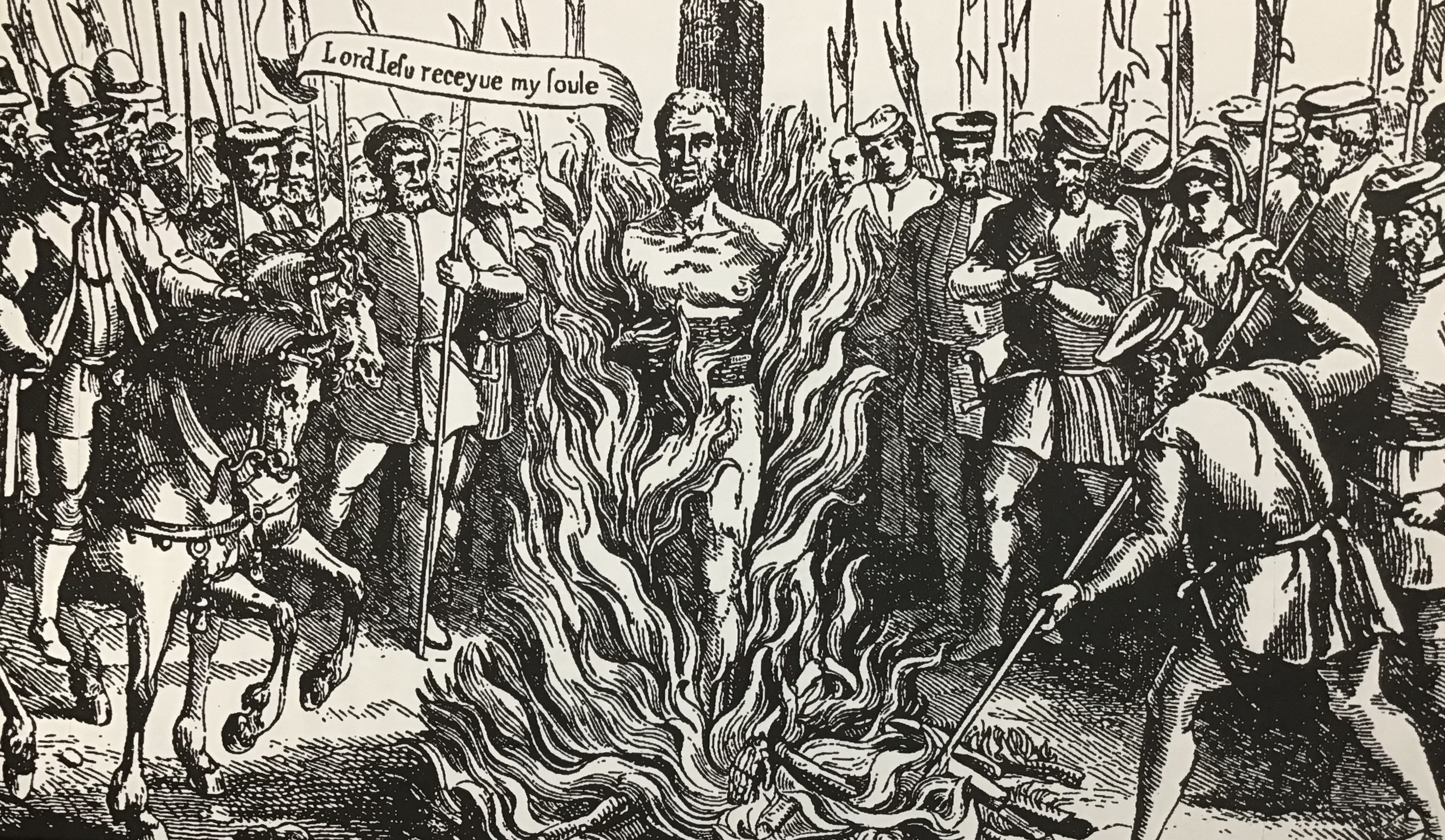
Bishop Hooper burned at the stake for the gospel.
Although we Protestants say that we don’t venerate the saints, you wouldn’t know it the way some pastors fawn over Luther, Calvin, Knox, Spurgeon, and other reformers. Don’t get me wrong, I think those men were used mightily of God, in spite of their flaws and personal sin.
But what I wonder about is how it is that so many pastors who would look up to these men and admire them for their courage and boldness are so cowardly in their own churches when they are called upon by the testimony of the Word of God to stand firm against a potential revolt by those who do not want biblical change.
When Gideon was called to pull down the idols in his town, he may have been overcome by the fear of man, but at least he did it, even if under the cover of night. And when they found out what he did, they wanted to kill him.
When Josiah came to understand how far Judah had fallen away from obedience to the Law, he immediately began to purge Judah and Jerusalem of its idolatrous high places and reinstated the reform that was necessary to please the Lord. This led to a need to rebuild and reorder the temple so that proper worship could be restored.
And the church today is in need of men who are ready and willing to make the changes that are needed in their local churches where unbiblical practices have found a nesting place for ages. For fear of confrontation, loss of income, or prominent families, or a simple fear of losing your job, pastors remain silent in the face of unrepentant sin and all manner of false practices. Unregenerate men are allowed to remain on elder and deacon boards, unhealthy and unbiblical curriculum and programs continue to function so as to avoid a conflict with a women’s ministry head or the parents of the youth. The call for entertainment in church continues to ring louder as the Word of God is given less time to work in the hearts that need it.
Yes, we admire Luther’s stand at the Diet of Worms where he refused to recant. We applaud Spurgeon for being unwilling to give in to the New Measures that sought to entertain the goats. We are in awe of Whitefield who preached the gospel wherever he could garner an audience. We rejoice at the courage of John Rogers and the other Marian martyrs who refused to stop preaching under Bloody Mary of Tudor, and were burned at the stake for it. But will we stand today? Where is our courage? Where is our godly resolve to trust God in the face of angry adversity within and outside of the church? Brothers! Be strong and very courageous!
Ministry can be an exhilarating challenge at times, and some people thrive on that rush. But it can also be a daunting challenge with lows as deep as the highs. Some people can become overwhelmed with the special challenges that they find in ministry–and either burn out, give up, or simply grow bitter. But the Lord provides for those he calls into service.
Yesterday we began to look at six ways which the Lord provides for His servants.The first way he provides is: He Gives Us Ministry Co-workers. You can read part one here: The Lord’s Provision for Ministry (part 1)
He Gives Us Financial Provision
“and because he was of the same trade, he stayed with them and they were working, for by trade they were tent-makers.… “But when Silas and Timothy came down from Macedonia, Paul began devoting himself completely to the word, solemnly testifying to the Jews that Jesus was the Christ.”” (Acts 18:3, 5 NASB95)
When Paul first arrived in Corinth, he needed a place to make a living. The blessing of meeting Aquila and Priscilla was more than a blessing and provision of co-workers in the gospel ministry. Verse 3 tells us that they shared the same trade: tent-making. This would make good sense because when Paul arrived there was no church to take an offering of support for his work. So, when the small group formed a tiny little church, he didn’t accept any financial support from them but supported himself from his own labors.
Verse 4 shows us that his need to work limited his ministry to the Sabbath day. It may have been that he used the evenings as well to teach and preach, but this would have been limited as well.
Paul later wrote to the Corinthian church that he did not want to take from them any financial support so that they would not be put under the financial stress. In 2 Corinthians 11:9 Paul wrote, “and when I was present with you and was in need, I was not a burden to anyone; for when the brethren came from Macedonia they fully supplied my need, and in everything I kept myself from being a burden to you, and will continue to do so.” (2 Corinthians 11:9, NASB95).Instead of burdening the Corinthian Church, Paul wrote that he took the support he received from the churches in Macedonia. We see that in verse 5 when Paul and Silas returned they brought a financial gift to help Paul so that he didn’t have to work as a tentmaker anymore.
This wasn’t an issue of laziness on Paul’s part, but an issue of mission. Paul was called to plant churches, not make tents! When Paul wrote to the Philippians he thanked them for their generosity in providing for this ministry. He said in Philippians 4:15, “You yourselves also know, Philippians, that at the first preaching of the gospel, after I left Macedonia, no church shared with me in the matter of giving and receiving but you alone” (Philippians 4:15, NASB95). How encouraging it is to know that the Lord provides for his minister’s needs!
Do you know how much an F/A 18 Hornet twin engine fighter plane costs? $94 million dollars! [2] Do you think the pilots that fly those beautiful machines pay for their own jets? How about the fuel? Of course not! They are serving us as they protect the United States. Paul wrote in 1 Corinthians 9:7, “Who at any time serves as a soldier at his own expense? Who plants a vineyard and does not eat the fruit of it? Or who tends a flock and does not use the milk of the flock?” (1 Corinthians 9:7, NASB95)
We all pay taxes that pay for those planes, the fuel, the rockets and the pilots. I happily pay for those things because I want those men and women who defend our country to be safe and to keep us safe. Ministry is no different. Some people don’t pay taxes, and some begrudge the taxes they pay. Same thing goes in church. Some people don’t give, or they give very little. They begrudge God. Don’t be that person. Support the ministry of your church, missionaries and other ministries which the Lord is using to promote the gospel of Jesus Christ.
He Gives Us Ministry Focus
“And he was reasoning in the synagogue every Sabbath and trying to persuade Jews and Greeks. But when Silas and Timothy came down from Macedonia, Paul began devoting himself completely to the word, solemnly testifying to the Jews that Jesus was the Christ.” (Acts 18:4–5, NASB95)
Whenever Paul and the missionary team entered into a city, they didn’t need to figure out what they were supposed to do. The Lord had laid that out for his Apostles when he was with them, and nothing had changed. When Paul entered a city, he proclaimed the gospel to the people. After souls were saved, he established a church where Christ was worshiped. Then he discipled the Christians until there were some who were mature enough to be leaders. Then he moved on to plant another church somewhere else.
In Acts 2:42 we see how the church conducted its services when it gathered: “They were continually devoting themselves to the apostles’ teaching and to fellowship, to the breaking of bread and to prayer.” (Acts 2:42, NASB95). This isn’t mysterious. No need to be creative and reinvent the wheel of worship.
Verse 4 says Paul reasoned in the synagogue every Sabbath trying to persuade the Jews and Greeks of the truthfulness of the gospel. He did that everywhere he went. And in verse 5 when Timothy and Silas find him, he was still at it!
As a pastor, whenever we gathered together to conduct board meetings we always had an agenda. Perhaps you have been at a meeting that goes nowhere and is just a giant time waster. I hate that. I don’t know about you, but If I have to meet I want to have a purpose and know where I am going, and I want the meeting to stop when we are done.
God has an agenda for the Church, doesn’t he? He wants us to go out into the whole world and preach the gospel, baptizing them and making disciples. He wants us to admonish and teach everyone with wisdom so that everyone is complete in Christ (Philippians 2:30). He wants our churches to focus on Scripture teaching, biblical fellowship, communion and prayer. That’s the plan and we need to stick to it and not wander off into a spiritual drift pattern.
Let me ask you honestly, how are you involved in these purposes? Are you personally helping the church in moving forward to be faithful to this purpose or are you slowing it down?
It’s hard to imagine the hardships that the Apostle Paul must have faced at times. Having travelled so far away from family and that which was familiar would be enough to cause most people to struggle. Add to that the immense physical strain in travelling by foot, having poor accommodations and little to eat at times. We could understand if Paul and his teammates grew weary. The beatings and imprisonments compounded and heightened the suffering he endured for the sake of Christ.
As Paul wandered about in Athens (Acts 17), he was all alone. His travelling companions would catch up with him later, but for now he walked the streets and engaged people with the gospel of Jesus Christ. As he moved about the city, his heart was provoked by the widespread idolatry, and as he left Athens his ministry did not show as much fruit as he hoped. How did Paul continue for so long without being burned out and frustrated?
A Lifeway Research Survey completed in 2015 states conservatively that the number of men leaving the ministry are about 250 per month. Some statistics are as high as 1,700 a month. The reasons given in the Lifeway survey would have been understood by the Apostle Paul and experienced by him in some form:
84 percent say they’re on call 24 hours a day.
80 percent expect conflict in their church.
54 percent find the role of pastor frequently overwhelming.
53 percent are often concerned about their family’s financial security.
48 percent often feel the demands of ministry are more than they can handle.
21 percent say their church has unrealistic expectations of them. [1]
So, it is fair to ask ourselves once again, how could Paul continue so faithfully in the ministry under such difficult circumstances? This isn’t just important for those in ministry to know, but everyone in the Body of Christ as well. We are all called as ministers of the New Covenant. You may not preach a sermon every Sunday, but you might teach Sunday school, or AWANA or lead a weekly Bible study. All of Christ’s disciples are called, even if not vocationally, to minister to one another and to carry the gospel to the world. In this series of posts I’d like to examine six ways which the Lord provides for His servants. The first way he provides is…
He Gives Us Ministry Co-workers
“After these things he left Athens and went to Corinth. And he found a Jew named Aquila, a native of Pontus, having recently come from Italy with his wife Priscilla, because Claudius had commanded all the Jews to leave Rome. He came to them,” (Acts 18:1–2, NASB95)
“But when Silas and Timothy came down from Macedonia, Paul began devoting himself completely to the word, solemnly testifying to the Jews that Jesus was the Christ.” (Acts 18:5, NASB95)
Leaving Athens, Paul was still all alone. Back in Acts 17:13-15 the missionary team was broken up in order to get Paul out of the area because of the physical danger he was in from the angry Jewish leaders who were stirring up riots in Berea. Paul went to Athens alone and then travelled to Corinth, a little over 50 miles away. If Athens was noted for its philosophical and religious nature, Corinth was known for its sensual attractions. The city was one of the largest and most prominent ports in the ancient world and it was a melting pot of money, religions and fleshly sin, much like Los Angeles and New York City.
The need was great in Corinth for the gospel. As Paul came to this great ministry opportunity, the Lord provided for him ministry partners named Priscilla and Aquila, a married couple. Aquila, whose name was Latin for “eagle,” was originally from the Roman province of Pontus, near the Black Sea in what is now called Turkey. Aquila and Priscilla had been living in Rome but had been commanded to leave along with all other Jews. This was because of a command in 49 A.D. from Emperor Claudius.
Along with this couple, the Lord brought back Silas and Timothy from Macedonia (v. 5). When they found Paul, he was busy faithfully proclaiming the gospel in the synagogue. Paul now had a full team that joined him in preaching and discipling those that came to Christ. Even as gifted as the Apostle Paul was, he needed the help of co-workers to be able to faithfully carry out the mission he had received from Christ.
This reminds me that when the Lord Jesus sent out his disciples, he sent them out in groups of at least two, sometimes more. I don’t think this is a command, but it is good wisdom.
Ecclesiastes 4:9-12 says, “Two are better than one because they have a good return for their labor. For if either of them falls, the one will lift up his companion. But woe to the one who falls when there is not another to lift him up. Furthermore, if two lie down together they keep warm, but how can one be warm alone? And if one can overpower him who is alone, two can resist him. A cord of three strands is not quickly torn apart.” (Ecclesiastes 4:9-12, NASB95)
Think about those in your church. These are your ministry partners and co-workers for the gospel ministry. We should be working together, encouraging one another, stirring one another up to love and good deeds. We should be making incursions into enemy territory in teams.
If you’re not doing anything, that means that you aren’t just disobeying the Lord in not serving, but you are not being a co-worker for someone else. Others are needing to carry on without you! Get in the game! The team needs you!
“And when they brought those kings out to Joshua, Joshua summoned all the men of Israel and said to the chiefs of the men of war who had gone with him, “Come near; put your feet on the necks of these kings.” Then they came near and put their feet on their necks. And Joshua said to them, “Do not be afraid or dismayed; be strong and courageous. For thus the Lord will do to all your enemies against whom you fight.”” (Joshua 10:24–25)
When you begin reading the book of Joshua, you can almost sense the fear and intimidation that Joshua was feeling. It starts with the announcement that Moses is dead. And then over and over again Joshua and the people of Israel are told to be strong and courageous.
After gaining some victories, assurance, and even a few tough lessons, Joshua has grown quite a bit as a leader by chapter 10. As five kings band together to try and stop the advancement of Israel into the Canaanite territory, it quickly becomes obvious that God is fighting for his people and they are unstoppable. The five kings in fear and desperation hide out in a cave, where they are discovered and sealed into the cave to await their fate.
After destroying the five kingdoms, Joshua returned to the sealed cave to deal with the kings. What he did next is worthy of note for leaders in the church today.
1. Joshua summoned all the men of Israel. The men were the leaders of the families and clans, as well as those who fought the battles. By Joshua summoning all the men so that they could be built up in courage, he was strengthening and stabilizing the whole nation. Similarly, when the pastoral leadership of the church strengthens and gives courage to the men in the church as a whole, they strengthen the whole church.
2. Joshua encouraged the chiefs of the men of war…[to] come near; put your feet on the necks of these kings.” Joshua then turned to the leaders of the warriors—the commanders, and gave them the honor of this courageous symbolic act of victory. Not only did this act allow them to taste the victory for themselves, but it also strengthened their courage as the people saw not just Joshua as a mighty man whom God could use, but many mighty men God was using. Again, the local church should not be a place of pastor worship, but a place where the pastors are “equipping the saints for the work of the ministry.” This means that we should be producing multiple warriors for Christ, and among them many will rise to the place of “chiefs of the men of war.” How encouraging to know that your local church is a fertile growing place for mighty men of God!
3. Joshua finally spoke God’s Word to them to both focus and humble them: “And Joshua said to them, “Do not be afraid or dismayed; be strong and courageous. For thus the Lord will do to all your enemies against whom you fight”” (Joshua 10:25). These are very similar words to those that the Lord said to Joshua when he failed at Ai (Joshua 8:1). Joshua had absorbed those words and was now living by them. He knew that the Word of God is a powerful two-edged sword, and he wanted to equip his men with the same weapon that he had received. Those words were more than simply true—they contained reminders of humility and focus—don’t be afraid or discouraged, be strong and courageous. But don’t forget that the Lord will be fighting for you. It is not you who has won these victories.
Locker room pep talks are strongly associated with sports, and so many men are familiar with them. But that isn’t what Joshua gave them, and its not what our churches need. Leave the pop psychology to Oprah Winfrey and Joel Osteen. Real leaders need en-couragement, meaning they need courage from God himself. Hype only lasts so long. Courageous leaders need to point up and coming leaders beyond themselves to God himself. Preach the Word and let the lion out!
Joining a denomination or going at it alone are not the only options for churches, pastors, leaders, and ministries.
Maintaining doctrinal fidelity and alignment is critical when seeking to work with others to accomplish Great Commission objectives.
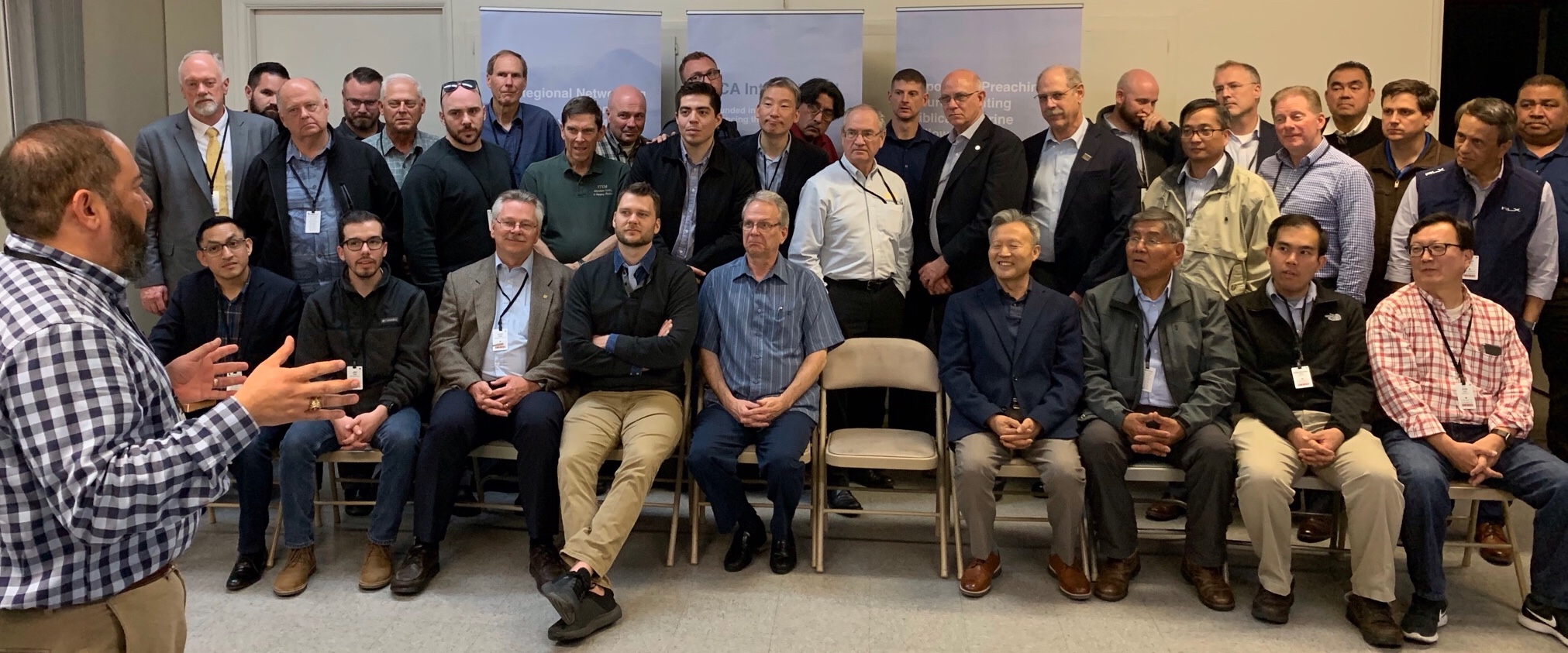
IFCA International was founded in 1930 to fight against the onslaught of theological liberalism growing in denominational churches, mission agencies, and seminaries.
Listen to a podcast I was invited to record with some fellow pastors a few months ago as they ask me more about IFCA International. To find out more, go to http://www.IFCA.org.



 Always Reforming