When stripped down to our historical foundation, IFCA International is a Bible movement. Our churches and ministries exist to preach Christ crucified (1 Cor. 1:23), a prospect that has never been acceptable to the world and is rejected by the apostate church. Like the Apostle Paul, we do not shrink from declaring the whole counsel of God (Acts 20:27). We believe that God has spoken without error and that His Word has never failed. We believe that the Word of God rules over the Church and God’s people, and that this authority extends to all humanity whether it accepts it or not. We believe the Bible, and this should have a direct impact upon how we minister in the preaching of the Word.
“And David became greater and greater, for the LORD of hosts was with him.” (1 Chronicles 11:9)
The vast majority of the first nine chapters of First Chronicles is a genealogy, and most people simply breeze over the names and relations listed there. And after a description of Saul’s and Jonathan’s deaths and David’s ascension to the throne, another list of names is given. Whereas the first lists were genealogies, this list is very different.
In the U.S. Memorial Day is a holiday which is normally celebrated with picnics and barbecues, a long way from the its intended purpose. Memorial Day was originally set aside as a day to remember or memorialize the men and women who have fought to defend our country in the armed services. The Vietnam Veterans Memorial Wall in Washington D.C. currently has 58,272 names of those who died or remain missing in the Vietnam War.
So what’s my point? My point is that lists of names mean something. And not only to their family and loved ones. This becomes incredibly clear in 1 Chronicles 11:10-12:40 where the names of King David’s mighty men are given along with some of their accomplishments. These were great men of war and courage. Some fought against unthinkable odds and everyone fought with great courage and faithfulness to the king.
Here are a few thoughts I had about these men:
Like David, the mighty men were only successful because the Lord had given them success–they knew it. The beginning of a great fall begins with pride!
Their faithfulness to King David was a faithfulness to the Lord who had placed David upon the throne. Mighty men recognize God’s leaders and do all they can to support them.
The mighty men had different ranks based upon their abilities, performance, and successes. There is “the three,” “the thirty” and the those who were very great, but “did not attain to the three” or “the thirty.” Everyone isn’t equal. Performance, skill, and effort matter. In a day when everyone gets a participation ribbon, this shows that mighty men strive and push themselves to be their best in the service of the Lord.
The mighty men loved their king and were willing to go above and beyond to serve and please him, even risking their lives to give him water from his hometown well (1Chron 11:15-19). This devotion was matched by David’s unwillingness to indulge himself with this sort of sacrifice. There was mutual love, respect, and loyalty between the king and his mighty men.
The mighty men had a great kinship and loving respect for one another built around their devotion to the Lord and his king. They were united in purpose and vision, each doing his own part for the common cause.
The virtues of honor, devotion, courage, selfless service and sacrifice are not exclusive to the military. These are the virtues that members of the Church should uphold as well. Our King is Jesus and our goal is clearly given in the Great Commission. May the Lord be pleased to raise up mighty men (and women!) from within our own churches to his glory and honor!
In his famous hymn “This is My Father’s World”, Maltbie Babcock wrote these comforting words:
This is my Father’s world, O let me ne’er forget/ That though the wrong seems oft so strong, God is the ruler yet. This is my Father’s world: The battle is not done; Jesus who died shall be satisfied, And earth and heav’n be one.
This stanza pulls together two truths that confront us in this world—“the wrong seems oft so strong” and “God is the ruler yet.” In the next three post I want to address this from the biblical perspective of Psalm 75. Over each of the next three posts I will lay out a total of Nine Ways in Which the Sovereignty of God in Dealing with the Wicked Affects Our Attitude Toward our Present Circumstances. Let’s begin…
1. It Makes us Aware That God is Always Near Us (v. 1A)
Psalm 75:1a “We give thanks to you, O God; we give thanks, for your name is near.”
The reason for the psalmist’s thankfulness was that the “name” of God was near. The “name” of course, points to the presence of God himself. David wrote about this nearness in Psalm 139:1-12 when he spoke of the Lord intimately knowing mankind from when he knit us in our mother’s womb as well as every other aspect of our lives. There is nowhere that we can hide or be hidden from his presence.
This is a comforting reality in times of need and pain. God really is right here with us. He hears your prayers. He sees your enemies as they attack. He sees it all.
2. It Gives us a Thankful Heart (v.1b)
Psalm 75:1b “We recount your wondrous deeds.”
Along with his nearness was a legacy of remembering that brought forth a thankful heart.
Remembering and reciting aids in developing a thankful heart. We are forgetful people, aren’t we? The Lord knew this, and so he constantly calls his people throughout the Scriptures to remember, even instructing them to set up memory aids, special dates, rites, and festivals. In the Church Age, Christ instituted the Lord’s Supper to be done “in remembrance of him.” Why? Because as monumental as the cross of Christ is for our eternity, we still forget about it if left to ourselves.
Psalm 78:4 speaks about the need for parents to recite these memories to their children. It says, “We will not hide them from their children, but tell to the coming generation the glorious deeds of the Lord, and his might, and the wonders that he has done.”
We can grow anxious and weary when we forget that God is in control. We can begin to see ourselves as helpless, awash in the chaos of the world, victims of chance. But if you sit down and read through the pages of Scripture, you will quickly begin to see that God has always been in control. Reminding yourself of this fact will change your outlook radically.
3. It Teaches Us Patience (v. 2)
Psalm 75:2 “At the set time that I appoint, I will judge with equity.”
Here we have a change of speakers—the song has moved from Asaph speaking (or the priest who led the singing) to God himself speaking. The Lord says that “at the set time that I appoint…” This language in Hebrew refers to seasonal time, not clock time. Clock time spins fast. Seasons don’t work by a clock. Fruit doesn’t ripen according to your watch. God doesn’t punch-in to work.
Let there be no mistake, God will judge—he says so. But he will judge at the set time that he appoints. We can’t say “Amen” to God’s sovereignty and then be impatient when he doesn’t act on our schedule, can we? We can’t be like Martha, Lazarus’ sister, who got so upset that Mary wasn’t helping her prepare the food in the kitchen that she stomped right into the middle of Jesus’ teaching time and demanded that the LORD command her sister to help her! It appears Martha thought Jesus needed a little help leading the world. He doesn’t.
When you become impatient and wonder when God will judge, remember that God is in control as he has always been. Be still and know that he is God.
Although we Protestants say that we don’t venerate the saints, you wouldn’t know it the way some pastors fawn over Luther, Calvin, Knox, Spurgeon, and other reformers. Don’t get me wrong, I think those men were used mightily of God, in spite of their flaws and personal sin.
But what I wonder about is how it is that so many pastors who would look up to these men and admire them for their courage and boldness are so cowardly in their own churches when they are called upon by the testimony of the Word of God to stand firm against a potential revolt by those who do not want biblical change.
“The problem with preachers today is that nobody wants to kill them anymore!”
Steven J. Lawson
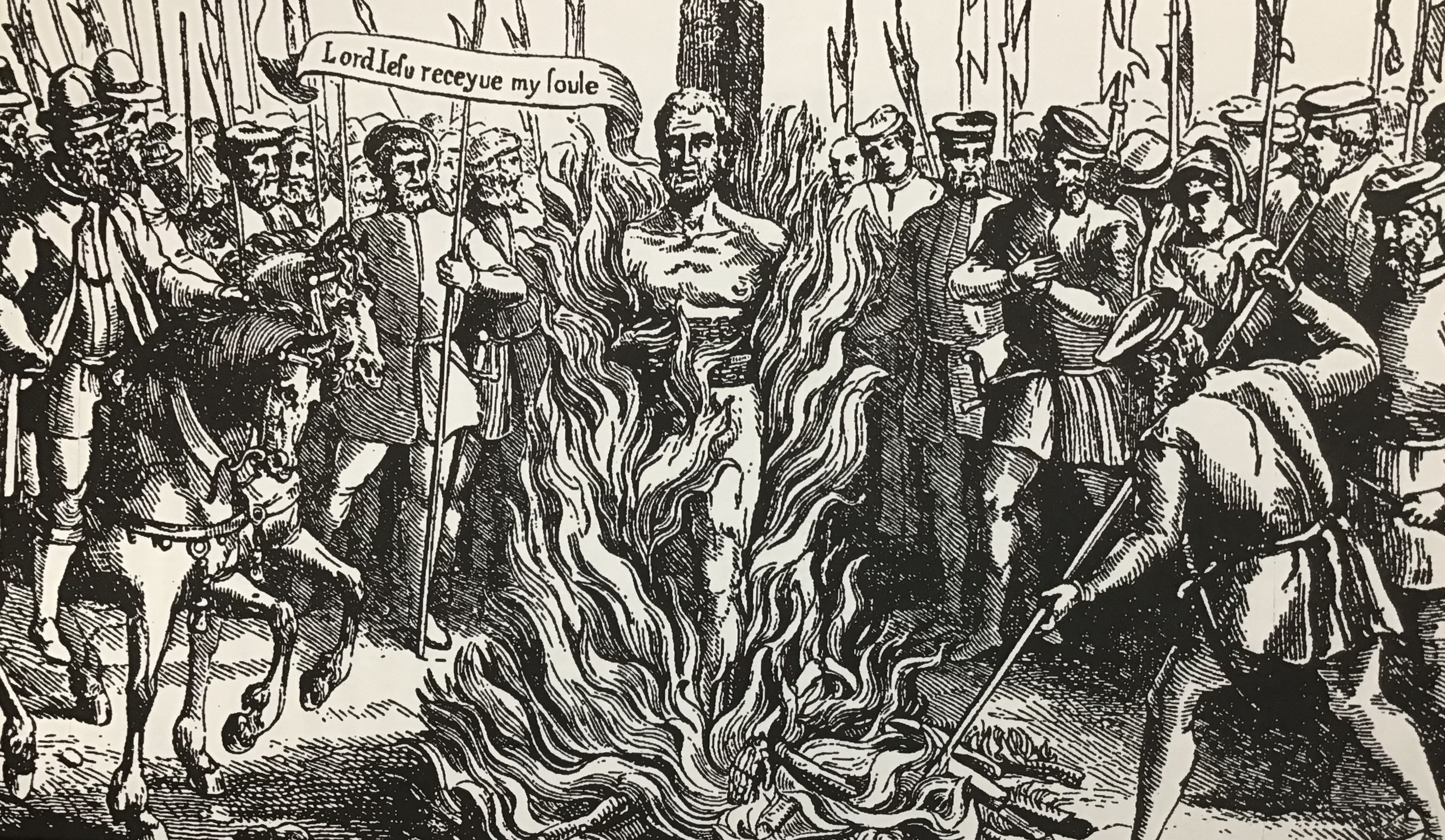
Bishop Hooper burned at the stake for the gospel.
Although we Protestants say that we don’t venerate the saints, you wouldn’t know it the way some pastors fawn over Luther, Calvin, Knox, Spurgeon, and other reformers. Don’t get me wrong, I think those men were used mightily of God, in spite of their flaws and personal sin.
But what I wonder about is how it is that so many pastors who would look up to these men and admire them for their courage and boldness are so cowardly in their own churches when they are called upon by the testimony of the Word of God to stand firm against a potential revolt by those who do not want biblical change.
When Gideon was called to pull down the idols in his town, he may have been overcome by the fear of man, but at least he did it, even if under the cover of night. And when they found out what he did, they wanted to kill him.
When Josiah came to understand how far Judah had fallen away from obedience to the Law, he immediately began to purge Judah and Jerusalem of its idolatrous high places and reinstated the reform that was necessary to please the Lord. This led to a need to rebuild and reorder the temple so that proper worship could be restored.
And the church today is in need of men who are ready and willing to make the changes that are needed in their local churches where unbiblical practices have found a nesting place for ages. For fear of confrontation, loss of income, or prominent families, or a simple fear of losing your job, pastors remain silent in the face of unrepentant sin and all manner of false practices. Unregenerate men are allowed to remain on elder and deacon boards, unhealthy and unbiblical curriculum and programs continue to function so as to avoid a conflict with a women’s ministry head or the parents of the youth. The call for entertainment in church continues to ring louder as the Word of God is given less time to work in the hearts that need it.
Yes, we admire Luther’s stand at the Diet of Worms where he refused to recant. We applaud Spurgeon for being unwilling to give in to the New Measures that sought to entertain the goats. We are in awe of Whitefield who preached the gospel wherever he could garner an audience. We rejoice at the courage of John Rogers and the other Marian martyrs who refused to stop preaching under Bloody Mary of Tudor, and were burned at the stake for it. But will we stand today? Where is our courage? Where is our godly resolve to trust God in the face of angry adversity within and outside of the church? Brothers! Be strong and very courageous!



 Always Reforming