Sleeping Under the Threat of a Tornado

So Jesus, knowing that they were going to come and take Him by force to make Him king, withdrew again to the mountain by Himself alone. Now when evening came, His disciples went down to the sea, and after getting into a boat, they began to cross the sea to Capernaum. It had already become dark, and Jesus had not yet come to them. And the sea was stirred up because a strong wind was blowing. Then, when they had rowed about twenty-five or thirty stadia, they saw Jesus walking on the sea and drawing near to the boat; and they were frightened. But He said to them, “It is I; do not be afraid.”  (John 6:15–20, LSB)

Last night, while half way across the country, I received weather alerts telling me that there was a growing threat that tornadoes were possible back home. I saw the weather map in the morning when I passed by the TV screen in the hotel lobby and the dark red spots over home made me a little concerned—but these things always seem to pass by, right?

Last night the text appeared on my phone: “We are going down [into the basement]. Please pray.” The accompanying photo of an emergency weather alert didn’t settle my heart: “National Weather Service: TORNADO WARNING in this area until 10:45 PM EDT. Take shelter now in a basement of an interior room on the lowest floor of a sturdy building…”

After feeding 5,000 men, not counting women and children, Jesus knew that the people wanted to make him their king. I wondered, what kind of king could they have wanted? Israel was under Roman occupation and a part of the Empire, though they wouldn’t have accepted that truth. Surely they didn’t think Jesus would become the new Emperor of Rome. The Herodian Dynasty was still active, and Herod was called a “king” even though he ruled locally at the pleasure of Rome. Would Jesus simply take Herod’s place as the “king of the Jews” in Palestine? The more I think about it, not only did Jesus refuse to allow them to make him their king because he needed to be crucified for the sins of men, but add to that the fact that the type of king the people wanted was far too small of an office for Jesus. He wasn’t satisfied to simply be a king, or the king of the Jews, or even the Emperor of Rome. No, Jesus is the King of kings and Lord of lords. The people weren’t thinking big enough.

That may have been why John shows his readers that Jesus crossed the sea in a storm by walking upon the water. Jesus was overqualified to be a simple client-king. He was too powerful to fit into the hierarchy of rulers and petty lords that dotted the earth in those days. The God-Man who can feed his people, had complete power over nature. He was not scared of the storm as the disciples in their little fishing boat were. Of course not. He made that body of water, and he commanded the wind and the waves. He wasn’t a victim of gravity and didn’t need to obey the laws of nature that say a man’s mass is heavier than water. Just like he was Lord of the Sabbath, Jesus is Lord over all, so that even the wind and the seas obey him.

After I prayed for my family—and pray I did!—I was able to rest. I didn’t have the best night of sleep, but I slept. Being half-way across the country reminds a person that they are helpless to do anything to help. But had I been huddled in the basement with my wife and daughters, what would I have done if a tornado had touched down in our neighborhood? I was powerless to help them—either away or at home.

But as I called out to the One who has all power, who is greater than any earthly king or president or prime minister, I was reminded of the final words of Jesus above as I prayed, “It is I; do not be afraid.”
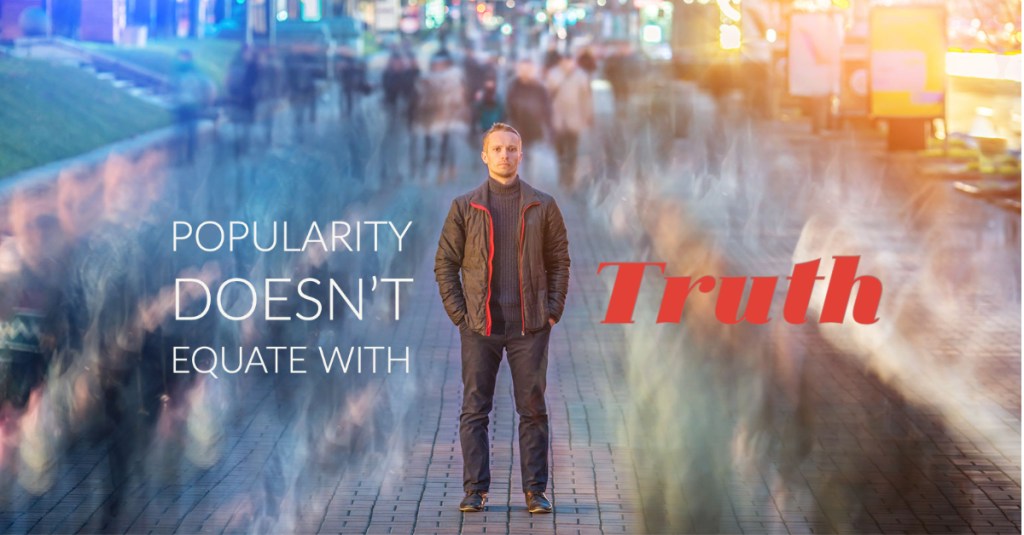
Popularity Doesn’t Equate with Truth

“Moreover, Jehoshaphat said to the king of Israel, “Please inquire first for the word of Yahweh.” Then the king of Israel gathered the prophets together, about four hundred men, and said to them, “Shall I go against Ramoth-gilead to battle or shall I refrain?” And they said, “Go up, for the Lord will give it into the hand of the king.” But Jehoshaphat said, “Is there not yet a prophet of Yahweh here that we may inquire of him?”” (1 Kings 22:5–7 LSB)

As I was reading the passage above, I noticed something I hadn’t seen before in my previous readings in 1 Kings.

King Jehoshaphat requested that King Ahab first inquire about the will of God before agreeing to go to war with him. Ahab obliged by calling 400 so-called prophets who told him that the Lord approved of the war.

But Jehoshaphat was not fooled. Something didn’t sit right with the message these prophets gave. The text doesn’t tell us why, but Jehoshaphat didn’t accept these 400 prophets as speaking from the Lord. As a matter of fact, this is what caught my eye.

Again, it says in verse 7, “But Jehoshaphat said, “Is there not yet a prophet of Yahweh here that we may inquire of him?”” It is almost as if the king told Ahab, “Yes, yes, I have heard the popular opinion of all these men, but…don’t you have any actual prophets of Yahweh, or only these fakers? I’d actually like to hear what Yahweh has to say.”

Ahab doesn’t seem to be confused because he knows that his sleight of hand trick hasn’t worked. He knows that he has been keeping the good stuff in the back and hasn’t brought out the real prophet of Yahweh. Ahab wasn’t looking for truth, only for a confirmation of his preconceived plans.

You know, some people claim to want the truth, but they want their truth, as the current foolishness of our day would say. But the truth is a stubborn thing. Something is either true or it is not. And the number of people you get to back a lie doesn’t increase its truthfulness. A lie is always a lie no matter how many false prophets can lip-sync in unison the siren song of the culture or popular opinion.

We need to ask ourselves this as well. Do I really want to know the truth, or am I wanting to fit in, to follow with the cool crowd (whoever the “cool kids” might currently be)?

Appeals to “science” or straw man arguments, or the number of books written or Instagram followers may sway those who want to affirm their own preconceived notions, but popularity and doctrine don’t equal truth. Whether it is the cultural doctrines of gender politics, abortion, or feminism, or the theological doctrines of eschatology, pneumatology, or ecclesiology. Memes don’t prove the truth. Mic drop blog posts and Facebook rants bring more heat than light.

What we need is to hear a true prophet of Yahweh speak. God has spoken, and He has done so perfectly in His Word. So, instead of gathering polemics and talking points from Fox News, CNN, Twitter, or YouTube, for those of us called out by Christ, let’s open our Bibles and listen to God speak.

We Will Not Be Silent and We Will Not Bow Down

“In a time of universal deception, telling the truth is a revolutionary act. Let us determine that we will not be shamed into silence or inaction. We will speak, and like Shadrach, Meshach, and Abednego in the book of Daniel, let us resolve that we will not bow.”

Erwin Lutzer, We Will Not Be Silenced, 38.

It is interesting to read about the Apostle Paul’s experience in Jerusalem in Acts 21-26. In these chapters, Paul is constantly allowed to share with different audiences his testimony in one way or another. Incredibly, in many instances, he isn’t allowed to finish his explanation of why he believes in Jesus Christ.

At first, Paul is seized while worshipping in the temple and dragged outside of the temple grounds so he can be stoned to death. By the providence of God, he is rescued by Roman soldiers whom he asks for permission to speak to the angry mob because they don’t seem to agree about why they want to kill him. But before Paul finishes his explanation, the crowd erupts in rage and he is once again needing to be rescued by the Roman soldiers and carried away to safety.

Again and again, Paul speaks: to the Sanhedrin, to Felix the Governor, before Felix’s wife Drusilla. Following Felix, Paul was allowed to speak to the incoming Governor Festus, and in frustration and to seek justice, he finally appealed to Caesar himself.

In each of these interactions, Paul spoke the truth—whether about his beliefs, his experiences, the deception of his enemies, or the truth of the gospel message and Jesus Christ. And in each opportunity, he found that most of those that called him to speak the truth were not actually interested in hearing the truth. And he also found that when he spoke the truth, those who claimed to want to hear the truth did not actually want the truth spoken. Many responded with violence and murder.

Dear Christian, do you not see that this attitude is similar to the one we face in our world today, and it is growing stronger? Many people speak about wanting the truth—but they do not want it when we speak it. Some want a version of the truth that suits them and their version of reality. Some truly want to hear it but are seriously disappointed that it is not what they had hoped. Some respond with calls to silence the truth and truth-speakers.

But like Paul, we cannot be silent. And like Jeremiah before him, we must say, “If I say, “I will not mention him, or speak any more in his name,” there is in my heart as it were a burning fire shut up in my bones, and I am weary with holding it in, and I cannot” Jeremiah 20:9.

In today’s world, telling the truth is a revolutionary act. May we speak the truth no matter what. Don’t forget that we are a city on a hill whose light cannot be hidden.

Holy Stubbornness

“Now at Iconium they entered together into the Jewish synagogue and spoke in such a way that a great number of both Jews and Greeks believed. But the unbelieving Jews stirred up the Gentiles and poisoned their minds against the brothers. So they remained for a long time, speaking boldly for the Lord, who bore witness to the word of his grace, granting signs and wonders to be done by their hands. But the people of the city were divided; some sided with the Jews and some with the apostles.” (Acts 14:1-4)

The preaching of the gospel will always accomplish its intended purpose. Soemtimes the fields are slow to yield anything. We need to keep at it and trust the Lord for the growth. But sometimes the results are seen immediately, as in Acts 14 where a great number of Jews and Gentiles came to faith in Christ after the apostles proclaimed the gospel to them in Iconium. How exciting when this happens!

But along with this immediate burst of growth came an immediate response from the enemy. Spiritual warfare in the shape of stirring up strife and the poisoning of minds is said to have been the tactic used here. This probably means that lies and jealous striving were used to incite the Gentiles against the new Christians. It’s interesting that the non-believing Jews who would normally have nothing to do with Gentiles were now willing to feign concern for the Gentiles so long as they could accomplish their desire of persecution.

What I want to point out is what verse 3 says, “so they remained for a long time, speaking boldly for the Lord.” The “they” of verse three refers to the apostles Paul and Barnabas (13:50). In response to the attack against the new church in Iconium, the apostles did what any mother would do when her baby is attacked—they stayed longer to defend and care for her.

This “holy stubbornness” is a response of love and courage. Paul and Barnabas weren’t willing to proclaim the gospel, see people receive Christ, and then move on. The goal wasn’t to impress their buddies with evangelistic growth statistics. Their goal was to make disciples of Christ, and that meant that they needed to stay as long as necessary in order to ensure that their brothers and sisters in Iconium were protected from the wolves there.

Accompanying the apostles’ stay was the presence of God who gave to them bold speech that was empowered by Christ. It was Christ working through the apostles who bore witness to the word of His grace. This along with signs and wonders that accompanied the powerful Word confirmed the gospel and these messengers as being from God. This would go a long way to both strengthen the Church and warn the enemy.

Sometimes we think of evangelism in rosy, romantic terms that ignores what it really is—an incursion behind enemy lines to snatch away from the devil those who once were his, but now belong to Christ. And the enemy will not stand by idly and allow this to happen. We can expect him to fight back.

And this is where holy stubbornness is needed. Since we belong to Christ, we do not need to fear the enemy. Christ is for us, so who can be against us? But that truth does not remove the reality of spiritual attack, hardship, and persecution. We might feel the heat of warfare increase as the battle rages in our community and all around us.

Be encouraged. The devil doesn’t mess with the sleepers. He doesn’t want to rouse a church that is deep in apathy. But once you begin raiding the smoldering sticks from his fires, he will rage and seek to stop you. This might come as discouragement, personal attacks, division, distraction, or many other of his numerous schemes. Don’t give up! Don’t stop making disciples. Don’t become distracted. Don’t move on.

Dig in. Be stubborn. Refuse to relent. God is with us. We have the victory!

Rise Up O Men of God!

“This is not a moment for timid souls. Boldness comes easily when you are in the presence of those who agree with you; it is difficult when you are standing alone in the midst of people who seek your demise. Boldness behind a pulpit is one thing; boldness in a city council meeting is another. Boldness is seen most clearly when you have burned the bridge that would have enabled you to retreat to safety.”

Erwin Lutzer, We Will Not Be Silenced: Responding Courageously to Our Cultures Assault on Christianity, 120.

We are at a critical point in the history of the world and the Church. Should the Lord tarry, our children will look back on these dark and trying days and judge whether we were courageous in the face of great opposition or see evidence of compromise and capitulation. What will make the difference? Can I suggest a few things from Acts 4:8-12, where the disciples ran into their first major confrontation with aggression?

“Then Peter, filled with the Holy Spirit, said to them, “Rulers of the people and elders, if we are being examined today concerning a good deed done to a crippled man, by what means this man has been healed, let it be known to all of you and to all the people of Israel that by the name of Jesus Christ of Nazareth, whom you crucified, whom God raised from the dead—by him this man is standing before you well. This Jesus is the stone that was rejected by you, the builders, which has become the cornerstone. And there is salvation in no one else, for there is no other name under heaven given among men by which we must be saved.” (Acts 4:8-12)

1. The disciples were filled with the Spirit.

This is the only way a group of Christ-followers who were cowering behind locked doors only a few days before could be so radically different. Courage and boldness is not for those of this type of personality. Boldness and courage filled the hearts of those filled with the Spirit.

2. The disciples testified to Jesus Christ.

The evangelical church is scattered and divided about a lot of things today—spiritual gifts, baptism modes, music, methodology, women in ministry, and more. Don’t get me wrong, hese are all incredibly important things. But the primary need for standing firm against the onslaught of the enemy is the gospel message. The heart and focus must highlight the cross of Jesus Christ and the atoning work accomplished. Everything else must be seen in its subordinate place.

3. The disciples upheld the importance of the resurrection of Christ.

The resurrection points to the acceptance of the sacrifice of Christ on our behalf. It is not tangential, but central. The resurrection of Christ points to our own future resurrection and glorification. If you grasp this, then courage is sure to come because nothing—NOTHING—can stop you. Not even death.

4. The disciples never forgot that Jesus was rejected too.

If you forget that they hated Jesus, you might be tempted into the sin of seeking to please man. But if you remember that they hated our Lord and crucified the Lord of glory, then we will not be surprised when they hate us as well—no matter how winsome or loving or kind we might be.

5. The disciples knew that there is no other hope for the world than Jesus.

If a person could be saved through Islam, or Mormonism, or liberation theology, then it would be much easier to just quietly practice our faith privately without any care about others because they’ll eventually get to heaven too. But the message of Jesus was clear—He is the only way to the Father. And that should embolden us because although some people might want to silence us or shout us down, we can’t be silent if we truly love them.

Brothers and sisters, don;t lose heart. Jesus is coming soon, but we have work to do and we can’t allow the shouts of the world to drown us out.