Mighty Men of God

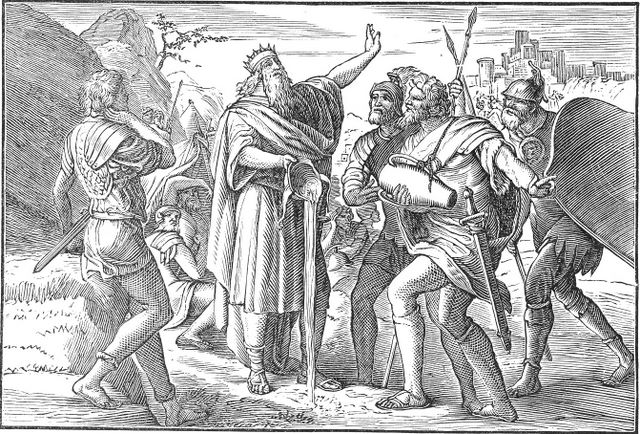
David's three mighty men

David’s Mighty Men

“And David became greater and greater, for the LORD of hosts was with him.” (1 Chronicles 11:9)

The vast majority of the first nine chapters of First Chronicles is a genealogy, and most people simply breeze over the names and relations listed there. And after a description of Saul’s and Jonathan’s deaths and David’s ascension to the throne, another list of names is given. Whereas the first lists were genealogies, this list is very different.

This coming weekend is Memorial Day in the United States, a holiday which is normally celebrated with picnics and barbecues, a long way from the true purpose this holiday. Memorial Day was originally set aside as a day to remember or memorialize the men and women who have fought to defend our country in the armed services. The Vietnam Veterans Memorial Wall in Washington D.C. currently has 58,272 names of those who died or remain missing in the Vietnam War.

So what’s my point? My point is that lists of names mean something. And not only to their family and loved ones. This becomes incredibly clear in 1Chronicles 11:10-12:40 where the names of King David’s mighty men are given along with some of their accomplishments. These were great men of war and courage. Some fought against unthinkable odds and everyone fought with great courage and faithfulness to the king.

Here are a few thoughts I had about these men:

  • Like David, the mighty men were only successful because the Lord had given them success and they knew it. The beginning of a great fall begins with pride!
  • Their faithfulness to King David was a faithfulness to the Lord who had placed David upon the throne. Mighty men recognize God’s leaders and do all they can to support him.
  • The mighty men had different ranks based upon their abilities, performance and successes. There is “the three,” “the thirty” and the those who were very great, but “did not attain to the three” or “the thirty.” Everyone isn’t equal. Performance, skill and effort matter. In a day when everyone gets a participation ribbon, this shows that mighty men strive and push themselves to be their best in the service of the Lord.
  •  The mighty men loved their king and were willing to go above and beyond to serve and please him, even risking their lives to give him water from his hometown well (1Chron 11:15-19). This devotion was matched by David unwillingness to indulge himself with this sort of sacrifice. There was mutual love, respect and loyalty between the king and his mighty men.
  • The mighty men had a great kinship and loving respect for one another built around their devotion to the Lord and his king. They were united in purpose and vision, each doing his own part for the common cause.

The virtues of honor, devotion, courage, selfless service and sacrifice are not exclusive to the military. These are the virtues that members of the Church should uphold as well. Our King is Jesus and our goal is clearly given in the Great Commission. May the Lord be pleased to raise up mighty men (and women!) from within our own churches to his glory and honor!

Book Review: God’s Battle Plan for the Mind

Godsbattleplan

Review: God’s Battle Plan for the Mind: The Puritan Practice of Biblical Meditation, David W. Saxton

Many areas of modern evangelicalism are devoid of deep thinking on biblical matters. It isn’t uncommon to hear Christians speak of the need to set aside doctrinal differences in order to foster a sense of unity. Although I am all for biblical unity, there can be little unity when there is no consensus on biblical truth. And it is this very issue that begins to show our need for a massive return to biblical meditation upon the Word of God and doctrine.

Saxton’s book takes twelve short chapters to uncover the largely lost discipline of biblical meditation in hopes that this much-needed excercise will be brought back as a mainstream practice in the Church.

In chapter 2, entitled “Unbiblical Forms of Meditation,” Saxton wisely warns of the counterfeits that masquerade as the genuine article. Roman Catholic spirituality, mysticism and contemplative prayer are especially important because of the current emphases that have promoted these practices and their accompanying works through the Spiritual Formation movement. Along with these the author briefly examines TM (transcendental meditation), yoga and Far Eastern religious ideas of meditation before moving on in chapter 3 with a short study not the biblical idea of meditation.

Saxton shows that he is very familiar with the Puritan’s wisdom on this subject, and he demonstrates their warm practices and wisdom throughout the book. One of the highlights of reading this book is all of the thoughtful quotes from the Puritans that are included within which serve to allow them to teach us the how and what of biblical meditation.

If I were to mention any negatives about this excellent book it would be just two. First, the chapter which defined what biblical meditation is (ch. 3) was a bit anemic in regards to the amount of biblical evidence and study given to it. I understand that this book was about the Puritan’s practice, but I was hoping for more than a very glossed over treatment of the biblical texts. Second, I found that this book read more like a compendium of Puritan wisdom with the author weaving it all together with a few sentences and phrases. When Saxton does find his voice, it is clear that he has absorbed much of the language and phrasing of the Puritans himself and so writes in an engaging manner that made me wish he had done so throughout. The final concluding chapter was closest to this idea and it was to me the most enjoyable as far as readability and smoothness.

Overall this book is a blessing to the Church and I pray that it will not only be read by many, but that it will become a practical handbook that engages more believers in the regular practice of biblical meditation.

[God’s Battle Plan for the Mind: The Puritan Practice of Biblical Meditation, David W. Saxton (Reformation Heritage Books, 2015)]

Choosing to Pursue God in Our Daily Choices

making choices

If a believer is to survive in a world of constant distraction, he must make honest and discerning choices about the use of his time. He must be willing to part with anything that clutters his mind to the point that he can no longer silently commune with the Lord. He must consciously and practically obey that biblical admonition to “lay aside every weight, and the sin which doth so easily beset us, and let us run with patience the race that is set before us, looking unto Jesus” (Heb. 12: 1–2a).“—David W. Saxon, God’s Battle Plan for the Mind: The Puritan Practice of Biblical Meditation

Lord, Make Us Humble

humble

I’m pretty sure it was innocent, but I still laugh when I think of the sweet gift that a church member gave to me one day, a copy of C.J. Mahaney’s book Humility: True Greatness. How does a person respond to that kind of a gift? I laugh even now thinking about it. I don’t think this person was secretly saying she thought I was proud (at least I didn’t get that idea from her). It was simply a heart-felt gift to me as her pastor, meant to bless me and care for my soul. For that I am thankful because I know from the testimony of Scripture and personal experience that pride is something every Christian struggles with in one form or another.

First Peter 5 gives a much-needed call for every Christian to be humble. The Apostle Peter even begins by placing himself as a fellow elder with those whom he is writing to showing his own need to humble himself under the Lordship of Christ. Peter, a man who throughout the Gospels struggled with pride, understood from years of experience that the church will not function as it needs to if we all hang on to our pride.

Beginning first with the elders, Peter addressed the leaders of Christ’s church with the need to achieve two purposes–shepherd and exercise oversight (v. 2). Interestingly, he does not limit his comments to these activities alone. Like our heavenly Father, Peter is concerned not only with deeds, but also with the attitudes of the heart.

Peter wrote that elders are to lead and oversee but they are to make sure that they are not heavy-handed, or leading out of an attitude that expects the royal treatment from those whom they are leading. He also warned that there is the temptation to lead only to gain money or power. All of these reasons for pastoring are more than sinful, they are shameful.

Sometimes people will ask me the motivation for certain false teachers. How is it that they can callously fleece the most helpless and needy people in the name of God? While I can’t know anyone’s heart motives, I do know that it is a fact of human nature that people change. Perhaps, these false teachers began well, but they took their eyes off of Christ and began to place them on other things-their problems made them bitter and hard, their needs made them seek money, their lust for power made them seek more influence and to make a name for themselves. I simply can’t tell what specifically drives a person to such a wicked state.

What I do know is that your heart as well as mine can also change. We too can slide toward pride. Peter warned that we are to all clothe ourselves with humility (v. 5) because the Lord opposes those who are proud, but gives grace to the humble.

When we fight with one another because of our pride, we open up the church (and our families) to the attacks of the evil one. He is watching, looking for opposition and in-fighting so that he can swoop in and bring his destruction (v. 8). Resist him by humbling yourself. Don’t let pride precede your destruction.


Theological Commitments of the Biblical Gospel: Preserving True Saints to the End

eternal-security

Preservation of the True Saints

This doctrine will have an impact when we come across a person (whether inside or outside of the church) who says that they received Christ as Savior at an earlier time, but that they have “backslidden” or lost their salvation and need to be saved again (or similarly, “rededicate my life to Christ”). But as we are assured in Rom 8:28-39 and other passages (Jn 6:37; 10:27-29; 17:12; 18:9; 1Cor 1:8-9; Phil 1:6; 1Thess 5:23-24; 2Thess 3:3; 2Tim 1:12; 4:18; Heb 7:25), our assurance of salvation is based upon the bedrock of the gospel. This is primary.

But a close corollary that cannot be missed is the need to walk in newness of life (Rom 6:4), bearing fruit in keeping with repentance (Matt 3:8), renewing our minds to conform to Christ (Rom 12:1-2; Col 3:10), putting off the old self, putting indwelling sin to death and putting on the new man(Rom 6:6; Eph 4:2; Col 2:11; 3:9), walking in the Spirit and not in the flesh (Rom 8:4; Gal 5:25).

All of these together, and more, mean that a person redeemed by Christ is a new creation and should not walk in their former manner of life. If that has not happened, then that person may need salvation for the first time and has not come to grips with the fulness of the truth of the gospel. Another possibility is that they are a true believer, but they have been disobedient to the Lord for an extended period of time, are immature, and in need of loving correction and to be discipled.

The bottom line is this: many of those in America who profess to be Christians know little to nothing about the true gospel and are in need of salvation. Some have been “Christianized” through exposure to the church, but their lives demonstrate a rebellion to our King. They too must be evangelized.

Those who are sincere and broken will need further conversation and observation to conclude their spiritual state, along with many gospel conversations that will either bring them to Christ or bring them to stability and point them toward maturity.