It’s not hard for me to think about multiple examples of personal failure over my 51 years of life. I can recall so many bad decisions–dumb ones, sinful ones, immature ones, naive ones, rash ones, prideful ones. Like I said, I remember too many. The problem is, leaders have to make multiple decisions all day, every day. The more decisions we need to make, the greater potential there is to make another bonehead decision. So what do we do?
It’s not hard for me to think about multiple examples of personal failure over my 51 years of life. I can recall so many bad decisions–dumb ones, sinful ones, immature ones, naive ones, rash ones, prideful ones. Like I said, I remember too many. The problem is, leaders have to make multiple decisions all day, every day. The more decisions we need to make, the greater potential there is to make another bonehead decision. So what do we do? Well, you could:
Give up being a leader. And if you really are poor at decision making because you constantly make the kinds of bad choices I named before, that might not be a bad decision. But don’t rush into it! Keep reading.
Give up making decisions, but remain a leader. This type of leader is known as a “lame duck.” You have actually done #1 above, but continue to call yourself a leader. This never works for long, and is frustrating for the people you are supposed to lead. It’s better for you to step down than to play this game.
Start making better decisions.Duh. But before you stop reading, consider this: All leaders make bad decisions. All of them. The best leaders make fewer poor decisions and there are reasons for that, which are beyond the scope of this article. But the fact is, by growing and improving on your decision making, you will become a better leader.
In Joshua 7, Joshua made some poor decisions as he took Israel from a victory over Jericho, to an embarrassing defeat when his army was defeated by a tiny army. His failure not only cost the lives of thirty-six of his men (Josh 7:5), but it put courage into the heart of his enemies while simultaneously putting fear into the heart of Israel.
Several years ago my wife and I got food poisoning from eating at a fast-food place. It was pretty traumatic for us, and we were sick for days. I knew it was the food–I could taste it and smell it. It was so engrained into my memory that now, over 20 years later I can still go back to that moment when we started to become violently ill. I had no desire to eat at that restaurant again for many, many years. Bad decisions are like that–they leave a really bad taste in your mouth that makes it hard to overcome.
After the Lord directed Joshua on how to make everything right, it was time for Joshua to face his fear. Joshua 8:1 helps us so much here for learning how to overcome the fear of a poor decision so that we can make better decisions. It says,
“And the Lord said to Joshua, “Do not fear and do not be dismayed. Take all the fighting men with you, and arise, go up to Ai. See, I have given into your hand the king of Ai, and his people, his city, and his land.”
(Joshua 8:1, ESV)
Fear of the future and the unknown as well as discouragement from past failings can be the biggest hurdle to clear after a major failure. But notice here that the Lord commanded Joshua not to fear or be dismayed. Yes, poor decisions were made. But the mission has not changed. Joshua was to lead the people into the Promised Land, and Ai needed to be conquered. The problem was that Joshua had rushed in, he didn’t consult the Lord and made the decisions to go to war and send in a smaller army without seeing if this was the Lord’s will. The Bible doesn’t tell us, but maybe Joshua was beating himself up over the bad decisions made. Any leader knows that’s not a stretch to imagine. It happens all the time.
But the Lord says to Joshua, Do not fear and do not be dismayed. Once we are assured that we are being guided by the Word and Spirit, we must move forward without fear of the future or discouragement from the past. Joshua wasn’t running ahead of God anymore. Now he was going to decide that he needed to obey, and this was the first command. Warren Wiersbe has wisely written, “The promises of God make the difference between faith and presumption” ( Warren W. Wiersbe, Be Strong, “Be” Commentary Series (Wheaton, IL: Victor Books, 1996), 97.)
Notice also, that the Lord gave Joshua direction: “Take all the fighting men with you, and arise, go up to Ai.” So often, poor decisions are made because we make the decision. Spiritual leadership is not the same as corporate leadership because the spiritual leader directs God’s people from God’s Word to do God’s business. When we forget this, we become spiritual entrepreneurs, not spiritual leaders. They may look the same, but they aren’t. Spiritual entrepreneurs work for themselves, to achieve their own goals, and often receive the glory for it from men who do not recognize the difference. Joshua had taken the reigns and failed, now he was going to learn to take his lead from the Lord.
Finally, the Lord gave Joshua his strength: “See, I have given into your hand the king of Ai, and his people, his city, and his land.” After the amazing victory over Jericho, you would think that it was obvious that God was going to give Israel the strength to fight. But the loss at Ai shows how quickly a victory can blind us to our dependence. All too quickly we can begin to strut like roosters, full of pride as if we did anything to achieve the victory. In order for Joshua to grow as a leader, he needed to remember that every victory was given by the Lord–big or small.
Joshua obeyed the Lord, carrying out the directives he was given with precision, and the Lord gave him the victory as he promised. Remember that. The answer isn’t give up when you fail, but learn from your failures and grow as a leader. Psalm 37:23-24 is a great encouragement in this way: “The steps of a man are established by the Lord, when he delights in his way; though he fall, he shall not be cast headlong, for the Lord upholds his hand.” (Psalm 37:23–24, ESV)
A few nights ago I awoke with the aches and pains of a sickness I have been fighting for a few days. Unable to sleep, I started to reflect upon all the friends and loved ones that are struggling with pain and suffering to a much greater degree. I thought about those who are facing a crumbling marriage, the loss of a spouse, the onset of a disease that will take their life. I lay in the dark and considered the deep comfort that we have in Christ.
The Christian life is not an easy one, and may even be fraught with greater struggles because of our commitment to follow Christ whatever the cost. But there is no accounting for the presence of Christ in the midst of these struggles.
Dear brothers and sisters in Christ, the world is watching. Please do not show them a perfect, polished life free of any pain or sorrow. Such a life does not exist in this broken world. Show them that you too are cracked and flawed, just as they are. Show them that you too struggle with weaknesses and doubts. And then show them that our God sent his Son for us, to bring us safely to his promised land. He gives his Spirit so that as we sit in pain and doubt we will know his supernatural presence and find comfort.
As you listen to the song below, remember that we must sometimes fight for faith to know the joy of the Lord—and in the end, Jesus will be victorious. Like Job, we may not always understand, but we trust.
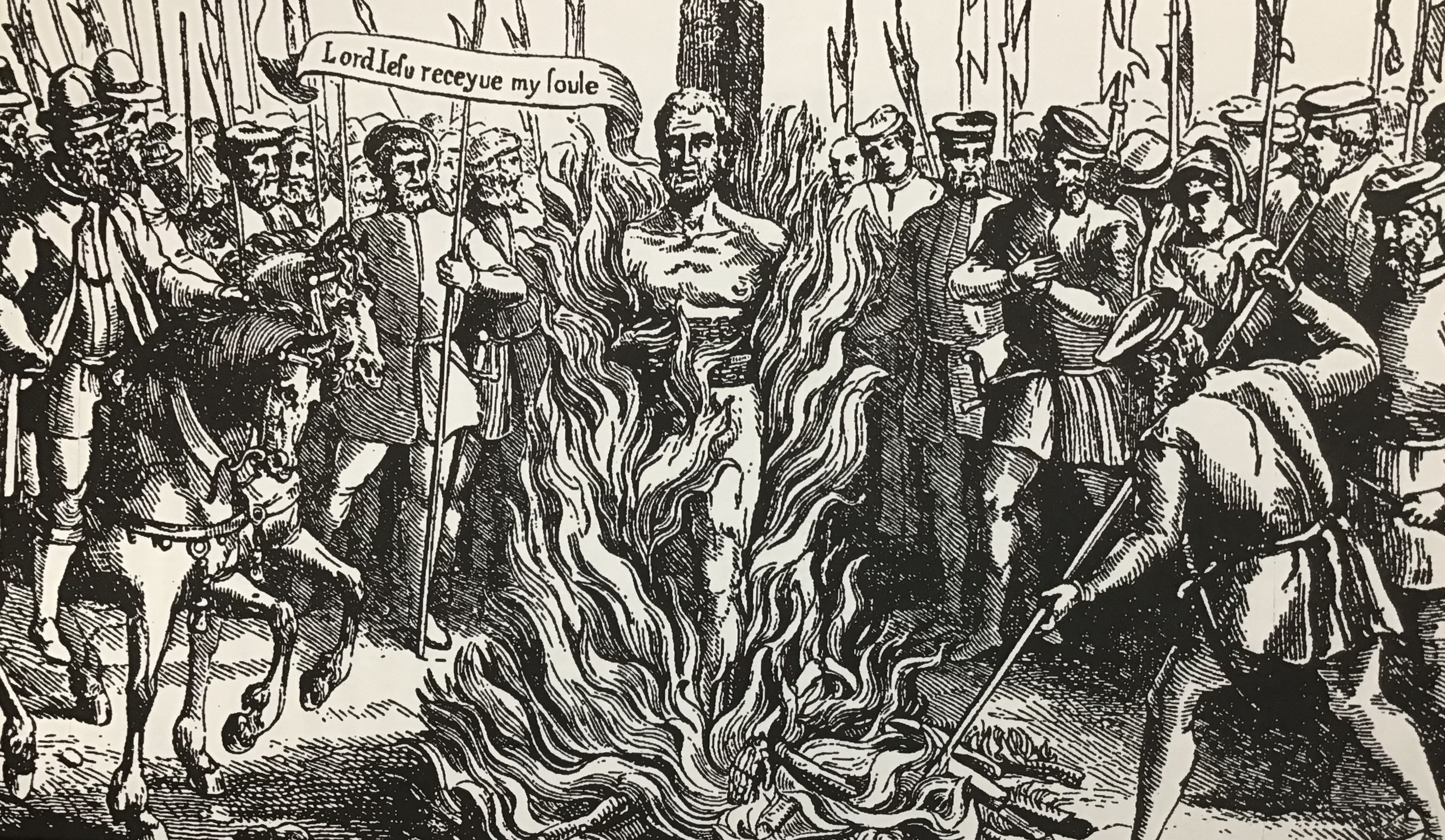
Bishop John Hooper burned at the stake by the order of Queen Mary Tudor
Some claim that since whether one is Amil, Premil, Postmil, is not an issue of salvation, and therefore should be left out of a church doctrinal statement. I think I addressed this in the last post, but I will say this: If we are only going to include universal truths that all Christians agree upon from every communion and tradition, we will indeed have a very small statement.
Circumstances do not bring joy, only Christ does. The Apostle Paul’s outlook on his own life was that it was not his own, that he was a servant of Jesus Christ first and foremost. He said that in his opening words to the Philippian church. Paul derives his joy from his identity as a servant, so that he does not look primarily to his circumstance, but to his fulfillment of his Master’s will. Endurance through trials is not a work of the flesh, but a work of the Spirit.
This is something that the world cannot understand at all. For a world without God, when suffering comes, they often seek the quickest route out. The world does not see any benefit for suffering and pain. As a matter of fact, when they see a Christian suffer, they can sometimes mock us, and ask where our God is. Why doesn’t he relieve our suffering when we have been so faithful to serve him?
Paul is helping the Philippian church to see that his imprisonment is not the worst thing that could happen to him. Discontentment is worse. Joylessness is worse.
In Philippians 1:15-18, Paul sat in a prison cell, yet was filled with joy in the continued preaching of the gospel. He was not bitter about the fact that he wanted to be out doing the work of the ministry. And he wasn’t bitter about those who were free, and used their freedom to preach the gospel, not to serve Christ, but to jab at Paul! Paul ended his thought in verse 18 with “in that I will rejoice.” Christ was being glorified. How could anything be better?
But as Paul thought for a second, he realized that there were reasons for continued rejoicing beyond just the present preaching of the Word. Let’s look at a few of these reasons that he laid out for rejoicing:
Rejoice in the Prayers of the Saints (v.19)
Paul writes how he can rejoice because he knows that the brothers and sisters in Philippi are praying for him. In Philippians 4:1 Paul has mentioned that he constantly kept the church in his prayers, and he is aware that they have done the same for him. This is a greater challenge in the church today because our society tends toward more and more isolation. We might see what you eat on Facebook or Instagram, and hear about how great your vacation was, but the real issues in our lives are kept hidden.
In general, we shouldn’t overshare. We need to be wise about what we say and to whom we say it. But in matters of praying for one another, we need to grow deeper without going into gossip or unnecessary details. The example we see from Paul was that he shared himself with the church. He shared his thoughts, his fears, his needs, and his weaknesses. This type of transparency allowed the church to better pray for him. And in this prayerfulness for one another, Paul could rejoice. He knew that the church was praying for him in his struggles and trials. And he prayed for their welfare as their spiritual father. But prayer is not all that was needed. He adds, “and…”
Rejoice in the Help of the Spirit (v. 19)
Paul’s joy was based upon much more than the faithful prayers of the saints in Philippi. Prayer is only as good as the God to whom we pray. The intercession of the saints must be accompanied by a movement of God. Our prayers shouldn’t stop until God answers one way or another. Paul knows that something will happen when the saints pray and the Spirit “helps.” This is really where Paul finds his assurance. His confidence comes with the working of the Lord.
The word “help” (ESV) is an unfortunate rendering because it seems such a weak word. The KJV’s “supply” is a little better, but still doesn’t give the best picture of the critical nature here. The Greek word epichoragia is a word that is used in Ephesians 4:16 to speak about a ligament that serves to support the body: “from whom the whole body, joined and held together by every joint with which it is equipped, when each part is working properly, makes the body grow so that it builds itself up in love.” (Ephesians 4:16, ESV)
That is the kind of “help” the Spirit is. Without him, we are crippled spiritually. We cannot go on. He is that critical. The Spirit’s help is not like an assistant, whom we can do without. He is like a knee joint for a sprinter—invaluable. The reference to “the Spirit of Jesus Christ” means the Holy Spirit. He is the One who will bring about Paul’s “deliverance.”
But what sort of deliverance was Paul expecting? Some have thought that maybe this salvation is from his situation—temporal salvation; others have thought that it was spiritual. Perhaps Paul was thinking about the fact that whether he lived on and was freed or whether he died a martyr’s death, he would be saved. The Spirit of Jesus would deliver him from death, or deliver him from this life through death. Either way, Paul would be set free in some form or another.
Where we set our eyes changes what we see. If we set our eyes on Christ, we see hope. Christ delivers from the challenges we face today, and he has conquered our sin, winning for us salvation and eternal life. But when we put our eyes on our problems, on the circumstances that we are in the middle of, our vision is clouded. We can be given over to despair and hopelessness. Paul could have easily gone there as he sat in prison. But he knew he had good friends praying for him, and that the Spirit of Jesus was working it all out. He would get out of that prison, and either he would be reunited with his friends, or he would be safe in the arms of Jesus.
What about you? Are you trusting in the Lord to deliver you in your times of need? Have you forgotten the power of God? Stop trusting in your own strength. Stop seeking to be the answer to your own prayers. Depend upon the Lord’s strength. Why are you downcast? It is because you have placed your hopes in something other than the Lord. Hope in God. Finally, we need to…
Rejoice in Expected Courage (v. 20)
Paul is eager to see where the Lord is directing him. He knows the prayers are for his release, and he knows that the Spirit is at work, but the future is still unclear. When Paul says he has “eager expectation,” this idea pictures a person straining his neck to see what is ahead just around the bend. It is a great word. Paul isn’t dreading the future, he is embracing it. He is hopeful!
So, what are the possibilities? He expects that whatever happens, he will not be ashamed. Why would he be? He is not a criminal. He is on trial for the gospel. He has no remorse in prison. He would do it all over again. He has glorified his Lord in his ministry.
Let me ask you, are you ready to meet the Lord today? Would you be ashamed of what you have accomplished in your short life on this planet? Are you banking on the next 10-20 years to make something of your life for Christ? That is borrowed time, my friends. It may never come. You need to put your life in order today. You don’t want to be lying in a hospital bed thinking about how ashamed you will be to face the Lord because your life was only a pursuit of personal desires.
Instead, Paul was anticipating having a lion’s heart to face whatever would happen. He expected to have “full courage” for whatever he faced. You see, if he was released from prison, his message of the risen Christ would be vindicated in many people’s eyes. And if he received the death penalty, then he expected to be filled with courage just as much. How? It had to do with how he had been as a servant. You see, Paul wasn’t only speaking about the courageous death he would face—courage as he faced the executioner.
Whether he lived or died was inconsequential. Eager expectation, hope, and courage marked Paul’s outlook. Paul’s lion-like boldness was based upon the salvation won for him at the cross and how he had remained faithful to his Master. Paul was ready to die well.
With heaven before us, what do we really need to fear? Jesus has conquered sin and death. Our best days are ahead of us. Christ is King! Let us have courage to face the uncertain future knowing that the face of Christ and eternal life is a certainty!



 Always Reforming