Our Great Resurrection Hope (part 4)

He is risen! On this beautiful Resurrection Sunday morning, there is eternal hope for every believer in Christ Jesus. Although they are fun, the easter egg hunts, baskets, pretty Spring dresses, and bunnies cannot compare to the joy that rises in the heart of those who have placed their trust in Christ. In this final post of our great resurrection hope, we will look at the crushing of the enemy and the final victory that we are assured. Our hope is not a wishful thinking but an assured confidence.

In Part 1, we learned that Christ’s Resurrection Guarantees the Christian’s Resurrection, and in Part 2, we saw that Christ’s Resurrection Reverses the Curse of Humanity, and in Part 3, we saw that Christ’s Resurrection Gives Hope for the Future. Let us look at Paul’s words in 1Corinthians 15:24-26 as we consider the fourth reason this day is one of such great hope.

Then comes the end, when he delivers the kingdom to God the Father after destroying every rule and every authority and power. For he must reign until he has put all his enemies under his feet. The last enemy to be destroyed is death.

(1 Corinthians 15:24–26, ESV)

Christ’s Resurrection Guarantees the Defeat of Every Enemy of Christ (vv. 24-26)

When Jesus Christ died upon the cross, he set into motion the assured and final victory over every enemy of God. This includes Satan and the demons and every human being that have rebelled against God. (v. 24)

Jesus Christ will destroy every rule, and every authority and power that will not submit to him. Not a single enemy of God will remain. His reign will last until every enemy is conquered and put under his feet (v. 25)

The final enemy shall be death (v. 26). Until the resurrection of Jesus Christ, death was the undefeated champion of every fight fought. Nobody faces death and walks away. Some might escape for a few more days or even years, but death always wins. But in Jesus Christ, death has met its match. Jesus Christ is stronger than death.

The great enemy of mankind that began in the Garden will finally be stopped. All the dead who have trusted in Christ will have been raised from the dead and transformed into glorified bodies, just like Jesus has been. There will be no more death at all.

The death of death will have come because of the death of Christ. All things will be made right.

This is the hope we have in Christ. This is what the resurrection means to Christians. It directly affects each of of us.

Charles Haddon Spurgeon said, “Death in its substance has been removed, and only the shadow of it remains.… Nobody is afraid of a shadow, for a shadow cannot block a man’s pathway for even a moment. The shadow of a dog can’t bite; the shadow of a sword can’t kill.” Christ Himself took the full force of death’s destroying power by dying and paying for our sin, then rising from the grave. Trusting Jesus may not remove death’s shadow, but remember, shadows can’t hurt us.”[1]

The resurrection reminds us of this truth. We are more than conquerors in Christ Jesus. We have nothing to fear, even death itself. We shall be raised from the dead, because Christ lives!

And all the enemies of God shall be dealt with as well.

That leads me to ask a question of you this morning. Do you have this hope in the resurrection of Jesus Christ? That would depend upon whether you have placed your faith and trust in him.

Jesus’ resurrection guarantees the resurrection of his followers. But it does something else. It points to the fact that he always keeps his promises. Jesus promised that he would rise from the dead. And he promised that he would come back. Not just to raise his disciples from the dead, but also to judge the unrighteous.

So, this Easter, what have you placed your hope in? Is it in the salvation in Jesus Christ or is it in yourself? Only salvation in Christ offers the great hope that we have this morning. Everything else is like a hollow chocolate bunny.


[1] https://bible.org/illustration/nobody-afraid-shadow

Hope for Leaders Who Have Made Dumb Decisions (weekend repost)

It’s not hard for me to think about multiple examples of personal failure over my 51 years of life. I can recall so many bad decisions–dumb ones, sinful ones, immature ones, naive ones, rash ones, prideful ones. Like I said, I remember too many. The problem is, leaders have to make multiple decisions all day, every day. The more decisions we need to make, the greater potential there is to make another bonehead decision. So what do we do?

Read the rest of the post here: Hope for Leaders Who Have Made Dumb Decisions

Hope for Leaders Who Have Made Dumb Decisions

It’s not hard for me to think about multiple examples of personal failure over my 51 years of life. I can recall so many bad decisions–dumb ones, sinful ones, immature ones, naive ones, rash ones, prideful ones. Like I said, I remember too many. The problem is, leaders have to make multiple decisions all day, every day. The more decisions we need to make, the greater potential there is to make another bonehead decision. So what do we do? Well, you could:

  1. Give up being a leader. And if you really are poor at decision making because you constantly make the kinds of bad choices I named before, that might not be a bad decision. But don’t rush into it! Keep reading.
  2. Give up making decisions, but remain a leader. This type of leader is known as a “lame duck.” You have actually done #1 above, but continue to call yourself a leader. This never works for long, and is frustrating for the people you are supposed to lead. It’s better for you to step down than to play this game.
  3. Start making better decisions. Duh. But before you stop reading, consider this: All leaders make bad decisions. All of them. The best leaders make fewer poor decisions and there are reasons for that, which are beyond the scope of this article. But the fact is, by growing and improving on your decision making, you will become a better leader.

In Joshua 7, Joshua made some poor decisions as he took Israel from a victory over Jericho, to an embarrassing defeat when his army was defeated by a tiny army. His failure not only cost the lives of thirty-six of his men (Josh 7:5), but it put courage into the heart of his enemies while simultaneously putting fear into the heart of Israel.

Several years ago my wife and I got food poisoning from eating at a fast-food place. It was pretty traumatic for us, and we were sick for days. I knew it was the food–I could taste it and smell it. It was so engrained into my memory that now, over 20 years later I can still go back to that moment when we started to become violently ill. I had no desire to eat at that restaurant again for many, many years. Bad decisions are like that–they leave a really bad taste in your mouth that makes it hard to overcome.

After the Lord directed Joshua on how to make everything right, it was time for Joshua to face his fear. Joshua 8:1 helps us so much here for learning how to overcome the fear of a poor decision so that we can make better decisions. It says,

And the Lord said to Joshua, “Do not fear and do not be dismayed. Take all the fighting men with you, and arise, go up to Ai. See, I have given into your hand the king of Ai, and his people, his city, and his land.

(Joshua 8:1, ESV)

Fear of the future and the unknown as well as discouragement from past failings can be the biggest hurdle to clear after a major failure. But notice here that the Lord commanded Joshua not to fear or be dismayed. Yes, poor decisions were made. But the mission has not changed. Joshua was to lead the people into the Promised Land, and Ai needed to be conquered. The problem was that Joshua had rushed in, he didn’t consult the Lord and made the decisions to go to war and send in a smaller army without seeing if this was the Lord’s will. The Bible doesn’t tell us, but maybe Joshua was beating himself up over the bad decisions made. Any leader knows that’s not a stretch to imagine. It happens all the time.

But the Lord says to Joshua, Do not fear and do not be dismayed. Once we are assured that we are being guided by the Word and Spirit, we must move forward without fear of the future or discouragement from the past. Joshua wasn’t running ahead of God anymore. Now he was going to decide that he needed to obey, and this was the first command. Warren Wiersbe has wisely written, “The promises of God make the difference between faith and presumption” ( Warren W. Wiersbe, Be Strong, “Be” Commentary Series (Wheaton, IL: Victor Books, 1996), 97.)

Notice also, that the Lord gave Joshua direction: “Take all the fighting men with you, and arise, go up to Ai.” So often, poor decisions are made because we make the decision. Spiritual leadership is not the same as corporate leadership because the spiritual leader directs God’s people from God’s Word to do God’s business. When we forget this, we become spiritual entrepreneurs, not spiritual leaders. They may look the same, but they aren’t. Spiritual entrepreneurs work for themselves, to achieve their own goals, and often receive the glory for it from men who do not recognize the difference. Joshua had taken the reigns and failed, now he was going to learn to take his lead from the Lord.

Finally, the Lord gave Joshua his strength: “See, I have given into your hand the king of Ai, and his people, his city, and his land.” After the amazing victory over Jericho, you would think that it was obvious that God was going to give Israel the strength to fight. But the loss at Ai shows how quickly a victory can blind us to our dependence. All too quickly we can begin to strut like roosters, full of pride as if we did anything to achieve the victory. In order for Joshua to grow as a leader, he needed to remember that every victory was given by the Lord–big or small.

Joshua obeyed the Lord, carrying out the directives he was given with precision, and the Lord gave him the victory as he promised. Remember that. The answer isn’t give up when you fail, but learn from your failures and grow as a leader. Psalm 37:23-24 is a great encouragement in this way: “The steps of a man are established by the Lord, when he delights in his way; though he fall, he shall not be cast headlong, for the Lord upholds his hand.” (Psalm 37:23–24, ESV)

Don’t Cover Your Cracks with Plaster

A few nights ago I awoke with the aches and pains of a sickness I have been fighting for a few days. Unable to sleep, I started to reflect upon all the friends and loved ones that are struggling with pain and suffering to a much greater degree. I thought about those who are facing a crumbling marriage, the loss of a spouse, the onset of a disease that will take their life. I lay in the dark and considered the deep comfort that we have in Christ.

The Christian life is not an easy one, and may even be fraught with greater struggles because of our commitment to follow Christ whatever the cost. But there is no accounting for the presence of Christ in the midst of these struggles.

Dear brothers and sisters in Christ, the world is watching. Please do not show them a perfect, polished life free of any pain or sorrow. Such a life does not exist in this broken world. Show them that you too are cracked and flawed, just as they are. Show them that you too struggle with weaknesses and doubts. And then show them that our God sent his Son for us, to bring us safely to his promised land. He gives his Spirit so that as we sit in pain and doubt we will know his supernatural presence and find comfort.

As you listen to the song below, remember that we must sometimes fight for faith to know the joy of the Lord—and in the end, Jesus will be victorious. Like Job, we may not always understand, but we trust.

Doctrine Worth Dying For (weekend repost)

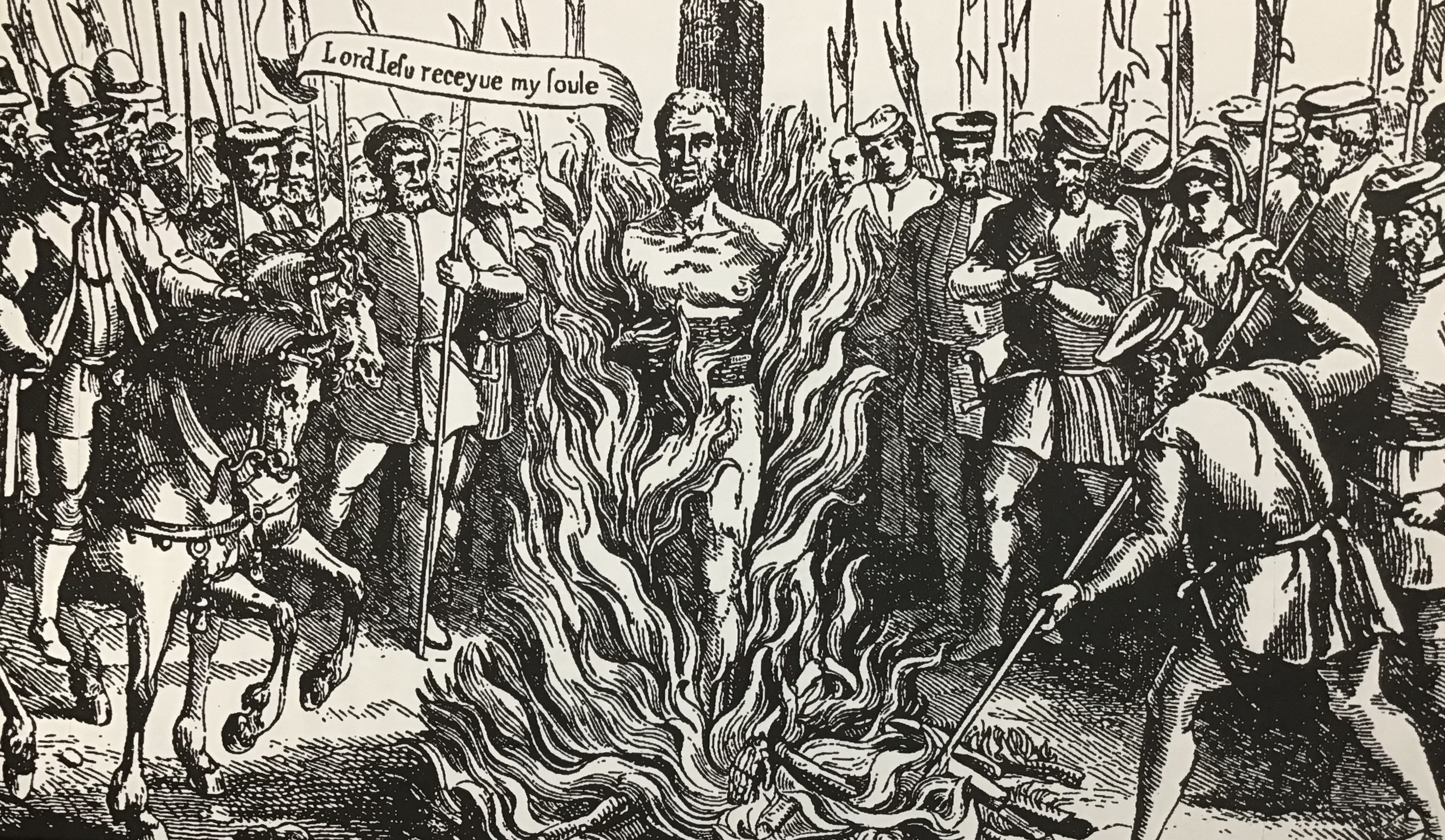
Bishop John Hooper burned at the stake by the order of Queen Mary Tudor

Some claim that since whether one is Amil, Premil, Postmil, is not an issue of salvation, and therefore should be left out of a church doctrinal statement. I think I addressed this in the last post, but I will say this: If we are only going to include universal truths that all Christians agree upon from every communion and tradition, we will indeed have a very small statement.

Read the full post here: Doctrine Worth Dying For