What Are the Reasons that You Don’t Evangelize?

20140721-104312-38592589.jpg
According to a 2013 Barna report, 73% of Born Again Christians believe that they have a personal responsibility to share their faith with others, but only 52% of those polled said they had actually shared their faith with someone else in the past year. (Link)

Do you share Christ with others? What encouragement can you give to those who don’t?

If you are among those who rarely evangelize, why not? What is the biggest reason that you don’t share Christ?

Three Reasons to Preach Christ Crucified

saving-drowning-man

“For the word of the cross is folly to those who are perishing, but to us who are being saved it is the power of God.” (1Corinthians 1:18)

1. Because It is Not Popular (v. 18)

Not only is it not popular, it is moronic (moria in Greek). Consider the fact that the gospel of Jesus Christ demands that we say to sinners that a poor and humble Jewish man was God, and that he was nailed to a cross to die a criminals death despite his perfect innocence. We proclaim that this Man was not only a man, but that he is God in the flesh. That he is perfect and sinless and that he was born of a virgin. Furthermore, we proclaim that all of humanity is lost and that each individual man, woman and child is a wretched sinner. We proclaim that Christ is the only hope for humanity and that all other claims are lies from the pit of hell and all who seek salvation in any other name are doomed to eternal damnation. We proclaim that Jesus Christ has done all that is necessary for our salvation, and that he rejects all attempts to earn salvation on our own. He, being the King demands our allegiance and one day every knee shall bow and every tongue shall confess that He is Lord.

Brothers, when we proclaim this, the world will overwhelmingly reject us as fools of the worst kind. We will be called bigots, intolerant, and uneducated religious zealots. And that is why so many bow to the pressures and soften their message. Paul was keenly aware of the propensity of men to soften the blow of the gospel by using soothing words that made the hearer feel at ease. He said in 1Cor 2:1-5 that he purposely made it his aim to proclaim the unvarnished gospel of Jesus Christ crucified. Today, preachers everywhere are trying to make Jesus look cool. They are trying to make Christianity attractive. They are doing just what Paul avoided.

The cross was not cool. It was brutal and bloody.

The call of Christ is not popular. True Christianity will never court the world. But pastors will continue to attempt to make our precious faith more palatable in order to gain the popularity of the world. This is nothing but pride. Nobody should enter the ministry or the pulpit in order to make his own name great. Isaac Watts wrote, “When I survey the wondrous cross on which the Prince of glory died; My riches gain I count but loss, and pour contempt on all my pride.” PREACH CHRIST BECAUSE IT IS NOT POPULAR!

2. Because They Are Perishing (v. 18)

When we preach the message of the cross, the world sees it as folly because they do not see the danger to their souls. Sometimes they fail to see the danger because they do not see it in our eyes and do not hear it in our voices as we proclaim cold truth from our pulpits. Brothers, do you feel the truth of Hell? Do you remember the days when you were among the brood of vipers?  Do you recall that you were once a vessel prepared for destruction? Have you forgotten that you were on the precipice of the bottomless pit and you were ready in due time to slip into eternal fire separate from God to be tormented for all eternity? HAVE YOU FORGOTTEN?

When we remember our own dying state we will be quick to point people to the only remedy for their souls—the cross of Christ. When we remember that they are perishing, we will not care about their mocking and their cries for ear-tickling sermons—we will give them what we know they need. Wrote Thomas Brooks, “The damned shall live as long in hell as God himself shall live in heaven.” That fact alone should drive us to preach Christ crucified.

Check your hearts, brothers. Do you feel the terror of hell and do you cry out with Paul on Sunday mornings: (2Cor. 2:15-16) “For we (!) are the aroma of Christ to God among those who are being saved and among those who are perishing, to one a fragrance from death to death, to the other a fragrance from life to life. Who is sufficient for these things?” PREACH CHRIST BECAUSE THEY ARE PERISHING!

3. Because It is the Power of God (v. 18)

Power in the pulpit. Power evangelism. Power encounters. Pastors want power. But the power of God is not found in the usual places. It is not found in business models or worldly philosophy (v. 22). It is not found in charismatic dramatics or signs and wonders (v. 22).  It isn’t found in confrontation with demons and the occult. The power of God was displayed on the cross, where God sent His Son to be crushed for our iniquities. Jesus became sin on our behalf, so that we might become the righteousness of God! That is power!!!

Concerning the justification of God, John Calvin said, “Wherever the knowledge of it is taken away, the glory of Christ is extinguished, religion abolished, the Church destroyed, and the hope of salvation utterly overthrown.” This is the power of the cross. Why is the Church so weak and utterly incapable of making an impact in our nation? It has left this message behind and taken up the banners of politics, pop psychology, health and wealth, and so many other empty promises.

The Roman Catholic system, the Emerging movement, the Seeker Sensitive movement and the Liberal mainline denominations have all shown us what becomes of those who lay aside the cross of Christ. But it hasn’t stopped many men from flirting with those compromising  philosophies. Richard Baxter, “If a hardened heart is to be broken, it is not stroking but striking that must do it.” The only thing that can cut another stone is a diamond, the hardest gem on earth. In order to cut the hardest heart, we must use the sharpest tool. That is the gospel of Jesus Christ!

In Heb. 4:12 we are reminded, “For the word of God is living and active, sharper than any two-edged sword, piercing to the division of soul and of spirit, of joints and of marrow, and discerning the thoughts and intentions of the heart.”

Brothers, in our churches the temptation can be overwhelming to give up expository preaching in favor of sugar coated sermons that aim to please the itching ears of people. We reason in our hearts that once we have them in our churches we can preach the gospel to them, we just need to ease them into it. Don’t fall for this pragmatic lie! You are merely a tool in God’s hand. He uses you as His minister to wield His weapon of choice. You cannot change the soul of a man in any way. It is the Word of God preached—the Gospel alone that brings a sinner to his knees.

PREACH CHRIST BECAUSE THE MESSAGE OF THE CROSS IS YOUR ONLY POWER!

Thessalonian Lessons in Church Planting

Churchplanting

The Church of Thessalonica was established during Paul’s second missionary journey. It is chronicled in Acts 15:36-18:22. In this post I want to walk through this journey and then apply a few lessons that can be applied to church planting.

Paul’s journey began in Antioch, were Paul and Barnabas had a sharp disagreement over John Mark, as to whether he should join them on their trip or not. Apparently John Mark had abandoned them on a previous trip and Paul did not think it was a good idea to depend upon him. Barnabas took John Mark and went to the island of Cyprus while Paul took Silas as his partner (Acts 15:36-41).

Meanwhile Paul and Silas headed to the region of Galatia to encourage the churches that Paul and Barnabas had established in the first missionary journey (Acts 15:36). The first stop mentioned was in Derbe and then on to Lystra. At Lystra Paul took Timothy with him on his journey (Acts 16:1-5).”

From Galatia Paul traveled with Silas and Timothy through the region called Phrygia, moving in a Northwest direction, avoiding Asia Minor (modern Turkey) because the Holy Spirit had forbidden that Paul should go there (Acts 16:6).

Paul then decided to go above Asia Minor into a Roman province called Bithynia, but Paul and his party were once again forbidden by the Spirit from going into this region (16:7). That meant that North and South were out of bounds to travel in. They could go back or they could press on toward Mysia along the northern border of Asia and Mysia until they reached Troas, which they did (Acts 16:8).

It was while in Troas that the Lord revealed to Paul his mission. He was given a vision of a Macedonian man who called out to him to come over and help him. Paul would have recognized this man as Macedonian from his traditional hat and clothing that had been a mark of the Macedonian people for centuries before and carries on even to today.

Although Macedon is not as well known to most of us today outside of the biblical references to it, it is important for us to know a little about its history.

The Macedonian kingdom was the “greatest empire ever known to human history.” [1] It was the empire of Alexander III also known as Alexander the Great.

Before he died at the age of 33, Alexander had succeeded in extending his kingdom from Egypt in the south to the Indus River in India to the east. His father, Philip II conquered the Greek city states and taught his son well many strategies that served him well as he sought to conquer the rest of the world. Alexander conquered Asia Minor, Phoenicia, Palestine, Egypt, Babylonia and India.

Alexander’s armies are pictured in Daniel 7:6 as a swift leopard with four wings. It says, “After this I looked, and behold, another, like a leopard, with four wings of a bird on its back. And the beast had four heads, and dominion was given to it.” The speed of the army was represented by the leopard’s speed amplified by four wings. The four heads refer to what happened after Alexander’s death. Since he died so young, possibly by poisoning, no plan of succession was in place.

After much turmoil, the kingdom was divided among his four generals into four kingdoms, with Antipater receiving the former Macedonian kingdom and Greece. At Antipater’s death, Cassander had the opportunity to take control and he solidified his position by marrying Alexander’s half-sister, the daughter of King Philip II. Her name? Thessaloniki.

In 316 BC Cassander founded a new city by consolidating 26 towns into the new city he called Thessalonica. This prestigious city would go through many more changes and wars by the time Paul would enter into it. When Paul came, it was a jewel to the Romans and had a population of about 200,000, which was quite large for a city in its day.

Let’s go back to Acts 16. Now we can see God’s purpose in not allowing Paul to go to Mysia or Asia or Bithynia! He wanted them to go to Macedon to bring the gospel message to the Gentiles!

Notice in verse 10 that it says “we” (cp. v.8 says “they”). What we find here is that in Troas Paul picked up another traveling companion—the author of Acts and the Gospel named for him—Luke! Paul went from Troas (in Mysia) across the island of Samothrace to the mainland of Macedonia and the city of Neapolis (16:11).

From Neapolis Paul and his friends went to the Roman colony of Philippi, named after Alexander the Great’s father King Philip II (16:12). In this city, Paul and his company met Lydia and led her to Christ. Later they were beaten with rods and thrown into jail after casting the demon out of a slave girl. (16:13-24) Welcome to Macedonia!

While in jail, God intervened and a jailer and his family were saved (16:25-40). From Lydia and the jailer’s family and any other’s saved on that trip to Philippi Paul established the first church in Europe. The letter we call Philippians was written to them.

Source: http://www.biblestudy.org/maps/apostle-paul-second-missionary-journey-map.html

Source: Biblestudy.org

Acts 17:1-9 tells us about the establishment of the Thessalonian church. Leaving Philippi, Paul passed through Amphipolis and Apollonia, probably because they were so small (17:1) and moved to the city of Thessalonica, where a synagogue had been established by the Jewish population.”

In these 9 verses, I’d like to make three observations about the work that Paul did in planting this church and make some applications for our lives.

1. Paul “reasoned from the Scriptures with a Purpose (vv. 2-4).
Paul’s time in Thessalonica was short—he knew that. He was not on a vacation or sight seeing trip. He was literally on a mission. Because of that purpose, Paul’s time was focused, purposeful and methodical.
Verse 2 says he“reasoned”with the Jews. This word in Greek is dilegomai and it is where we get our word “dialogue.” Paul “dialogued” with them. He had deep, meaningful conversations with them about the Scriptures and their meaning. But it had a purpose and an aim. they didn’t argue about Jonah’s whale or who the Nephilim in Genesis 6 are. Paul made a bee-line to the cross and Jesus.”
Paul wanted to show them from the Old Testament that Jesus is the long-awaited Messiah (v. 3). And Paul was seeking to change the hearts and minds of his listeners (v.4)! His mission had a purpose. Remember the way that Paul talked to King Agrippa? Acts 26:24-29. Paul preached for change!”
Studying the Bible and going to church is good. Listening to sermons and reading Christian books is good. But to what end do we do these things? Is it to seek holiness in our lives? It is to grow in Christ? Why do we share Christ? Is it to see people saved?”

2. Faithful gospel proclamation will also attract opposition from our enemy and those blinded by sin (vv. 5-9).

In a sense, these gospel preachers were turning the “world upside down” by preaching their message about King Jesus. We need to be honest. Most people like the status quo. We don’t like it when people rock the boat. And we love our sin. Listen to John 3:19-20. It says, “And this is the judgment: the light has come into the world, and people loved the darkness rather than the light because their works were evil. For everyone who does wicked things hates the light and does not come to the light, lest his works should be exposed.”

Paul was trying to build a lighthouse in the darkness of Thessalonica. But the darkness wasn’t about to just roll over and let that happen. It fought back. So, we must wage war!” We too need to fight like Paul—reasoning, preaching the gospel, and persuading with the truth.

Second Corinthians 10:3-6 says,“For though we walk in the flesh, we are not waging war according to the flesh. For the weapons of our warfare are not of the flesh but have divine power to destroy strongholds. We destroy arguments and every lofty opinion raised against the knowledge of God, and take every thought captive to obey Christ, being ready to punish every disobedience, when your obedience is complete. “

3. Finally, Jesus must be trusted to build his own church (Matt 16:18).

It is easy to give up and be discouraged by adversity and the roadblocks that we encounter. To see all the failures and not the victories. Afterall, Paul followed Jesus’ commands and went to Macedonia, just as he said. Yet in Philippi he was beaten then jailed. Next in Thessalonica a mob formed and attacked their friend Jason in his home. When Paul left Thessalonica, he was probably only there from 3-6 months, but they had to move on!”

But a church was planted in Thessalonica. And it grew and matured…even with the absence of Paul! God gave life to that seed of a church and although Paul left when it was a weak little seedling, God would cause it to grow.”

We certainly can learn from this. We need to work hard, and work smart, but we must learn as well to trust Jesus with the results. After all, it is HIS church.
 

[1] Green, Gene L. The Letters to the Thessalonians. The Pillar New Testament Commentary. Grand Rapids, MI; Leicester, England: W.B. Eerdmans Pub.; Apollos, 2002; p. 9.

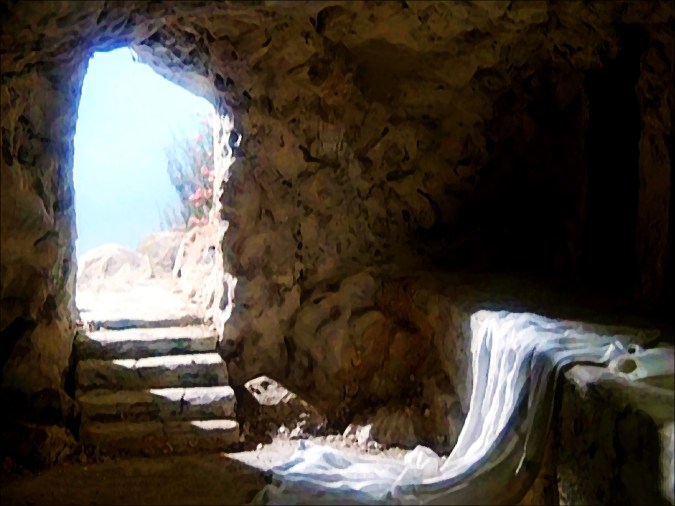
Our Immediate Blessings From the Resurrection (John 20:19-29)

The-Empty-Tomb

Because of Jesus’ death and resurrection, all of God’s children will be raised again, in the twinkling of an eye, and we will be transformed from dead corpses to living, breathing, glorified, never-to-die again living people. What a glorious day that will be. But did you know that there are blessings that were given to us and that we can enjoy here and now because of Jesus’ resurrection?

1. The Resurrection Dispels Fear, and Replaces It with Peace (vv. 19-21a)

Verse 19 tells us that it is the evening of the resurrection. Most of us are going to celebrate the resurrection today. But the first Easter Sunday was not filled with Christians celebrating—they were hiding. They had locked the doors behind them, fearful and unsure about what to do. The reports the women brought back were confusing, to say the least and they had no idea if the religious leaders were cooking up another plot to purge Jerusalem of the followers of Jesus. So it is not surprising to find them huddled together for safety, locked in a room. But doors and locks can’t stop Jesus. We are not alone, he is still with us.

In John 14:19, Jesus had told them, “Yet a little while and the world will see me no more, but you will see me. Because I live, you also will live.”

For a little while (3 days) they did not see Jesus. But now they saw him. He appeared right before their eyes so that there was no doubt that he was alive. And what were his first words to the gathered saints? “Peace be with you.” Jesus knew the turmoil that raged inside their hearts. And just as he could calm the wind and the waves with is words, his presence among them also brought peace. As Paul reminds us, “If God is for us, who can be against us?” (Rom 8:31). Jesus is alive. He still dispels fear and offers peace to us. His resurrection conquers the fear of death and the wrath to come. It promises all who will repent of their sins and turn to Christ in faith that he will give to them peace with God. God will give forgiveness of sins and shower his love upon those who trust in him alone.

2. The Resurrection Disperses the Faithful (vv. 21b-22)

You know, I’ve seen death separate many families, including my own. In many families, a mother or grandmother is like the glue that keeps everyone together, especially during the holidays. But when she dies, often the family begins to drip apart from one another. It’s a sad reality. Death disperses a family.
But here is a curious result not of death, but of Jesus’ resurrection. His resurrection caused his disciples to disperse. Christ’s death and resurrection brought satisfaction for God’s wrath against our sin. His saving work was done. But the work of the disciples had only begun. Jesus had done his work on the cross, but the disciples would need to go into the world and share the message of the gospel with sinful men. And from the point of view of these terrified disciples, that must have seemed like an impossible task. But Jesus had given them his peace and promised the Holy Spirit. His words pointed forward 40 days to the Day of Pentecost when the Spirit would bring power and boldness for the Great Commission.

With confidence in the risen Lord, the Church now moves from a safe place to boldly declare the truth of Jesus Christ. God the Father sent Jesus on a mission—he had an aim and a purpose—and so do all his disciples.
Acts 1:8 says, “But you will receive power when the Holy Spirit has come upon you, and you will be my witnesses in Jerusalem and in all Judea and Samaria, and to the end of the earth.” We have a mission and the power to carry this mission out-the Holy Spirit. Jesus is alive and we ought to tell someone!

3. The Resurrection Dispenses Forgiveness (v. 23)

This verse can be misunderstood to teach that Jesus is giving to Christians the right to forgive sins. But only God has the power and prerogative to do that. So what is he talking about? Jesus is telling his disciples that when we disperse into the world with the gospel message, it is that message that points people to Jesus—the only one who can forgive and wash away the stains of sin and guilt. If the gospel message is received with faith in Christ alone, God will assuredly forgive the sins of those who receive the message as delivered by Jesus’ faithful disciples.

But the opposite is true as well. If acceptance of the gospel delivered by Christians is acceptance and forgiveness by God, then we need to realize that when the messengers and their message are rejected, that God and his Son’s sacrifice are also being rejected. Forgiveness of sins and peace with God are also rejected.

Do you remember those things called typewriters? For you kids out there, those were keyboards and printers all wrapped into one. If you remember typewriters, then you remember that there was no “back” button and you probably remember “White Out.” It was that magical bottle of white liquid that could be brushed over a typing error. Then you could go back and type little there was no error.

Forgiveness is like whiteout. This world doesn’t offer “do-overs,” but God does. Jesus’ blood is like “white-out” for your soul. It covers over all your sins and makes it like you never sinned…ever! Jesus’ death on the cross bought that forgiveness!

4. The Resurrection Deepens Flimsy Faith (vv. 24-28)

Thomas is probably most famous for this embarrassing incident. He had missed the earlier appearance of Jesus to the other disciples and having heard their story he had his doubts. And before we jump on poor Thomas, think about what we are talking about here.

My friend lost his grandfather a couple of weeks ago. I went to his funeral. But what if someone told me that good old Bill had just been by the house and I just missed him? “Come on,” I’d say. “Dead people stay dead. He’s up in Rose Hills. Nobody leaves the cemetery. Nobody.” They don’t lock the gates of Green Hills Memorial Park to keep people in, do they? So, when Thomas has his doubts, I can totally understand. And it wasn’t just a lack of faith. Nobody expected Jesus to rise again. So, his doubt is understandable.

But as we read, Jesus did rise again and he showed up again among the disciples, but this time when Thomas was there. And again he had to calm them and give them his peace. After all, Jesus once again appeared back from the dead and in a locked room.

How many of us have had thoughts of doubt and a lack of faith? We’ve doubted the goodness and kindness of God. We’ve doubted his ability or willingness to forgive our sins. We’ve doubted his love for us. We’ve doubted his power to heal or his power to answer our prayers. So, are we really in a position to point fingers at Thomas?

But to his credit, Thomas’ lack of faith melted away. Look again at verse 28. Although we don’t know any more about Thomas, Church tradition says that Thomas continued to preach the gospel and went as far away as Kerala, India where he brought the gospel to a group that today are called Nasrani or Saint Thomas Christians. Thomas’ flimsy faith was made solid by the resurrection of Christ. Although we cannot see Christ in the flesh as the disciples did, we shall one day see him clearly: “For now we see in a mirror dimly, but then face to face. Now I know in part; then I shall know fully, even as I have been fully known” (1Cor. 13:12 ).

By focusing on the reality of the cross and the resurrection of Jesus Christ, our faith is bolstered and we are placed back on track.

 

How to Pray, pt. 6 (Matt. 6:12)

forgive

The first half of these lesson on prayer taught us to pray for God’s name, God’s kingdom and God’s will.

The second half, so far has taught us to ask for God’s provision for our physical needs. As we move from our physical needs, the next two petitions address our spiritual needs: forgiveness of our sins and deliverance from temptations and evil.

We are twice as needful of spiritual provisions as physical needs, although in our daily attention we spend far more time addressing physical needs than spiritual ones!

Let’s turn to Matt 6:12 and look at this fifth petition in the Lord’s model prayer: “and forgive us our debts, as we also have forgiven our debtors.”

The Problem-Debts
This word used in the Greek New Testament comes from a verb which means “to owe, as in a financial obligation.” It is usually used for monetary debts, but it is also used for a moral obligation.

We know that this is not a financial debt that Jesus is talking about here because this same saying in Luke 11:4 has the word hamartias or sins. Forgive us our sins, as we ourselves forgive everyone who are indebted to us.

Luke’s account shows us that debts in this context are sins. Sin is pictured as a debt, and the sinner is pictured as a debtor. Get this: sin is not only wrong, but it requires payment—the debt must be settled. This is a major problem. Many People woefully underestimate the seriousness, deadliness and consequences of their sins before God.

To illustrate this, look at the picture that Jesus paints of our situation using a story that will hopefully tingle in our ears: Matt 18:21-35.

  • V. 21: Notice that the context of this parable is in response to Peter’s question about forgiveness.
  • V. 23: This parable is couched in financial terms. The servant who owes the king is said to be in debt.
  • V. 24. How much is ten thousand talents by today’s standards? A talent was worth about 20 years wages. The servant here owes the king 10,000 talents, or $6 billion dollars! This is a dramatic representation of the amount of sins that we have committed against our King and God.

You need to grasp this if you are ever to grasp forgiving others. If you see yourself as a relatively good person (relative to others, not relative to God), then you will never understand why we ought to forgive as God forgave us. Back to our story in Matthew 18:

  • V. 25-27 Not surprisingly, the servant could not pay the king the debt, despite all the servant’s vain promises that he could.

Scottish pastor Horatius Bonar wrote these words in a hymn:
Not what my hands have done can save my guilty soul;
Not what my toiling flesh has borne can make my spirit whole.
Not what I feel or do can give me peace with God;
Not all my prayers and sighs and tears can bear my awful load.

Your voice alone, O Lord, can speak to me of grace;
Your power alone, O Son of God, can all my sin erase.
No other work but Yours, no other blood will do;
No strength but that which is divine can bear me safely through.

Thy work alone, O Christ, can ease this weight of sin;
Thy blood alone, O Lamb of God, can give me peace within.
Thy love to me, O God, not mine, O Lord, to Thee,
Can rid me of this dark unrest, And set my spirit free.

We’ll come back to this parable later. But what I want you to understand is that great debt of sin that every person owes to God. It is both wrong, and must be paid.

If you are a Christian, your debt has been paid. Your sins have been forgiven. Your account has been settled.
For you, passages like Col 2:13-14 are sweet:

And you, who were dead in your trespasses and the uncircumcision of your flesh, God made alive together with him, having forgiven us all our trespasses, by canceling the record of debt that stood against us with its legal demands. This he set aside, nailing it to the cross.

Now, if  you have never approached Jesus Christ and asked for his mercy and forgiveness, then you still owe a huge debt of sin to God, and you can never repay it. But it doesn’t need to end for you this way. Notice what 1John 1:9 says, “if we confess our sins…”

Forgiveness by God for your sins requires confession on your part. Confession doesn’t mean repeating all the things that you’ve done. Confession is from the Greek verb homologeo and it literally means “the same word.”
Confession is when you say the same things about your sins as God does. God knows what you have done. He isn’t surprised. He wants YOU to recognize them as offenses against HIM, and to call them what they are. He wants you to agree with him that they are sins, and they are wrong, and they are a stench in his nostrils.
If you confess with a broken heart and a right attitude, God will forgive and will cleanse you from all unrighteousness.
If you play the part, saying “I’m sorry” in order to get out of punishment, or in order to satisfy your guilt without truly seeing the depths of your sins, your only fooling yourself and your sins remain.
When you realize how your sins are an offense against God, then you will want to be changed. You will want to turn from them. You will want to get away from them like a wretched garment that is stained with filth and vomit.

Is. 55:6-7 says, “Seek the Lord while he may be found; call upon him while he is near; let the wicked forsake his way, and the unrighteous man his thoughts; let him return to the Lord, that he may have compassion on him, and to our God, for he will abundantly pardon.”