I HAVE SEEN GOD USE good theology to liberate lives. But I have also seen people misuse theology, resulting in abuse, hard hearts and pain. One thing that I have become concerned about in theological studies is the temptation to make overly strong divisions: between academics and the church, between theology and life, between truth and
love. In the past the task of theological reflection was often intertwined with the experience and character of the theologian, so that the result was an organic connection between themes like prayer, humility, suffering and community and the act of “doing” theology. My worry is that in our day, for many of us, we have unintentionally cultivated what might be called theological detachment: such a view produces a divide between spirituality and theology, between life and thought, between faith and agency.—Kelly Kapic, A Little Book for New Theologians, Kindle Loc. 41.
leadership
Do you treat your church like a rental car?

“People treat rental cars much differently than cars they own, and people treat a church they “just rent” much differently than one where they “own the mission.” Pastors and church leaders aim for “buy-in” and “involvement,” but what they really long for is ownership. When we turn the pages of Scripture, we are forced to deal with a God who demands utter and absolute commitment to His ways and His cause. We are desperate for this radical ownership to be the mark of our local churches. As our church members embrace the beauty of mutual oneness and ownership in the local body, they move from “renting” or “borrowing” the mission they hear the preachers preaching and internalize the mission as their own.”
Designed to Lead: The Church and Leadership Development, Eric Geiger and Kevin Peck, Kindle loc. 1837.
Preaching with a Tender, Compassionate Heart
There have been times in my ministry when an icy chill has come over my heart, when my soul no longer weeps, when my sermons no longer connect, and when the act of preaching becomes a drudgery. I know that I have then lost compassion for people. That is when I retreat to a small taco stand in the barrio of East Los Angeles, to a place where real people live. I order a cup of coffee and sit with my back against the wall. Then I watch, I observe, I read, and I listen intently for the heart cry.
A group of gang-bangers come in for a snack-one in four will die before the age of eighteen; two of the others will end up in prison. All are doomed to a hard life. A young mother comes in with her brood of youngsters. It is obvious that they are poor. They share drinks. They live in poverty; some will never see a forest or snow. An old drunk staggers in, begging for a meal. He is quickly thrown out. That was somebody’s baby boy. A mother at one time cradled that man and nursed him. The poor specimen of humanity has children. His wife is somewhere out there. They have long since disowned him, but they have not forgotten him. He is still somebody’s daddy. For all I know, he could have been my own.
I look, I listen until I hear their cries, until their souls cry out to me, “Please help, I’m perishing!” until the tears pour forth from my melted heart! I am in love with humanity once again. Now I am fit to ascend the pulpit, to weep with those who weep, to laugh with those who laugh, and to bring a living Word-Christ-to a needy people. Now I can preach with passion, for now I have compassion.— Dr. Alex Montoya, Preaching with Passion
Mighty Men of God
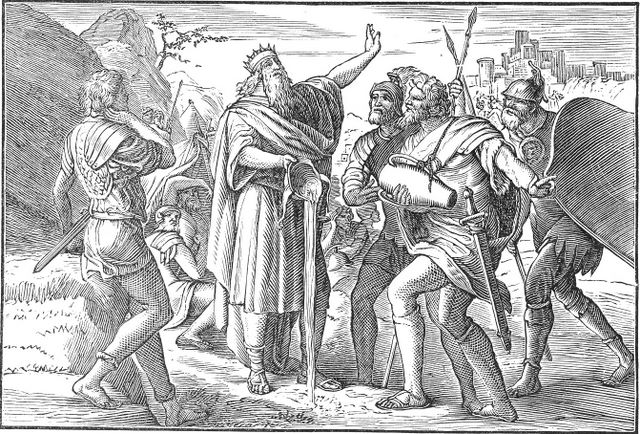
David’s Mighty Men
“And David became greater and greater, for the LORD of hosts was with him.” (1 Chronicles 11:9)
The vast majority of the first nine chapters of First Chronicles is a genealogy, and most people simply breeze over the names and relations listed there. And after a description of Saul’s and Jonathan’s deaths and David’s ascension to the throne, another list of names is given. Whereas the first lists were genealogies, this list is very different.
This coming weekend is Memorial Day in the United States, a holiday which is normally celebrated with picnics and barbecues, a long way from the true purpose this holiday. Memorial Day was originally set aside as a day to remember or memorialize the men and women who have fought to defend our country in the armed services. The Vietnam Veterans Memorial Wall in Washington D.C. currently has 58,272 names of those who died or remain missing in the Vietnam War.
So what’s my point? My point is that lists of names mean something. And not only to their family and loved ones. This becomes incredibly clear in 1Chronicles 11:10-12:40 where the names of King David’s mighty men are given along with some of their accomplishments. These were great men of war and courage. Some fought against unthinkable odds and everyone fought with great courage and faithfulness to the king.
Here are a few thoughts I had about these men:
- Like David, the mighty men were only successful because the Lord had given them success and they knew it. The beginning of a great fall begins with pride!
- Their faithfulness to King David was a faithfulness to the Lord who had placed David upon the throne. Mighty men recognize God’s leaders and do all they can to support him.
- The mighty men had different ranks based upon their abilities, performance and successes. There is “the three,” “the thirty” and the those who were very great, but “did not attain to the three” or “the thirty.” Everyone isn’t equal. Performance, skill and effort matter. In a day when everyone gets a participation ribbon, this shows that mighty men strive and push themselves to be their best in the service of the Lord.
- The mighty men loved their king and were willing to go above and beyond to serve and please him, even risking their lives to give him water from his hometown well (1Chron 11:15-19). This devotion was matched by David unwillingness to indulge himself with this sort of sacrifice. There was mutual love, respect and loyalty between the king and his mighty men.
- The mighty men had a great kinship and loving respect for one another built around their devotion to the Lord and his king. They were united in purpose and vision, each doing his own part for the common cause.
The virtues of honor, devotion, courage, selfless service and sacrifice are not exclusive to the military. These are the virtues that members of the Church should uphold as well. Our King is Jesus and our goal is clearly given in the Great Commission. May the Lord be pleased to raise up mighty men (and women!) from within our own churches to his glory and honor!
Spurgeon on Preaching with Emotion
That is what you must do with your sermons, make them red-hot; never mind if men do say you are too enthusiastic, or even too fanatical, give them red-hot shot, there is nothing else half as good for the purpose you have in view. We do not go out snow-balling on Sundays, we go fire-balling; we ought to hurl grenades into the enemy’s ranks.—C.H. Spurgeon, The Soul Winner: How to Lead Sinners to the Saviour; Fleming H. Revel edition, 69.
 Always Reforming