Do’s and Don’t’s of Sermon Introductions

Do not:

  1. Make your introduction disproportionate to the sermon. Your intro is like a porch to your sermon (the house). Make the porch fit the house.
  2. Cram details into the sermon that should more properly be placed into the sermon under a main or sub-point.
  3. Avoid eye contact or read your intro. Eye contact is important to engage your listeners. Know your intro so well that you will not need to read it. With that said, lengthy quotes are seldom appropriate in an introduction.
  4.  Introduce your first point, or a sub-point or idea in your sermon. This is confusing. Introduce the main point, which should cover your proposition and outline.
  5. Introduce the book, genre, author or audience. This material is background, but not the main idea of the text.

Do:

  1. Be clear, and concise. Make an impact that will leave your listener wanting more.
  2. Be creative. Introducing every sermon in the same manner gets as tedious as a bologna sandwich every day for lunch. Mix it up.
  3. Be careful in your use of sensational or shocking introductions. They may distract from the message proper, and if over-done will desensitize your listeners over time.
  4. Be brief. Don’t repeat yourself or use multiple illustrations. Get to the main idea and transition into your proposition as quickly as possible. Your job is to exposit the text—so move on to it!
  5. Be energetic. Nothing invites a wandering mind and a good nap than a boring preacher.

A Tool To Sharpen Your Preaching

If we want to improve in any skill, we must practice. This axiom is also true for preaching. If you don’t get many opportunities to preach, them you won’t be able to grow as an expositor. But there is an additional tool beyond practice that is also needed. As a matter of fact, it goes hand in hand with practice. It’s feedback. We need help with seeing our blindspots and our weaknesses in our sermons and delivery. One good place to get helpful feedback is from our church–those people that love us and want us to grow in our skills.

Now I understand that going to someone in your church and asking them to critique your preaching is a scary prospect because we are opening ourselves up to someone when we are very vulnerable. But we need the feedback if we are to get better and improve our preaching skills. So here is how you can being:

  1. Find two or three people you trust will be both kind and honest with you as they critique your preaching.
  2. If you have an idea of where you might need to improve, try working on this skill set for a month. Don;t try to change too much too fact or you will freeze up with the “paralysis of analysis” syndrome. Once you get a skill under your belt, you can move on.
  3. Explain to those people who are giving you feedback what they should be looking for. They need to know how to identify weakness in you beyond what they like and don’t like. It needs to be defined and measurable.
  4. After they give you feedback, thank them and assure them that you will take their comments into consideration and work on these things. Then do it!

I have created a simple form to give to those in a church with helpful areas for them to take notes. I would suggest that you not only explain what they are looking for, understand that they are helping you out, so don’t demand that they spend too much time distracted with the critique so that they get nothing from the message. In fact, you might want to rotate those that help you with feedback so it isn’t the same people week after week. Here are the questions I include on my form:

Sermon Evaluation

  • Preacher’s name: _____________________ 
  • Sermon title: _________________________
  • Sermon main text: ____________________
  • Date preached: _______________________

Introduction:

  • Did the introduction lead to the main idea of the text?
  • Was it interesting?
  • Did it include enough background info to give context without bogging down the sermon?

Sermon Body:

  • Was there a clear outline?
  • Was the outlining of the sermon choppy?
  • Did the preacher point us back to the text to prove his point?
  • Did he stray from the text or explain it?
  • Were there sufficient illustrations to make the abstract ideas concrete? 
  • Was there appropriate application given?
  • Was the main point of the text the main point of the sermon?
  • Was there doctrinal error?
  • Was the explanation of the main doctrines clear?

Sermon Conclusion:

  • Was the gospel somehow included in the sermon or conclusion?
  • Was this message God-centered?
  • Was this message overall clear, somewhat clear, muddy, or confusing?
  • Was the hearer given something to do or believe?

Outline:

(The one giving feedback should be instructed to write out your outline as they heard it. This should help you evaluate how successfully you gave out the outline in regard to repetition, and clarity.)

Preaching for a Verdict

An important concept that cannot be ignored in sermon preparation is the fact that the sermon needs to have a purpose–a reason for existing. A meandering monologue that seems to wander to and fro can be muddy, disorganized, frustrating, and unprofitable to the listener.

Each of the biblical writers had a reason for why they wrote their biblical texts, so too the biblical expositor needs to have a purpose as well. He must enter into his sermon preparation with a clear understanding of what he is expecting his hearer to do when he has finished explaining, illustrating, and applying the biblical text.

Whether it is to glorify God, come to repentance, understand a theological concept more clearly, obey a command, or some other purpose, the sermon needs to have a clear purpose.

Can you imagine what it was like for the Israelites to wander in the wilderness for forty years? If you’ve ever sat in a sermon with no point, then you may have felt like an Israelite for 45 minutes, and it probably felt like you were suffering for over an hour!

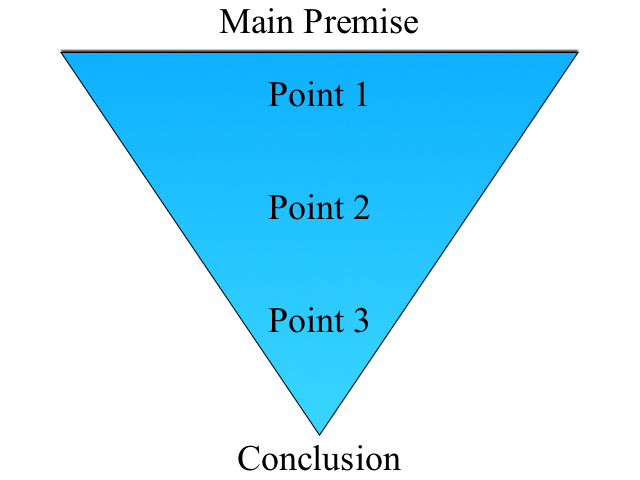
One way to help yourself not be “that guy” is to think about your sermon as an apologetic argument. You are seeking to prove to your listener your main premise. Not every sermon will benefit from this idea, but there are some sermon texts that will be particularly suited for this concept. I have made a graphic to help explain the idea:

If you think about your sermon like an inverted funnel, with the premise to be proven in your introduction, each successive point will develop and build up to the conclusion. The conclusion should leave your hearer with the strong evidence that your premise is true. You want them to understand that they should either accept your biblical premise or they must deny the clear teaching of Scripture.

A simple example of this type of sermon outline is:

  • Premise: Jesus Christ is the Son of God
  • Point/Proof 1: His virgin birth prophesied
  • Point/Proof 2: His sinless life practiced
  • Point/Proof 3: His resurrection proven
  • Conclusion: Therefore, you must believe on the Lord Jesus Christ

In this form of sermon organization, the conclusion is what you are seeking as your verdict. You state it, prove it, and then call your hearer to act. And this action may be simply a change of thinking as much as it could be a change of behavior.

This does not mean that your hearer will necessarily respond as you expect–heart change is the work of the Holy Spirit. But by organizing your message in this way you will make your expectations clear and prove your premise. Hopefully your making it irrefutable from Scripture.

The sinful heart may still reject the truth, but you will have accomplished your goal as an expositor to deliver the message faithfully and compellingly.

The Use and Abuse of Quotes in Your Sermon

Illustrations have been described as windows that add light into the sermon in order to illuminate abstract truths. If that is true, and I believe it is, then quotes are a good tool to have in your sermon arsenal. Except when they aren’t. Quotes can be used effectively, and they can be abused in the worst way. I want to point out the proper and improper uses of quotes in a sermon.

Good Uses of Quotes

Here are 6 reasons to use a good quote would be appropriate:

  1. Artistry: The writer says something more beautifully than you can say it yourself.
  2. Clarity: The writer makes the point clearer than you can.
  3. Impact: The writer says something in a powerful way to make your point.
  4. Pithiness: The writer says something in a memorable and “catchy” way.
  5. Depth: The writer says something with a profundity that you can’t seem to say yourself.
  6. Interesting: The writer says something that draws interest or excites the imagination.

Poor Uses of Quotes

Here are 8 reason you ought to think twice before using that quote in your next sermon:

  1. Quotes that are too good not to share, even though they have nothing to do with the main idea of your sermon. Just because you like it, don’t squeeze it in.
  2. Quotes that are not short and to the point. Two page quotes from a Puritan in old English aren’t helpful unless you are trying to help someone fall asleep.
  3. Quotes that are only an interest to a very specific audience. Just because you love reading Wallace’s Greek Grammar doesn’t mean you should quote from it.
  4. Quotes that you have to explain after you read it. It’s like a joke–if you have to explain it, it’s not funny.
  5. Quotes that can be stated in your own words easily.
  6. Quotes that are meant to carry a sense of authority, i.e., “The great theologian so-and-so says…” The Scripture should be our authority. Quotes of men may bring clarity, but they should not bear the weight of authority to prove our point.
  7. Quotes that you cannot verify or find the source. If we proclaim the truth, we shouldn’t be using quotes that may be false.
  8. Quotes that are shocking and controversial. This isn’t because they don’t work, but because they do. This type of quote might just derail your sermon if your audience does not recover from the shocking quote bomb you let loose.

How Preparing Your Sermon is Like Spaghetti Sauce-And I Don’t Mean that it’s Spicy!

If you’re a pastor, you’ve more than likely heard the analogy of your sermon being like spiritual meat or spiritual milk. After all, those are pictures taken from the New Testament. But have you ever considered that your sermon has some similarities with spaghetti sauce?

My wife is part Italian, but she learned how to make spaghetti sauce from my dad-at least the sauce I prefer. I’m not sure where he learned to make it, but it is so good that my mouth is watering as I write this. Anyways, I have noticed something about spaghetti sauce—it is always better the second or third day after it is made (assuming there is any left over).

I think is is most likely because all of the ingredients—the spices, tomatoes, and meat—all have time to meld together in a way that they don’t have time to do when the sauce is fresh. Sure, the sauce is good when it is freshly made, but when it has time to sit for a while, it is so much better.

The same is true for sermons. A sermon that is preached is good when all of the “ingredients” are present—solid exegesis, helpful application, a pinch of humor, a sprinkling of illustration, a solid introduction and a passionate conclusion. But if you let that same sermon sit for a few days in the mind and heart of the preacher, the Holy Spirit will continue to do His work and the Word will become richer and deeper as all of those ingredients continue blending together in harmony, resulting in a richer sermon.

So, the next time you go to preach a message, make sure that you have some time to let it sit and soak in for a while. Don’t become a preaching machine that simply spits out sermon after sermon. Not only will it become less appetizing to those that listen, it is dangerous for your own soul.

For those of you that have listened to your pastor preach for a while, have you noticed that there are days when God really grips him and it affects his delivery and excitement? What do you think made the biggest difference? Share this with us in the comments.