Beware of the Subtle Fisherman

Hooked

“As wise and learned as you are, take heed to yourselves, lest he outwit you. The devil is a greater scholar than you, and a nimbler disputant: he can transform himself into an angel of light to deceive: he will get within you, and trip up your heels before you are aware: he will play the juggler with you undiscerned, and cheat you of your faith or innocency, and you shall not know that you have lost it; nay, he will make you believe it is multiplied or increased, when it is lost. You shall see neither hook nor line, much less the subtle angler himself, while he is offering you his bait. And his bait shall be so fitted to your temper and disposition, that he will be sure to find advantages within you, and make your own principles and inclinations betray you; and whenever he ruineth you, he will make you the instruments of ruin to others.”

-Richard Baxter, The Reformed Pastor

How to Live a Life of Gladness and Joy–Psalm 90

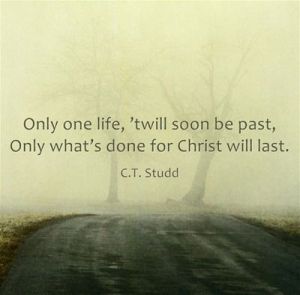
Studd quote

In my office I have an old grandfather clock that was given to me by my grandparents. On the face of the clock it says, Tempus Fugit, Latin for “time flies.” It’s so true, isn’t it? So, how can we make sure that we don’t waste our lives, but instead live for the Lord with joy and gladness? Moses instructs us in this psalm.

1Lord, you have been our dwelling place

in all generations.

Before the mountains were brought forth,

or ever you had formed the earth and the world,

from everlasting to everlasting you are God.

You return man to dust

and say, “Return, O children of man!”

For a thousand years in your sight

are but as yesterday when it is past,

or as a watch in the night.

You sweep them away as with a flood; they are like a dream,

like grass that is renewed in the morning:

in the morning it flourishes and is renewed;

in the evening it fades and withers.

For we are brought to an end by your anger;

by your wrath we are dismayed.

You have set our iniquities before you,

our secret sins in the light of your presence.

For all our days pass away under your wrath;

we bring our years to an end like a sigh.

10 The years of our life are seventy,

or even by reason of strength eighty;

yet their span is but toil and trouble;

they are soon gone, and we fly away.

11 Who considers the power of your anger,

and your wrath according to the fear of you?

12 So teach us to number our days

that we may get a heart of wisdom.

13 Return, O Lord! How long?

Have pity on your servants!

14 Satisfy us in the morning with your steadfast love,

that we may rejoice and be glad all our days.

15 Make us glad for as many days as you have afflicted us,

and for as many years as we have seen evil.

16 Let your work be shown to your servants,

and your glorious power to their children.

17 Let the favor of the Lord our God be upon us,

and establish the work of our hands upon us;

yes, establish the work of our hands![1]]

Before we get to the “practical” portion of living life with gladness and joy, we need to see that the basis of this type of living comes from a correct understanding of (1) The Timelessness of God (in verses 1-2); (2) The Temporariness of Man  (in verses 3-6); (3) A Short Life Shortened by Sin (in verses 7-11);  and finally, (4) How to Live Life with Gladness and Joy (verses 12-17).

1. The Timeliness of God (vv. 1-2)

The has proven to his children over and over that he is stable and faithful to men throughout all generations. He has shown this truth in special ways to Israel and Christ’s Church. Even before man, or even the earth and her majestic mountains were created, when there was no one to testify to his faithfulness, the Lord was the same. As Revelation 22:13 reminds us, he has no ending and beginning—he IS the alpha and omega. Psalm 102:25-27 says:

Of old you laid the foundation of the earth,

and the heavens are the work of your hands.

They will perish, but you will remain;

they will all wear out like a garment.

You will change them like a robe, and they will pass away,

but you are the same, and your years have no end.[2]

Our God is never-changing and unbound by time.

2. The Temporariness of Men (vv. 3-6)

Do you realize that man is just animated dust (v. 3)? We were made of the dust of the ground and we shall return to that dust when our life is removed from this body we inhabit. And if that isn’t bad enough, verses 4-6 reminds us that our time before God is only momentary and fleeting away. We are like the vapor of steam that rises in the morning when the sun hits the dew on the grass.

Do you see the comparison that is made in these first two sections of this psalm? God is eternal and timeless, and man is temporal and bound in time. It is like comparing a diamond to a styrofoam cup. One is eternally valuable and the other is only momentarily useful, but common, abundant and short-lived. This can be jarring and unsettling in our narcissistic world, but if we are to see things biblically, we need to set these matters in order correctly.

3. A Short Life Shortened by Sin (vv. 7-11)

Verses 7-8 are clear, this eternal god who has created everything sees all of our sins.No man escapes from his sovereign examination. And verses 9-11 teach us that God does not just watch with an indifferent eye, but he sees in order to judge our sins.

For Moses, the author of this psalm, he would have seen this truth firsthand in the life of Pharaoh. Having repeatedly ignored the command of God to let the Hebrew nation go in clear defiance to the judgments he and his nation experienced (Ex 10:28), Pharaoh personally faced the temporal wrath of the Lord in the angel of death visiting his own home and killing his own son. Some people, like Pharaoh, will face the horrible reality of the judgment of God in this life. They will reap what they have sown. And if they will not bow the knee in repentance to God, they will face him again in eternal judgment.

Some people have scoffed at the idea of God judging sin because they think that those who are not judged in this life must get away without facing the consequences for their sins against God. That is the way that the psalmist felt in Psalm 73. As he looked around, he became envious of the way the wicked not only seem to get away for their sin, but they seem to die happier than the righteous. Apparently, crime does pay! But then he came to his conclusion, “For behold, those who are far from you shall perish; you put an end to everyone who is unfaithful to you.[3]” It may take some time, but the Lord always gets his man and no one escapes the final judgment of God.

Life is short enough. But our sin drags us down and shortens the length of many lives. Seeking joy and gladness in sin is temporary solution that will never compensate for the misery that it brings.

4. How to Live Life with Gladness and Joy (vv. 12-17)

In this last section, we see some of the more practical aspects of this psalm. Below I have listed five applications of what Moses wrote in his psalm that can point our hearts to live life in a God-honoring way:

1. Remember that God is eternal and your life is short, so make it count! (v. 12)

Everyone has a finite number of days on this planet. If you think that you have forever to get busy for the Lord, you might be tempted to squander your short life. But if you focus and get busy in the work the Lord has for you, you will find the purpose the Lord has made you for.

2. Live with Heaven in mind (v. 13)

Do you really believe that Jesus is coming again? We can often see what we believe in the way that we live our daily lives. In Revelation 22:20, we not only see the Lord’s promise of his return, but we also get a glimpse of the Apostle John’s longing heart to see Jesus. That should make us more aware that when he comes, the Lord is going to hold us accountable for the few short years we lived for him (Matt 25:14-30). Somebody said that Christians are so heavenly minded that they are of no earthly good. But I think that we can be so earthly minded that we do no heavenly good.And when we are busy at our work in the fields of the Lord, we will find our joy, especially as we look forward to our great reward.

3. Find joy in your relationship with the Lord. (v. 14)

Have you ever eaten a fruit salad where a sweet piece of fruit makes another sweet piece of fruit seem like it’s not sweet at all? The world can be like that. We chase after cheap, temporary thrills and when the One true joy—Christ, is presented to us, we find that he isn’t so sweet to our souls. But we sometimes have been overly satisfied with the trinkets and baubles of the world instead of the treasure that is Christ. That is why some Christians can find no joy or gladness in the Lord. Entertainment has overshadowed the substance of Christ. But if we will pull back and focus on the Scriptures as they point us to the Lord, we will find that he is the sweetest joy of all (Jer 2:11-13).

4. Look at the blessings and not just the hardships of life (vv. 15-16)

Life is hard sometimes. An honest biblical view of the world would never deny that. But we are not called to Christ so that we can complain and grow bitter over this fact. Moses asked the Lord to help him and the people to see the blessings as well as the hardships, to literally “make them glad” (v. 15) and for the Lord’s goodness to be shown to his people. We need to pray that way as well when we feel that we are growing cold and unthankful.

5. Stay busy with God’s work (v. 17).

Finally, the psalmist ends asking for the Lord to establish the work of the people’s hands with divine favor. God has given us work to do, and we not only want the Lord to bless our work, but we also want the Lord to establish it as well. Can you imagine truing to rake leaves in a wind storm? Who wants to do that? We want our life and work to count for the glory of God so that when this short life ends, we will be satisfied and glad that God used our feeble work to further his great and glorious plan just a little bit. And that is a life that will end with joy!


[1] The Holy Bible: English Standard Version (Wheaton: Standard Bible Society, 2001), Ps 90:1–17.

[2] The Holy Bible: English Standard Version (Wheaton: Standard Bible Society, 2001), Ps 102:25–27.

[3] The Holy Bible: English Standard Version (Wheaton: Standard Bible Society, 2001), Ps 73:27.

Thessalonian Lessons in Church Planting

Churchplanting

The Church of Thessalonica was established during Paul’s second missionary journey. It is chronicled in Acts 15:36-18:22. In this post I want to walk through this journey and then apply a few lessons that can be applied to church planting.

Paul’s journey began in Antioch, were Paul and Barnabas had a sharp disagreement over John Mark, as to whether he should join them on their trip or not. Apparently John Mark had abandoned them on a previous trip and Paul did not think it was a good idea to depend upon him. Barnabas took John Mark and went to the island of Cyprus while Paul took Silas as his partner (Acts 15:36-41).

Meanwhile Paul and Silas headed to the region of Galatia to encourage the churches that Paul and Barnabas had established in the first missionary journey (Acts 15:36). The first stop mentioned was in Derbe and then on to Lystra. At Lystra Paul took Timothy with him on his journey (Acts 16:1-5).”

From Galatia Paul traveled with Silas and Timothy through the region called Phrygia, moving in a Northwest direction, avoiding Asia Minor (modern Turkey) because the Holy Spirit had forbidden that Paul should go there (Acts 16:6).

Paul then decided to go above Asia Minor into a Roman province called Bithynia, but Paul and his party were once again forbidden by the Spirit from going into this region (16:7). That meant that North and South were out of bounds to travel in. They could go back or they could press on toward Mysia along the northern border of Asia and Mysia until they reached Troas, which they did (Acts 16:8).

It was while in Troas that the Lord revealed to Paul his mission. He was given a vision of a Macedonian man who called out to him to come over and help him. Paul would have recognized this man as Macedonian from his traditional hat and clothing that had been a mark of the Macedonian people for centuries before and carries on even to today.

Although Macedon is not as well known to most of us today outside of the biblical references to it, it is important for us to know a little about its history.

The Macedonian kingdom was the “greatest empire ever known to human history.” [1] It was the empire of Alexander III also known as Alexander the Great.

Before he died at the age of 33, Alexander had succeeded in extending his kingdom from Egypt in the south to the Indus River in India to the east. His father, Philip II conquered the Greek city states and taught his son well many strategies that served him well as he sought to conquer the rest of the world. Alexander conquered Asia Minor, Phoenicia, Palestine, Egypt, Babylonia and India.

Alexander’s armies are pictured in Daniel 7:6 as a swift leopard with four wings. It says, “After this I looked, and behold, another, like a leopard, with four wings of a bird on its back. And the beast had four heads, and dominion was given to it.” The speed of the army was represented by the leopard’s speed amplified by four wings. The four heads refer to what happened after Alexander’s death. Since he died so young, possibly by poisoning, no plan of succession was in place.

After much turmoil, the kingdom was divided among his four generals into four kingdoms, with Antipater receiving the former Macedonian kingdom and Greece. At Antipater’s death, Cassander had the opportunity to take control and he solidified his position by marrying Alexander’s half-sister, the daughter of King Philip II. Her name? Thessaloniki.

In 316 BC Cassander founded a new city by consolidating 26 towns into the new city he called Thessalonica. This prestigious city would go through many more changes and wars by the time Paul would enter into it. When Paul came, it was a jewel to the Romans and had a population of about 200,000, which was quite large for a city in its day.

Let’s go back to Acts 16. Now we can see God’s purpose in not allowing Paul to go to Mysia or Asia or Bithynia! He wanted them to go to Macedon to bring the gospel message to the Gentiles!

Notice in verse 10 that it says “we” (cp. v.8 says “they”). What we find here is that in Troas Paul picked up another traveling companion—the author of Acts and the Gospel named for him—Luke! Paul went from Troas (in Mysia) across the island of Samothrace to the mainland of Macedonia and the city of Neapolis (16:11).

From Neapolis Paul and his friends went to the Roman colony of Philippi, named after Alexander the Great’s father King Philip II (16:12). In this city, Paul and his company met Lydia and led her to Christ. Later they were beaten with rods and thrown into jail after casting the demon out of a slave girl. (16:13-24) Welcome to Macedonia!

While in jail, God intervened and a jailer and his family were saved (16:25-40). From Lydia and the jailer’s family and any other’s saved on that trip to Philippi Paul established the first church in Europe. The letter we call Philippians was written to them.

Source: http://www.biblestudy.org/maps/apostle-paul-second-missionary-journey-map.html

Source: Biblestudy.org

Acts 17:1-9 tells us about the establishment of the Thessalonian church. Leaving Philippi, Paul passed through Amphipolis and Apollonia, probably because they were so small (17:1) and moved to the city of Thessalonica, where a synagogue had been established by the Jewish population.”

In these 9 verses, I’d like to make three observations about the work that Paul did in planting this church and make some applications for our lives.

1. Paul “reasoned from the Scriptures with a Purpose (vv. 2-4).
Paul’s time in Thessalonica was short—he knew that. He was not on a vacation or sight seeing trip. He was literally on a mission. Because of that purpose, Paul’s time was focused, purposeful and methodical.
Verse 2 says he“reasoned”with the Jews. This word in Greek is dilegomai and it is where we get our word “dialogue.” Paul “dialogued” with them. He had deep, meaningful conversations with them about the Scriptures and their meaning. But it had a purpose and an aim. they didn’t argue about Jonah’s whale or who the Nephilim in Genesis 6 are. Paul made a bee-line to the cross and Jesus.”
Paul wanted to show them from the Old Testament that Jesus is the long-awaited Messiah (v. 3). And Paul was seeking to change the hearts and minds of his listeners (v.4)! His mission had a purpose. Remember the way that Paul talked to King Agrippa? Acts 26:24-29. Paul preached for change!”
Studying the Bible and going to church is good. Listening to sermons and reading Christian books is good. But to what end do we do these things? Is it to seek holiness in our lives? It is to grow in Christ? Why do we share Christ? Is it to see people saved?”

2. Faithful gospel proclamation will also attract opposition from our enemy and those blinded by sin (vv. 5-9).

In a sense, these gospel preachers were turning the “world upside down” by preaching their message about King Jesus. We need to be honest. Most people like the status quo. We don’t like it when people rock the boat. And we love our sin. Listen to John 3:19-20. It says, “And this is the judgment: the light has come into the world, and people loved the darkness rather than the light because their works were evil. For everyone who does wicked things hates the light and does not come to the light, lest his works should be exposed.”

Paul was trying to build a lighthouse in the darkness of Thessalonica. But the darkness wasn’t about to just roll over and let that happen. It fought back. So, we must wage war!” We too need to fight like Paul—reasoning, preaching the gospel, and persuading with the truth.

Second Corinthians 10:3-6 says,“For though we walk in the flesh, we are not waging war according to the flesh. For the weapons of our warfare are not of the flesh but have divine power to destroy strongholds. We destroy arguments and every lofty opinion raised against the knowledge of God, and take every thought captive to obey Christ, being ready to punish every disobedience, when your obedience is complete. “

3. Finally, Jesus must be trusted to build his own church (Matt 16:18).

It is easy to give up and be discouraged by adversity and the roadblocks that we encounter. To see all the failures and not the victories. Afterall, Paul followed Jesus’ commands and went to Macedonia, just as he said. Yet in Philippi he was beaten then jailed. Next in Thessalonica a mob formed and attacked their friend Jason in his home. When Paul left Thessalonica, he was probably only there from 3-6 months, but they had to move on!”

But a church was planted in Thessalonica. And it grew and matured…even with the absence of Paul! God gave life to that seed of a church and although Paul left when it was a weak little seedling, God would cause it to grow.”

We certainly can learn from this. We need to work hard, and work smart, but we must learn as well to trust Jesus with the results. After all, it is HIS church.
 

[1] Green, Gene L. The Letters to the Thessalonians. The Pillar New Testament Commentary. Grand Rapids, MI; Leicester, England: W.B. Eerdmans Pub.; Apollos, 2002; p. 9.

How to Pray, pt. 3 (Matt 6:10a)

Focus is sometimes very difficult. Especially after dinner and a long day. It’s easy to lose focus. I remember one day when I had spent the whole night working on an assignment for school. I hit the print button as I took a shower and then off to seminary I went.

Image

At chapel I sat up near the front so that I wouldn’t be tempted to fall asleep (a tactic that I used for classes after lunch as well!). On that particular day, John MacArthur was our chapel speaker. But the focus was gone. I fought hard, but the sleep won out. I’m pretty sure Dr. MacArthur saw me sleeping that day.

But other than sleepiness, we can lose focus, can’t we? Those two sisters, Mary and Martha teach us that Martha lost her focus on the most important things (Lk 10:38-42). And we can do that in our prayer times as well.

So far we have seen that our prayers need to be honed:

  1. With a God-centered focus on God as our Father–“Our Father in heaven…”
  2. With a God-Centered focus on God’s holiness–“…hallowed be your name…”
  3. Now, With a God-centered focus on God’s Kingdom, “…your kingdom come”

God has given us a job to do on this earth. And it’s not to make it to the top of the corporate ladder or feather our retirement nest or finally reach all those goals in our bucket list. Those are all fine and have their place, but it isn’t first place and too much time on those things will cause us to lose our focus on God’s kingdom.

You know that almost everything we spend these short 70+ years on this earth gaining will all be burned up one day? Not much will be left if we don’t spend our time wisely. And that begins with prayer.

In the 2nd Petition, “your kingdom come” we focus our prayers on three matters:

  1. We pray that Satan’s kingdom may be destroyed.

A kingdom means that there are people who are being ruled by a king; and the vast majority of humanity is ruled by Satan, the prince of the power of the air (Eph 2:2). When we pray, petitioning that God’s kingdom come, we are at the same time asking that Satan’s kingdom be destroyed, since these two kingdoms are incompatible.

When we pray for the destruction of Satan’s kingdom, we are praying in line with the psalmist: “God shall arise, his enemies shall be scattered;and those who hate him shall flee before him! As smoke is driven away, so you shall drive them away;as wax melts before fire, so the wicked shall perish before God! (Ps. 68:1-2).

Also, when we pray for God’s kingdom to come, we pray in agreement with what is revealed in prophecy will one day surely come. In Revelation 20:1-3, 7-15 we see the yet-future defeat of Satan and the judgment of all the wicked. At this point in history, all of sinful humanity will be placed into one of two places-with God, or in the Lake of fire. The final separation of darkness and light will be complete! Sin and evil will be eradicated and finally be completely judged!

There are some dark and sinister elements in our world that Christians need to war against. You need to be in deep and concerted prayer for God to strike down the enemies of the gospel and for him to use you as his agent to bring about those changes.

I’ve prayed that the Lord would remove obstacles, including people, to the preaching of the gospel. I’ve prayed that the Lord would shut down strip clubs and bars. I’ve prayed that back-sliding sinners would be crushed by their sins so they will look up to Jesus once more. I’ve prayed that family members would be overwhelmed by their sin and would seek Christ with a repentant heart and that they would be miserable until they do so.

I want to see God’s Kingdom come. And I don’t want to see the kingdom of darkness grow—not in my neighborhood. Not in my church. Not in my home. What about you?

  1. Likewise, when we pray, “Your kingdom come,” we pray that God’s grace may advance:

The Church is made up of those who are currently living in the grace of our Savior Jesus Christ here on earth. We have not been glorified, and we have not received all that has been promised for us, yet we hope expectantly in Jesus’ finished work on the cross. It is this hope that we are to busying ourselves in moving forward while we still have breath:

The Apostle Paul, in writing to the believers in Thessalonica, wanted to see the Church of Jesus Christ grow, praying: Finally, brothers, pray for us, that the word of the Lord may speed ahead and be honored, as happened among you( 2Thess 3:1, emphasis mine). Paul wanted to see Christ come into the hearts and lives of people, and so he shared the gospel with everyone he came into contact with. Like Alex Montoya says, “If it looks human, evangelize it!”

Image

Do you realize that God has blessed you, in part so that you can make his name great in the whole earth? Notice the connection that the psalmist makes: “May God be gracious to us and bless usand make his face to shine upon us, that your way may be known on earth, your saving power among all nations. Let the peoples praise you, O God; let all the peoples praise you!” (Ps 67:1-3)

Do you pray for God’s kingdom to come? Does it match your hunger for souls to be saved?

Paul’s hunger to see his fellow Jews saved was so intense, that he wrote,  “I am speaking the truth in Christ—I am not lying; my conscience bears me witness in the Holy Spirit— that I have great sorrow and unceasing anguish in my heart. For I could wish that I myself were accursed and cut off from Christ for the sake of my brothers, my kinsmen according to the flesh” (Rom. 9:1-3) and in Romans 10:1, “Brothers, my heart’s desire and prayer to God for them is that they may be saved.”

  1. Finally, when we pray, “Your kingdom come,” we pray that the kingdom of God’s Glory may be hastened

This is possibly the most prominent idea that we think about when we consider this phrase of the Lord’s prayer. Every true follower of Jesus Christ looks forward to the day when our Savior returns, and hopes that he comes soon. As Revelations 22:20 says, “He who testifies to these things says, “Surely I am coming soon.” Amen. Come, Lord Jesus!”

Notice the message that comes to us through 2 Peter 3:8-13:

  1. It acts as a warning to those who think that Jesus’ return is far off.
  2. It reminds us to keep working towards fulfilling the Great Commission until he comes again.
  3. It encourages us to keep waiting eagerly for that day when it finally does come and we see our Savior face to face!

But awaiting the Lord’s coming needs to be accompanied with a die-hard obedience to his last words—Take the gospel to the world! Make disciples. Push forward. Take the kingdom with violence—violent men for Christ and the gospel are needed. The Church needs men and women who are not lax or passive. Men and women who study hard and pray hard and preach hard and live godly lives that cannot be denied by our enemies.

Are you that kind of Christian? Pray that you would be!

Solid Theological Studies Resources

20140203-084156.jpg
Mike Vlach, professor of Theology over at TMS is one of those guys that both is crazy smart and a good guy. His official bio over at TMS says:

Michael J. Vlach, Ph.D. is Professor of Theology at The Master’s Seminary in Sun Valley, California where he has been teaching full time since 2006.

Michael has a B.S. in Business Administration from the University of Nebraska and a Master of Divinity degree from The Master’s Seminary in Sun Valley, California. He also earned his Ph.D. in Systematic Theology from Southeastern Baptist Theological Seminary in Wake Forest, North Carolina.

Michael specializes in the areas of Systematic Theology, Historical Theology, Apologetics, and World Religions. His specific area of expertise concerns the nation Israel and issues related to refuting the doctrine of Replacement Theology. Dr. Vlach was awarded the “Franz-Delitzsch Prize 2008” for his dissertation, “The Church as a Replacement of Israel: An Analysis of Supersessionism.” He is also the author of five books:

Has the Church Replaced Israel?: A Theological Evaluation (B & H Academic, 2010)

20 Tips for Writing Seminary Papers (Theological Studies Press, 2010)

The Church as a Replacement of Israel: An Analysis of Supersessionism (Peter Lang, 2009)

Dispensationalism: Essential Beliefs and Common Myths (Theological Studies Press, 2008)

Philosophy 101: The Big Idea for the 101 Most Important People and Ideas in Philosophy (Theological Studies Press, 2007)

Dr. Vlach is also the Founder and President of TheologicalStudies.org, a cutting-edge website devoted to providing quality articles, news, and information related to Christian theology. Michael speaks regularly at churches and conferences and has appeared on several national radio and television broadcasts including The History Channel.

Michael is also a member of the Evangelical Theological Society and has taught various courses in Theology for Liberty University in Lynchburg, Virginia.

All that to say Mike knows his stuff. He’s blessed the Church with materials for study at his site www.theologicalstudies.org. Check it out.