The Inheritance of the Meek-Matthew 5:5

Blessed are the meek, for they shall inherit the earth.- Matthew 5:5

Image

A. W. Tozer once wrote, The meek man is not a human mouse afflicted with a sense of his own inferiority. Rather he may be in his moral life as bold as a lion and as strong as Samson; but he has stopped being fooled about himself. He has accepted God’s estimate of his own life. He knows he is as weak and helpless as God declared him to be, but paradoxically, he knows at the same time that he is in the sight of God of more importance than angels. In himself, nothing; in God, everything. That is his motto.

Some confuse meekness with a wimpiness. They think that a meek person could be knocked down by a slap with a wet noodle. Others think that a meek person is always inoffensive to the point of compromise. This idea says that a meek person wants everyone to get along and to be liked by everyone no matter the cost. Another popular idea sees a meek person as a doormat. He is the one who is so weak-willed that he has no ones respect, not even his dog’s.

But that’s not the way the Bible speaks of a meek person.

First, know that Meekness is a fruit of the Spirit (Gal 5:23), therefore it is not a natural disposition, but a supernatural grace. Sometimes we see an especially nice and gentle person, and we see them as being meek. There are some people born this way, but this is not biblical meekness. The Bible commands Christians to be meek, and therefore there is an expectation that all who call Jesus Lord be meek:

Titus 3:1-2: Remind them [servants of the Lord] to be submissive to rulers and authorities, to be obedient, to be ready for every good work, to speak evil of no one, to avoid quarreling, to be gentle, and to show perfect courtesy toward all people.

Col. 3:12 Put on then, as God’s chosen ones, holy and beloved, compassion, kindness, humility, meekness, and patience,

Eph. 4:1-2 I therefore, a prisoner for the Lord, urge you to walk in a manner worthy of the calling to which you have been called, with all humility and gentleness, with patience, bearing with one another in love,

2Tim. 2:24-25 And the Lord’s servant must not be quarrelsome but kind to everyone, table to teach, patiently enduring evil, correcting his opponents with gentleness. God may perhaps grant them repentance leading to a knowledge of the truth,

Second, the Greek word for “meekness”-praus- is defined this way: “Not being overly impressed by a sense of one’s self-importance; gentle, humble, considerate, meek.”

So every Christian is called to be meek, or not overly impressed by a sense of our self-importance, but gentle and humble.

In any discussions regarding the Beatitudes, we must recognize that each one builds upon the one before.

We must first be poor in spirit (Matt. 5:3), knowing that we are sinners and cannot gain a righteous standing on our own in God’s eyes. We realize that we must come to God empty handed, asking for God’s mercy.

We must mourn over our sin (Matt 5:4). Because we have looked internally and have seen our spiritual poverty, we recognize how much we have offended a holy God and we mourn over this fact.

This realization of our unworthiness to receive mercy should have the result of making us humble and meek. We cannot be overly impressed with our self-importance when we view ourselves through the lens of Scriptures and the first two beatitudes.

Now this is where Jesus’ sermon really begins to turn up the heat and become really uncomfortable. Dr. Lloyd-Jones writes:

Now why is this? Because here we are reaching a point at which we begin to be concerned about other people. Let me put it like this. I can se my own utter nothingness and helplessness face-to-face with the demands of the gospel and the law of God. I am aware, when I am honest with myself, of the sin and the evil that are within me, and that drag me down. And I am ready to face both theses things. But how much more difficult it is to allow other people to say things like that about me! I instinctively resent it. We all of us prefer to condemn ourselves than to allow somebody else to condemn us. I say of myself that I am a sinner, it instinctively I do not like anybody else to say I am a sinner. That is the principle that is introduced at this point. So far, I myself have been looking at myself. Now, other people are looking at me, and I am in a relationship to them and they are doing certain things to me. How do I react to that? That is the matter which is dealt with at this point. I think you will aggress that this is more humbling and more humiliating than everything that has gone before. It is to allow other people to put the searchlight upon me instead of my doing it myself. [Studies in the Sermon on the Mount, p.54]

So, meekness relates to our reactions and attitudes towards others. In this, we are going to look at our meekness toward God and then in the next post our meekness toward other people.

First, our meekness toward God must include a submission to His will. There are times in our lives when things don’t turn out like we had hoped or planned. We are hurt, disappointed, and maybe even crushed and bitter. Meekness carries itself without murmuring or bitterness. Instead, it recognizes that the hand of God is good, even when we can’t see it as clearly as we would like to.

The meek heart recognizes that our heavenly Father is much more gracious and merciful than we deserve. Consider the response of old Eli (1Sam 3:18). We see a similar response in Mary (Luke 1:38).

Eli would have his whole family line wiped out. Mary’s dreams were radically altered ad she would live out her days with a cloud of scandal always over her head and whispers behind her back. But both accepted the will of the Lord with meekness.

Sometimes we can have the opposite attitude towards the will of God in our lives. We can have the attitude of Jonah (Jon 4:9). Like Jonah, we forget who we are, and how God has saved us out of the belly of hell and we declare with our attitudes, if not with our lips, that we deserve so much better.

So, our meekness toward God must include a submission to His will.

Secondly, our meekness towards God needs to be evident in our conformity to His Word. The spiritually meek desire their minds to be conformed to the mind of God. Conforming our minds to God’s Word means we do not quarrel with the instruction with the Word. Instead, the meek Christian wrestles with the corruptions and sins in his own heart.

How often it is the opposite. We can argue with the sermon, because we don’t like what God has said. We excuse it by getting mad at the preacher, or claim that “that’s just his interpretation of that verse.” In reality, we are not humbling ourselves before God’s Word. We are being proud and stiff-necked.

Consider the meek attitude of Cornelius in Acts 10:33. This gentile man was humble before the Word and ready to receive all that the Apostle Peter taught.

James 1:21 reminds us that we must put away our sins and all filthiness. That’s recognizing our spiritual poverty and mourning over our own sins, crying out to Jesus for forgiveness. But it doesn’t stop there. James 1:21 continues to say that we are to receive the implanted Word. It is this Word of God, implanted in us, that confronts us. The Word of God is not a part of us, it is outside of us. It needs to invade our hearts, to offend, to cut deeply, to get up in our face and speak the truth we refuse to see. When we allow that to happen, we must be meek. We must bow to the Word of God and stop arguing with it.

It’s time for an attitude check. How’s your attitude been with God? Don’t just look at the surface—go down deep. Be brutally honest.

Have you had a rotten attitude about your life and circumstances and shown it by being discontent? Do you believe you deserve better? You’re not being meek.

Have you gotten mad at God’s Word when it confronts your sin? When God calls you a liar, a spiritual harlot, a compromiser?

When God says through his Word that you have been a lazy servant, a disobedient slave or a luke-warm Christian, have you thought that God was talking to someone else, when he was looking right at you in his Word?

To be meek, we need to wrestle with our pride. We must go beyond a self-evaluation and allow God to evaluate us.

Next we will talk about how we meekly deal with others. But the basis for dealing with others is built upon our relationship with God. If can’t be meek in the presence of God, we will never be meek in the eyes of men.

The ultimate purpose of the Word of God is so much more…

“When the Word of God, faithfully taught by the people of God and empowered by the Spirit of God, falls down, people become different. Lusting people become pure, fearful people become courageous, thieve become givers, demanding people become servants, angry people become peacemakers, complainers become thankful, and idolaters come to joyfully worship the one true God. The ultimate purpose of the Word of God is not theological information but heart and life transformation.” Paul David Tripp, Dangerous Calling, 51.

Biblical Reformation that Leads to Biblical Revival, pt. 2

Bible

On Friday I posted part one of this article that compared the biblical revivals of Jehoshaphat, Hezekiah, and Josiah with the Great Awakening as recording by Jonathan Edwards in his work, A Faithful Narrative of the Surprising Work of God. You can read that post here. In that post I explained the necessity of godly leadership as a catalyst for effecting revival. This leadership needs to exist in the church and the home. Today I would like to continue by showing that biblical reformation also requires three more elements to set the stage which will allow God to move forward if he wished to bring about true biblical revival.

2.    Respect for the Word of God; 2Chron 17:7-9; 30:1-27; 34:8-21

Second Chronicles 17:7-9 tells us that Jehoshaphat had a high view of the Word of God. In the third year of his reign, having cleared Judah of false worship, Jehoshaphat sent out his officials, along with a group of Levites and some priests to go throughout Judah to teach the “book of the Law of the Lord” to the people. The king knew that change is not merely an organizational or motivational agenda. He didn’t seek to write up a mission statement or cast a vision for the people. Instead, he immediately removed the clear violations of God’s Word and then proceeded to teach the people the Law so that they could see for themselves what God expected of them. 

King Hezekiah understood that a respect for the Word of God is more than a mere reverence for the Book. True respect means to honor God with obedience. In 2 Chronicles 30, Hezekiah took the next step that was necessary after restoring the Temple–celebrating the Passover as prescribed in the Law. This required preparations that had not occurred for many years, including calling all of Israel to join in the feast. The priests were required to consecrate themselves in preparation for the day. With the feast and offerings came a  renewed delight in God and his Word.

Josiah lived in a day when the Law had been lost. The Word of God was nowhere to be found and because of this, it was neither read nor obeyed. When the workmen assigned to restore and cleanse the Temple came across the Book of the Law it was brought before the King. As Shaphan the secretary read the Book before the king he immediately realized how disobedient Judah had been in not keeping the Law. From this reading Josiah could now understand God’s displeasure with His people and why He had poured out his wrath upon them. Straightaway Josiah sought to restore what had not been observed in the Law.

During the beginning of the Great Awakening, the people began to react to the preaching of the Word with intense passion. Societally, people were expected to attend church with the result that nominal Christians filled the pews at times. As Edwards saw the Spirit moving, he saw many of these same people respond to the preached Word with increased power and emotional response. The hard hearts of the people were being softened by the Word.

There is a way to pay lip service to the preaching of the Word–a mechanical way of going through the motions. But do we weep over our Bibles as we see our sinful selves reflected in the pages of Scripture (James 1:22-24)? Are we broken by the Word allowing it to pierce into our hearts and scan our very souls (Heb 4:12-13)?  And the man in the pulpit is no different. Many preachers lack passion in their preaching because they lack a passion in their hearts for God. Cold sermons often times come from a cold heart.

Let me ask you friend, do you think deeply about the Word of God, or do you plow through your Bible reading and devotions, excusing your quick reading as “better than nothing?”Do you think that God subscribes to the “quantity is better than quality” idea behind Bible reading?

At our churches, do we expect the Word to break hardened hearts, or are we timid, never really expecting that the Word will change much in ourselves or others? If we look at the amount of evangelism you do personally, we can see what you expect. 

Opening up ourselves to be revived by the Holy Spirit will take the efforts of those who lead the church and the home. But every believer is called to have a holy reverence for the Word of God that extends beyond mere lip service. In the next blog post I will look at two more steps that our godly trio of Judean Kings took that we can also emulate in our homes and churches.

A Reading List for Training Leaders

Portrait of John Calvin

Since my last post was about the necessity of biblical leaders setting the example for the church that is seeking revival, I thought that I would share with you the reading list that we have for preparing men for the roles of deacon and elder at our church. The list is not all-inclusive of what our men need in order to be prepared, but it is a starting point for dipping their feet into deeper theological waters. This reading list assumes a continuing reading of the Bible along with additional reading after this list is completed, as well as discussions, papers and oral exams.

Required reading materials:

  • Introduction to the IFCA International (5 pages)
  • A Short History of the IFCA (7 pages)
  • The Deliberate Church, Dever and Alexander (202 pages)
  • The Gospel and Personal Evangelism, Dever (119 pages)
  • The Supremacy of God in Preaching, Piper (110 pages)
  • Preaching with Passion, Montoya (152 pages)
  • Dispensationalism, Ryrie (213 pages)
  • Biblical Calvinism, Daniels (13 pages)
  • The Doctrines of Grace, Boice and Ryken (226 pages)
  • Biblical Eldership (295 pages) or The New Testament Deacon (159 pages), Strauch
  • The Pastoral Epistles, Paul
  • Instruments in the Redeemer’s Hands, Tripp (354 pages)
  •  Lectures and Sermon Audio:
  • “Watch Your Life and Teaching” – C.J. Mahaney
  • “Abstain from Sexual Immorality” – John Piper
  • “Church, Congregationalism and Elders” – John Hammett and Phil Newton
  • “What is the Gospel?” – D.A. Carson
  • “Preaching the Gospel” – Tim Keller
  • “The Passion and Power of Apostolic Preaching” – Steve Lawson
  • “God, Psychology and Christian Care of the Soul” – David Powlison

Biblical Reformation that Leads to Biblical Revival, pt. 1

There is no doubt that the church today needs revival. But not revival as it is sometimes defined—evangelistic tent meetings in which the Holy Spirit is scheduled to arrive on our set dates. Revivals or “awakenings” as they used to be called, mark a special time when God’s people are moved upon by God and there is evidence of the Spirit’s powerful work among his people and those he draws to salvation through the proclamation of the gospel message.

Today there is a lot of activity in the evangelical church–lots of money being spent, books printed, conferences held, churches planted and sermons preached. With the technology of our day, there is more access to the Bible, sermons, and the gospel world-wide than ever before. We have in our country almost all of the world’s largest churches.

But would we say that there is revival happening in our nation or our churches? Most of us would say no, and I would heartily agree. There are victories and people are being saved but the Church today, especially in North America, is a long way from revival. Do you desire revival in our churches and our nation?I do, and I think that you do as well.

As I was preparing to preach Psalm 80 in our church, a psalm that is a prayer for God to revive Israel after the Assyrian invasion, I was interested in looking at the times in which God had brought Israel revival before. Then I compared Israel’s activities to those described by Jonathan Edwards in his work entitled, A Faithful Narrative of the Surprising Work of God, written in 1737 to describe what was happening during America’s Great Awakening.

Over the next two blog posts I would like to share with you four requirements of biblical reform that are critical if we hope to see biblical revival in our churches and the nations.

1.    Godly Leadership- 2Chron 17:3- 6; 2Chron 29:2; 31:20; 34:2-3

Second Chronicles 17 tells us that when Jehoshaphat took over the throne from his father Asa as the ruler of Judah that he made some drastic changes. Because he was a man who feared the Lord, Jehoshaphat obeyed him not only in his own personal practices of not worshipping false idols, but he also led his kingdom in holiness by taking down the places of false worship and removing the idols that led his people astray. Verse 3 tells us that this took a courageous heart, because even though he was the king, it is easy for a ruler to capitulate to the whims of the people in order to please them and make leading them easier. But Jehoshaphat was no Pontius Pilate. He stood firm and did what was right. And because of this, verse 5 tells us that the Lord established the kingdom in his hands along with bringing to him great riches and honor.

Second Chronicles 29 tells the heroic story of king Hezekiah and his reign of Judah. Even as a young man (verse 1 tells us he was 25 when he began to reign) Hezekiah walked in the ways of his forefather king David by obeying the Lord from his heart. Hezekiah longed to see the Temple restored and consecrated for worship once again. He was repulsed at the way the Lord had been treated in the Temple worship and he enlisted the Levites to help carry out his desires (2Chr 31). Hezekiah understood that by turning their backs on the Lord they had invited his wrath, and that the only way to reverse this and invite his blessings was to restore the Temple and repent appropriately.

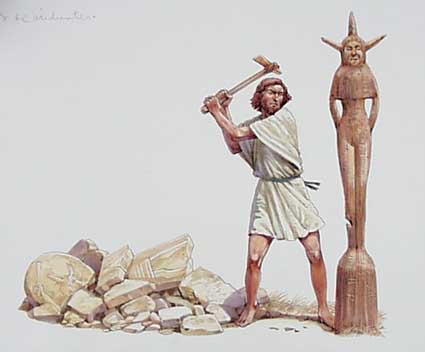
smashing idolsIn chapter 34 of Second Chronicles we are confronted by the astounding example of Josiah, the eight year old king of Judah. Verse 3 doesn’t say that he began to seek the Lord after he grew older, but that even as a child he began to seek the Lord. By the time he was twenty, Josiah was so strong in the Lord that he began to once again dismantle the   idolatry that had once again infested Judah. After this, Josiah cleansed the Temple, reinstated obedience to the Book of the Law, which was once again in their possession, which led to the reinstatement of the Passover and obedience to the other laws they had failed to keep.

In each and every one of these kings of Judah, we see a heart that longs not only to obey God, but to lead God’s people into obedience. These men critically analyzed the situations that they found themselves in and compared it to the Word of God. Then with courage and strength from the Lord, they led their people into reform. Interestingly, this pattern repeated itself in New England thousands of years later.

Sometimes we have an inaccurate understanding of history that leads us to wrong conclusions. We might have the idea that the Great Awakening that began in Northampton was begun under the influence of Edwards’ preaching. But in his Faithful Narrative, Edwards tells of how under his grandfather Solomon Stoddard five “harvests” were experienced in his life. These “harvest” were the unfolding work of the Spirit within the village as well as in the church that Stoddard led.

You see, just as with the godly kings of Israel and Judah, Edwards understood that influence of leaders has long-lasting effects—for good or for evil. Stoddard was a godly man and he had a major effect in his parish—and Edwards reaped many benefits from his grandfather’s groundwork in that town. But as time went by, the effects of sin began to return. And before the Great Awakening happened, many of the youth of Northampton were once again becoming more and more worldly—sound familiar?

So how did Edwards deal with this? Much like Jehoshaphat, Hezekiah and Josiah dealt with it. Edwards picked up the mantle of leadership as the pastor of the church in Northampton. Edwards preached sermons to the church that demanded that the youth repent of their worldliness and carousing. And then he met with the fathers of those in his church and called upon them to take up their duty as leaders of their homes and begin to enforce godliness. Edwards wrote that his preaching fell upon those hard hearts and began to break them. And the fathers agreed. They began to see that the preached word was changing their children’s attitudes toward their sinful behavior. God had begun to move and the youth began to obey without much additional prodding by their fathers.

Many of us are preachers and fathers. If we want revival in our country, and our state and in our city and in our church it must start in our homes. We must preach for change—and for holiness. We must be godly leaders in our own homes and godly leaders require that our churches put into action what the Word of God says.