 I love fishing. I remember a time when a friend and I climbed a fence and hiked into an abandoned gravel pit to fish a pond we found inside of it. The pond wasn’t very large, (we were able to cast to the other side) but we figured that since it was inaccessible, it might have good fishing. We didn’t catch anything. There weren’t any fish in the little pond. No life at all. It was just a big whole where rainwater had collected.
Sometimes Christians are like that. They don’t venture out where the fish are, and they never catch fish. They reluctantly throw their hooks into a bucket. “Oh well,” they reason, “I guess I’m not an evangelist.” Or, we can be guilty of thinking that since we no longer have any unbelieving friends, we don’t need to share Christ.
Churches as a whole can be guilty of this as well. Instead of being about the business of saving souls, they focus on making everyone in the church comfortable, or inviting Christian friends from other churches to their church. Friends, that isn’t evangelism, that is, to change the analogy, sheep stealing. Moving sheep from one pen to another doesn’t increase the size of the flock.
Pastor E.V. Hill said that the church throughout the ages has struggled in this area, becoming “keepers of the aquarium instead of fishers of men.”
We are not to be keepers of our little (or big) aquarium. We are called by Jesus to be fishers of men.
In this blog post, I would like to call your attention to four facts about the call of every Christian to be fishers of men, or evangelists.
1. Jesus Uses Every Type of Person to Preach the Gospel.
“While walking by the Sea of Galilee, he saw two brothers, Simon (who is called Peter) and Andrew his brother, casting a net into the sea, for they were fishermen.” (Matt 4:18)
Jesus chose rough, unpromising men to be his Apostles. None of the original twelve disciples were formally trained, that we know of. The only exception was the Apostle Paul, who was a special exception all around. None of those Jesus chose were religious leaders. Many were fishermen. Matthew was a tax collector.
Many of them were so obscure in their background that we know very little about them. The other followers of Jesus included women, former prostitutes, slaves and slave-owners, businessmen and women, soldiers, and even politicians.
Although Jesus could have done the work of evangelism alone, his plan was to use his disciples to win other disciples for the kingdom. God uses means (us) to preach the gospel to the world (the end of which is to bring glory to God).
Have you ever considered how God has placed you where you are to effect change in your sphere of influence? We are called to take the gospel to our corner of the world, wherever that may be right not.
As a pastor, I have limited access to many different types of people in their “natural environment” even though I regularly evangelize and share Christ. As a matter of fact, whether at the barbershop or a party, nothing seems to kill a conversation quicker than the question, “So what do you do for a living?” I know that when I say, “I’m a pastor,” immediately most people tense up. I’ve seen beer cans disappear and language instantly cleaned up, followed by a change of subject or location!
 I have limited success and less opportunity to share the gospel with unsaved teachers as a Christian teacher can. I cannot reach out to unsaved businessmen in the same way that a Christian businessman can. I cannot gain the same access to unsaved students as a Christian student can. I can’t speak to your neighbors about Christ as well as you can. I don’t mean that you can explain the gospel in a different way, because the gospel message is the same to all of humanity. But we all have different relationships and are different people—and that gives us different opportunities and different personalities and different styles that God uses as his means for preaching the same gospel to different audiences. Everybody has access to a whole range of unbelievers that many others do not.
2. Jesus Calls Us to Evangelism as Part of Following Him.
And he said to them, “Follow me, and I will make you fishers of men.” (Matt 4:19)
Peter, Andrew, James and John had had other encounters with Jesus before this incident in Matthew 4. This was not the first time they had followed Jesus. But now Jesus was calling them to make a bigger commitment. Included in this command to follow Jesus was the need to evangelize. Why?
- It is the way of the wise (Prov 11:30)
- It results in rewards (Deut. 12:3). This is our capacity to reflect the glory of God.
- It is commanded (Matt 28:19-20). We may not be evangelists, but that does not exempt us from God’s command. As Paul told Timothy in 2 Tim 4:5, “Do the work of an evangelist”
Some excuses you may be using to excuse yourself, along with my response:
- I don’t have any friends. So, make friends.
- I only have Christian friends. So, make non-Christian friends.
- I don’t know how to share my faith. Go to your pastor and tell him you’d like to learn. And then sign up to go out with your church when they do, or call an unsaved friend and make a date to have some coffee together.
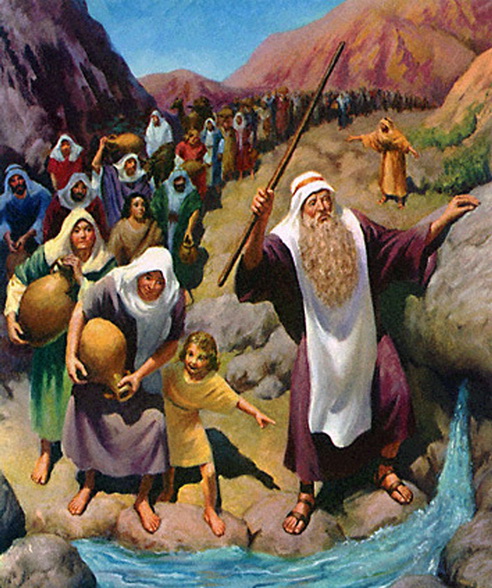
- I don’t speak well. Neither did Moses (Ex. 4:10-14)
- I’m too busy.
- Too busy to obey the Lord?
- Too busy to pluck a soul from hell?
- Too busy to throw the life-giving seed of the Word?
- If this is truly the case, you are too busy and your priorities are sinfully warped and out of place.
- I’m shy, I’m scared. This is the fear of man, and it is sinful.
Sometimes we would prefer to die for Jesus than to live for him….We are more concerned about looking stupid (a fear of people) than we are about acting sinfully (fear of the Lord). (Ed Welch, When People are Big and God is Small, pp. 39, 40.)
The reality is that a call to be a disciple of Jesus requires that we die to ourselves and live for Christ. Jesus said it clearly, “Then Jesus told his disciples, “If anyone would come after me, let him deny himself and take up his cross and follow me.” (Matt 16:24). Our comfort and ease matter little in this regard.
3. Jesus is the One who Makes Us Into Fishers of Men.
And he said to them, “Follow me, and I will make you fishers of men.” (Matt 4:19)
“I will make you fishers of men.”
Consider with me for a second the changes to John and James, two of Jesus’ disciples. Mark 3:17 says that Jesus gave these brothers the nickname, Boanerges, or “sons of thunder.” Why? It is quite possible because they were men who were rough around the edges—like bulls in a china shop, as we might say. In Luke 9:51-56, the Sons of Thunder asked Jesus if they could call down fire from heaven to consume an inhospitable Samaritan village. This incident shows us that they did not have tender hearts of mercy for the lost (at least not all the lost). But they would learn, and they would be radically changed by the Lord.
James was the first of the Apostles killed for his faith (Acts 12:1-3). John was later known as the Apostle of Love because of his extensive writing about the love of God (see 1John 4:7-12). Both had learned to be servants and to love others as Christ loved them. They became excellent examples of fishers of men.
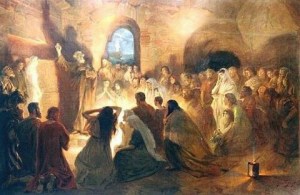 Think about the changes that happened to “first-to-stick-his-foot-in-his-mouth” Peter. Of course, he is most infamously known for being shackled by the fear of man when he had stated publicly that he would be willing to die for Christ before denying him (Matt 26:69-75). But the Peter we see after the resurrection is a completely different man. In Acts 2:14; 3:11-12; 4:7-8, he was set free from his fear of man to be bold for the Lord in his testimony. What was the difference? Acts 4:13 says, “Now when they saw the boldness of Peter and John, and perceived that they were uneducated, common men, they were astonished. And they recognized that they had been with Jesus.” They had been with Jesus and they had received his Spirit. This will be what makes a difference for us as well. As we spend time with the Lord, we will become more like him. We will grow in compassion for the lost and we will preach the gospel to them. When we deny ourselves, as Jesus did, all the excuses begin to melt away. When we remember that we are not alone in our evangelistic efforts, we find comfort and help. Consider Jesus’ words:
Nevertheless, I tell you the truth: it is to your advantage that I go away, for if I do not go away, the Helper will not come to you. But if I go, I will send him to you.
When the Spirit of truth comes, he will guide you into all the truth, for he will not speak on his own authority, but whatever he hears he will speak, and he will declare to you the things that are to come. He will glorify me, for he will take what is mine and declare it to you.” (John 16:7, 13-14)
But you will receive power when the Holy Spirit has come upon you, and you will be my witnesses in Jerusalem and in all Judea and Samaria, and to the end of the earth.” (Acts 1:8)
You cannot evangelize in your own power. God empowers you to do what he commands you to do. He makes you a fisher of men.
4. Jesus Calls Some to Dedicate Their Lives in Full Time Gospel Ministry.
“Immediately they left their nets and followed him” (Matt 4:20). “Immediately they left the boat and their father and followed him” (Matt 4:22).
The disciples left everything (Matt 9:27). Worldly security. Family. Home. They did this to follow Jesus in full time ministry. But being dedicated to the ministry of the gospel is also a high honor (1Tim 3:1). Never again would Peter, Andrew, James and John be known as fishermen. These four and the rest would forever be known as Jesus’ Apostles.
God has not called everyone to be an evangelist or a full time minister of the gospel, but God has called every Christian to share his or her faith. This is not an option, nor is it a suggestion. It is a command. As we have seen, there is no excuse that we can come up with that is acceptable to the Lord. When we don’t share Christ with others, we are disobedient. There may be some who have felt that God might be calling them to give up their job for full time service in the gospel. Maybe it is to be a missionary or maybe to be a pastor one day. If that is the case, how are you preparing to obey the Lord’s calling on your life? Do something! If you don’t plan to do something, you are planning to do nothing.






 Always Reforming