Why You Should Boldly Preach Christ Crucified

For the word of the cross is foolishness to those who are perishing, but to us who are being saved it is the power of God.

(1 Corinthians 1:18, NASB95)
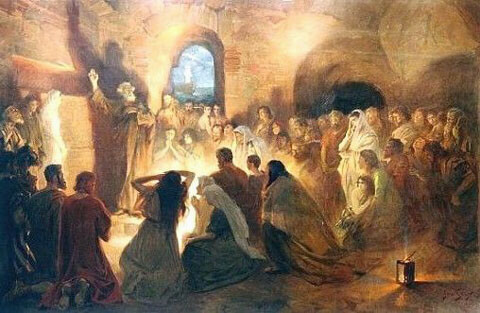
Peter preaching
  1. Because It is Not Popular (v. 18)
    Not only is it not popular, it is moronic (moria in Gk.). Consider the fact that the gospel of Jesus Christ demands that we say to sinners that a poor and humble Jewish man was God, and that he was nailed to a cross to die a criminals death despite his perfect innocence. We proclaim that this man is not only a man, but that he is God in the flesh. That he is perfect and sinless and that he was born of a virgin.

Furthermore, we proclaim that all of humanity is lost and that each individual man, woman, and child is a wretched sinner.
We proclaim that Christ is the only hope for humanity and that all other claims are lies from the pit of hell and all who seek salvation in any other name are doomed to eternal damnation.


We proclaim that Jesus Christ has done all that is necessary for our salvation, and that he rejects all attempts to earn salvation on our own. He, being the King, demands our allegiance and one day every knee shall bow and every tongue shall confess that He is Lord.

Brothers, when we proclaim this the world will overwhelmingly reject us as fools of the worst kind. We will be called bigots, intolerant, and uneducated religious zealots. And that is why so many bow to the pressures and soften their message. Paul was keenly aware of the propensity of men to soften the blow of the gospel by using soothing words that made the hearer feel at ease.
He said in 1Corinthians 2:1-5 that he purposely made it his aim to proclaim the unvarnished gospel of Jesus Christ crucified. Today, preachers everywhere are trying to make Jesus look cool. They are trying to make Christianity attractive. They are doing just what Paul avoided.

Brothers, the cross was not cool. It was brutal and bloody.

The call of Christ is not popular. True Christianity will never court the world. But pastors will continue to attempt to make our precious faith more palatable in order to gain the popularity of the world. This is nothing but pride. Nobody should enter the ministry or the pulpit in order to make his own name great.

Isaac Watts wrote, “When I survey the wondrous cross on which the Prince of glory died; My riches gain I count but loss, and pour contempt on all my pride.”
PREACH CHRIST BECAUSE IT IS NOT POPULAR!

2. Because They Are Perishing (v. 18)
When we preach the message of the cross, the world sees it as folly because they do not see the danger to their souls. Sometimes they fail to see the danger because they do not see it in our eyes and do not hear it in our voices as we proclaim cold truth from our pulpits.
Brothers, do you feel the truth of Hell?
Do you remember the days when you were among the brood of vipers?
Do you recall that you were once a vessel prepared for destruction?
Have you forgotten that you were on the precipice of the bottomless pit and you were ready in due time to slip into eternal fire separate from God to be tormented for all eternity?
HAVE YOU FORGOTTEN?

When we remember our former state we will be quick to point people to the only remedy for their souls—the cross of Christ. When we remember that they are perishing, we will not care about their mocking and their cries for ear-tickling sermons—we will give them what we know they need.

Wrote Thomas Brooks, “The damned shall live as long in hell as God himself shall live in heaven.” That fact alone should drive us to preach Christ crucified. Check your hearts brothers. Do you feel the terror of hell and do you cry out with Paul on Sunday mornings: “For we (!) are the aroma of Christ to God among those who are being saved and among those who are perishing, to one a fragrance from death to death, to the other a fragrance from life to life. Who is sufficient for these things?”(2Cor. 2:15-16)

PREACH CHRIST BECAUSE THEY ARE PERISHING!

3. Because It is the Power of God (v. 18)
Power in the pulpit. Power evangelism. Power encounters. Pastors want power.
But the power of God is not found in the usual places.
It is not found in business models or worldly philosophy (1Cor 1:22).
It is not found in dramatic, emotionalism (1Cor 1:22).
It isn’t found in phony encounters and confrontations with demons and the occult.

The power of God was displayed on the cross, where God sent His Son to be crushed for our iniquities. Jesus became sin on our behalf, so that we might become the righteousness of God! That is power!

Concerning the justification of God, John Calvin said, “Wherever the knowledge of it is taken away, the glory of Christ is extinguished, religion abolished, the Church destroyed, and the hope of salvation utterly overthrown.” This is the power of the cross.

Why is the Church so weak and utterly incapable of making an impact in our nation? Because many so-called Christian churches have left this message behind and taken up the banners of politics, pop psychology, health and wealth, and so many other empty promises.

The Roman Catholic system, the Emerging movement, the Seeker Sensitive movement and the Liberal mainline denominations have all shown us what becomes of those who lay aside the cross of Christ. But it hasn’t stopped many men from flirting with those compromising philosophies.


Puritan pastor Richard Baxter has written, “If a hardened heart is to be broken, it is not stroking but striking that must do it.” The only thing that can cut another stone is a diamond, the hardest gem on earth. In order to cut the hardest heart, we must use the sharpest tool.

In Hebrews 4:12 we are reminded, “For the word of God is living and active, sharper than any two-edged sword, piercing to the division of soul and of spirit, of joints and of marrow, and discerning the thoughts and intentions of the heart.”

Brothers, even in our fundamental Bible churches the temptation can be overwhelming to give up expository preaching in favor of sugar coated sermons that aim to please the itching ears of people. We reason in our hearts that once we have them in our churches we can preach the gospel to them, we just need to ease them into it. Don’t fall for this pragmatic lie!

You are merely a tool in God’s hand. He uses you as His minister to wield His weapon of choice. You cannot change the soul of a man in any way without the intervention of the Word, the Spirit and Christ. It is the Word of God preached—the Gospel alone that brings a sinner to his knees.

PREACH CHRIST BECAUSE THE MESSAGE OF THE CROSS IS YOUR ONLY POWER!

What Happened to Evangelistic Visitation?

If we are honest, we would have to admit that many churches in the U.S. are not growing from conversions but from transfers from other churches. I’ll admit that there are some valid reasons for a Christian to leave one church to attend another, but the Great Commission isn’t about shuffling believers from one church to another. There are many things a church can do to bolster its outreach, but one that is consistently missed in the vast majority of churches today is evangelistic visitation. What is that you ask? Keep reading and I’ll explain.

Every Saturday for many years there were at least two people from Grace Baptist Church that would go out to share the gospel with our community—myself and one of our deacons named Everett. Some Saturdays there were others that would join us, but many times it was just the two of us. Everett and I shared Christ with gang members, homeless people in the park, people in half-way houses, and everyday people that look like you and me.

We had dogs chase us, people scream at us, a couple of doors slammed in our faces, and even a few people that I am convinced were demon possessed. Although we visited door to door in order to hopefully share Christ with our neighbors, we found that this method wasn’t too successful. Instead we found that evangelistic visitation was far more productive.

Whenever a person visited our church, they would receive a bulletin and a small visitor’s card that we asked them to fill out as a record of their visit. These cards were placed in the offering plate when the offering was received. When the deacons counted the offering, they would take out these cards and give them to me for follow up.

In my discussions with many pastors and church leaders, many churches don’t do anything to record visitors anymore. I’m not sure why, but they don’t seem to even collect a card to record visitors. In my many visits to different churches, most didn’t request a card to be filled out, and of those that I have filled out, only one has ever done something with it.

On Tuesday when I came into the office, I would send out a welcome letter thanking the visitor for coming. If they wrote the name of who invited them on their visitor card, I would include that as well. Sometimes I would call the friend of our visitor and ask them some questions to find out more about what brought them to our church.

But my follow up didn’t stop there. On the following Saturday, Everett and I would take that card and drive over to the visitor’s house to pay them a visit. Yes, you read that right! We actually showed up at their front door! When we did this, we followed a few rules that worked for us:

1. We only visited on Saturdays from 10am-12pm. This is because before 10 some people were sleeping in and after noon they would be leaving for the day. Three day holidays were almost worthless as far as visiting goes.

2. We took a church flyer or business card with us to leave if they didn’t answer the door. We wanted our visitor to know we came by and missed them. A quick note on a church invite flyer or the back of my business card was slipped in the door jamb for the visitor to find when they returned home.

3. We didn’t call to make an appointment. We found that when we made arrangements we would often find nobody home. It was better to surprise our visitors. Even so, the vast majority were happy to see us.

4. We thanked them for their visit and asked if they had any questions about what they heard. Their visit showed us that they had some interest in church and the Bible. Our conversation helped us determine if the visitors were Christians or needed to hear the gospel.

5. We made sure to express that we were there because we had an important message that we wanted them to hear. We assumed God had sent us as His messengers and we were not ashamed, but bold ambassadors for Christ.

6. We invited them to come back Sunday (the next day). Many people were shocked that the man that preached the sermon had taken the time to personally visit them. This impression made them more open to come back, and it showed them in a tangible way that we truly cared for them.

Having successfully visited our visitor, we usually asked them if we could pray for them and if they had any special prayer needs. The visit often ended with smiles, laughs, and a new relationship begun. Of all the people that returned a second time, many were those that had been visited by someone in our church.

When you think about what connected you to your church, what sticks out the most? What were the things that turned you off about visiting a new church?

The Lying Allure of Desire

My son, be attentive to my wisdom;
incline your ear to my understanding,
that you may keep discretion,
and your lips may guard knowledge.
For the lips of a forbidden woman drip honey,
and her speech is smoother than oil,
but in the end she is bitter as wormwood,
sharp as a two-edged sword.
Her feet go down to death;
her steps follow the path to Sheol;
she does not ponder the path of life;
her ways wander, and she does not know it.
” (Proverbs 5:1-6)

Although the context of Proverbs 5 clearly is a father’s warning to his son about the dangers of adultery, there is something more basic here that I think we all need to pay attention to if we are to continue walking in holiness.

This “forbidden woman” aligns not only with the tempter/temptress in the area of sex, but there is also a warning against chasing after anything forbidden. Eve desired the forbidden fruit in the Garden of Eden, and before her, Lucifer sought to take the place of God by seeking to take the glory that belongs to God alone. Man also seeks to steal God’s glory through pride, and we seek to idolize our own desires, placing them above the will and commands of God.

And what should catch our eye in this section of Proverbs 5 is the desirability of the forbidden object that blinds us to the tragic end that comes when we seek after it. The forbidden woman’s lips drip honey—not only desirable, but speaking with sweet words that are entice us to overlook the wickedness in her words. Her speech is described as being smooth like oil, words which rationalize and clear the way for our sin, without which we might be stopped by a sensitive conscience. These “smooth words” give answers to objections, and resistance is overcome with cool reasoning. Like the neurotoxin of a spider’s sting, the desire numbs the conscience, drawing in its victim slowly and carefully so as not to awaken a sense of guilt.

The fruit looks desirable, and it only makes sense to take it, after all, it offers so many advantages—what fool would pass up the delights that are promised? The fruit may take on many forms and flavors, but the fruit and its poison always fools and the same pathway of promises are never kept.

Hidden under the tongue of honey and smooth oil is a dagger. And the fool who follows this path will find they will awaken from their poison-induced stupor when it is too late. The desire has conceived her deadly spawn within the soul of the fool and has birthed sin. And like tiny parasitoid wasp eggs that have hatched, and the larvae awaken to feast on their host, leading to its tortuous death.

Why would we ever chase the forbidden fruit of sin and its desires? Because we are children of Adam and follow in Adam’s footsteps. And the only hope we have of breaking free from this body of sin and death is to place our hope in the One who resisted every temptation to sin and paid for the penalties of our sins committed upon the cross Romans 7:24-25).

The good news is that Christ, the serpent crusher, has won the victory. And as God’s children, we have been set free to walk in holiness and righteousness. One day, the victory will be complete, the serpent will be cast away into eternal fire, and the temptations will all end. Until then, I pray that we would all take the warnings of Scripture seriously and not allow for sin—even baby sin—to find a hiding place in our hearts, any more than we would allow a poisonous spider to nest in our pillow.

When the Tempest Passes

“When the tempest passes, the wicked is no more,
but the righteous is established forever.” (Proverbs 10:25)

We have all had hard times in our lives, but sometimes it seems like wave after wave of bad news keeps crashing against us, giving us little time to catch our breath. This year has felt like that to many, maybe even you.

Sometimes, in the midst of that constant barrage, we can begin to feel like we are losing our grip, like the darkness will swallow us, and we will be lost. Can I point to some hope in these times? “When the tempest passes, the wicked is no more, but the righteous is established forever.” (Proverbs 10:25)

What a great verse to remember for 2020. Every tempest and storm in life passes. The question we need to answer is, will we be standing on the other side? For the follower of Christ, the answer is an exuberant “yes!”

The tempest in your life might not be a person, it might be sickness, or financial troubles. It could be heartbreak, or maybe loss of a loved one. These too will pass. The sin which has brought into our world death, destruction, disease, calamity, and wicked people has been defeated upon the cross.

One day soon, the Lord will return and the storm will pass. One day, all will be made right in this world and all evil, and every effect from the fall will be brought to perfect righteousness.

The tempest will pass. Cling to Jesus in the storm. But if you feel your grip begin to slip, don’t worry. He is holding you firmly in his hands. And nothing can snatch you away.

Not Fair-Weather Followers

Though the fig tree should not blossom, nor fruit be on the vines, the produce of the olive fail and the fields yield no food, the flock be cut off from the fold and there be no herd in the stalls, yet I will rejoice in the Lord; I will take joy in the God of my salvation.

Habakkuk 3:17-18

I had a friend in my seminary days named Dave, who was a die-hard Cleveland Browns fan. In case you have never heard of the Browns, they are an NFL football team, and according to the Bench Report, they are in the top 10 worst football teams in NFL history. But Dave was willing to endure friendly ribbing and a bit of ridicule because, for whatever reason, he loved his team.

This sort of faithfulness through good and bad times can be recounted over and over in more important ways–in marriage, in business relationships, and in friendships. But it is especially critical when we are talking about our faith in the Lord Jesus.

The Apostle Paul warned Timothy, “But understand this, that in the last days there will come times of difficulty.” (2 Timothy 3:1, ESV). This can be expected because the unrighteous people of this world will rebel against those that they perceive to be lovers of God and His Word.

Jesus himself said, ““If the world hates you, know that it has hated me before it hated you. If you were of the world, the world would love you as its own; but because you are not of the world, but I chose you out of the world, therefore the world hates you. Remember the word that I said to you: ‘A servant is not greater than his master.’ If they persecuted me, they will also persecute you. If they kept my word, they will also keep yours. But all these things they will do to you on account of my name, because they do not know him who sent me.” (John 15:18–21, ESV)

Today is Election Day here in the USA. I don’t know the results, but I do know that somebody has to lose. I am hopeful that those who love liberty and justice will rise up and vote to protect our freedoms as they vote. But there is no guarantee that this will happen. On the evening of the last presidential election, I went to bed while the votes were still being tallied and the pundits were making their predictions. I awoke to hear the news in the morning.

No matter the results, I am not a fair-weather follower of Jesus. Even if this country flips over into anarchy and chaos, so that the economy tanks, the banks are emptied, and the streets are filled with hatred and violence. I will mourn, and pray, and resist–but I will not stop looking to Jesus Christ as my hope because I am not a fair-weather follower. …”I will rejoice in the Lord; I will take joy in the God of my salvation.