“Our apologetic must presuppose the authority and truth of Christ’s Word in Scripture, casting down all reasoning that exalts itself against God. We must use the tools supplied by the Holy Spirit, not the devices of sin. We must seriously recognize that the sinner’s problem in rejecting the Bible is ethical, not intellectual. Only regeneration can bring a man to belief, and apologetic argument must never presume to preempt or in any way take the place of regeneration.” – Greg Bahnsen
The ultimate purpose of the Word of God is so much more…
“When the Word of God, faithfully taught by the people of God and empowered by the Spirit of God, falls down, people become different. Lusting people become pure, fearful people become courageous, thieve become givers, demanding people become servants, angry people become peacemakers, complainers become thankful, and idolaters come to joyfully worship the one true God. The ultimate purpose of the Word of God is not theological information but heart and life transformation.” Paul David Tripp, Dangerous Calling, 51.
Justified by Grace Alone
“Justification by faith is the anthropological reflex of Paul’s basic conviction that what God has done for sinful human beings is entirely a matter of grace.” -Douglas Moo
Not everything changes…
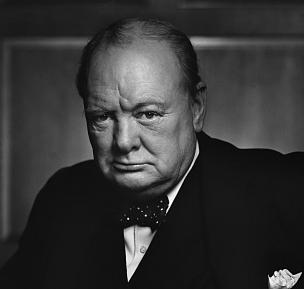
Winston Churchill is one of my favorite historical heros. His wit and wisdom is often needed in this flippant and politically correct age. Here is a great quote that I came upon today.
“It is curious that, while in the days of my youth I was much reproached with inconsistency and being changeable, I am now scolded for adhering to the same views I had early in life and even of repeating passages from speeches which I made long before most of you were born. Of course the world moves on and we dwell in a constantly changing climate of opinion. But the broad principles and truths of wise and sane political actions do not necessarily alter with the changing moods of a democratic electorate. Not everything changes. Two and two still make four, and I could give you other instances which go to prove that all wisdom is not new wisdom.” –Speech delivered in Manchester, December 6, 1947.
Fellow preachers, we should never be accused of preaching something new. Yes, new ways of saying old truths, but never allow novelty to replace the faithful declaration of those grand old doctrines of the faith.
Biblical Reform that Leads to Biblical Revival, pt. 3
In this series of posts I have been demonstrating the reforms that lay the groundwork for biblical revival. Those can be found here and here. Just as a caution, I don’t want to overstate my case. These are not sure-fire steps that lead to certain revival. There’s enough of that nonsense in the church today. The Bible doesn’t give that sort of prescription. But as we have seen, the Bible does teach through precept and example. In this case, we have looked at the reforms of Kings Jehoshaphat, Hezekiah and Josiah along with the observations of Jonathan Edwards and his participation in the Great Awakening.
Previously we have seen that biblical reform must come in the areas of leadership and a high regard for the Word of God. Today we will look at the need to reject everything that is contrary to God’s Word and will.
3. Rejection of Everything Contrary to God’s Word and Will-2Chron 17:6; 30:14; 31:1; 34:3-5
King Jehoshaphat was clear about the prohibition of idol worship. So had all the other kings before him that had allowed it. But in 2 Chronicles 17:6, it tells us that Jehoshaphat did something about it. The text says that “his heart was courageous in the ways of the Lord.” This courageous heart sought to obey the Lord in all things, including the destruction of the popular high places of worship and the Asherim.
For his part, King Hezekiah did similarly brave acts recorded in 2 Chronicles 30:14 and 31:1. And Josiah at the ripe young age of 20 likewise followed in the godly footsteps of these two kings (2Chron 34:3-5), making sure to defile the graves of the pagan priests.
We see that often times the problem isn’t knowing what the will of the Lord is or where we can find counsel in His Word. The problem so often in the church is that it lacks leaders with backbone and deep conviction of heart to risk losing everything in order to bring things into biblical alignment.
Jonathan Edwards wrote that when the Spirit began to actively sweep through New England, not only was there the fruit of godly leadership and a respect for the Word of God, but the people began to show signs of radically changed lives. Edwards described them as people who lived not for the pleasures and amusements of this world but for the breaks in between their daily work and their free time to engaged in spiritual activities. These renewed Christians prayed and read the Word together; they put aside their sinful amusements and picked up new, godly habits. Edwards wrote that hardly a conversation was had that didn’t include talk about Christ. True biblical fellowship began to sprout afresh in New England.
Our culture is saturated with filth and worldliness. But it seems that there is a massive pipeline that pumps that filth right into Christian homes. And if it comes into our homes, it is often coming into our churches. Our churches are becoming Corinthianized–adapting the church to fit into the sinful elements of our culture instead of reaching out to the sinful world we live in with the life-giving gospel of Jesus Christ.
What we need is a return to the Word. We need to realize that our too many Christians are being entertained to death. They are overwhelmed with cable TV, streaming movies, the internet, streaming music, social media sites like Facebook, Twitter, and Pinterest. I know that many of these social media sites can be used for good purposes (including blogging), as well as for evil. We must help our churches, and for some of us, even our own families, see what God outright rejects as, while we teach them what he expects. This begins with a reformation of the heart. Only when the heart is changed will those attractions of the world begin to lose their luster and Christ will be seen for the treasure that He truly is.

