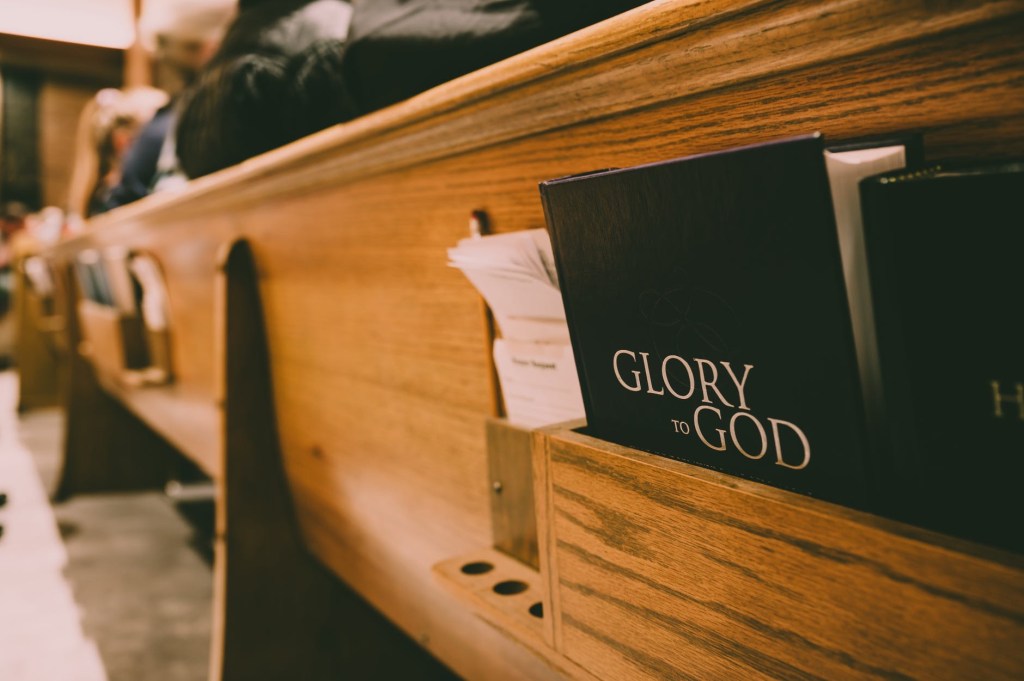
“We do not live near enough to God, do we? I know that some of you wait upon Him day and night and you abide under the shadow of the Almighty, but I fear that there are some workers who forget to do this. We should work with the hands of Martha, but yet keep near the Master with the heart of Mary! We need a combination of activity and meditation. When we get that, when we inwardly retire for consultation with our Lord and then come out actively to labor for our Lord—then shall we be good stewards in the little part of the great house with which He has entrusted us.”
– Charles Spurgeon, 1895, Sermon 2440
I love congregational singing before listening to the preaching of the Word of God. It prepares my heart to hear from God in a special way. And when I am the one who will be delivering the Word, it is no different. Singing not only prepares my heart, it settles my spirit, focuses my heart and mind, and begins the process of worship within my own soul.
Unfortunately I have also witnessed a few fellow pastors take advantage of the time before they preach to continue reviewing their notes, or to discuss other matters with the staff sitting next to them, and sometimes even checking their phones. Not only is this a poor example to those in the congregation, but it is also a lost opportunity to sit at the feet of the Lord as a worshipper.
As Spurgeon mentions in the above quote, may we not be so busy preparing the spiritual meal of the Word that we fail to sit at the feet of Jesus. As we are filled from the infinite well of living water, we will have more than enough to share with others from the overflow.
It’s no accident that the New Testament uses the term “pastors” because of the similarities of the duties of Christian leaders and the herdsmen of the time. The pastor or sheep-herder/shepherd was to constantly be among his sheep, tending them, feeding them, watching over them, leading them, and caring for them personally.
When stripped down to our historical foundation, IFCA International is a Bible movement. Our churches and ministries exist to preach Christ crucified (1 Cor. 1:23), a prospect that has never been acceptable to the world and is rejected by the apostate church. Like the Apostle Paul, we do not shrink from declaring the whole counsel of God (Acts 20:27). We believe that God has spoken without error and that His Word has never failed. We believe that the Word of God rules over the Church and God’s people, and that this authority extends to all humanity whether it accepts it or not. We believe the Bible, and this should have a direct impact upon how we minister in the preaching of the Word.
“Our Lord attracted sinners because He was different. They drew near to Him because they felt that there was something different about Him. And the world should see us to be different. This idea that you are going to win people to the Christian faith by showing them that after-all you are remarkably like them, is theologically and psychologically a profound blunder.”—D. Martyn Lloyd-Jones
The Church of Thessalonica was established during Paul’s second missionary journey. It is chronicled in Acts 15:36-18:22. In this post I want to walk through this journey and then apply a few lessons that can be applied to church planting.
Paul’s journey began in Antioch, were Paul and Barnabas had a sharp disagreement over John Mark, as to whether he should join them on their trip or not. Apparently John Mark had abandoned them on a previous trip and Paul did not think it was a good idea to depend upon him. Barnabas took John Mark and went to the island of Cyprus while Paul took Silas as his partner (Acts 15:36-41).
Meanwhile Paul and Silas headed to the region of Galatia to encourage the churches that Paul and Barnabas had established in the first missionary journey (Acts 15:36). The first stop mentioned was in Derbe and then on to Lystra. At Lystra Paul took Timothy with him on his journey (Acts 16:1-5).”
From Galatia Paul traveled with Silas and Timothy through the region called Phrygia, moving in a Northwest direction, avoiding Asia Minor (modern Turkey) because the Holy Spirit had forbidden that Paul should go there (Acts 16:6).
Paul then decided to go above Asia Minor into a Roman province called Bithynia, but Paul and his party were once again forbidden by the Spirit from going into this region (16:7). That meant that North and South were out of bounds to travel in. They could go back or they could press on toward Mysia along the northern border of Asia and Mysia until they reached Troas, which they did (Acts 16:8).
It was while in Troas that the Lord revealed to Paul his mission. He was given a vision of a Macedonian man who called out to him to come over and help him. Paul would have recognized this man as Macedonian from his traditional hat and clothing that had been a mark of the Macedonian people for centuries before and carries on even to today.
Although Macedon is not as well known to most of us today outside of the biblical references to it, it is important for us to know a little about its history.
The Macedonian kingdom was the “greatest empire ever known to human history.” [1] It was the empire of Alexander III also known as Alexander the Great.
Before he died at the age of 33, Alexander had succeeded in extending his kingdom from Egypt in the south to the Indus River in India to the east. His father, Philip II conquered the Greek city states and taught his son well many strategies that served him well as he sought to conquer the rest of the world. Alexander conquered Asia Minor, Phoenicia, Palestine, Egypt, Babylonia and India.
Alexander’s armies are pictured in Daniel 7:6 as a swift leopard with four wings. It says, “After this I looked, and behold, another, like a leopard, with four wings of a bird on its back. And the beast had four heads, and dominion was given to it.” The speed of the army was represented by the leopard’s speed amplified by four wings. The four heads refer to what happened after Alexander’s death. Since he died so young, possibly by poisoning, no plan of succession was in place.
After much turmoil, the kingdom was divided among his four generals into four kingdoms, with Antipater receiving the former Macedonian kingdom and Greece. At Antipater’s death, Cassander had the opportunity to take control and he solidified his position by marrying Alexander’s half-sister, the daughter of King Philip II. Her name? Thessaloniki.
In 316 BC Cassander founded a new city by consolidating 26 towns into the new city he called Thessalonica. This prestigious city would go through many more changes and wars by the time Paul would enter into it. When Paul came, it was a jewel to the Romans and had a population of about 200,000, which was quite large for a city in its day.
Let’s go back to Acts 16. Now we can see God’s purpose in not allowing Paul to go to Mysia or Asia or Bithynia! He wanted them to go to Macedon to bring the gospel message to the Gentiles!
Notice in verse 10 that it says “we” (cp. v.8 says “they”). What we find here is that in Troas Paul picked up another traveling companion—the author of Acts and the Gospel named for him—Luke! Paul went from Troas (in Mysia) across the island of Samothrace to the mainland of Macedonia and the city of Neapolis (16:11).
From Neapolis Paul and his friends went to the Roman colony of Philippi, named after Alexander the Great’s father King Philip II (16:12). In this city, Paul and his company met Lydia and led her to Christ. Later they were beaten with rods and thrown into jail after casting the demon out of a slave girl. (16:13-24) Welcome to Macedonia!
While in jail, God intervened and a jailer and his family were saved (16:25-40). From Lydia and the jailer’s family and any other’s saved on that trip to Philippi Paul established the first church in Europe. The letter we call Philippians was written to them.
Acts 17:1-9 tells us about the establishment of the Thessalonian church. Leaving Philippi, Paul passed through Amphipolis and Apollonia, probably because they were so small (17:1) and moved to the city of Thessalonica, where a synagogue had been established by the Jewish population.”
In these 9 verses, I’d like to make three observations about the work that Paul did in planting this church and make some applications for our lives.
1. Paul “reasoned from the Scriptures with a Purpose (vv. 2-4).
Paul’s time in Thessalonica was short—he knew that. He was not on a vacation or sight seeing trip. He was literally on a mission. Because of that purpose, Paul’s time was focused, purposeful and methodical.
Verse 2 says he“reasoned”with the Jews. This word in Greek is dilegomai and it is where we get our word “dialogue.” Paul “dialogued” with them. He had deep, meaningful conversations with them about the Scriptures and their meaning. But it had a purpose and an aim. they didn’t argue about Jonah’s whale or who the Nephilim in Genesis 6 are. Paul made a bee-line to the cross and Jesus.”
Paul wanted to show them from the Old Testament that Jesus is the long-awaited Messiah (v. 3). And Paul was seeking to change the hearts and minds of his listeners (v.4)! His mission had a purpose. Remember the way that Paul talked to King Agrippa? Acts 26:24-29. Paul preached for change!”
Studying the Bible and going to church is good. Listening to sermons and reading Christian books is good. But to what end do we do these things? Is it to seek holiness in our lives? It is to grow in Christ? Why do we share Christ? Is it to see people saved?”
2. Faithful gospel proclamation will also attract opposition from our enemy and those blinded by sin (vv. 5-9).
In a sense, these gospel preachers were turning the “world upside down” by preaching their message about King Jesus. We need to be honest. Most people like the status quo. We don’t like it when people rock the boat. And we love our sin. Listen to John 3:19-20. It says, “And this is the judgment: the light has come into the world, and people loved the darkness rather than the light because their works were evil. For everyone who does wicked things hates the light and does not come to the light, lest his works should be exposed.”
Paul was trying to build a lighthouse in the darkness of Thessalonica. But the darkness wasn’t about to just roll over and let that happen. It fought back. So, we must wage war!” We too need to fight like Paul—reasoning, preaching the gospel, and persuading with the truth.
Second Corinthians 10:3-6 says,“For though we walk in the flesh, we are not waging war according to the flesh. For the weapons of our warfare are not of the flesh but have divine power to destroy strongholds. We destroy arguments and every lofty opinion raised against the knowledge of God, and take every thought captive to obey Christ, being ready to punish every disobedience, when your obedience is complete. “
3. Finally, Jesus must be trusted to build his own church (Matt 16:18).
It is easy to give up and be discouraged by adversity and the roadblocks that we encounter. To see all the failures and not the victories. Afterall, Paul followed Jesus’ commands and went to Macedonia, just as he said. Yet in Philippi he was beaten then jailed. Next in Thessalonica a mob formed and attacked their friend Jason in his home. When Paul left Thessalonica, he was probably only there from 3-6 months, but they had to move on!”
But a church was planted in Thessalonica. And it grew and matured…even with the absence of Paul! God gave life to that seed of a church and although Paul left when it was a weak little seedling, God would cause it to grow.”We certainly can learn from this. We need to work hard, and work smart, but we must learn as well to trust Jesus with the results. After all, it is HIS church.
[1] Green, Gene L. The Letters to the Thessalonians. The Pillar New Testament Commentary. Grand Rapids, MI; Leicester, England: W.B. Eerdmans Pub.; Apollos, 2002; p. 9.