Biblical Reformation that Leads to Biblical Revival, pt. 1

There is no doubt that the church today needs revival. But not revival as it is sometimes defined—evangelistic tent meetings in which the Holy Spirit is scheduled to arrive on our set dates. Revivals or “awakenings” as they used to be called, mark a special time when God’s people are moved upon by God and there is evidence of the Spirit’s powerful work among his people and those he draws to salvation through the proclamation of the gospel message.

Today there is a lot of activity in the evangelical church–lots of money being spent, books printed, conferences held, churches planted and sermons preached. With the technology of our day, there is more access to the Bible, sermons, and the gospel world-wide than ever before. We have in our country almost all of the world’s largest churches.

But would we say that there is revival happening in our nation or our churches? Most of us would say no, and I would heartily agree. There are victories and people are being saved but the Church today, especially in North America, is a long way from revival. Do you desire revival in our churches and our nation?I do, and I think that you do as well.

As I was preparing to preach Psalm 80 in our church, a psalm that is a prayer for God to revive Israel after the Assyrian invasion, I was interested in looking at the times in which God had brought Israel revival before. Then I compared Israel’s activities to those described by Jonathan Edwards in his work entitled, A Faithful Narrative of the Surprising Work of God, written in 1737 to describe what was happening during America’s Great Awakening.

Over the next two blog posts I would like to share with you four requirements of biblical reform that are critical if we hope to see biblical revival in our churches and the nations.

1.    Godly Leadership- 2Chron 17:3- 6; 2Chron 29:2; 31:20; 34:2-3

Second Chronicles 17 tells us that when Jehoshaphat took over the throne from his father Asa as the ruler of Judah that he made some drastic changes. Because he was a man who feared the Lord, Jehoshaphat obeyed him not only in his own personal practices of not worshipping false idols, but he also led his kingdom in holiness by taking down the places of false worship and removing the idols that led his people astray. Verse 3 tells us that this took a courageous heart, because even though he was the king, it is easy for a ruler to capitulate to the whims of the people in order to please them and make leading them easier. But Jehoshaphat was no Pontius Pilate. He stood firm and did what was right. And because of this, verse 5 tells us that the Lord established the kingdom in his hands along with bringing to him great riches and honor.

Second Chronicles 29 tells the heroic story of king Hezekiah and his reign of Judah. Even as a young man (verse 1 tells us he was 25 when he began to reign) Hezekiah walked in the ways of his forefather king David by obeying the Lord from his heart. Hezekiah longed to see the Temple restored and consecrated for worship once again. He was repulsed at the way the Lord had been treated in the Temple worship and he enlisted the Levites to help carry out his desires (2Chr 31). Hezekiah understood that by turning their backs on the Lord they had invited his wrath, and that the only way to reverse this and invite his blessings was to restore the Temple and repent appropriately.

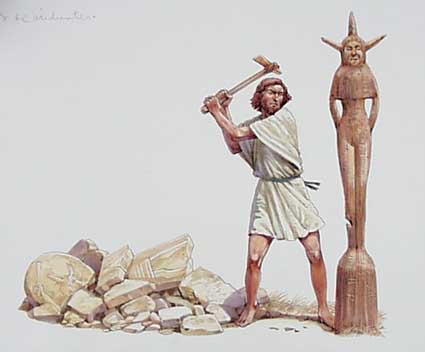
smashing idolsIn chapter 34 of Second Chronicles we are confronted by the astounding example of Josiah, the eight year old king of Judah. Verse 3 doesn’t say that he began to seek the Lord after he grew older, but that even as a child he began to seek the Lord. By the time he was twenty, Josiah was so strong in the Lord that he began to once again dismantle the   idolatry that had once again infested Judah. After this, Josiah cleansed the Temple, reinstated obedience to the Book of the Law, which was once again in their possession, which led to the reinstatement of the Passover and obedience to the other laws they had failed to keep.

In each and every one of these kings of Judah, we see a heart that longs not only to obey God, but to lead God’s people into obedience. These men critically analyzed the situations that they found themselves in and compared it to the Word of God. Then with courage and strength from the Lord, they led their people into reform. Interestingly, this pattern repeated itself in New England thousands of years later.

Sometimes we have an inaccurate understanding of history that leads us to wrong conclusions. We might have the idea that the Great Awakening that began in Northampton was begun under the influence of Edwards’ preaching. But in his Faithful Narrative, Edwards tells of how under his grandfather Solomon Stoddard five “harvests” were experienced in his life. These “harvest” were the unfolding work of the Spirit within the village as well as in the church that Stoddard led.

You see, just as with the godly kings of Israel and Judah, Edwards understood that influence of leaders has long-lasting effects—for good or for evil. Stoddard was a godly man and he had a major effect in his parish—and Edwards reaped many benefits from his grandfather’s groundwork in that town. But as time went by, the effects of sin began to return. And before the Great Awakening happened, many of the youth of Northampton were once again becoming more and more worldly—sound familiar?

So how did Edwards deal with this? Much like Jehoshaphat, Hezekiah and Josiah dealt with it. Edwards picked up the mantle of leadership as the pastor of the church in Northampton. Edwards preached sermons to the church that demanded that the youth repent of their worldliness and carousing. And then he met with the fathers of those in his church and called upon them to take up their duty as leaders of their homes and begin to enforce godliness. Edwards wrote that his preaching fell upon those hard hearts and began to break them. And the fathers agreed. They began to see that the preached word was changing their children’s attitudes toward their sinful behavior. God had begun to move and the youth began to obey without much additional prodding by their fathers.

Many of us are preachers and fathers. If we want revival in our country, and our state and in our city and in our church it must start in our homes. We must preach for change—and for holiness. We must be godly leaders in our own homes and godly leaders require that our churches put into action what the Word of God says.
How to Become a Doer and Not Just a Hearer of the Word

This past Sunday I spoke to our church about Jesus’ command to his disciples and those in the crowd to “do and observe” what the Pharisees and Scribes who sat in Moses’ seat taught, so long as it was accurately reflected in the Bible. We are also called by Scriptures to do and observe all that the Bible teaches. So, as a people who desire to be not merely hearers, but doers, I gave these five applicational thoughts about how to “use” the Bible more effectively. If you want to hear the sermon that this is taken from, you can download or stream it here, entitled “The Authority of the Word of God.”

  1. Notate. Take note of application given in sermons you hear. Literally take notes! Look for what God would have you DO with his Word. Don’t just collect biblical information. Then, go back and review your notes, praying for help to obey what you have seen that he wants you to do.


  2. Saturate. On your own, read your Bible with an eye for application. This means that you need to know how to find universal principles in the Bible. These are truths that are good in every time and every culture. They are also consistent with the whole Bible.


  3. Categorize. Take those universal truths and begin categorizing them into useful headings. Begin by setting up categories for your roles in life–Bible verses for you as a Father/Mother, as a husband/wife, as a son/daughter, as a Christian, as an employee, as a neighbor.


  4. Organize. Put Scriptures (and the principles that they speak of) in categories that will lend themselves to your use–such as pride, humility, gossiping, the tongue, hope, fear of man, decision making, forgiveness, etc. Some of these will be more useful to you than others, so be sure to put them on a list that you can tuck into your Bible, or even write into the end papers of your Bible so they are handy whenever you need them.


  5. Apply. Now, when you are, for example, having a bad day with your mouth–you keep hurting others, or maybe you’ve lost your temper–you can turn in your Bible and meditate on what God’s Word says about that issue and what you need to do. As you do this over and over, you will not only begin to remember where to go without having to look at the list, but you will slowly memorize those verses.


It’s not brain surgery or rocket science, but it does take discipline and effort. Jesus said for you and I to “do and observe” His Word. If you claim that the Bible is truly your authority, then you need to know it so you can obey it. If not, then you are merely a hearer of the Word and not a doer–fooling yourself. May we never find ourselves there.

What is Expository Preaching? Conclusion

Expository preaching seeks to declare the Word of God in the clearest fashion so that the message that God intended is left unhindered. This can only be done by following the historical grammatical principles of hermeneutics so as to come to the proper understanding of the text. The structure of the sermon that is derived from that understanding must also be taken from the structure of the Scriptures so that the biblical text is always served by the homiletics, not the other way around. That sermon, when properly applied to the lives of the modern hearer will be used by the Holy Spirit to move the hearers as He sees fit. Above all, expository preaching has a high view of Scripture because it seeks to bring glory to God. Although there are many other forms of preaching that exist in the world today, it is this writer’s strong conviction that expository preaching is the only biblical method of preaching that does justice to God and His Word and therefore ought to be the norm in the Church today.

What Is Expository Preaching? Part 7

THE EXPOSITORY SERMON – ITS EFFECTS
Once the sermon is prepared and preached it still has not completed its work. Hebrews 4:12 states that, “the word of God is living and active and sharper than any two-edged sword, and piercing as far as the division of soul and spirit, of both joints and marrow,and able to judge the thoughts and intentions of the heart.” Such a powerful reaction can be expected to accompany the preaching of an expository sermon because it has allowed God to speak to His creatures. To be sure, wherever the Word is preached, there will follow certain effects.

It Glorifies God
In 2 Corinthians 4:5 Paul put preaching into perspective when he stated, “we to not preach ourselves but Christ Jesus as Lord, and ourselves as your bond-servants for Jesus’ sake.” Preaching is not finally about the preacher’s skill or ability to powerfully impact his hearers. It is not essentially about those who hear the message and their response to it. In the final analysis, preaching is about bringing glory to God.

The prophet Jeremiah was commanded to speak to the stubborn Israelites about then sinfulness, but God declared before Jeremiah spoke that they would not listen to his message, “You shall speak all these words to them, but they will not listen to you; and you shall call to them, but they
will not answer you” (Jer. 7:27). In declaring the Word of the Lord, Jeremiah was also declaring the righteous judgments of God not only to Israel but also to all the watching nations. The same thing is echoed in the words of the prophet Ezekiel, through whom God spoke saying, “But you shall
speak My words to them whether they listen or not, for they are rebellious” (Ezek. 2:7). The positive side of this call to faithfulness, is that when people hear of the mercy and forgiveness that has been purchased for them and they believe, then the name of the Lord is glorified (Acts 13:48-49).

Because expositional preaching allows the Word of God to speak rather than mixing God’s voice with other voices, it is God who is most clearly revealed in this type of preaching, and it is He who receives all the glory for His Word.

It Feeds the Soul
Jesus said it best when He declared, “It is written, MAN SHALL NOT LIVE ON BREAD ALONE, BUT ON EVERY WORD THAT PROCEEDS OUT OF THE MOUTH OF GOD.” Peter was instructed to make sure that he tended the Lord’s sheep in an appropriate manner that was reflective of the Good Shepherd (John 21:15-17), and that must include the regular diet of the Word of God.

Psalm 63 speaks of the hungering and thirsting for the Lord. This cannot be satisfied by emotional hype and other cheap substitutes. The satisfaction of the hungering soul can only be found in encountering God through the pages of Scriptures. It is also from this feeding of the soul through the preaching of the Word that Christians are able to grow up in their salvation (lPet 2:2). Of course, as the believer grows up in the faith, then it becomes his responsibility- to begin feeding himself (Heb. 5:12-13) along with the regular intake of the Word of God in preaching.

It Educates the Church
As a pastor feeds the sheep in his congregation on a steady diet of the Word expositionally preached, he will be developing in them a reverence for the Word as well as giving them a deepening understanding of how the Scriptures as a whole speak God’s message to them. In this day that we live in, our society is biblically illiterate. Some of this is because of our culture’s movement away from the biblical principles that were the
norm for society. But some of the blame must be laid upon the church for abandoning the expositional preaching of the Word of God for topical, thematic, biographical, social, moralistic and pragmatic messages that divorced the Word from its original message and intent.

The mission left by Christ, given to Paul and passed down to Timothy still applies to the church today, “The things which you have heard from me in the presence of many witnesses, entrust these to faithful men who will be able to teach others also” (2Tim. 2:2). It is therefore part of the expository preacher’s call to make sure that he is not just filling up forty-five minutes of time with lofty words, but that his message touches both the mind and the heart so as to produce faithful and knowledgeable disciples who are equipped to make other disciples themselves.

It Teaches Hermeneutics By Modeling
Part of the educational process of preaching is left unspoken but is a reality nonetheless. Expositional preaching (as all other types of preaching) eventually teaches the congregation how to study the Bible for itself. As the preacher proclaims the message, the listeners are discerning the process that he went through to derive such an interpretation. Shoddy preparation, eisogesis and shallow exegesis all proclaim to the church that the Word of God is not something to be taken seriously.

Because of this reality, the expository preacher must seek not only to be sure that he is fully prepared when he steps into the pulpit, but he must also seek to weave into his message explanations as to how he arrived at his conclusions and why he rejected others. Although he must be sure that he does not drown his listeners with confusing jargon and linguistics that they cannot understand, he must be prepared to teach them how they can delve deeper in their own personal studies. This will not only enrich their own lives, but it will also enrich the lives of those who are taught by them as well as further producing leaders and teachers who can equip others as well.

What Is Expository Preaching? Part 6

20110807-104222.jpg

A Text-Driven Outline

From the foundational information that was derived from the grammatical and
syntactical studies that were done earlier in the exegetical process, the expositor should
have been able to construct an exegetical outline. It is from this outline that the expositor
may want to stay as close as possible in order to derive his preaching outline. Some
homileticians recommend a big idea or propositional statement with a plural noun that
will lead into the homiletical outline. All of this is fine as long as it is not forced and
contrived. Although alliteration is a good device for keeping the main points in the
hearer’s memory for a longer period of time, one must be careful not to allow the outline
to begin to drive the sermon. All too often a preacher can get so involved in finding that
perfect word that will fit into his outline that he is willing to stretch the bounds of what
the text says in order to have symmetry. If one stays within the text’s boundaries, even
without fancy alliteration and other homiletical devices, God will be honored.

A Sermon that Starts. Stays and Ends with the Text

Expository sermons are marked by a high view of Scripture. This is further
evidenced in the way that the sermon is committed to stay with the text and to explain
that text in light of the immediate context and other considerations addressed in my previous posts on this subject.

Other types of preaching may give lip service to the text by reading it and going
elsewhere for proof-text. Others may use the text as a springboard to launch out into any
variety of subjects without ever coming back to the original verses. But the expository sermon attempts to stay with the text, to explain the text and to end with the text so that
the hearer leaves with a fuller and clearer understanding of the Scriptures than they had
before.

A Text-Driven Homiletic

Although this could be applied in different ways, the text-driven sermon needs to
take into consideration the genre that is being considered for the format of the sermon. If
a narrative section is to be considered, then the preacher would do better to allow the
story to unfold than to try to force the story into the form of “three points and a poem.” If
the genre is wisdom literature, as in Proverbs, the form might be clustering up proverbs
according to a theme. Epistolary books fit better into the traditional homiletical outline,
but even within these letters one can find other sub-genres. The idea is simply that the
expository preacher allows the Bible to speak for itself in whatever form God inspired the
text. We should not try a one-size-fits-all type of homiletical presentation for every
type of genre. If God gave us different types of writings, then we ought to search out the
appropriate format for that specific style of writing.